
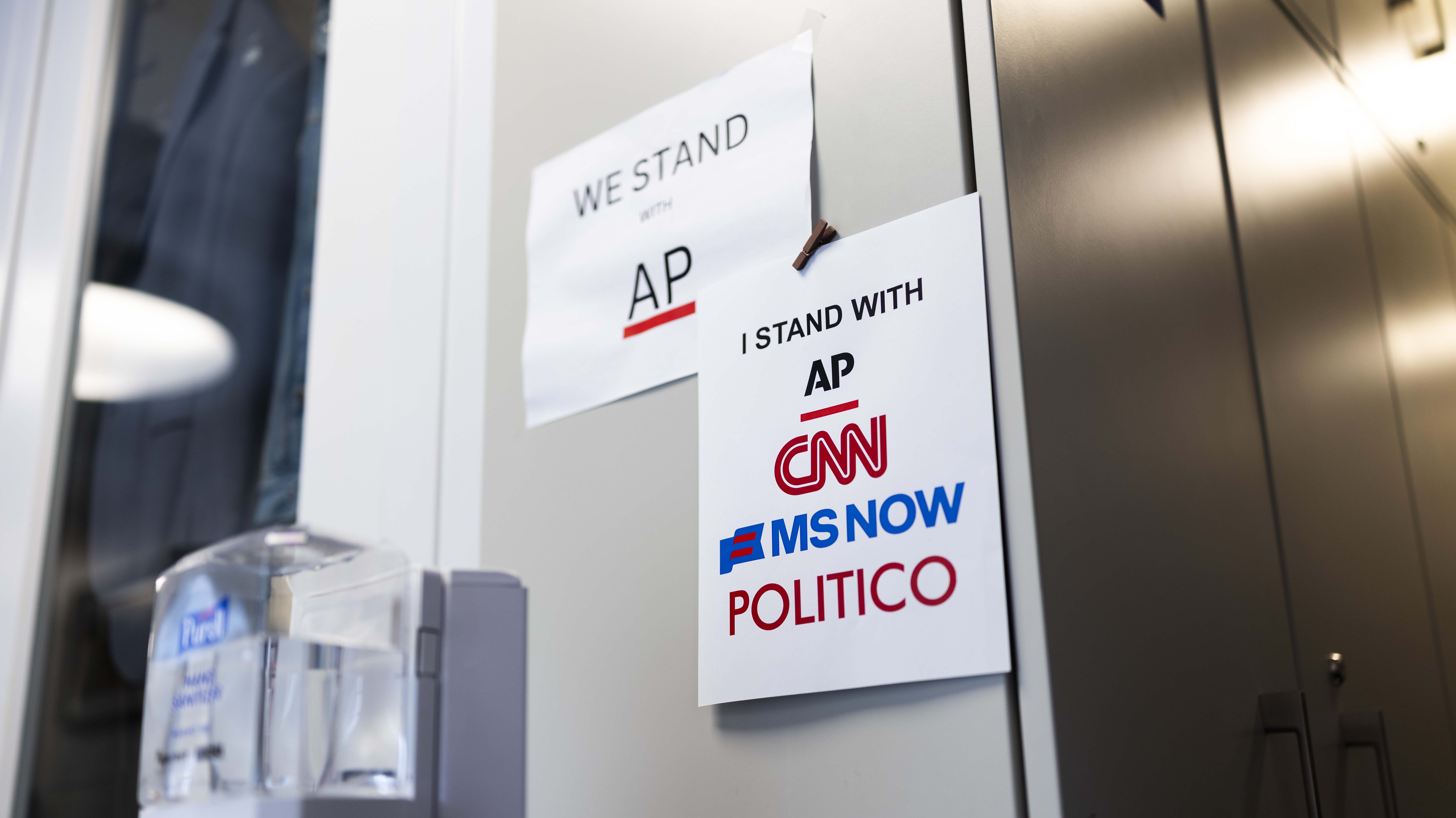
(WASHINGTON) — Reporters and producers from news organizations that President Donald Trump barred from the White House were back on the grounds after a federal judge granted a temporary restraining order to restore their passes.
Earlier Thursday, the lawyer for media organizations requested an emergency hearing as early as Thursday, telling a federal judge that the government has “already repeatedly” violated his temporary restraining order after the three news organizations were denied entry into the White House earlier in the day.
“Defendants have already repeatedly violated the Court’s Order. Plaintiffs respectfully request that the Court set a hearing by videoconference or teleconference as soon as possible this morning,” Ted Boutrous wrote.
Judge Timothy Kelly ordered the government to respond to the plaintiffs’ notice of non-compliance by 12:30 p.m. ET Thursday.
In a declaration submitted by the White House in response to Kelly’s order, officials said that access had been restored as of 9:55 a.m. ET.
Around noon on Thursday, the outlets reported that they were beginning to be granted access to the White House grounds.
CNN reporter Betsy Klein, who had her hard pass taken on Saturday, and others, walked through a White House gate shortly after noon after her hard pass was given back to her. MSNOW correspondent Laura Barrón-López was also back on the campus Thursday afternoon.
Politico reported one of its reporters had also been granted access.
Earlier Thursday, Kelly granted CNN, Politico and MS NOW a temporary restraining order requiring the White House to restore the outlets’ hard-pass press credentials.
The order requires the defendants, excluding President Donald Trump, as well as their agents and representatives, to “immediately return, reinstate, and restore” the White House hard-pass press credentials held by employees of CNN, MS NOW and Politico.
Kelly granted the media organizations’ request in the ongoing case Cable News Networks, Inc. v. Trump after their credentials were revoked on Sept. 18, according to the court order.
Kelly expressed skepticism about the Trump administration’s argument that the stories it cited as justification for revoking the outlets’ press credentials raised national security concerns.
Kelly described the stories identified by the administration as “routine” and said he was “skeptical” that the government’s stated interest in safeguarding national security was the actual motivation for revoking the hard passes. He also noted that Trump did not mention national security concerns when he announced the ban.
“Nothing in the record that predates this suit suggests that the revocation of Plaintiffs’ hard passes was motivated by national security concerns,” Kelly said in the filing. “Certainly, that is not what President Trump said when he announced that he was “banning” Plaintiffs from the White House — instead, he focused on the alleged lack of truthfulness and negativity of Plaintiffs’ reporting.”
In a hearing on Wednesday, Kelly signaled that he believes the White House failed to follow the process established by earlier court cases to terminate a reporter’s credential.
“I think it is fair to say that the process that the court laid out in those two cases – the circuit laid out in those two cases – wasn’t followed here,” he said.
Boutrous focused on that due process argument near the end of the hearing, telling the court that the White House’s “Alice in Wonderland process” for terminating the credentials is “arbitrary” and “irrational.”
“It’s not due process when there’s been a prejudgment of the issue. Clearly, that’s happened,” Boutrous said. “They’re going to keep playing games, moving the ball. That’s not due process.”
Justice Department lawyer Michael Velchik argued that the notice the White House provided in letters sent after 10 p.m. Tuesday night, days after the ban took effect, was enough. He also suggested the outlets’ responses might convince Trump to change his mind about the ban.
Copyright © 2026, ABC Audio. All rights reserved.