
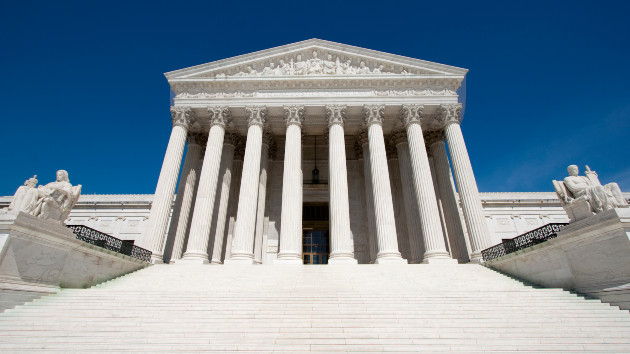
(WASHINGTON) — The Supreme Court on Friday delivered a major blow to President Donald Trump by invalidating most of global tariffs, a cornerstone of his economic policy in his second term.
In a 6-3 decision, written by Chief Justice John Roberts, the court deemed that the International Emergency Economic Powers Act (IEEPA) does not give Trump the power to unilaterally impose tariffs.
“We claim no special competence in matters of economics or foreign affairs. We claim only, as we must, the limited role assigned to us by Article III of the Constitution,” Roberts wrote. “Fulfilling that role, we hold that IEEPA does not authorize the President to impose tariffs.”
The Trump administration attempted to justify the tariffs by arguing that IEEPA says the president has the power to regulate “importation,” but Roberts said their read of the law was a stretch.
“Based on two words separated by 16 others in Section 1702(a)(1)(B) of IEEPA—‘regulate’ and ‘importation’—the President asserts the independent power to impose tariffs on imports from any country, of any product, at any rate, for any amount of time,” Roberts wrote. “Those words cannot bear such weight.”
Roberts said the court was highly skeptical of the claim that Congress had delegated to the president a “birth-right power to tax” though the passage of the 1977 law. Congress, not the president, has the power to impose tariffs and taxes, the majority concluded.
“The Framers did not vest any part of the taxing power in the Executive Branch,” the ruling said.
Justices Clarence Thomas, Brett Kavanaugh and Samuel Alito dissented from the majority, arguing that Trump should have the power to impose tariffs during national emergencies.
“The tariffs at issue here may or may not be wise policy. But as a matter of text, history, and precedent, they are clearly lawful,” Kavanaugh wrote.
Trump had publicly lobbied for months for the court to rule in his favor, including in remarks he delivered on Thursday about in Georgia. Trump, speaking on the economy, said “without tariffs, this country would be in such trouble right now.”
The White House has said it is prepared to present alternative avenues for imposing the tariffs under different legal authorities.
The Supreme Court’s ruling strikes down 70% of Trump’s global tariffs after they have collected more than $142 billion through December, according to the Yale Budget Lab.
While the Supreme Court rejected President Trump’s sweeping tariff power under IEEPA, the tariffs Trump imposed using Section 232 of the Trade Expansion Act of 1962 — such as tariffs on steel and aluminum — remain in place. Trump has also suggested in the past that he might attempt to reframe the tariffs as “licenses,” though such a move would likely be challenged in court.
Companies ranging from Costco to small businesses have sued the Trump administration to effectively “get in line” for refunds if the court deemed them unconstitutional.
The court’s majority did not explicitly address the issue of refunds or how that process would work.
Kavanaugh noted such in his dissent.
“Refunds of billions of dollars would have significant consequences for the U.S. Treasury. The Court says nothing today about whether, and if so how, the Government should go about returning the billions of dollars that it has collected from importers. But that process is likely to be a ‘mess,’ as was acknowledged at oral argument,” Kavanaugh wrote.
ABC News’ Elizabeth Schulze and Zunaira Zaki contributed to this report.
Copyright © 2026, ABC Audio. All rights reserved.