
India’s basmati rice exports to US impacted by floods and tariffs as Pakistan looks to benefit

India’s basmati rice exports to US impacted by floods and tariffs as Pakistan looks to benefit
Soumyabrata Roy/NurPhoto via Getty Images

(LONDON) — The Trump administration’s tariffs on Indian goods, initially 25% and then additional 25%, “due to India’s direct or indirect importation of Russian Federation oil,” is expected to make Indian basmati rice significantly more expensive for American consumers.

Basmati is an aromatic rice variety grown mostly in the Punjab region in northern India and is popular for its long grain, fluffy texture and distinct smell. This premium variety is sold for twice the price of other varieties meaning, even with limited quantity, basmati is considered a high value export.

India dominates the global market, providing the world with 65% of its basmati supply. Most of the rest comes from Pakistan.

The Indian price of exporting Indian rice is expected to rise sharply due to U.S. President Donald Trump’s tariffs on India, and the consequences for India could be extreme due to the stark tariff differential when compared to Pakistan.

While India faces a 50% duty, Pakistan has only a 19% tariff.

“We definitely see this [tariffs] as a positive thing,” Mudassar Ahmed, of Rice Partners, a Pakistani agricultural cooperative, to ABC News.

“The 50% tariff on Indian rice will effectively price it out of the U.S. market,” Malik Faisal Jahangir, chairman of the Rice Exporters Association of Pakistan, told Arab News.

Meanwhile, the northern state of Punjab in India, which shares borders with Pakistan’s Punjab province, has been experiencing the worst flooding since 1988.

Arvind Shukla, a journalist from local media outlet NewsPolti, told ABC News that the devastation from the floods has been widespread and that most of the districts that grow basmati have been severely impacted.

The floods submerged more than 150,000 hectares of farmland — an estimated 10% of potential output, the Indian Rice Exporters’ Federation (IREF) spokesperson told ABC News.

Farmers in Punjab have an average landholding of 8.95 acres per farmer, significantly more than the national average of 1.08, according to the Government’s Agriculture Census, and farming is more mechanized and resource-intensive, with farmers often investing in costly equipment financed through high-interest loans, leaving them among the most debt-burdened in the country.

Any disruption in crop yields, particularly of high value crops like basmati, makes them vulnerable to significant debt and potential default.

Punjab province in Pakistan has also flooded, with the region producing 90% of the country’s Basmati rice. More than 1,000 people have died in the floods since August 2025, as per Pakistan’s National Disaster Management Authority.

Officials estimate that 30 to 35% of their basmati output may have been impacted, according to the early estimates of Rice Partners Pvt Ltd., with the overall basmati damage may being up to 10% or 15%.

Pakistan exported approximately 772,725 tons of basmati rice in the last fiscal year, earning $876.9 million, an increase from 595,120 tons when compared to the year before, as reported by the Pakistan Bureau of Statistics.

India, however, in the last fiscal year exported 234,467 metric tons of basmati rice which is valued at $300 million to the U.S. alone, as per the Indian Agricultural and Processed Food Products Export Development Authority.

The U.S. rice import market has grown from 7% of the domestic market in 1993-94 to over 25% in 2022-23, according to the U.S. Department of Agriculture (USDA), and the aromatic variety accounts for 60% of U.S. imports, with basmati from India and Pakistan as well as jasmine from Thailand.

The Basmati rice market is expected to grow to approximately $27 billion by 2032, as per Market Research Future’s Global Basmati Rice Market report.

“Pakistan can provide some basmati because of tariff difference, but can’t compensate for India’s quantity,” Vinod Kumar Kaul, executive director of India Rice Exporters Federation (IREF), said to ABC News.

Copyright © 2025, ABC Audio. All rights reserved.

Ukrainian drones attack Moscow on eve of Trump-Zelenskyy meeting, Russia says

Ukrainian drones attack Moscow on eve of Trump-Zelenskyy meeting, Russia says
Viktor Kovalchuk/Global Images Ukraine via Getty Images

(LONDON) — At least 41 drones were shot down while heading toward Moscow from Monday evening through to Tuesday morning, according to city Mayor Sergei Sobyanin, amid what Russian Defense Ministry data suggested was a major Ukrainian drone barrage.

Sobyanin said the first Ukrainian drones were downed at around 7:30 p.m. Moscow time — 12:30 p.m. EST — on Monday, with interceptions over the capital region continuing through into Tuesday morning.

Sobyanin reported no casualties but said emergency services were responding to reports of falling debris.

Russia’s Defense Ministry said its forces downed at least 69 drones from midnight on Monday through to Tuesday morning.

On Monday, the ministry claimed to have downed a total of 236 Ukrainian drones — the largest daily tally since Sept. 12, and the second largest daily total through both August and September to date.

Elsewhere, Andriy Kovalenko — the head of the Counter-Disinformation Center operating as part of Ukraine’s National Security and Defense Council — suggested in a post to Telegram that Ukrainian drones also targeted the Russian city of Yelabuga, in the Republic of Tatarstan and around 565 miles east of Moscow.

Yelabuga is home to the Alabuga Special Economic Zone, which houses a major Russian long-range strike drone manufacturing facility.

Flight disruptions occurred across Russia amid the attacks.

Rosaviatsiya, the federal air transport agency, reported temporary restrictions on commercial flights at Moscow’s Sheremetyevo airport.

The state-run Tass news agency said disruptions affected the capital’s other three airports — Vnukovo, Domodedovo and Zhukovsky.

Other airports in Yaroslavl, Saratov, Samara, Begishevo, Kazan and Gelendzhik were also put under temporary restrictions, Rosaviatsiya said.

The latest Ukrainian drone strikes come on the eve of U.S. President Donald Trump’s planned meeting with Ukrainian President Volodymyr Zelenskyy on the sidelines of the United Nations General Assembly.

Trump’s efforts to forge a peace deal between Russia and Ukraine have so far been unsuccessful. The president has expressed frustration with both Zelenskyy and Russian President Vladimir Putin, calling on both to make concessions to secure a settlement.

Kyiv and its European allies are pressing Trump to impose new sanctions on Russia while expanding military aide for Ukraine and offering future security guarantees to guard against repeated Russian aggression.

Upon his arrival in New York, Zelenskyy said in a post to social media, “Almost two dozen meetings are planned. A busy few days lie ahead. Ukraine must become stronger.”

On Sunday, the Ukrainian president again urged international partners to do more to force Russia to negotiate an end to its three-and-a-half-year-old full-scale invasion of its neighbor.

“There is a real need for strong pressure on Russia, new joint steps from everyone in the world who believes that international law must work again,” Zelenskyy said, calling specifically on “Europe, the USA, the G7 and G20 countries — all those who have real influence on Russia.”

“Strong sanctions, strong political pressure, Russia’s accountability for the war — all of this is necessary,” Zelenskyy wrote. “All of this will happen.”

Russia, meanwhile, continued its own nightly long-range strike campaign overnight into Tuesday.

Ukraine’s air force said Russia launched three missiles and 115 drones into the country overnight, of which 103 drones were downed or suppressed.

The air force reported the impacts of all three missiles and 12 drones across six locations.

Copyright © 2025, ABC Audio. All rights reserved.
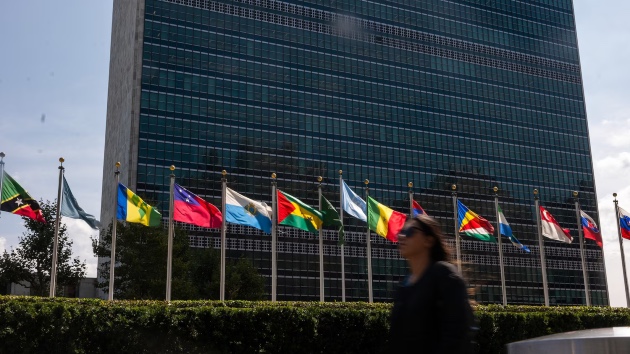
Zelenskyy calls on US to impose ‘strong’ sanctions on Russia at UN General Assembly

Zelenskyy calls on US to impose ‘strong’ sanctions on Russia at UN General Assembly
The United Nations headquarters is seen in Manhattan on Sept. 9, 2025 as the annual U.N. General Assembly, the 80th, began with thousands of delegates and world leaders expected to attend over the next few weeks. (Spencer Platt/Getty Images)

(LONDON) — Ukrainian President Volodymyr Zelenskyy urged attendees of this week’s United Nations General Assembly sessions in New York to use the meeting of world leaders to apply “strong political pressure” on Russia, as Moscow’s war on its neighbor wears on.

Zelenskyy posted to social media on Monday morning, following Russia’s latest overnight strike on Ukrainian cities across the country. Drones hit Donetsk, Dnipro, Sumy, Kyiv, Kharkiv, Zaporizhzhia and Kherson regions, Zelenskyy said.

At least three people were killed in Zaporizhzhia, the president said. Ukraine’s air force said Russia launched 141 drones into the country, of which 132 were downed or suppressed.

“This is already the fourth time that Russia accompanies one of the highest annual global diplomatic events with killings,” Zelenskyy said in his post, referring to this week’s UNGA sessions.

“That is why it is so important for this diplomatic week to be productive,” he added. “We must act so that killings and war do not become routine.”

“There is a real need for strong pressure on Russia, new joint steps from everyone in the world who believes that international law must work again,” Zelenskyy said, calling specifically on “Europe, the USA, the G7 and G20 countries — all those who have real influence on Russia.”

“Strong sanctions, strong political pressure, Russia’s accountability for the war — all of this is necessary,” Zelenskyy wrote. “All of this will happen.”

U.S.-led peace talks have thus far failed to produce a ceasefire in Ukraine, where Russian forces remain on the offensive at multiple points along the front line three-and-a-half years into Moscow’s full-scale invasion.

Russian attacks on Ukraine have intensified since U.S. President Donald Trump met with Russian counterpart Vladimir Putin in Alaska in August.

And in recent weeks, repeated Russian drone and aircraft violations of NATO airspace in Poland, Romania and Estonia have further raised tensions between Moscow and its Western adversaries.

At Tallinn’s request, the United Nations Security Council will convene an emergency meeting on Monday to discuss the violation of Estonian airspace by three Russian fighter aircraft on Sept. 12.

Trump — who is expected to meet with Zelenskyy in New York this week — has repeatedly expressed his frustration with Putin over the failure of peace efforts and Moscow’s continued long-range strikes. While in the U.K. last week, Trump said Putin had “let me down.”

Nonetheless, Trump has refused to impose on Russia the full raft of additional sanctions and tariffs that he has threatened. The White House did introduce additional 25% tariffs on all Indian imports in response to New Delhi’s continued purchases of Russian oil and military goods.

Trump said last week that he would not introduce further measures until European nations — who have broadly been more full-throated than the White House in their continued military and political backing for Kyiv — impose steep tariffs on India and China.

Oleksandr Merezhko, a member of the Ukrainian parliament and chair of the body’s foreign affairs committee, told ABC News that the planned Trump-Zelenskyy meeting in New York this week is positive.

“It’s always good and gives a chance to make him more receptive to our needs,” he said. “At the same time, I don’t have high expectations. Trump seems reluctant to employ serious sanctions against Russia and its allies.”

Kyiv will be watching closely to see how many states back a planned resolution expressing support for Ukraine. “It’s indicative of our support in the world, including in the Global South,” Merezhko said.

Russian officials, meanwhile, have signaled no imminent willingness to agree to a ceasefire or to a meeting between Putin and Zelenskyy, an idea proposed by Trump after his Alaska summit with the Russian president.

Last week, Russian Foreign Minister Sergei Lavrov said Trump’s disappointment with the pace of the negotiations with Russia can be “partly explained by the fact that he wants quick solutions.”

ABC News’ Anna Sergeeva and Ellie Kaufman contributed to this report.

Copyright © 2025, ABC Audio. All rights reserved.

Russia carries out ‘massive’ attack across Ukraine

Russia carries out ‘massive’ attack across Ukraine
Scott Peterson/Getty Images

(NEW YORK) — Russia carried out a “massive” attack across Ukraine Friday night into Saturday morning, using more than 600 drones and missiles, according to the Ukrainian Air Force.

Russia confirmed Saturday that it had “launched a massive strike using long-range air- and ground-based precision weapons and attack drones against Ukrainian military-industrial complex enterprises developing the Sapsan tactical missile system, producing multipurpose strike and reconnaissance drones, robotic combat vehicles, interceptor UAVs, and loitering munitions.”

The Russian Ministry of Defense claimed that “the strike’s objectives were achieved” and “all designated targets were hit.”

However, Ukraine said their air defense systems repelled most of the projectiles, even though they confirmed at least three people were killed and dozens of others were injured, according to Ukrainian President Volodymyr Zelenskyy.

The Russian strikes targeted Ukraine’s central city of Dnipro and the wider Dnipropetrovsk region, as well as the Mykolaiv, Chernihiv and Zaporizhzhia regions, and also communities in the Poltava, Kyiv, Odesa, Sumy, and Kharkiv regions, according to Zelenskyy.

“The enemy aimed at our infrastructure, residential areas, and civilian enterprises,” the Ukrainian president said in a post on X. “In Dnipro, a missile with cluster munitions directly struck an apartment building.”

“Every such strike is not a military necessity but a deliberate strategy by Russia to terrorize civilians and destroy our infrastructure,” he added. “That is why a strong international response is needed.”

Meanwhile, one month after his summit with Russian President Vladimir Putin in Alaska, U.S. President Donald Trump’s proposed in-person meeting between Putin and Zelenskyy has yet to come to fruition.

Russia has steadily intensified its long-range strikes on Ukraine. During one such strike last week, around two dozen Russian drones entered Poland — by far the largest-ever of Russian drones into NATO airspace. At least three of the drones were shot down by responding Polish and Dutch fighters.

NATO has responded by launching Operation Eastern Sentry, which it says will enhance its air defense posture all along the bloc’s eastern edge. Some allies are pushing for more action. Polish Foreign Minister Radoslav Sikorski, for example, has suggested that NATO should shoot down Russian drones operating over western Ukraine.

Ukrainian officials, meanwhile, are still pushing for the expanded sanctions and tariffs that Trump has repeatedly threatened to impose on Russia in response to Moscow’s refusal to accept a ceasefire or peace deal.

“And if the world does not deliver a truly tangible response to Russia’s prolonging of the war, if sanctions and tariffs are postponed, if the Russian army can already launch drones with impunity even against Poland — Putin will continue to see it as permission to wage war,” Zelenskyy said.

Copyright © 2025, ABC Audio. All rights reserved.

As Trump heads to Europe, Russian drones hit Kyiv and Zelenskyy urges sanctions

As Trump heads to Europe, Russian drones hit Kyiv and Zelenskyy urges sanctions
Francisco Richart Barbeira/NurPhoto via Getty Images

(LONDON) — Russia continued its nightly strikes on Ukraine — including the capital Kyiv — as U.S. President Donald Trump prepared to depart for his state visit to the U.K. on Tuesday, with the White House’s efforts to broker peace between the combatants still stalled.

Ukraine’s air force said Russia launched 113 drones into the country overnight into Tuesday morning, of which 89 were shot down or suppressed. Twenty-two drones impacted across six locations, with falling debris falling in two locations.

Air defenses were active in the sky over Kyiv, local officials there said. Drone attacks caused fires at a shopping center and an industrial facility on the outskirts of the capital, Ukraine’s State Emergency Service reported on Telegram.

“During the fire extinguishing, the aggressor struck the site again, damaging two fire-rescue vehicles,” the service said.

Ukrainian President Volodymyr Zelenskyy said that Russian attacks were reported in Kyiv, Mykolaiv, Zaoprizhzhia Sumy, Kharkiv, Donetsk and Kherson regions. “Now is the time to implement a joint defense of our European sky with a multilayer air defense system,” he wrote on Telegram.

At least six people were killed and 55 injured in Russian attacks across Ukraine, according to Ukrainian officials. The attacks included a rocket artillery strike on the southern city of Zaporizhzhia, officials said.

Russia’s Defense Ministry, meanwhile, said its forces downed at least 87 Ukrainian drones overnight into Tuesday.

Russia’s ongoing full-scale invasion — which began in February 2022 — is expected to be a topic of discussion when Trump meets with British Prime Minister Keir Starmer during his U.K. visit.

Britain is a leading member of the so-called “Coalition of the Willing” — a group of mostly-European allied nations that have committed to expanding military support for Ukraine and possibly deploying troops to the country as part of a post-war peacekeeping force. 

Trump has ruled out deploying U.S. troops inside Ukraine, though hinted at the possible involvement of U.S. air assets in any future peacekeeping mission. Moscow has repeatedly said it will not accept the presence of any foreign troops on Ukrainian soil.

One month after his summit with Russian President Vladimir Putin in Alaska, Trump’s proposed in-person meeting between Putin and Zelenskyy has yet to come to fruition.

Meanwhile, Russia has intensified its long-range strikes on Ukraine. During one such strike last week, around two dozen Russian drones entered Poland — by far the largest-ever of Russian drones into NATO airspace. At least three of the drones were shot down by responding Polish and Dutch fighters.

NATO has responded by launching Operation Eastern Sentry, which it says will enhance its air defense posture all along the bloc’s eastern edge. Some allies are pushing for more action. Polish Foreign Minister Radoslav Sikorski, for example, has suggested that NATO should shoot down Russian drones operating over western Ukraine.

Trump raised concerns along NATO’s eastern frontier when he said Russia’s drone incursions into Poland “could have been a mistake” — a suggestion quickly contested by Warsaw.

“We would also wish that the drone attack on Poland was a mistake. But it wasn’t. And we know it,” Polish Prime Minister Donald Tusk wrote on social media.

Ukrainian officials, meanwhile, are still pushing for the expanded sanctions and tariffs that Trump has repeatedly threatened to impose on Russia in response to Moscow’s refusal to accept a ceasefire or peace deal.

On Monday, Zelenskyy previewed “an active week of our diplomacy” in a post to Telegram.

“Now — one week before the [United Nations] General Assembly — President Trump will be in Europe,” Zelenskyy wrote. “We continue our very active work with European leaders to ensure that we are all coordinated and actually reach decisions to put pressure on Russia.”

“And if the world does not deliver a truly tangible response to Russia’s prolonging of the war, if sanctions and tariffs are postponed, if the Russian army can already launch drones with impunity even against Poland — Putin will continue to see it as permission to wage war,” Zelenskyy said.

Copyright © 2025, ABC Audio. All rights reserved.

Israel begins ground offensive in Gaza City, IDF says

Israel begins ground offensive in Gaza City, IDF says
Majdi Fathi/NurPhoto via Getty Images

(LONDON) — The Israeli military began a ground offensive in Gaza City, the Israel Defense Forces said on Tuesday.

The IDF confirmed that the maneuver to occupy Gaza City that began overnight included two divisions, with a third expected to join.

The next phase of the Israeli military action in the city follows the beginning early this month of ground operation in the city, the largest in the Gaza Strip, military officials said at the time.

Israeli officials then a week ago issued an order calling for all residents of the city to evacuate, saying at the time that the Israeli military would operate “with great force” within Gaza City.

“Staying in the city is extremely dangerous,” Avichay Adraee, a spokesperson for the Israel Defense Forces, said on social media at the time.

It was not immediately clear how many people remained in the city on Tuesday. At the Holy Family Church in Gaza City, a church official told ABC News they were still sheltering inside, with no intention to leave.

Tuesday’s military action in Gaza City followed a visit on Sunday and Monday by U.S. Secretary of State Marco Rubio, who met privately with Israeli Prime Minister Benjamin Netanyahu.

After a joint news conference on Tuesday, Rubio said the United States supported Israel’s goal of destroying Hamas.

Hamas in a statement on Tuesday accused Netanyahu and Israel of destroying “every chance” of reaching an agreement to end the war and return remaining hostages. Hamas, which is a designated terrorist organization, said the U.S. knew “full well” that Israel was doing so.

But Rubio, as he again briefly spoke with the press as he boarded a plane out of Tel Aviv, said the U.S. was still pushing for a “negotiated” end to the war in Gaza.

“We think we have a very short window of time in which a deal can happen,” he said. “We don’t have months anymore; we probably have days, maybe a few weeks. So, it’s a key moment, an important moment.”

Copyright © 2025, ABC Audio. All rights reserved.

North Korea nuclear weapons status ‘irreversible,’ state says, as US-Japan-South Korea drills begin

North Korea nuclear weapons status ‘irreversible,’ state says, as US-Japan-South Korea drills begin
VCG/VCG via Getty Images

(LONDON) — North Korean officials on Monday said the country’s status as nuclear state “has become irreversible,” despite efforts by the West to negotiate an end to the production of those weapons, according to state media.

“The position of the Democratic People’s Republic of Korea as a nuclear weapons state which has been permanently specified in the supreme and basic law of the state has become irreversible,” North Korea’s Permanent Mission to the U.N. said in a press statement, according to the Korean Central News Agency.

The International Atomic Energy Agency, the intergovernmental body for nuclear cooperation, has no “legal right and moral justification” to interfere with what North Korea consider an “internal affair,” the mission’s press statement said.

The statement on Monday was one of several anti-U.S. messages issued by North Korea that coincided with the launch of Freedom Edge 25, a joint military exercise being held by the United States, South Korea and Japan, off South Korea’s Jeju Island. Those drills are scheduled to run through Sept. 19.

North Korea’s Pak Jong Chon, vice-chairman of the Central Military Commission, said on Sunday that those drills “pose a grave challenge to the security interests of our state and a major danger of undermining regional stability and escalating military tension,” according to state media.

The secretive state on Monday accused the United States of violating its own stated obligation of preventing nuclear proliferation “while concentrating more than anyone else on nuclear power buildup.”

“The U.S. has gone to extremes in its nuclear threat as days go by and the U.S.-led nuclear alliance is getting desperate in its confrontational moves,” the North Korean officials said on Monday.

IAEA Director General Rafael Mariano Grossi earlier this month pointed to North Korea’s nuclear development programs as “clear violations” of U.N. Security Council resolutions.

He said his agency nonetheless “continues to maintain its enhanced readiness to play its essential role in verifying the DPRK’s nuclear program.”

Copyright © 2025, ABC Audio. All rights reserved.

Rubio and Netanyahu meet in Israel to discuss Hamas war, Gaza City operation

Rubio and Netanyahu meet in Israel to discuss Hamas war, Gaza City operation
U.S. Secretary of State Marco Rubio and Israeli Prime Minister Benjamin Netanyahu on February 16, 2025. Photo courtesy: Koby Gideon (GPO)/Handout/Anadolu via Getty Images

(LONDON) — U.S. Secretary of State Marco Rubio arrived on Sunday morning in Israel, where he met with Israeli Prime Minister Benjamin Netanyahu to discuss the war in Gaza.

“My focus will be on securing the return of hostages, finding ways to make sure humanitarian aid reaches civilians, and addressing the threat posed by Hamas,” Rubio said on social media ahead of his flight to Israel.

He added, “Hamas cannot continue to exist if peace in the region is the goal.”

The secretary and his wife, Jeanette Dousdebes Rubio, were greeted upon arrival at Ben Gurion airport by U.S. Ambassador to Israel Mike Huckabee and his wife, Janet Huckabee.

Rubio later met one-on-one with Netanyahu before the two visited the Western Wall in Jerusalem, also called the the “Wailing Wall,” one of the world’s most significant religious sites for the Jewish people. While there, Netanyahu said he and Rubio “buried a note among the stones.”

Rubio and Netanyahu toured the archaeological site along with Netanyahu’s wife, Sara, Rubio’s wife, and Huckabee and his wife.

“I think his visit here is a testament to the resilience and strength of the American-Israeli alliance, which is as durable and strong as the stones of the Western Wall that we just touched,” Netanyahu said of Rubio’s visit.

Netanyahu and Rubio, according to the prime minster’s statement, offered a joint prayer for the safety of the hostages, as well as a special prayer honoring President Donald Trump, whom Netanyahu described as “a true friend of the Jewish people and the State of Israel.”

“Under President Trump, Secretary Rubio and their entire team, this alliance has never been stronger, and we appreciate it very much,” Netanyahu’s statement said. “Not only on behalf of the people of Israel today, but also on behalf of the generations of Jews who came before us, in the hope that we will rebuild our country with friends like you. Thank you, Marco.”

During his meetings with Netanyahu and other Israeli officials, Rubio is expected to “convey America’s priorities in the Israel-Hamas conflict and broader issues concerning Middle Eastern security, reaffirming U.S. commitment to Israeli security,” according to the U.S. State Department.

Netanyahu and Rubio are also expected to discuss the planned Israeli operation to seize control of Gaza City, the largest city in the Gaza Strip, the State Department said.

Israel last week issued an order calling for residents of the city to evacuate, saying the Israeli military would operate “with great force” within the city.

Copyright © 2025, ABC Audio. All rights reserved.

NATO allies close airspace along Russia, Belarus borders after drone incursions

NATO allies close airspace along Russia, Belarus borders after drone incursions
Polish Prime Minister’s Office / Handout/Anadolu via Getty Images

(LONDON) — Latvian Defense Miniter Andris Spruds announced Thursday that the country will become the latest NATO ally to close its airspace along its eastern borders with Russia and Belarus, following the intrusion of at least 19 Russian drones into Polish airspace this week.

“There is no immediate threat,” the minister said, adding that the border airspace will remain closed for at least one week until Sept. 18.

The country’s armed forces are “on heightened alert” during the “Namejs” military exercise, which began on Sept. 2 and will run until Oct. 8, Spruds said.

“Russian unmanned aerial vehicles in NATO airspace are a warning signal, and we must do everything possible to prevent an escalation of drone attacks,” the minister said in a statement published by the Defense Ministry.

“The closure of the Latvian airspace zone will allow us to fully control the restricted airspace, facilitate the detection of unauthorized flying objects, free up the restricted zone for NATO Baltic Air Policing mission fighter jets and our air defense,” Spruds said.

The closure will also “enable enhanced testing of acoustic airspace monitoring systems, conduct drone and counter-drone simulations, deploy additional mobile combat units and provide training,” he added.

Latvian forces “are permanently on duty in the eastern border area to shoot down aggressor-state drones if necessary,” the ministry said in its statement.

The Latvian announcement came hours after Poland’s Operational Command issued notification on Thursday of the closure of Polish airspace all along the 260-mile border with Belarus. Airspace was closed from late on Wednesday and will remain so until Dec. 9, the command said in a statement posted to X.

Last month, neighboring Lithuania declared a no-fly zone along its 56-mile border with Belarus from Aug. 14 until Oct. 1, with the option to extend the closure if deemed necessary. The restrictions there go up to 12,000 feet, meaning high-flying commercial aircraft can still transit the airspace.

Vilnius took the decision after two Russian Gerbera drones — one of which was carrying 4.4 pounds of explosives — crashed on Lithuanian territory having flown in from Belarus. Lithuania’s Defense Minister Dovile Sakaliene told ABC News that Lithuania is “ready” to shoot down any drones that enter the no-fly zone.

Estonia — which shares a 183-mile frontier with Russia — is now the only Baltic state not to have imposed new airspace restrictions along its eastern border.

Earlier this week, the Foreign Ministry in Tallinn summoned the Russian charge d’affaires at Moscow’s embassy after a Russian Mi-8 helicopter violated Estonian airspace over the Baltic Sea.

Foreign Minister Margus Tsahkna said the incident was the third of its kind in 2025. This week’s violation occurred near Vaindloo Island in the Gulf of Finland, around 17 miles north of Estonia’s coastline.

The helicopter was in Estonian airspace for around four minutes, the press service of Estonia’s Defence Forces said, with its transponder turned off and without a flight plan.

Estonia last month reported a Ukrainian drone crashing and exploding on its territory. Estonian police said the drone was likely en route to attack targets inside Russia. Tallinn blamed Russian jamming measures for the craft going off course.

A second Ukrainian drone crashed into the Russian portion of Lake Peipus, which forms part of the Estonia-Russia border, an Estonian military spokesperson confirmed to ABC News.

Copyright © 2025, ABC Audio. All rights reserved.
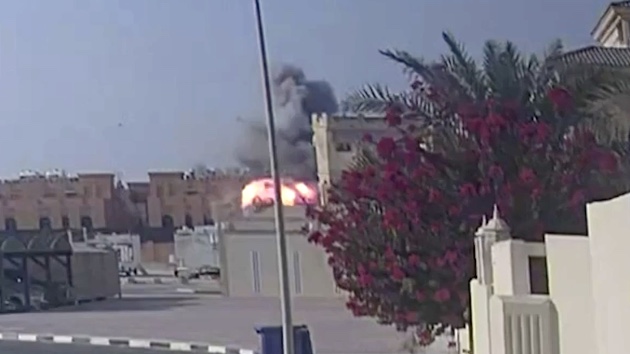
Senior Hamas officials likely survived Israeli strikes on Doha, Israeli sources say

Senior Hamas officials likely survived Israeli strikes on Doha, Israeli sources say
Security footage captures the moment of an Israeli strike targeting Hamas leaders in Doha, Qatar, on September 9, 2025. (Photo by Security Camera/Anadolu via Getty Images)

(DOHA, Qatar) — Israel has informed the U.S. that the chances of success of its strikes Tuesday on a Hamas residence in Doha, Qatar, have “decreased significantly,” two Israeli sources familiar with the matter told ABC News — likely confirming Hamas’ assertion that the strikes failed to kill top Hamas officials.

Five Hamas members and a Qatari official were killed in the strike. Hamas’ senior leaders survived the strike, Hamas said Tuesday.

“There was a meeting of the negotiating team and some Hamas leaders to discuss the ideas sent by the United States and the paper sent by President Trump,” Hamas political bureau official Suhail al-Hindi told Al Jazeera of when the strike took place.

Among those killed were the son of a senior Hamas leader, Dr. Khalil Al-Hayya — the head of the Hamas movement in Gaza and the head of Hamas’ negotiating team for a ceasefire with Israel — and an aide. Al-Hayya himself survived, according to Hamas.

Israeli Prime Minister Benjamin Netanyahu said Israel acted “wholly independently,” and took “full responsibility” for the strike in Doha on Hamas leadership in a brief statement Tuesday.

Netanyahu said he “convened the heads of Israel’s security organizations,” at noon local Israeli time Tuesday and “authorized a surgical precision strike” on Hamas leadership.

The strike targeted the residential headquarters of several members of the Hamas Political Bureau in Doha, according to Qatar.

Israel has faced criticism over the attack, with Arab nations, the United Kingdom and France all condemning the attack that took place on sovereign land.

President Donald Trump said he was “not thrilled” with the Israeli strike in Doha on Tuesday night ahead of a dinner with several members of his Cabinet.

“I’m not thrilled about the whole situation. It’s not a good situation, but I will say this, we want the hostages back, but we are not thrilled about the way that went down today,” Trump said.

“I was very unhappy about it, very unhappy about every aspect, and we got to get the hostages back, but I was very unhappy about the way that went down,” Trump said.

Qatar also condemned the attack, saying the “criminal attack constitutes a flagrant violation of all international laws and norms and a serious threat to the security and safety of Qataris and residents of Qatar,” a spokesperson for Qatar’s Ministry of Foreign Affairs posted on X.

Qatar said it will continue to mediate ceasefire negotiations between Hamas and Israel, as it has done alongside Egypt.

Hamas leadership and its primary negotiators have been based in Doha for years while trying to get a ceasefire and hostage release deal.

Israeli officials said the strikes on Doha were “completely justified,” alleging this Hamas leadership initiated and organized the Oct. 7, 2023, attack on Israel.

“Israel’s security policy is clear — Israel’s long arm will act against its enemies everywhere. There is no place for them to hide,” Israeli Defense Minister Israel Katz said in a statement Wednesday.

“If the Hamas murderers and rapists do not accept Israel’s conditions for ending the war, primarily the release of all hostages and the disarmament of their weapons — they will be destroyed and Gaza will be destroyed,” Katz said.

Qatar is home to the largest U.S. military base in the region. Al Udeid Air Base was attacked by Iran in June in retaliation for U.S. strikes on Iranian nuclear facilities, with Qatari forces helping the U.S. to intercept the missiles.

Earlier Tuesday, Trump said the U.S. “feels badly” about the location of the attack and added that “unilaterally bombing inside Qatar, a sovereign nation and close ally of the United States that is working very hard and bravely taking risks with us to broker peace does not advance Israel or America’s goals,” in a statement read by White House press secretary Karoline Leavitt.

Copyright © 2025, ABC Audio. All rights reserved.