(LONDON and TEL AVIV) — Israeli Prime Minister Benjamin Netanyahu will convene his cabinet to discuss the proposed Gaza Strip ceasefire deal on Thursday, with the cabinet and the wider government expected to approve the blueprint to end the two-year-old war.
The cabinet will meet after days of intense negotiations in the Egyptian Red Sea city of Sharm el-Sheikh, where Israeli and Hamas representatives hashed out the final details of a plan based on the 20-point proposal presented by U.S. President Donald Trump last month.
Netanyahu is expected to convene his cabinet meeting at 5 p.m. local time — 10 a.m. ET. The cabinet is expected to approve the deal, after which the proposal will be put to the wider government. A government vote to ratify the deal is then expected at around 6 p.m. local time — 11 a.m. ET.
The cessation of all fighting by the IDF and Hamas will go into effect after the Israel government ratifies the deal, according to an Israeli official.
Trump announced on Wednesday that Israel and Hamas had agreed to the first phase of the deal, in which all remaining hostages — alive and dead — will be released from Gaza in exchange for an as-yet undetermined number of Palestinians being held in Israeli prisons. Nearly 2,000 prisoners are believed to be under discussion for release.
The Israel Defense Forces will also pull back to the so-called “yellow line” in Gaza — a reference to a proposed ceasefire map released by the White House last month showing multiple stages of withdrawal. The full details of the agreed-to deal have not been made public and the exact location of that “line” may have shifted during the negotiations.
A senior Israeli official told ABC News that the 72-hour window for Hamas releasing all hostages will begin after the Israeli government ratifies the deal, which it is expected to do on Thursday.
The 20 hostages thought to still be alive are therefore expected to be released all in one group on Sunday or Monday, the official said.
An Israeli official told ABC News that the IDF will have 24 hours to move to the yellow line once the deal is ratified by the government.
“This means that ALL of the Hostages will be released very soon, and Israel will withdraw their Troops to an agreed upon line as the first steps toward a Strong, Durable, and Everlasting Peace. All Parties will be treated fairly!” Trump said in a post to social media, explaining the first phase of the agreement.
“This is a GREAT Day for the Arab and Muslim World, Israel, all surrounding Nations, and the United States of America, and we thank the mediators from Qatar, Egypt, and Turkey, who worked with us to make this Historic and Unprecedented Event happen,” the post continued.
Key Arab and Muslim said in supportive statements that they would back the White House plan, all pressing Hamas to accept the blueprint that could end more than two years of intense fighting in the Gaza Strip, which has been largely destroyed by Israeli offensives since the war began after Hamas’ surprise terror attack on Israel on Oct. 7, 2023.
Intense strikes across Gaza continued on Thursday, even as the final elements of the deal were hammered out by negotiators in Egypt.
(LONDON) — A supply of U.S. Tomahawk cruise missiles to Ukraine could help “push Russia back,” Margus Tsahkna — the foreign minister of NATO ally Estonia — told ABC News, after U.S. President Donald Trump said he had “sort of made a decision” on whether to green-light the long-range weapon for Ukrainian use.
Tsahkna said in an interview Tuesday that Trump approving the supply of the cruise missile to Kyiv would send “a very strong message” to Moscow.
“Whatever we can give — without any restrictions — to Ukraine, it is helping to win the war and push Russia back,” Tsahkna said. “So, if President Trump and the U.S. is deciding to take down restrictions from military support, as well Tomahawks, it’s just helping Ukraine to win and push Russia back.”
“It’s up to the U.S. to decide that,” Tsahkna said.
Ukrainian President Volodymyr Zelenskyy has confirmed that Kyiv is seeking access to the American-made long-range missile, different variants of which have ranges of up to 1,550 miles, according to the Missile Defense Project at the Center for Strategic and International Studies.
Russia’s most populous and politically important cities of Moscow, St. Petersburg, and a host of important air, naval, oil refining and drone production facilities would be within range if the longest-range version of the Tomahawk is supplied to Ukraine.
There remain major obstacles to any Ukrainian use of Tomahawks. For one, the main launch platforms for the cruise missile are naval vessels — most commonly submarines — and bomber aircraft, neither of which Ukraine possesses.
Only in recent years has the U.S. developed a small and very limited capability of firing Tomahawks from large launch vehicles, known as the Typhon missile system. Germany and the Philippines have reportedly expressed an interest in obtaining the Typhon, but to date, only the U.S. operates the platform. The small numbers of such launch vehicles in the U.S. military’s inventory makes it likely that they would not be on the battlefield anytime soon if approved by President Trump.
NATO allies have said little on the potential for Ukrainian Tomahawk use, or allied support for their supply.
“I think I want to find out what they’re doing with them,” Trump said of Ukraine’s Tomahawk request on Monday. “I would ask some questions. I’m not looking to escalate that war.”
The Kremlin has warned that a Tomahawk supply to Ukraine would do just that.
“This will lead to the destruction of our relations, or at least the positive trends that have emerged in these relations,” Russian President Vladimir Putin said in a video clip released on Sunday by Russian state television.
On Monday, Kremlin spokesperson Dmitry Peskov told reporters that Moscow is “carefully analyzing” related developments.
“The question, as before, is as follows: Who can launch these missiles, even if they are on the territory of the Kyiv regime — can only Ukrainians launch them, or should the U.S. military do so?” he asked.
“Who sets the targets for these missiles — the American side or the Ukrainians themselves?” Peskov added. “Therefore, a very thorough analysis is needed here. We have certainly heard the statements, they are very serious, and we are studying them.”
“Even if this happens, there is no panacea that can now change the situation on the front lines for the Kyiv regime, there is no magic weapon, be it Tomahawks or missiles — they will not be able to change the dynamics,” Peskov said.
Officials in Kyiv said they disagree.
The Tomahawk “is extremely important as a deterrent weapon, because the presence of this weapon for Russia will be a clear signal that we have something to respond with if they continue this terror,” Serhiy Leshchenko, an adviser to the head of Zelenskyy’s office, said in a television appearance.
Andriy Kovalenko — the head of the Counter-Disinformation Center operating as part of Ukraine’s National Security and Defense Council — said in posts to Telegram that the Tomahawk would represent “not tactical deterrence, but a strategic turning point.”
“As soon as Moscow and St. Petersburg fully and consistently feel the war, it will mean either a search for a replacement for Putin by the elites and an exit from the war, at least temporarily, or Putin himself will do everything to stop the war,” Kovalenko suggested.
But significant practical challenges remain.
Ivan Stupak, a former officer in the Security Service of Ukraine (SBU), suggested in an interview with ABC News that the Tomahawk is the latest headline-grabbing “wonder weapon” that would have a limited battlefield effect, even if the White House decided to approve its transfer to Ukrainian arsenals.
It is not clear how many Tomahawks the U.S. military could spare for Ukrainian use. The rate of Tomahawk production has ranged from 55 to 90 annually in recent years, according to Reuters. The Pentagon has already said it plans to purchase just 57 missiles in 2026.
The intensity of the war in Ukraine dwarfs those numbers. Recent months have seen Russia launch between 100 and 200 missiles of all types into Ukraine each month, per Ukrainian air force data analyzed by ABC News. On a nightly basis, Ukraine launches dozens of long-range drones into Russia, according to the Defense Ministry in Moscow.
Stupak, who has advised Ukrainian parliamentarians on security matters during Russia’s full-scale invasion, said he was skeptical that the U.S. would deliver enough Tomahawks to turn the tide of the war.
U.S. control over target selection may limit their effectiveness further, Stupak said, as may American concerns about sensitive technical data falling into Russian hands if any Tomahawks were captured.
Along with the issue of launch platforms, there would be a need for training. Unless American military personnel are on the ground to assist in their usage — and Trump has already publicly ruled out deployed U.S. troops to Ukraine — Ukrainian operators will also need significant training to be able to use the weapon.
Ukraine is already using shorter-range Western-supplied cruise missiles — the Storm Shadow/SCALP British-French cruise missile, which have a maximum range far shorter than the Tomahawk at around 155 miles.
The extent of allied involvement in their use is unclear, but Germany’s then-Chancellor Olaf Scholz was widely criticized for hinting in 2024 that British and French personnel were involved in “target control.”
Yuriy Boyechko, the CEO of the Hope For Ukraine humanitarian organization, told ABC News he was skeptical of any Tomahawk proposal.
“Ukraine currently does not possess the specialized launch equipment or the trained personnel needed to field the Tomahawk missile system,” he said. “Right now, Ukraine is under daily mass attacks and needs quick, practical solutions to protect civilians and to conduct offensive operations deep into Russian territory.”
The “only solution” for Kyiv, Stupak suggested, is for Ukraine to continue its own cruise missile and ballistic missile production drive.
(LONDON) — As Israel’s military prepared last month to launch its ground offensive into Gaza City, the Israel Defense Forces published a warning about al-Kawthar Tower, a residential high-rise in the city.
Avichay Adraee, the IDF’s Arab-language spokesperson, shared on social media a satellite photo with the building highlighted in red. Leave now, he said at about 10 a.m. local time, adding, “The defense army will attack the building soon due to the presence of Hamas terrorist infrastructure inside it or adjacent to it.”
By the time the afternoon began, an Israeli airstrike had reduced that building and another one-time residential high-rise like it to piles of rebar and concrete.
Those systematic warnings and strikes — which came weeks ahead of the second anniversary of the brutal conflict between Israel and Hamas, the terrorist group that launched a surprise attack on Oct. 7, 2023, that killed more than 1,200 — were just two of many as Israel continued its campaign to “crush” Hamas, in the words of Prime Minister Benjamin Netanyahu.
Israel, in the second year of the war, continued hunting militants throughout the Gaza Strip, proceeding at times in block-by-block sweeps of neighborhoods and buildings. Like the al-Kawthar Tower, many buildings and much infrastructure have been destroyed in the process. Hospitals, schools-turned-shelters and sprawling “tent cities” of displaced people have all been routinely attacked. The United Nations in March described the damage as “unprecedented,” saying at that time that some 51 million tons of rubble covered the enclave.
Many have died, including thousands of noncombatants, according to officials at government agencies run by Hamas. By Sunday, two days prior to the war’s second anniversary, the death toll in the strip had risen to 67,139, the Hamas-run Gaza Ministry of Health said.
An average of 27 children have been killed each day over the past two years, the strip’s media office said on Monday.
A broadening conflict and Trump’s helping hand
A ceasefire deal came into effect a day before President Donald Trump took office in January. As the president’s second term began, he said he would seek to be a “peacemaker and unifier.” He said he wanted to measure success by the wars the U.S. ended and “perhaps most importantly, the wars we never get into.”
Trump has in months since pushed for a resolution to the war between Israel and Hamas. He hosted Netanyahu at the White House and dispatched Secretary of State Marco Rubio to Tel Aviv and Qatar to assist in negotiations.
But still, the sinews of the conflict have stretched wider in the last year. Although the military said its focus has remained on destroying Hamas in Gaza, the IDF also launched significant air, ground and sea campaigns into Yemen, Lebanon, Syria and Iran. As of the war’s second anniversary, Israeli troops are still occupying recently seized territory in Lebanon and Syria — plus conducting air and artillery strikes in both.
“Together, we pushed back our enemies’ plans of destruction,” Netanyahu said on social media on Saturday. “From Gaza to Rafah, from Beirut to Damascus, from Yemen to Tehran, together we have achieved great things.”
He added, “From victory to victory — we are changing the face of the Middle East together. Together we will continue to act to ensure the eternity of Israel.”
Israeli forces have used U.S.-provided weapons and intelligence throughout its recent regional conflicts. Trump in June ordered U.S. fighter and bomber aircraft to launch an attack on several key nuclear facilities in Iran — assisting Israel in an intense and broad airstrike and covert operations campaign it had already launched against Tehran. Trump in a speech after the strikes said, “Iran, the bully of the Middle East, must now make peace. If they do not, future attacks will be far greater and a lot easier.”
Trump also told ABC News he thought the attacks had been “excellent” and suggested there was “more to come.”
Accusations of ‘genocide’ against Israel, UN commission says Israel has, since the first months of the conflict, been accused of systematically killing noncombatants, including claims that its actions in Gaza amount to a genocide, according to an independent U.N. commission and the Palestinian Authority president.
Those claims continued to dog Israel in the second year of its conflict, as civilian casualties in Gaza climbed, mass hunger spread and the IDF repeatedly forced large numbers of Palestinians to relocate. As Israel opened aid routes in July, the IDF said in a statement that that there is “no starvation in Gaza.”
The International Association of Genocide Scholars, for example, passed a resolution in September saying Israel’s “policies and actions” in Gaza “meet the legal definition of genocide,” established by the U.N. in 1948, the organization said in a release.
Human Rights Watch said in a statement late last month, “Israel’s actions in Gaza should have long ago triggered the ‘duty to prevent’ under the Genocide Convention, but states have failed to act decisively.”
Israel has vociferously rejected all allegations of genocide, framing its critics as anti-Semitic or — in Netanyahu’s words — “useful idiots” in the service of both Hamas and Iran.
Those accusations continued into the summer and fall of this year, as another group, the Integrated Food Security Phase Classification, a global initiative monitoring hunger with the backing of governments, the United Nations and nongovernmental organizations, warned that the “worst-case scenario of famine” was unfolding in Gaza.
“Mounting evidence shows that widespread starvation, malnutrition, and disease are driving a rise in hunger-related deaths,” the IPC warning said. “Latest data thresholds have been reached for food consumption in the Gaza Strip, and for acute malnutrition in Gaza City.”
Netanyahu’s office called that determination “an outright lie” and “a modern blood libel.”
International outrage built as the killing of civilians at or close to aid sites — including those organized by the U.S. and Israel-backed Gaza Humanitarian Foundation — by Israeli forces happened on multiple occasions. The U.N. and other aid groups refused to collaborate with the GHF. U.N. experts said the group was an “utterly disturbing example of how humanitarian relief can be exploited for covert military and geopolitical agendas in serious breach of international law.”
The experts alleged an “entanglement of Israeli intelligence, U.S. contractors and ambiguous non-governmental entities” with the GHF.
The organization’s executive chairman told ABC News in June that he “fundamentally” disagrees “with the premise that our operation is somehow disproportionately imperiling people.”
The IDF repeatedly rejected claims that it had intentionally fired on hungry civilians. Israeli military and political officials, plus the GHF, blamed Hamas or other Palestinian actors for the violent and desperate scenes near the aid sites.
A peace deal takes shape under Trump Since returning to office in January, Trump has twinned his push for a peace deal with apocalyptic threats against Hamas. The president has framed a possible ceasefire agreement as one part of a wider Middle East accord, and “something special” for the whole region.
The president has secured buy-in from key Arab and Muslim states, his efforts energized by his criticism of Israel’s audacious and unsuccessful effort to assassinate top Hamas official Khalil Al-Hayya in an airstrike in the Qatari capital of Doha.
The 20-point peace plan presented by Trump and Netanyahu at the White House on Sept. 29 appears a far cry from his February “Gaza Riviera” redevelopment scheme, which he said would see the U.S. “take over” and “own” the Gaza Strip, overseeing its reconstruction with Palestinians relocated outside of the strip.
The new proposal foresees a transfer of power to a technocratic Palestinian government backed by a temporary “International Stabilization Force,” manned by Arab and other international partners to oversee the security of Gaza. The new government would also be overseen by the “Board of Peace” transitional body, chaired by Trump with other members including former British Prime Minister Tony Blair.
The IDF, though, would remain along the Gaza perimeter and in the southern Philadelphi frontier crossing, while retaining freedom of military action throughout the strip. Hamas leaders would be allowed to leave the strip, but the organization would have to fully disarm.
Hamas on Friday gave a positive initial response, signifying its readiness to free all hostages in exchange for Palestinian prisoners if “the field conditions for the exchange are met.”
But the group said more negotiations will be needed before it can agree to a full peace deal. This week, Hamas, Israeli and U.S. representatives will gather in Egypt’s Red Sea city of Sharm el-Sheikh for further ceasefire talks.
In any settlement, those responsible for post-war Gaza face a daunting reconstruction task.
Entire towns have disappeared from Gaza over the past two years. The U.N. reported in September that 78% of Gaza Strip buildings had been partially or fully destroyed. An ABC News visual analysis of satellite imagery and more than 200 verified social media videos showed that 88% of Gaza’s schools are destroyed or damaged.
In Gaza City, where the al-Kawthar Tower and others were brought down last month, more than 50 such “terror towers” were destroyed before the ground invasion began, Israel said. Netanyahu in a statement, said those towers coming down was “just a start.”
“We brought down 50 terror towers in two days, and this is just the opening for the independent operation of the ground maneuver in Gaza City,” Netanyahu said as the Gaza City invasion began.
The U.N. warned in a statement that the operation to seize Gaza City would be “catastrophic” for civilians.
When Netanyahu spoke of the potential deal on Saturday, he again lauded the strong military action in the city, saying, “As a result of the intense military pressure we applied and the diplomatic pressure, Hamas was pressured into agreeing to the plan we presented.”
And U.S. Secretary of State Marco Rubio has several times discussed the difficulties that lie ahead, even if a deal is made to pause or end the fighting.
He said last month that “when all is said and done, there is still a group called Hamas, which is an evil group that still has weapons and is terrorizing.” He added, “there is still the hard work ahead of, once this ends, of rebuilding Gaza in a way that provides people a quality of life that they all want.”
“Who’s going to do that?” Rubio added. “Who’s going to pay for it? And who’s going to be in charge of it?”
Mount Everest 8,848 m (29,029 ft) and the Himalayas, aerial photo, Nepal, Asia./(Bim/Getty)
(SEOUL, South Korea) — Scaling the world’s highest peak is a risky adventure. But even hanging around the base camp can be dangerous, as hundreds of holiday makers being trapped when the area was hit in an unexpected blizzard over the weekend.
Taking advantage of an eight-day National Day holiday in China, many visitors and tour groups flocked to Tibet, trekking through the remote Karama Valley, which leads to the eastern side of Mount Everest, known in Tibetan as Qomolangma.
Tour groups heading to Mount Everest during the holiday were fully booked months in advance. Usually, the weather on Mt. Everest is great at this time of year. But an unexpected blizzard trapped hundreds of trekkers in the mountain.
A local government release said that, as of Sunday, 350 trekkers had reached the small township of Qudang, while authorities had made contact with the remaining 200-plus trekkers.
Qu Zhengpu, a 27-year-old experienced hiker, told ABC news he believes that there are more trekkers on the mountain with no cellphone signal, so it’s almost impossible for the rescue teams to get contact with them. Some of his experienced hiking friends even chose to stay on the mountain and wait for the snow to stop.
“This scale of snow storm is very rare this time of the year for Mount Everest, even my local friends haven’t seen that for years,” he said.
There are two trails on the China side of Mount Everest. The northern part is mostly for mountain hikers, while the eastern side for trekkers.
After hiking up the northern side of Mount Everest, astronomy photographer and mountaineering enthusiast Geshuang Chen wanted to explore and film more on the mountain, so she joined a trekking tour group this holiday, and became one of the members trapped by the blizzard.
Chen got off the mountain safely.
She told ABC News that the heavy snow storm started on the night of Oct. 4.
“The snow was so heavy, the thunder and lighting made it terrifying,” Chen said. “On the morning of the 5th, the snow was more than 3 feet deep, already up to my thigh. I barely slept for the whole night, I was so worried.”
The local government has organized a rescue team of police and villagers with yaks to go into the mountain to help the trapped trekkers. Chen said she was extremely grateful to arrive in the nearby town safely, where she was greeted by the local villagers with warm milk tea and food.
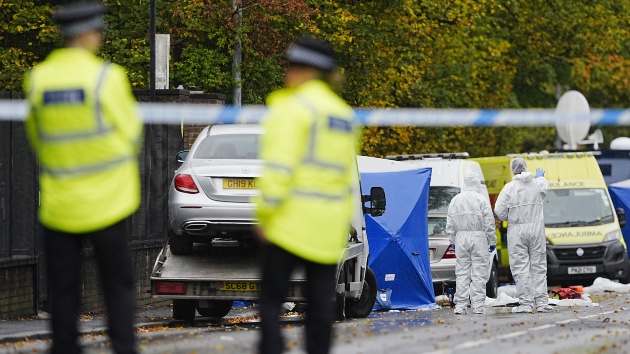
The police investigation continues at the scene near Heaton Park Hebrew Congregation synagogue in Crumpsall, Manchester, where two people died in a terror attack. Picture date: Friday October 3, 2025. (Photo by Peter Byrne/PA Images via Getty Images)
(LONDON) — Two of the Manchester synagogue attack victims appeared to been shot by police officers who were trying to stop the assailant, the Greater Manchester Police said Friday.
One of the victims with apparent gunshot wounds died during the attack and the other remains hospitalized, police said.
“The Home Office Pathologist has advised that he has provisionally determined, that one of the deceased victims would appear to have suffered a wound consistent with a gunshot injury,” Police Chief Constable Stephen Watson said in a statement.
Police said they determined the victims who were shot were likely hit by police because the suspect — who was fatally shot by police — was not in possession of any firearms, according to their initial investigation.
Police alleged that Jihad Al-Shamie, 35, a British citizen of Syrian descent, drove a vehicle into a crowd outside the Heaton Park Hebrew Congregation Synagogue early on Thursday. He then allegedly exited the vehicle and began attacking people with a blade — actions that police said were a terrorist incident.
As the attack unfolded, congregants blockaded themselves inside the synagogue, keeping Al-Shamie outside. He was then struck and killed by police gunfire, officials said.
Both of those who appeared to have been struck by law enforcement were believed to have been sheltering inside the synagogue, where they were “close together” behind a door as “worshippers acted bravely to prevent the attacker from gaining entry,” police said.
Police earlier on Friday said in a statement that they had identified the two victims killed during the attack as Adrian Daulby, 53, and Melvin Cravitz, 66, both of whom were from Crumpsall.
Law enforcement did not immediately say which of the victims appeared to have been hit by gunfire. The victim who was shot and injured was one of three who were receiving treatment for injuries in local hospitals, police said on Friday.
Three additional suspects — two men and a woman — were also taken into custody and arrested on suspicion of commission, preparation and instigation of acts of terrorism, police said on Thursday.
(LONDON) — Two men were killed and three were wounded in a terrorist incident outside a synagogue in Manchester, England, on the Jewish holiday of Yom Kippur, officials said.
One suspect drove a car into a group of worshippers and then attacked people with a knife outside the Heaton Park Hebrew Congregation Synagogue on Thursday morning, Manchester police said.
Responding police shot and killed that suspect, preliminarily identified as 35-year-old Jihad Al-Shamie, a British citizen of Syrian descent, police said. He was wearing a vest with “the appearance of an explosive device,” police said, adding that the vest was later “deemed not to be viable.”
Three other suspects — two men in their 30s and a woman in her 60s — have been arrested on suspicion of commission, preparation and instigation of acts of terrorism, police said.
The two victims killed have only been identified by police as men.
The three wounded, also men, are in the hospital with serious injuries, police said.
The attack came as worshippers were gathered to mark Yom Kippur, which is considered the holiest day of the year in Judaism.
British Prime Minister Keir Starmer said, “A vile individual committed a terrorist attack that attacked Jews because they are Jews.”
He noted that in Britain “Jewish buildings, synagogues, even schools, require round the clock protection … because of the daily threat of anti-Semitic hatred.”
“To every Jewish person in this country … I know how much fear you will be holding inside of you. I really do,” Starmer said. “And so on behalf of our country, I express my solidarity, but also my sadness that you still have to live with these fears. … So I promise you that I will do everything in my power to guarantee you the security that you deserve, starting with a more visible police presence protecting your community. I promise you that over the coming days, you will see the other Britain, the Britain of compassion, of decency, of love. And I promise you that this Britain will come together to wrap our arms around your community and show you that Britain is a place where you and your family are safe, secure and belong.”
Starmer, who was in Denmark for a summit with European leaders when the attack occurred, said he was returning to the U.K. and would be chairing an emergency “COBRA” meeting — a gathering of senior officials to discuss and respond to national emergencies.
London Mayor Sadiq Khan said in a post to X he was “horrified by the violent attack.”
Khan said he had spoken with his counterpart in Manchester and Home Secretary Shabana Mahmood, “and would like to reassure Londoners that the Met Police are stepping up patrols in Jewish communities and synagogues across London.”
King Charles III and his wife, Queen Camilla, said in a statement they were “deeply shocked and saddened to learn of the horrific attack in Manchester, especially on such a significant day for the Jewish community.”
“Our thoughts and prayers are with all those affected by this appalling incident and we greatly appreciate the swift actions of the emergency services,” the statement said.
Israeli Prime Minister Benjamin Netanyahu also spoke out, saying, “Israel grieves with the Jewish community in the U.K. after the barbaric terror attack in Manchester. Our hearts are with the families of the murdered, and we pray for the swift recovery of the wounded. As I warned at the [United Nations]: weakness in the face of terrorism only brings more terrorism. Only strength and unity can defeat it.”
The Israeli Embassy in the U.K. also condemned the attack, saying in a statement, “That such an act of violence should be perpetrated on the holiest day of the Jewish calendar, in a place of prayer and community, is abhorrent and deeply distressing. … The thoughts and prayers of the people of Israel are with the victims, their families, and the entire Jewish community at this difficult time.”
ABC News’ Victoria Beaule and Zoe Magee contributed to this report.
(LONDON) — Two people were killed and four were wounded when a suspect drove a car into a group of worshippers and launched a stabbing attack outside a synagogue in Manchester, England, officials said.
Responding police shot and killed the suspect, Manchester police said, adding that two other suspects have been arrested.
Police have declared it a terrorist incident.
The attack occurred Thursday morning outside the Heaton Park Hebrew Congregation Synagogue, which is in a northern suburb of Manchester, officials said.
The suspect — who was wearing a vest with “the appearance of an explosive device” — drove a car directly at worshippers outside the synagogue and then attacked people with a knife, police said.
The four wounded victims have been hospitalized with serious injuries, police said.
The attack came as worshippers were gathered to mark Yom Kippur, which is considered the holiest day of the year in Judaism.
British Prime Minister Keir Starmer said in a post to X that he was “appalled by the attack.”
“The fact that this has taken place on Yom Kippur, the holiest day in the Jewish calendar, makes it all the more horrific,” the prime minister added.
“My thoughts are with the loved ones of all those affected, and my thanks go to the emergency services and all the first responders,” Starmer wrote.
Starmer was in Copenhagen, Denmark, for a summit with European leaders when the incident occurred. The prime minister said he was returning to the U.K. and would be chairing an emergency “COBRA” meeting — a gathering of senior officials to discuss and respond to national emergencies.
Starmer also said additional police are being deployed to synagogues across the country.
“We will do everything to keep our Jewish community safe,” he added.
London Mayor Sadiq Khan said in a post to X he was “horrified by the violent attack.”
Khan said he had spoken with his counterpart in Manchester and Home Secretary Shabana Mahmood, “and would like to reassure Londoners that the Met Police are stepping up patrols in Jewish communities and synagogues across London.”
King Charles III and his wife, Queen Camilla, said in a statement they were “deeply shocked and saddened to learn of the horrific attack in Manchester, especially on such a significant day for the Jewish community.”
“Our thoughts and prayers are with all those affected by this appalling incident and we greatly appreciate the swift actions of the emergency services,” the statement said.
The Israeli Embassy in the U.K. also condemned the attack, saying in a statement, “That such an act of violence should be perpetrated on the holiest day of the Jewish calendar, in a place of prayer and community, is abhorrent and deeply distressing. … The thoughts and prayers of the people of Israel are with the victims, their families, and the entire Jewish community at this difficult time.”
ABC News’ Victoria Beaule and Zoe Magee contributed to this report.
(LONDON) — Two people were killed and three were wounded when a man drove a vehicle toward a crowd of people and launched a stabbing attack near a synagogue in Manchester, a northern British city, on Thursday, according to police.
The suspect is also dead after being shot by police officers, Manchester police said.
The three injured are “in a serious condition,” police said.
The attack occurred outside the Heaton Park Hebrew Congregation Synagogue in a northern suburb of the city on Thursday morning, law enforcement said.
Police reported “injuries caused by both the vehicle and stab wounds.” A witness reported seeing a “car being driven towards members of the public,” along with a man being stabbed, police said.
Thursday is Yom Kippur, which is considered the holiest day of the year in Judaism.
Police said they had declared a major incident, along with a “PLATO” designation, a law enforcement shorthand that means the incident was being treated as a potential marauding terrorist attack.
British Prime Minister Keir Starmer said in a post to X that he was “appalled by the attack at a synagogue in Crumpsall.”
“The fact that this has taken place on Yom Kippur, the holiest day in the Jewish calendar, makes it all the more horrific,” the prime minister added.
“My thoughts are with the loved ones of all those affected, and my thanks go to the emergency services and all the first responders,” Starmer wrote.
Starmer was in Copenhagen, Denmark, for a summit with European leaders when the incident occurred.
Speaking to reporters, the prime minister said he was returning to the U.K. and would be chairing an emergency “COBRA” meeting — a gathering of senior officials to discuss and respond to national emergencies.
Starmer also said that additional police are being deployed to synagogues across the country. “We will do everything to keep our Jewish community safe,” he added.
The website of the synagogue where the incident occurred listed Yom Kippur-related events for both Wednesday and Thursday evenings.
London Mayor Sadiq Khan said in a post to X he was “horrified by the violent attack at a synagogue in Manchester.”
Khan said he had spoken with his counterpart in Manchester and Home Secretary Shabana Mahmood, “and would like to reassure Londoners that the Met Police are stepping up patrols in Jewish communities and synagogues across London.”
King Charles III and his wife, Queen Camilla, said in a statement they were “deeply shocked and saddened to learn of the horrific attack in Manchester, especially on such a significant day for the Jewish community.”
“Our thoughts and prayers are with all those affected by this appalling incident and we greatly appreciate the swift actions of the emergency services,” the statement said.
The Israeli Embassy in the U.K. also condemned the attack, saying in a statement, “That such an act of violence should be perpetrated on the holiest day of the Jewish calendar, in a place of prayer and community, is abhorrent and deeply distressing. … The thoughts and prayers of the people of Israel are with the victims, their families, and the entire Jewish community at this difficult time.”
ABC News’ Victoria Beaule and Zoe Magee contributed to this report.
(LONDON) — A vehicle was driven toward a crowd of people and a man was stabbed near a synagogue in Manchester, a northern British city, police said.
“One man has been shot, believed to be the offender,” the Greater Manchester Police said on social media.
The incident occurred outside the Heaton Park Hebrew Congregation Synagogue in a northern suburb of the city on Thursday morning, law enforcement said.
Police said at least four people had been injured, “with injuries caused by both the vehicle and stab wounds.” A member of the public told responding officers “he had witnessed a car being driven towards members of the public,” along with a man being stabbed, police said.
Firearms officers responded to the call, police said.
Police said they had declared the major incident, along with a “PLATO” designation, a law enforcement shorthand that means the incident was being treated as a potential marauding terrorist attack.
Thursday is Yom Kippur, which is considered the holiest day of the year in Judaism.
British Prime Minister Keir Starmer said in a post to X that he was “appalled by the attack at a synagogue in Crumpsall.”
“The fact that this has taken place on Yom Kippur, the holiest day in the Jewish calendar, makes it all the more horrific,” the prime minister added.
“My thoughts are with the loved ones of all those affected, and my thanks go to the emergency services and all the first responders,” Starmer wrote.
The website of the synagogue where the incident occurred listed Yom Kippur-related events for both Wednesday and Thursday evenings.