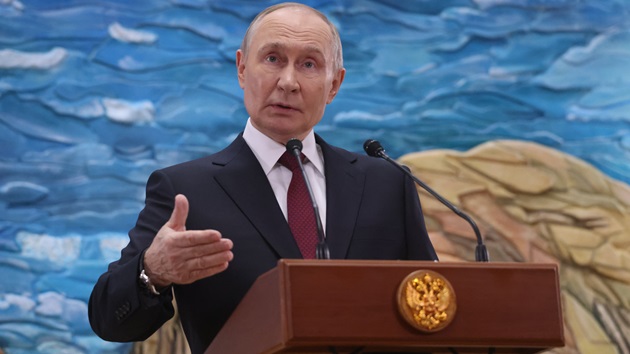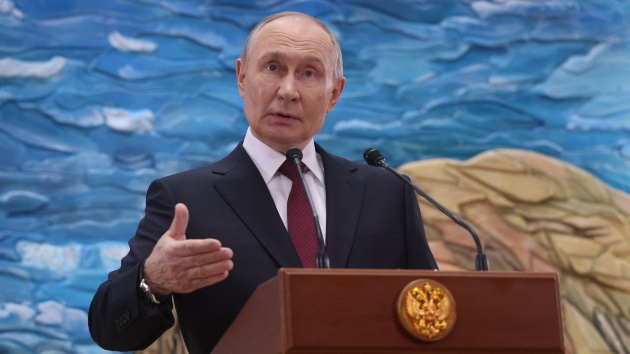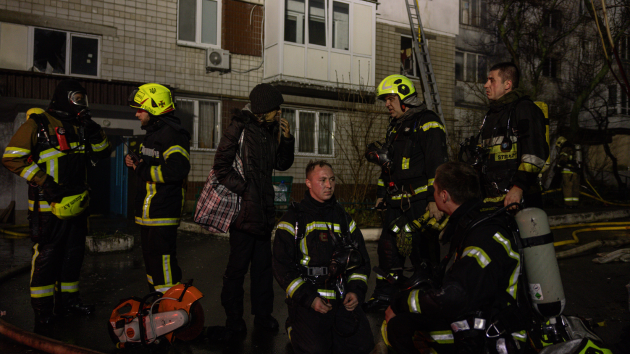
(NEW YORK) — Russia carried out a “massive” attack across Ukraine Friday night into Saturday morning, using more than 600 drones and missiles, according to the Ukrainian Air Force.
Russia confirmed Saturday that it had “launched a massive strike using long-range air- and ground-based precision weapons and attack drones against Ukrainian military-industrial complex enterprises developing the Sapsan tactical missile system, producing multipurpose strike and reconnaissance drones, robotic combat vehicles, interceptor UAVs, and loitering munitions.”
The Russian Ministry of Defense claimed that “the strike’s objectives were achieved” and “all designated targets were hit.”
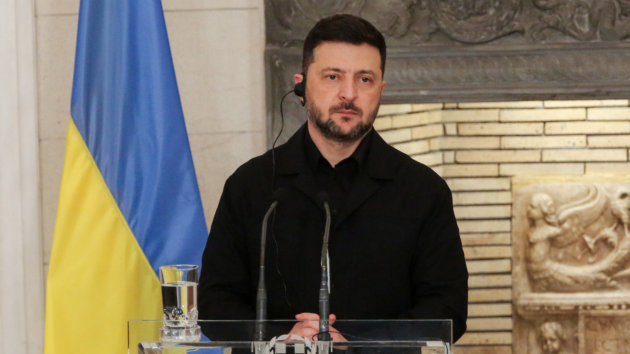
However, Ukraine said their air defense systems repelled most of the projectiles, even though they confirmed at least three people were killed and dozens of others were injured, according to Ukrainian President Volodymyr Zelenskyy.
The Russian strikes targeted Ukraine’s central city of Dnipro and the wider Dnipropetrovsk region, as well as the Mykolaiv, Chernihiv and Zaporizhzhia regions, and also communities in the Poltava, Kyiv, Odesa, Sumy, and Kharkiv regions, according to Zelenskyy.
“The enemy aimed at our infrastructure, residential areas, and civilian enterprises,” the Ukrainian president said in a post on X. “In Dnipro, a missile with cluster munitions directly struck an apartment building.”
“Every such strike is not a military necessity but a deliberate strategy by Russia to terrorize civilians and destroy our infrastructure,” he added. “That is why a strong international response is needed.”
Meanwhile, one month after his summit with Russian President Vladimir Putin in Alaska, U.S. President Donald Trump’s proposed in-person meeting between Putin and Zelenskyy has yet to come to fruition.
Russia has steadily intensified its long-range strikes on Ukraine. During one such strike last week, around two dozen Russian drones entered Poland — by far the largest-ever of Russian drones into NATO airspace. At least three of the drones were shot down by responding Polish and Dutch fighters.
NATO has responded by launching Operation Eastern Sentry, which it says will enhance its air defense posture all along the bloc’s eastern edge. Some allies are pushing for more action. Polish Foreign Minister Radoslav Sikorski, for example, has suggested that NATO should shoot down Russian drones operating over western Ukraine.
Ukrainian officials, meanwhile, are still pushing for the expanded sanctions and tariffs that Trump has repeatedly threatened to impose on Russia in response to Moscow’s refusal to accept a ceasefire or peace deal.
“And if the world does not deliver a truly tangible response to Russia’s prolonging of the war, if sanctions and tariffs are postponed, if the Russian army can already launch drones with impunity even against Poland — Putin will continue to see it as permission to wage war,” Zelenskyy said.
Francisco Richart Barbeira/NurPhoto via Getty Images
(LONDON) — Russia continued its nightly strikes on Ukraine — including the capital Kyiv — as U.S. President Donald Trump prepared to depart for his state visit to the U.K. on Tuesday, with the White House’s efforts to broker peace between the combatants still stalled.
Ukraine’s air force said Russia launched 113 drones into the country overnight into Tuesday morning, of which 89 were shot down or suppressed. Twenty-two drones impacted across six locations, with falling debris falling in two locations.
Air defenses were active in the sky over Kyiv, local officials there said. Drone attacks caused fires at a shopping center and an industrial facility on the outskirts of the capital, Ukraine’s State Emergency Service reported on Telegram.
“During the fire extinguishing, the aggressor struck the site again, damaging two fire-rescue vehicles,” the service said.
Ukrainian President Volodymyr Zelenskyy said that Russian attacks were reported in Kyiv, Mykolaiv, Zaoprizhzhia Sumy, Kharkiv, Donetsk and Kherson regions. “Now is the time to implement a joint defense of our European sky with a multilayer air defense system,” he wrote on Telegram.
At least six people were killed and 55 injured in Russian attacks across Ukraine, according to Ukrainian officials. The attacks included a rocket artillery strike on the southern city of Zaporizhzhia, officials said.
Russia’s Defense Ministry, meanwhile, said its forces downed at least 87 Ukrainian drones overnight into Tuesday.
Russia’s ongoing full-scale invasion — which began in February 2022 — is expected to be a topic of discussion when Trump meets with British Prime Minister Keir Starmer during his U.K. visit.
Britain is a leading member of the so-called “Coalition of the Willing” — a group of mostly-European allied nations that have committed to expanding military support for Ukraine and possibly deploying troops to the country as part of a post-war peacekeeping force.
Trump has ruled out deploying U.S. troops inside Ukraine, though hinted at the possible involvement of U.S. air assets in any future peacekeeping mission. Moscow has repeatedly said it will not accept the presence of any foreign troops on Ukrainian soil.
One month after his summit with Russian President Vladimir Putin in Alaska, Trump’s proposed in-person meeting between Putin and Zelenskyy has yet to come to fruition.
Meanwhile, Russia has intensified its long-range strikes on Ukraine. During one such strike last week, around two dozen Russian drones entered Poland — by far the largest-ever of Russian drones into NATO airspace. At least three of the drones were shot down by responding Polish and Dutch fighters.
NATO has responded by launching Operation Eastern Sentry, which it says will enhance its air defense posture all along the bloc’s eastern edge. Some allies are pushing for more action. Polish Foreign Minister Radoslav Sikorski, for example, has suggested that NATO should shoot down Russian drones operating over western Ukraine.
Trump raised concerns along NATO’s eastern frontier when he said Russia’s drone incursions into Poland “could have been a mistake” — a suggestion quickly contested by Warsaw.
“We would also wish that the drone attack on Poland was a mistake. But it wasn’t. And we know it,” Polish Prime Minister Donald Tusk wrote on social media.
Ukrainian officials, meanwhile, are still pushing for the expanded sanctions and tariffs that Trump has repeatedly threatened to impose on Russia in response to Moscow’s refusal to accept a ceasefire or peace deal.
On Monday, Zelenskyy previewed “an active week of our diplomacy” in a post to Telegram.
“Now — one week before the [United Nations] General Assembly — President Trump will be in Europe,” Zelenskyy wrote. “We continue our very active work with European leaders to ensure that we are all coordinated and actually reach decisions to put pressure on Russia.”
“And if the world does not deliver a truly tangible response to Russia’s prolonging of the war, if sanctions and tariffs are postponed, if the Russian army can already launch drones with impunity even against Poland — Putin will continue to see it as permission to wage war,” Zelenskyy said.
(LONDON) — The Israeli military began a ground offensive in Gaza City, the Israel Defense Forces said on Tuesday.
The IDF confirmed that the maneuver to occupy Gaza City that began overnight included two divisions, with a third expected to join.
The next phase of the Israeli military action in the city follows the beginning early this month of ground operation in the city, the largest in the Gaza Strip, military officials said at the time.
Israeli officials then a week ago issued an order calling for all residents of the city to evacuate, saying at the time that the Israeli military would operate “with great force” within Gaza City.
“Staying in the city is extremely dangerous,” Avichay Adraee, a spokesperson for the Israel Defense Forces, said on social media at the time.
It was not immediately clear how many people remained in the city on Tuesday. At the Holy Family Church in Gaza City, a church official told ABC News they were still sheltering inside, with no intention to leave.
Tuesday’s military action in Gaza City followed a visit on Sunday and Monday by U.S. Secretary of State Marco Rubio, who met privately with Israeli Prime Minister Benjamin Netanyahu.
After a joint news conference on Tuesday, Rubio said the United States supported Israel’s goal of destroying Hamas.
Hamas in a statement on Tuesday accused Netanyahu and Israel of destroying “every chance” of reaching an agreement to end the war and return remaining hostages. Hamas, which is a designated terrorist organization, said the U.S. knew “full well” that Israel was doing so.
But Rubio, as he again briefly spoke with the press as he boarded a plane out of Tel Aviv, said the U.S. was still pushing for a “negotiated” end to the war in Gaza.
“We think we have a very short window of time in which a deal can happen,” he said. “We don’t have months anymore; we probably have days, maybe a few weeks. So, it’s a key moment, an important moment.”
(LONDON) — North Korean officials on Monday said the country’s status as nuclear state “has become irreversible,” despite efforts by the West to negotiate an end to the production of those weapons, according to state media.
“The position of the Democratic People’s Republic of Korea as a nuclear weapons state which has been permanently specified in the supreme and basic law of the state has become irreversible,” North Korea’s Permanent Mission to the U.N. said in a press statement, according to the Korean Central News Agency.
The International Atomic Energy Agency, the intergovernmental body for nuclear cooperation, has no “legal right and moral justification” to interfere with what North Korea consider an “internal affair,” the mission’s press statement said.
The statement on Monday was one of several anti-U.S. messages issued by North Korea that coincided with the launch of Freedom Edge 25, a joint military exercise being held by the United States, South Korea and Japan, off South Korea’s Jeju Island. Those drills are scheduled to run through Sept. 19.
North Korea’s Pak Jong Chon, vice-chairman of the Central Military Commission, said on Sunday that those drills “pose a grave challenge to the security interests of our state and a major danger of undermining regional stability and escalating military tension,” according to state media.
The secretive state on Monday accused the United States of violating its own stated obligation of preventing nuclear proliferation “while concentrating more than anyone else on nuclear power buildup.”
“The U.S. has gone to extremes in its nuclear threat as days go by and the U.S.-led nuclear alliance is getting desperate in its confrontational moves,” the North Korean officials said on Monday.
IAEA Director General Rafael Mariano Grossi earlier this month pointed to North Korea’s nuclear development programs as “clear violations” of U.N. Security Council resolutions.
He said his agency nonetheless “continues to maintain its enhanced readiness to play its essential role in verifying the DPRK’s nuclear program.”
U.S. Secretary of State Marco Rubio and Israeli Prime Minister Benjamin Netanyahu on February 16, 2025. Photo courtesy: Koby Gideon (GPO)/Handout/Anadolu via Getty Images
(LONDON) — U.S. Secretary of State Marco Rubio arrived on Sunday morning in Israel, where he met with Israeli Prime Minister Benjamin Netanyahu to discuss the war in Gaza.
“My focus will be on securing the return of hostages, finding ways to make sure humanitarian aid reaches civilians, and addressing the threat posed by Hamas,” Rubio said on social media ahead of his flight to Israel.
He added, “Hamas cannot continue to exist if peace in the region is the goal.”
The secretary and his wife, Jeanette Dousdebes Rubio, were greeted upon arrival at Ben Gurion airport by U.S. Ambassador to Israel Mike Huckabee and his wife, Janet Huckabee.
Rubio later met one-on-one with Netanyahu before the two visited the Western Wall in Jerusalem, also called the the “Wailing Wall,” one of the world’s most significant religious sites for the Jewish people. While there, Netanyahu said he and Rubio “buried a note among the stones.”
Rubio and Netanyahu toured the archaeological site along with Netanyahu’s wife, Sara, Rubio’s wife, and Huckabee and his wife.
“I think his visit here is a testament to the resilience and strength of the American-Israeli alliance, which is as durable and strong as the stones of the Western Wall that we just touched,” Netanyahu said of Rubio’s visit.
Netanyahu and Rubio, according to the prime minster’s statement, offered a joint prayer for the safety of the hostages, as well as a special prayer honoring President Donald Trump, whom Netanyahu described as “a true friend of the Jewish people and the State of Israel.”
“Under President Trump, Secretary Rubio and their entire team, this alliance has never been stronger, and we appreciate it very much,” Netanyahu’s statement said. “Not only on behalf of the people of Israel today, but also on behalf of the generations of Jews who came before us, in the hope that we will rebuild our country with friends like you. Thank you, Marco.”
During his meetings with Netanyahu and other Israeli officials, Rubio is expected to “convey America’s priorities in the Israel-Hamas conflict and broader issues concerning Middle Eastern security, reaffirming U.S. commitment to Israeli security,” according to the U.S. State Department.
Netanyahu and Rubio are also expected to discuss the planned Israeli operation to seize control of Gaza City, the largest city in the Gaza Strip, the State Department said.
Israel last week issued an order calling for residents of the city to evacuate, saying the Israeli military would operate “with great force” within the city.
Polish Prime Minister’s Office / Handout/Anadolu via Getty Images
(LONDON) — Latvian Defense Miniter Andris Spruds announced Thursday that the country will become the latest NATO ally to close its airspace along its eastern borders with Russia and Belarus, following the intrusion of at least 19 Russian drones into Polish airspace this week.
“There is no immediate threat,” the minister said, adding that the border airspace will remain closed for at least one week until Sept. 18.
The country’s armed forces are “on heightened alert” during the “Namejs” military exercise, which began on Sept. 2 and will run until Oct. 8, Spruds said.
“Russian unmanned aerial vehicles in NATO airspace are a warning signal, and we must do everything possible to prevent an escalation of drone attacks,” the minister said in a statement published by the Defense Ministry.
“The closure of the Latvian airspace zone will allow us to fully control the restricted airspace, facilitate the detection of unauthorized flying objects, free up the restricted zone for NATO Baltic Air Policing mission fighter jets and our air defense,” Spruds said.
The closure will also “enable enhanced testing of acoustic airspace monitoring systems, conduct drone and counter-drone simulations, deploy additional mobile combat units and provide training,” he added.
Latvian forces “are permanently on duty in the eastern border area to shoot down aggressor-state drones if necessary,” the ministry said in its statement.
The Latvian announcement came hours after Poland’s Operational Command issued notification on Thursday of the closure of Polish airspace all along the 260-mile border with Belarus. Airspace was closed from late on Wednesday and will remain so until Dec. 9, the command said in a statement posted to X.
Last month, neighboring Lithuania declared a no-fly zone along its 56-mile border with Belarus from Aug. 14 until Oct. 1, with the option to extend the closure if deemed necessary. The restrictions there go up to 12,000 feet, meaning high-flying commercial aircraft can still transit the airspace.
Vilnius took the decision after two Russian Gerbera drones — one of which was carrying 4.4 pounds of explosives — crashed on Lithuanian territory having flown in from Belarus. Lithuania’s Defense Minister Dovile Sakaliene told ABC News that Lithuania is “ready” to shoot down any drones that enter the no-fly zone.
Estonia — which shares a 183-mile frontier with Russia — is now the only Baltic state not to have imposed new airspace restrictions along its eastern border.
Earlier this week, the Foreign Ministry in Tallinn summoned the Russian charge d’affaires at Moscow’s embassy after a Russian Mi-8 helicopter violated Estonian airspace over the Baltic Sea.
Foreign Minister Margus Tsahkna said the incident was the third of its kind in 2025. This week’s violation occurred near Vaindloo Island in the Gulf of Finland, around 17 miles north of Estonia’s coastline.
The helicopter was in Estonian airspace for around four minutes, the press service of Estonia’s Defence Forces said, with its transponder turned off and without a flight plan.
Estonia last month reported a Ukrainian drone crashing and exploding on its territory. Estonian police said the drone was likely en route to attack targets inside Russia. Tallinn blamed Russian jamming measures for the craft going off course.
A second Ukrainian drone crashed into the Russian portion of Lake Peipus, which forms part of the Estonia-Russia border, an Estonian military spokesperson confirmed to ABC News.
Security footage captures the moment of an Israeli strike targeting Hamas leaders in Doha, Qatar, on September 9, 2025. (Photo by Security Camera/Anadolu via Getty Images)
(DOHA, Qatar) — Israel has informed the U.S. that the chances of success of its strikes Tuesday on a Hamas residence in Doha, Qatar, have “decreased significantly,” two Israeli sources familiar with the matter told ABC News — likely confirming Hamas’ assertion that the strikes failed to kill top Hamas officials.
Five Hamas members and a Qatari official were killed in the strike. Hamas’ senior leaders survived the strike, Hamas said Tuesday.
“There was a meeting of the negotiating team and some Hamas leaders to discuss the ideas sent by the United States and the paper sent by President Trump,” Hamas political bureau official Suhail al-Hindi told Al Jazeera of when the strike took place.
Among those killed were the son of a senior Hamas leader, Dr. Khalil Al-Hayya — the head of the Hamas movement in Gaza and the head of Hamas’ negotiating team for a ceasefire with Israel — and an aide. Al-Hayya himself survived, according to Hamas.
Israeli Prime Minister Benjamin Netanyahu said Israel acted “wholly independently,” and took “full responsibility” for the strike in Doha on Hamas leadership in a brief statement Tuesday.
Netanyahu said he “convened the heads of Israel’s security organizations,” at noon local Israeli time Tuesday and “authorized a surgical precision strike” on Hamas leadership.
The strike targeted the residential headquarters of several members of the Hamas Political Bureau in Doha, according to Qatar.
Israel has faced criticism over the attack, with Arab nations, the United Kingdom and France all condemning the attack that took place on sovereign land.
“I’m not thrilled about the whole situation. It’s not a good situation, but I will say this, we want the hostages back, but we are not thrilled about the way that went down today,” Trump said.
“I was very unhappy about it, very unhappy about every aspect, and we got to get the hostages back, but I was very unhappy about the way that went down,” Trump said.
Qatar also condemned the attack, saying the “criminal attack constitutes a flagrant violation of all international laws and norms and a serious threat to the security and safety of Qataris and residents of Qatar,” a spokesperson for Qatar’s Ministry of Foreign Affairs posted on X.
Qatar said it will continue to mediate ceasefire negotiations between Hamas and Israel, as it has done alongside Egypt.
Hamas leadership and its primary negotiators have been based in Doha for years while trying to get a ceasefire and hostage release deal.
Israeli officials said the strikes on Doha were “completely justified,” alleging this Hamas leadership initiated and organized the Oct. 7, 2023, attack on Israel.
“Israel’s security policy is clear — Israel’s long arm will act against its enemies everywhere. There is no place for them to hide,” Israeli Defense Minister Israel Katz said in a statement Wednesday.
“If the Hamas murderers and rapists do not accept Israel’s conditions for ending the war, primarily the release of all hostages and the disarmament of their weapons — they will be destroyed and Gaza will be destroyed,” Katz said.
Qatar is home to the largest U.S. military base in the region. Al Udeid Air Base was attacked by Iran in June in retaliation for U.S. strikes on Iranian nuclear facilities, with Qatari forces helping the U.S. to intercept the missiles.
Earlier Tuesday, Trump said the U.S. “feels badly” about the location of the attack and added that “unilaterally bombing inside Qatar, a sovereign nation and close ally of the United States that is working very hard and bravely taking risks with us to broker peace does not advance Israel or America’s goals,” in a statement read by White House press secretary Karoline Leavitt.
(NEW YORK and LONDON) — Polish airspace was violated by at least 19 Russian drones overnight, the country’s prime minister said, in a torrent of activity that triggered a response from the NATO country’s air force, which scrambled and downed several of the drones.
“Those drones that posed a direct threat were shot down,” Prime Minister Donald Tusk said early on Wednesday on social media. “I am in constant communication with the Secretary-General of NATO and our allies.”
Two Polish F-16s and two Dutch F-35s were deployed to “help ensure safety in Polish skies,” the military said. The operations ended early on Wednesday, Warsaw said, adding that the search continued for downed drones and potential impact sites.
The country’s military command described the violations as “unprecedented,” saying they amounted to “an act of aggression that posed a real threat to the safety of our citizens.”
Polish authorities did not report any casualties related to the drone incursion.
Tusk said this marked the first time in history that Russian drones had been shot down on NATO territory, which he said “changes the political situation.”
Tusk told parliament on Wednesday that Warsaw had requested the invocation of NATO Article 4. The clause allows a NATO member to convene a meeting of allies to consult on an issue that could threaten its security.
“Today we must say very loudly and clearly to the entire Western world and all our allies — Article 4 is only the beginning of deeper cooperation for the security of our skies and our border, which is NATO’s border, and words alone are by no means enough,” Tusk said.
“This is not just a war for Ukrainians,” he added. “This is a confrontation that Russia has declared against the entire free world.”
Tusk said that at least 19 Russian drones entered the country’s airspace late Tuesday and into early Wednesday, some of which crossed over from Belarus, and at least three were subsequently shot down by Polish and NATO forces.
Poland previously invoked Article 4 on Feb. 24, 2022, the day Russia launched its full-scale invasion of Ukraine, which triggered urgent NATO consultations at the time.
NATO Secretary-General Mark Rutte said in a statement Wednesday morning that allies had held discussions after Poland’s Article 4 request. “Allies expressed solidarity with Poland and denounced Russia’s reckless behavior,” Rutte said. “A full assessment of the incident is ongoing. What is clear is that the violation last night is not an isolated incident.”
“Allies are resolved to defend every inch of allied territory,” Rutte added. “We will closely monitor the situation along our eastern flank, our air defenses continually at the ready.”
U.S. President Donald Trump is expected to speak with Polish President Karol Nawrocki on Wednesday, a White House official told ABC News. The official added that Trump and the White House are “tracking the reports out of Poland.”
NATO’s Supreme Headquarters Allied Powers Europe (SHAPE) said in a statement to social media that German Patriot surface-to-air missile systems based in Poland were placed on alert and that an Italian airborne early warning aircraft was deployed during the incursion. A NATO aerial refueling aircraft was also launched.
Col. Martin L. O’Donnell, a spokesperson for SHAPE, said in a statement, “This is the first time NATO planes have engaged potential threats in Allied airspace.”
Kremlin spokesman Dmitry Peskov on Wednesday referred journalists’ questions to Russia’s Defense Ministry.
“This is not within our competence, it is the prerogative of the Russian Ministry of Defense,” Peskov told reporters.
Asked to comment on accusations by Europe and NATO that the incident was a Russian provocation, Peskov replied, “The EU and NATO leadership accuse Russia of provocation on a daily basis, most often without even attempting to present any arguments.”
Peskov added that Russia had not received any requests for contact from Poland’s leadership.
In a post to Telegram, Russia’s Defense Ministry said its “massive strike” was only aimed at targets within Ukraine. “No targets on the territory of Poland were planned,” it said.
French President Emmanuel Macron condemned the incident as “simply unacceptable.” He in a post to X, “I call on Russia to put an end to this reckless escalation. I reiterate to the Polish people and their government our full solidarity.”
European Commission President Ursula von der Leyen said in post to X, “Europe is in a fight. A fight for our liberty and our ability to determine our destiny for ourselves.”
“Today, we have seen a reckless and unprecedented violation of Poland and Europe’s [airspace] by more than 10 Russian Shahed drones,” von der Leyen added. “Europe stands in full solidarity with Poland.”
European Union foreign affairs chief Kaja Kallas described the incident as “the most serious European airspace violation by Russia since the war began,” adding that “and indications suggest it was intentional, not accidental.”
U.S. Ambassador to NATO Matthew Whitaker, meanwhile, said in a post to X, “We stand by our NATO allies in the face of these airspace violations and will defend every inch of NATO territory.”
Ukrainian President Volodymyr Zelenskyy early on Wednesday described the violation as “another escalation step.”
“An extremely dangerous precedent for Europe,” he said in Ukrainian on the messaging app Telegram.
It was not immediately clear whether Russia had intended to send the drones into NATO airspace. Russian and Ukrainian drones have been known to go off course during long-range strikes due to electronic warfare measures employed by the combatants.
The incursions occurred during a major Russian strike on Ukraine, which the air force in Kyiv said consisted of 415 drones and 35 missiles. Of those, 386 drones and 27 missiles were intercepted or suppressed, the air force said.
The Kremlin did not immediately issue a statement but Zelenskyy positioned the violation as anything but an accident — saying it might have been considered one if it had been just one drone that crossed the border.
Zelenskyy called for consequences for Russia, saying Moscow “must feel that the war cannot be expanded and must be ended.”
Military officials in Poland earlier said the country’s airspace was “repeatedly violated by drone-type objects” in the overnight hours amid Russian strikes on targets in Ukraine.
“An operation is underway aimed at identifying and neutralizing the objects,” the Polish military said in one of its initial statements, each of which urged people to stay at home.
The most threatened areas had been Podlaskie, Mazowieckie and Lubelskie, Poland said. Polish security services said they sent an SMS message to cellphones in the area — sending the type of alert that’s become a nightly occurrence in neighboring Ukraine.
Earlier, the Polish military said it had scrambled jets and was taking “preventative” action during the “massive attack” carried out by Russia on facilities in Ukraine.
“Polish and allied aircraft are operating in our airspace, and ground-based air defense and radar reconnaissance systems have reached the highest state of readiness,” the military said in the earlier statement.
Tusk, the Polish prime minister, convened an extraordinary government meeting early on Wednesday, bringing together the country’s emergency and military officials.
Polish Deputy Prime Minister Radoslaw Sikorski, who also serves as foreign affairs minister, met prior to that meeting with Andrii Sybiha, the Ukrainian foreign affairs minister, according to Poland. Jacek Najder, Poland’s representative to NATO, was also present, the country’s Foreign Ministry said.
“The security of Polish women and men is the greatest priority,” the ministry said prior to the meeting.
Tusk in the emergency cabinet meeting said the there was “no reason to panic,” according to the Chancellery.
“The procedures were implemented correctly, the decision-making process was flawless, and the threat was effectively eliminated thanks to the resolute actions of commanders, soldiers, and our allies,” Tusk said during the meeting, according to his office. “I am deeply grateful.”
The Defense Ministry in Belarus — which is aligned with Russia and has assisted its invasion of Ukraine — said in a statement that its forces also downed drones that went off course “as a result of the impact of the parties’ electronic warfare assets.”
Minsk said it shared information with neighboring Poland and Lithuania regarding the incoming drones. “This allowed the Polish side to respond promptly to the actions of the drones by scrambling their forces on duty,” the ministry said.
The ministry added that Polish forces had also notified Belarusian forces of incoming unidentified aircraft from Ukrainian territory.
A Lithuanian Defense Ministry official told ABC News that there were no violations of Lithuanian airspace overnight.
In Romania — which borders Ukraine to its southwest — the Defense Ministry said two F-16 fighter jets were scrambled in response to a “group of aerial drones in the area of the Ukrainian town of Valcov, on the border with Romania.”
No drones entered Romanian airspace, the ministry said in a statement.
ABC News’ Dada Jovanovic, Morgan Winsor, Natalia Popova, Oleskiy Pshemyskiy, Patrick Reevell, Anna Sergeeva, Anne Flaherty and Michelle Stoddart contributed to this report.
(NEW YORK and LONDON) — Polish airspace was violated by at least 19 Russian drones overnight, the country’s prime minister said, in a torrent of activity that triggered a response from the NATO country’s air force, which scrambled and downed several of the drones.
“Those drones that posed a direct threat were shot down,” Prime Minister Donald Tusk said early on Wednesday on social media. “I am in constant communication with the Secretary-General of NATO and our allies.”
Polish and allied aircraft — including Dutch F-35 fighter jets — were airborne overnight to “help ensure safety in Polish skies,” the military said. Those operations ended early on Wednesday, Warsaw said, adding that the search continued for downed drones and potential impact sites.
The country’s military command described the violations as “unprecedented,” saying they amounted to “an act of aggression that posed a real threat to the safety of our citizens.”
Polish authorities did not report any casualties related to the drone incursion.
Tusk said this marked the first time in history that Russian drones had been shot down on NATO territory, which he said “changes the political situation.”
Tusk told parliament on Wednesday that Warsaw had requested the invocation of NATO Article 4. The clause allows a NATO member to convene a meeting of allies to consult on an issue that could threaten its security.
“Today we must say very loudly and clearly to the entire Western world and all our allies — Article 4 is only the beginning of deeper cooperation for the security of our skies and our border, which is NATO’s border, and words alone are by no means enough,” Tusk said.
“This is not just a war for Ukrainians,” he added. “This is a confrontation that Russia has declared against the entire free world.”
Tusk said that at least 19 Russian drones entered the country’s airspace late Tuesday and into early Wednesday, some of which crossed over from Belarus, and at least three were subsequently shot down by Polish and NATO forces.
Poland previously invoked Article 4 on Feb. 24, 2022, the day Russia launched its full-scale invasion of Ukraine, which triggered urgent NATO consultations at the time.
NATO Secretary-General Mark Rutte was “consulting closely with Poland,” Allison Hart, a spokesperson for the bloc, said on social media. She confirmed “numerous” drones had entered Poland and said that NATO defenses had been activated.
NATO’s Supreme Headquarters Allied Powers Europe said in a statement to social media that German Patriot surface-to-air missile systems based in Poland were placed on alert and that an Italian airborne early warning aircraft was deployed. A NATO aerial refueling aircraft was also launched.
Kremlin spokesman Dmitry Peskov on Wednesday referred journalists’ questions to Russia’s Defense Ministry.
“This is not within our competence, it is the prerogative of the Russian Ministry of Defense,” Peskov told reporters.
Asked to comment on accusations by Europe and NATO that the incident was a Russian provocation, Peskov replied, “The EU and NATO leadership accuse Russia of provocation on a daily basis, most often without even attempting to present any arguments.”
Peskov added that Russia had not received any requests for contact from Poland’s leadership.
French President Emmanuel Macron condemned the incident as “simply unacceptable.” He in a post to X, “I call on Russia to put an end to this reckless escalation. I reiterate to the Polish people and their government our full solidarity.”
European Commission President Ursula von der Leyen said in post to X, “Europe is in a fight. A fight for our liberty and our ability to determine our destiny for ourselves.”
“Today, we have seen a reckless and unprecedented violation of Poland and Europe’s [airspace] by more than 10 Russian Shahed drones,” von der Leyen added. “Europe stands in full solidarity with Poland.”
European Union foreign affairs chief Kaja Kallas described the incident as “the most serious European airspace violation by Russia since the war began,” adding that “and indications suggest it was intentional, not accidental.”
Ukrainian President Volodymyr Zelenskyy early on Wednesday described the violation as “another escalation step.”
“An extremely dangerous precedent for Europe,” he said in Ukrainian on the messaging app Telegram.
It was not immediately clear whether Russia had intended to send the drones into NATO airspace. Russian and Ukrainian drones have been known to go off course during long-range strikes due to electronic warfare measures employed by the combatants.
The incursions occurred during a major Russian strike on Ukraine, which the air force in Kyiv said consisted of 415 drones and 35 missiles. Of those, 386 drones and 27 missiles were intercepted or suppressed, the air force said.
The Kremlin did not immediately issue a statement but Zelenskyy positioned the violation as anything but an accident — saying it might have been considered one if it had been just one drone that crossed the border.
Zelenskyy called for consequences for Russia, saying Moscow “must feel that the war cannot be expanded and must be ended.”
Military officials in Poland earlier said the country’s airspace was “repeatedly violated by drone-type objects” in the overnight hours amid Russian strikes on targets in Ukraine.
“An operation is underway aimed at identifying and neutralizing the objects,” the Polish military said in one of its initial statements, each of which urged people to stay at home.
The most threatened areas had been Podlaskie, Mazowieckie and Lubelskie, Poland said. Polish security services said they sent an SMS message to cellphones in the area — sending the type of alert that’s become a nightly occurrence in neighboring Ukraine.
Earlier, the Polish military said it had scrambled jets and was taking “preventative” action during the “massive attack” carried out by Russia on facilities in Ukraine.
“Polish and allied aircraft are operating in our airspace, and ground-based air defense and radar reconnaissance systems have reached the highest state of readiness,” the military said in the earlier statement.
Tusk, the Polish prime minister, convened an extraordinary government meeting early on Wednesday, bringing together the country’s emergency and military officials.
Polish Deputy Prime Minister Radoslaw Sikorski, who also serves as foreign affairs minister, met prior to that meeting with Andrii Sybiha, the Ukrainian foreign affairs minister, according to Poland. Jacek Najder, Poland’s representative to NATO, was also present, the country’s Foreign Ministry said.
“The security of Polish women and men is the greatest priority,” the ministry said prior to the meeting.
Tusk in the emergency cabinet meeting said the there was “no reason to panic,” according to the Chancellery.
“The procedures were implemented correctly, the decision-making process was flawless, and the threat was effectively eliminated thanks to the resolute actions of commanders, soldiers, and our allies,” Tusk said during the meeting, according to his office. “I am deeply grateful.”
The Defense Ministry in Belarus — which is aligned with Russia and has assisted its invasion of Ukraine — said in a statement that its forces also downed drones that went off course “as a result of the impact of the parties’ electronic warfare assets.”
Minsk said it shared information with neighboring Poland and Lithuania regarding the incoming drones. “This allowed the Polish side to respond promptly to the actions of the drones by scrambling their forces on duty,” the ministry said.
The ministry added that Polish forces had also notified Belarusian forces of incoming unidentified aircraft from Ukrainian territory.
A Lithuanian Defense Ministry official told ABC News that there were no violations of Lithuanian airspace overnight.
In Romania — which borders Ukraine to its southwest — the Defense Ministry said two F-16 fighter jets were scrambled in response to a “group of aerial drones in the area of the Ukrainian town of Valcov, on the border with Romania.”
No drones entered Romanian airspace, the ministry said in a statement.
(DOHA, Qatar) — Five members of Hamas and a member of Qatar’s Internal Security Force were killed Tuesday in an Israeli strike on Doha, Qatar, targeting senior Hamas leadership in the country for ceasefire talks, according to statements from officials on each side.
Among the Hamas members killed were the son of a senior Hamas leader Dr. Khalil Al-Hayya — the head of the Hamas movement in Gaza and the head of the negotiating team for Hamas in the ongoing negotiations with Israel — and an aide to the leader. Al-Hayya himself, an apparent target of the strike, survived, according to Hamas.
“This crime represents an attack on the sovereignty of the sister State of Qatar, which, alongside sister Egypt, plays an important and responsible role in sponsoring mediation and efforts aimed at halting the aggression and reaching a ceasefire and prisoner-exchange agreement,” Hamas said in a statement Tuesday.
“It once again exposes the criminal nature of the occupation and its intent to undermine any chances of reaching an agreement. We affirm that the enemy has failed to assassinate the brothers in the negotiating delegation,” Hamas said.
There were “a number of injuries” among Qatari security personnel from the strike, Qatar’s Ministry of the Interior said.
“The competent authorities continue to survey and secure the targeted area using the explosives unit of the Internal Security Force,” the Ministry of the Interior said.
In a joint statement, Israeli Prime Minister Benjamin Netanyahu and Defense Minister Israel Katz said airstrikes targeting Hamas leadership in Doha were “completely justified in light of the fact that this Hamas leadership was the one who initiated and organized the October 7 massacre, and has not stopped launching murderous actions against the State of Israel and its citizens since then, including taking responsibility for the murder of our citizens in yesterday’s attack in Jerusalem.”
President Donald Trump said in a statement read by White House press secretary Karoline Leavitt that the U.S. “feels badly” about the location of the attack and adds that “unilaterally bombing inside Qatar, a sovereign nation and close ally of the United States that is working very hard and bravely taking risks with us to broker peace does not advance Israel or America’s goals.”
When asked when the administration learned about the attack, Leavitt said, “This morning, just before the attack.” Qatar said they heard from an American official about the attack as the explosions were taking place.
But, Trump said he “believes that this can serve as an opportunity for peace, and he’s still actively and aggressively pursuing it.”
Israel told the U.S. military it planned to strike Hamas in advance, but didn’t provide a location or other specifics in advance, a U.S. official told ABC News.
The vague notification left the military to discern on its own that explosions in Qatar were the result of Israeli action, the official said. The official declined to say when exactly the U.S. received the warning from Israel, noting only “it wasn’t sufficient enough to adequately warn regional partners.”
Netanyahu’s office said the action against top Hamas leadership was a “wholly independent Israeli operation.”
“Israel initiated it, Israel conducted it, and Israel takes full responsibility,” Netanyahu’s office said.
Netanyahu said he “convened the heads of Israel’s security organizations” at noon Tuesday and “authorized a surgical precision strike” on Hamas leadership.
“For years, these members of the Hamas leadership have led the terrorist organization’s operations, are directly responsible for the brutal October 7th massacre, and have been orchestrating and managing the war against the State of Israel,” the Israel Defense Forces said in a statement.
Trump also spoke to Netanyahu after the attack, the White House said.
“The prime minister told President Trump that he wants to make peace and quickly. President Trump believes this unfortunate incident could serve as an opportunity for peace. The president also spoke to the emir and prime minister of Qatar and thanked them for their support and friendship to our country. He assured them that such a thing will not happen again on their soil,” Leavitt said.
When asked whether Trump is upset with Netanyahu for these strikes on U.S. soil, Leavitt said Trump made his opinions clear to Netanyahu.
“The State of Qatar condemns in the strongest terms the cowardly Israeli attack targeting the residential headquarters of several members of the Hamas Political Bureau in the Qatari capital, Doha. This criminal attack constitutes a flagrant violation of all international laws and norms and a serious threat to the security and safety of Qataris and residents of Qatar,” a spokesperson for Qatar’s Ministry of Foreign Affairs posted on X.
However, Qatar said it will continue to mediate the ceasefire talks.
Qatar said its agencies immediately responded to the incident.
“While the State of Qatar strongly condemns this attack, it affirms that it will not tolerate this reckless Israeli behavior, its continued tampering with regional security, or any action targeting its security and sovereignty. Investigations are underway at the highest level, and further details will be announced as soon as they become available,” the spokesperson said.
The U.S. Embassy in Doha has issued a shelter-in-place order for their facilities due to the missile strikes.
“U.S. citizens are advised to shelter-in-place and monitor USEmbassyDoha social media for updates,” the embassy said in a statement on X.
A U.S. defense official said, “We’re aware of these reports but do not have any additional information to provide.”
“U.S. forces did not participate in the strikes,” according to a U.S. official.
Qatar is home to the largest U.S. military base in the region. Al Udeid Air Base was attacked by Iran in June in retaliation for U.S. strikes on Iranian nuclear facilities, with Qatari forces helping the U.S. to intercept the missiles.
Hamas leadership and its primary negotiators have been based in Doha for years while trying to get a ceasefire and hostage release deal.
“Prior to the strike, measures were taken in order to mitigate harm to civilians, including the use of precise munitions and additional intelligence,” the IDF said.
World leaders condemned Israel’s attack on Doha, including United Nations Secretary-General Antonio Guterres.
“We are just learning about the Israeli attacks in Qatar, a country that has been playing a very positive role to achieve a ceasefire and the release of all hostages. I condemn this flagrant violation of the sovereignty and territorial integrity of Qatar. All parties must work towards achieving a permanent ceasefire, not destroying it,” Guterres said.
“The evidence is clear. Excessive military spending does not guarantee peace. It often undermines it, fueling arms race, deepening mistrust, and diverting resources from the very foundations of stability. A more secure world begins by investing at least as much in fighting poverty as we do in fighting wars,” he added.
The United Kingdom and France condemned Israel’s strikes in Doha in separate statements.
“Today’s Israeli air strikes in Qatar are unacceptable under any circumstances, whatever the justification,” French President Emmanuel Macron said in a statement.
Egyptian officials called on the international community to “assume its legal and moral responsibilities regarding this flagrant Israeli violation, to take immediate action to halt the Israeli aggression, and to hold those responsible accountable, so that it does not add to Israel’s usual impunity.”
“The attack targeted a meeting of Palestinian leaders in the Qatari capital, Doha, to discuss ways to reach a ceasefire agreement. This attack is a flagrant violation of international law and the principles of respect for the sovereignty of states and the sanctity of their territories,” Egyptian officials said in a statement.
“Egypt affirms that this attack sets a dangerous precedent and an unacceptable development and constitutes a direct assault on the sovereignty of the sisterly State of Qatar, which plays a pivotal role in mediation efforts to achieve a ceasefire in the Gaza Strip. Egypt also believes that this escalation undermines international efforts aimed at calming the situation and threatens security and stability in the entire region,” the country added.
Saudi Arabia’s Crown Prince and Prime Minister Mohammad bin Salman condemned Israel’s attack targeting Hamas leadership in Doha, calling it a “criminal act” and a “flagrant violation of international laws,” in a statement released by the Saudi Press Agency.
The United Arab Emirates’ Sheikh Abdullah bin Zayed Al Nahyan, deputy prime minister and minister foreign affairs, “called on the international community, particularly the Security Council, to take up its legal and moral responsibilities to deter Israel and halt these barbaric Israeli attacks.”
“Continuing such reckless attacks, in the absence of a deterrent and decisive international stance, will have extremely dangerous repercussions for regional and international security and peace, and will cement a reality that cannot be tolerated or accepted,” the UAE said in a statement.
Iran also condemned the attack, calling it a “continuation of the crimes” Israel “has committed by violating all norms and international rules,” Iranian Foreign Ministry spokesperson Esmaeil Baghaei said in a statement in Farsi.
ABC News’ Michelle Stoddart, Anne Flaherty, Morgan Winsor, Shannon K. Kingston, Jordana Miller, Kirit Radia and Somayeh Malekian contributed to this report.