(NEW YORK) — A wintry blast is slamming the Great Lakes region with 3 to 5.5 feet of snow — and more lake effect snow is in the forecast for later this week.
Monday’s intense lake effect snow band from Lake Michigan brought 7.5 inches of snow and whiteout conditions near Hartford in western Michigan, where a pileup closed Interstate 94 in both directions.
About 14 passenger vehicles and three semitrucks were involved in the crash, according to the Michigan State Police. One driver was critically hurt.
A winter storm warning is ongoing in western Michigan on Tuesday morning.
“Please drive safely and just stay home if it’s unnecessary to drive,” state police said.
A lake effect snow warning remains in effect through Tuesday evening for Ohio, Pennsylvania and New York, where another 4 to 8 inches of snow is expected.
A new storm system will move in Wednesday, behind this system. One to 2 feet of lake effect snow is forecast for Michigan, Ohio, Pennsylvania and New York.
The heaviest snow will be closer to the lakes, but a rain and snow mix is possible from northern New Jersey to Maine Tuesday night into Wednesday.
No snow accumulation is forecast for the Interstate 95 corridor, but up to 9 inches of snow is possible from Vermont to northern Maine.
(LONDON) — South Korean President Yoon Suk Yeol declared an “emergency martial law” in a televised speech on Tuesday, the Yonhap news agency reported.
Yoon said the measure was necessary due to the actions of the country’s opposition, which he accused of controlling parliament, sympathizing with North Korea and paralyzing the government.
“I declare martial law in order to eradicate the shameless pro-North Korea anti-state forces that are plundering the freedom and happiness of our people and to protect the free constitutional order,” Yoon said, as quoted by ABC News editorial partner KBS.
This is a developing story. Please check back for updates.
ABC News’ Joe Simonetti contributed to this report.
Chair of the Democratic National Committee Jaime Harrison bangs the gavel on the first day of the Democratic National Convention (DNC) at the United Center in Chicago, Aug. 19, 2024. (Mandel Ngan/AFP via Getty Images)
(WASHINGTON) — The Democratic National Committee is hoping to highlight down-ballot successes last month as it hosts a key post-election meeting and looks to turn the page from its stinging White House loss.
DNC Chair Jaime Harrison wrote in a grassroots memo obtained first by ABC News that while Democrats fell short in the presidential race, beefy and historic investments in down-ballot contests offer a roadmap to success. The party was able to salvage four Senate races in states President-elect Donald Trump won and gain House seats despite headwinds at the top of the ticket.
“As we reflect on the cycle and take stock of where we fell short, it’s equally important to assess what worked. Data shows that the work of the DNC and our partners was effective in beating back what could have been a larger red wave,” Harrison wrote.
“In 2024, the DNC made strategic campaign grants in every state party for the first time in history, and delivered record-breaking investments directly to coordinated campaigns in every state — totaling over $264 million,” he added. “These investments yielded results and underscore the importance of continued state party investment…”
The memo marks the first public, thorough dissection by the DNC of the election results, in which Vice President Kamala Harris lost to Trump and Republicans flipped the Senate and kept the House of Representatives.
The document paints a rosy portrait of a party that failed to keep the White House but won Senate races in Trump-won states like Arizona, Michigan, Nevada, and Wisconsin, key House races in California and New York, and won a gubernatorial race in North Carolina, a state that has been a white whale for Democrats at the federal level.
Harrison specifically writes that despite the disappointments, Trump was kept below 50% in the popular vote (he still won it), Democrats held Senate seats in states Trump won and cut into Republicans’ House margin, and the party was successful in breaking some GOP state legislative majorities and holding on in certain chambers, including its one-seat majority in the Pennsylvania state House.
The memo highlights DNC efforts in all those cases, including voter registration efforts, investments in key demographic groups in Senate races, efforts in New York and California to boost prospects in key House races there and money sent to traditionally noncompetitive states like Alaska and Arkansas to make state legislative gains.
“Notable down-ballot wins in 2024 provide us with a roadmap on what works and where investments mattered most,” Harrison wrote.
The memo is being released at the start of a meeting of the Association of State Democratic Committees, where state party leaders will gather to discuss what went right and wrong in November.
The election is sparking a crowded race to lead the DNC, with Harrison not running for reelection as chair, and a broader party reckoning over its identity and whether it should be more centrist, populist, progressive or some combination of the three.
In an interview, Harrison conceded the election was a “mixed bag.”
“Of course, we lost the most important election on that ticket, the presidential election, and I’m heartbroken over that,” he said.
“But then when we start to look underneath that race and look into the battleground states, and what happened in other races, it’s, again, a mixed bag. Donald Trump didn’t have the coattails. It was not this landslide vote that many people wanted to say that it was on Election Day because Democrats still won in many of those battleground states.”
Harrison cited several reasons behind the “mixed” results.
On the one hand, Harris faced a historically short runway after President Joe Biden left the race in July, combined with economic headwinds and a liberal media ecosystem that still struggles to match Republican heavyweights like Fox News. Trump, Harrison said, had emerged as a “cultural” figure over the course of nine years who was able to put together an expansive coalition.
“I think time definitely was a part of it,” Harrison said. “I thought that she was going to be become sort of a cultural figure. Just seeing the early energy, I need to tell you, man, just that convention alone, I felt like there was something turning. But it didn’t go full circle. And that’s something that we got to figure out. Why not? Did we change the message? What did we do in order not to have it go full circle?”
“I don’t know if we need to find our own Joe Rogan [the influential podcaster who interviewed then endorsed Trump days before the election], and I’ve heard that from a number of folks, but I think we need to make sure that we’re in in all those spaces,” he added of whether Democrats need to expand their media strategy in traditional and non-traditional outlets.
Still, Harrison found positive signs in a state party infrastructure that Democrats had worked hard to revive after years of atrophy in recent years.
“We got to continue those investments. We can’t go back to the post-Obama years in which we minimized the amount of resources that the DNC sent to state parties,” he said. “We are still trying to work our way back from that point in time. So, now, it’s about focusing on continuing moving forward.”
Still, the meeting isn’t taking place in a vacuum, and the present could get in the way of discussions about the future.
Biden dropped a bombshell Sunday night when he announced that he was pardoning his son, Hunter, leading to a flood of Democratic criticism Monday over his intervention in Justice Department proceedings.
However, Harrison said he believed that the ASDC meeting would stay on track.
“The president is a good man, he’s a decent man, he’s a just person, and he always tries to do the best thing, and this is, I believe, the best thing at this point in time,” Harrison said. “Almost to a person, the Democrats that I’ve talked to, grassroots activists, Democrats, are leading. This won’t consume that.”
One person was killed and six firefighters were injured after a fire broke out at an apartment building in New York City on Monday. (WABC)
(NEW YORK) — One person was killed and six firefighters were injured after a multi-alarm fire broke out in an apartment building on the Upper East Side of Manhattan on Monday.
The fire started around 7:15 p.m. at a six-story residential building located between York and East End avenues on 82nd Street, according to a statement from fire officials.
When FDNY crews arrived to the scene, they reported heavy fire on the fifth and sixth floors.
The flames eventually extended down to the fourth floor, as well, officials said.
Crews stretched multiple hose lines and had to pull apart walls to fight the flames, according to a spokesperson for the FDNY.
The fire was elevated to three alarms around 7:40 p.m.
About 138 FDNY and EMS personnel responded to the blaze, representing 33 emergency response units, officials said.
FDNY officials say one civilian was killed, while six firefighters suffered minor injuries.
“You know, the art and skill of a firefighter is inherently dangerous,” a spokesperson for the FDNY said on Monday night. “It’s a cold night, we have a lot of water going on, we have ventilation — windows breaking, we have a lot of fire and smoke. So, thank God, all the [injuries] seem to be minor at this time.”
The civilian, who has not yet been identified, was found in the hallway of the fifth floor, the spokesperson said.
The fourth, fifth and sixth floors all suffered heavy damage from smoke and fire, and other parts of the building were damaged from the water.
Multiple apartments were impacted.
The FDNY said that an MTA bus was going to shelter some of the victims whose homes were affected until they could be “properly relocated.”
Fire marshals will continue to investigate the cause of the fire.
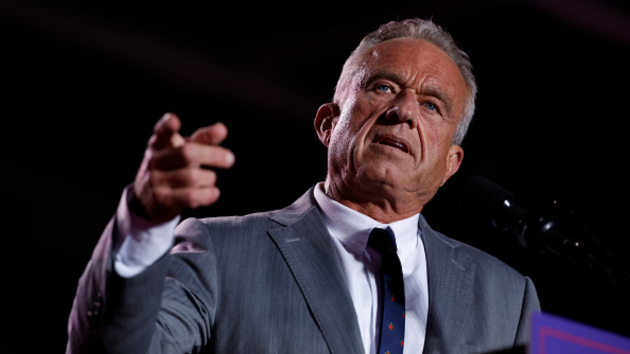
(WASHINGTON) — Ever since Robert F. Kennedy Jr. was picked by President-elect Donald Trump to lead the Department of Health and Human Services, he has been vocal about his plans to “Make America Healthy Again.”
Kennedy has vowed to crack down on dyes in the food industry and to reduce pesticides in the farm and agriculture industry.
He has called for restrictions on ultra-processed foods as part of an initiative to address the high rates of chronic disease in the United States, and he’s said more research needs to be conducted on vaccines.
Those plans could require him to override regulations set in place by the Food and Drug Administration or Centers of Disease Control and Prevention, and/or perhaps see new regulations put in place.
Political science experts say this may put him at odds with members of his own party, because Republicans typically advocate for fewer regulations and limited government oversight.
“I think where you would see the challenges would be on allocation of money,” Shana Gadarian, a professor of political science at the Maxwell School of Citizenship and Public Affairs at Syracuse University in New York, told ABC News.
“If all of a sudden HHS is now in the business of passing more regulations on the food industry, on agriculture, we might see that a Republican Senate majority and a Republican House is less interested in allocating a budget to HHS that then would be under a different leadership,” she continued.
Praise from other Republicans
Despite Republican criticism of previous Democratic initiatives to tackle disease and childhood obesity, Kennedy has received praise from some Republicans.
“RFK Jr. has championed issues like healthy foods and the need for greater transparency in our public health infrastructure,” Sen. Bill Cassidy, a Republican from Louisiana, said in a statement earlier this month. “I look forward to learning more about his other policy positions and how they will support a conservative, pro-American agenda.”
Sen. Ron Johnson of Wisconsin called Kennedy a “brilliant, courageous truth-teller whose unwavering commitment to transparency will make America a healthier nation,” and Sen. Josh Hawley called Trump’s decision to name him to head the HHS a “Bad day for Big Pharma!”
However, Gadarian said the support from some Republicans in the Senate may not translate to support among Republican constituents.
“We may want to separate what average people think about and know about [what Kennedy wants] and what elites in the party might have a vested interest in,” Gadarian said.
For farmers and others whose bottom lines might be negatively impacted by some of Kennedy’s proposed top-down policies, she said, “Those ideas of, like, removing pesticides from agriculture may actually be quite unpopular.”
Republicans’ distaste for regulation
Historically, the Republican party has been ideologically associated with a smaller, limited federal government.
During his January 1981 inaugural address, President Ronald Reagan stated, “Government is not the solution to our problem; government is the problem,” espousing the belief that the government should not intervene in American lives.
If Kennedy is confirmed, there may be some culling of regulations, such as the CDC decision on vaccines health insurers are required to cover, according to Gadarian.
But his confirmation may also lead to new regulations; for example, he might weigh in on which food dyes companies are allowed to use or the use of pesticides on farms.
While it isn’t yet fully clear how Kennedy could make all of his proposed changes directly through his leadership at HHS, as opposed to the Environmental Protection Agency or Department of Agriculture, he has called for restrictions on food additives, dyes and ultra-processed foods — which he could have direct influence over through the FDA.
Gadarian said this is not in line with the typical conservative view on regulations, which is to generally loosen them.
“I do think that increasing regulation on businesses like agriculture and others who use pesticides — or on the food industry — is, in fact, against a kind of idea of limited government, of loosening regulation so businesses can do business and not be encumbered by the federal government,” she said.
Robert Ravens-Seager, a professor of history and political science at American International College in Massachusetts, said he thinks the idea of Republicans being for “small” or “limited government” is a myth.
He said both Republicans and Democrats want government regulation, but they have different views on how it should be implemented.
“Once you are in the government, your dislike for government tends to diminish somewhat,” he told ABC News. “I think that in a very short amount of time, you’ve seen a change in the Republican party. They’ve changed from being a party of small government [and] I think that the government that’s going to be coming will be very heavy-handed.”
He added that he believes Kennedy could have an impact on the messaging around food and/or agriculture by advocating for consumers to buy what he says is safe and healthy. However, Ravens-Seager is not sure to what degree the impact will be.
“I definitely believe that he will have an impact on things like food additives, food safety, and the like,” Ravens-Seager said. “The food side, especially, goes against Republican orthodoxy and could make for some interesting debates, but the degree to which, on this issue in particular, he will find much support within the party seems doubtful.”
Sen. Chuck Grassley, a Republican from Iowa, said last month he wanted to meet with Kennedy before a confirmation hearing and “educate” him about agriculture, indicating concerns about views Kennedy has expressed.
“I’m willing to have a discussion with him and find out where he’s coming from,” Grassley told reporters, according to Politico. “But I may have to spend a lot of time educating him about agriculture, and I’m willing to do that.”
Eitan Hersh, a professor of political science at Tufts University in Massachusetts, said it’s important to remember that many steps need to occur before new regulations are put in place, including Kennedy being confirmed by the Senate, new regulations being proposed and approved, potential discussion in Congress and enforcement of those regulations.
“This is all maybes, but I think that the signaling happening with putting RFK in HHS is showing some sense of priorities, and I think those priorities are not favoring, necessarily, the interest of business and protecting them from regulation,” he told ABC News.
ABC News’ Cheyenne Haslett contributed to this report.
(LONDON) — The hunt is on to find three climbers who disappeared while trying to get to the top of New Zealand’s tallest mountain, authorities said.
The three men — 56-year-old Kurt Blair and 50-year-old Carlos Romero from the United States, along with one Canadian national — were visiting New Zealand and were reported overdue from their planned ascent of Aoraki Mount Cook on Monday morning, said inspector Vicki Walker, the Aoraki Area Commander, in a statement.
“The men flew into Plateau Hut at 3.30pm on Saturday 30 November, planning to summit Aoraki Mt Cook via Zurbriggen Ridge,” officials said. “They were due to meet their flight out at 8.30am on 2 December but did not arrive for the flight and were subsequently reported overdue.”
Aoraki Mt Cook is listed as 12,218 feet tall and sits in the Southern Alps, the mountain range that runs the length of New Zealand’s South Island.
A search was initiated on Monday and brought in teams from the Department of Conservation Search and Rescue Team, The Helicopter Line and local area police.
Several climbing-related items were located during the search and they are believed to belong to the three missing men, authorities said.
The search for three climbers was not able to resume on Wednesday due to adverse weather conditions on the mountain, officials confirmed.
“Weather conditions are likely to prevent any further search activity until Thursday this week, however Police will continue to monitor and assess the conditions,” authorities said.
Police have been working with the U.S. and Canadian embassies to inform and support the families of the three men.
“Further information regarding the third man will not be provided until we can be sure that all necessary family notifications have been carried out,” authorities continued.
The investigation into the missing men is currently ongoing.
(LOS ANGELES) — Hannah Kobayashi, a Hawaiian woman who has been missing for weeks, walked freely into Mexico just after noon on Nov. 12, the Los Angeles Police Department said on Monday.
The department said the case has been recategorized as a “voluntary missing persons” one and has been closed. Detectives said they believe she wanted to disappear.
The update comes after weeks of claims from family and friends that Kobayashi had been kidnapped and was in danger after she disappeared before boarding her connecting at Los Angeles International Airport in early November. She was heading from Hawaii to New York.
Kobayashi, 30, used her passport to buy a train ticket from L.A.’s Union Station to the San Ysidro point of entry, and from there walked into Mexico alone and with her luggage, police said.
Despite claims to the contrary from family, the LAPD said their evidence appeared to show that Kobayashi voluntarily did not board her flight to New York, that she had her airline give her bags to her in L.A. and that she roamed around L.A. before voluntarily heading to Mexico.
She also expressed a desire to disconnect from modern technology before she went off grid, police said on Monday. Detectives traveled to the border to look at surveillance video, which they said showed the woman crossing the border.
Kobayashi’s father, Ryan Kobayashi, died last month at a parking garage near LAX, after traveling to California from Hawaii to search for his daughter, according to the L.A. County Medical Examiner’s office.
LAPD authorities asked that Kobayashi contact her family from Mexico to let them she is OK. The department said it would try to contact Kobayashi if Customs and Border Protection alert the force that the Hawaiian native has reentered the United States.
State Emergency Service of Ukraine/Anadolu via Getty Images
LONDON — Ukraine’s air force said it shot down 22 of 28 Russian drones in Moscow’s latest overnight barrage, though acknowledged “several hits on critical infrastructure facilities” in the west of the country.
The air force said it also shot down three Russian Kh-59/69 cruise missiles fired at the central city of Kryvyi Rih.
Only three drones were unaccounted from the latest wave, the air force wrote on Telegram, one having been lost in flight due to jamming and two having left Ukrainian airspace.
The force reported “several hits” on targets in the western Ternopil and Rivne regions.
Oleksandr Koval, the head of the Rivne military administration, said on Telegram that the Russian attack targeted “an energy infrastructure facility.”
“All appropriate services are working at the scene,” Koval said, adding there were no reported casualties.
In Ternopil, military administration head Vyacheslav Nehoda said a drone hit an industrial facility causing a fire. “The fire was localized” and put out, Nehoda wrote in a Facebook update.
There were no casualties, Nehoda added, but “there were again problems with electricity supply for some subscribers.”
Russia’s Defense Ministry reported the overnight downing of one Ukrainian drone over the Bryansk region and one over the Belgorod region.
Russia’s long-range strike campaign appears set to continue through the winter in a bid to collapse Ukraine’s energy grid and exacerbate the war’s strain on the national economy.
President-elect Donald Trump’s November election victory has revived talk of peace negotiations after nearly three years of full-scale war. Both Moscow and Kyiv are maneuvering for leverage ahead of any potential negotiations.
Ukrainian President Volodymyr Zelenskyy hinted at the necessity for talks this week, telling Kyodo News that his nation must find “diplomatic solutions” to liberate territory occupied by Moscow since 2014, acknowledging that Kyiv’s “army lacks the strength to do that.”
But Zelenskyy suggested any talks — and any concessions — must be twinned with guaranteed protection from Western partners. An “invitation for Ukraine to join NATO is a necessary thing for our survival,” the president said following talks with European Union leaders in Kyiv on Sunday.
While diplomatic positioning continues, Zelenskyy is pushing allies to provide more weapons — particularly air defenses. German Chancellor Olaf Scholz visited Kyiv on Monday, pledging another $680 million worth of arms for Ukraine.
The U.S. also announced a fresh tranche of military aid on Monday valued at $750 million. The State Department said the “urgently needed” weapons included Stinger air defense missiles, HIMARS ammunition, artillery ammunition and a variety of anti-tank weapons.
(WASHINGTON) — A Republican president-elect pledges support for expansive tariffs as a means of protecting U.S. businesses and hamstringing global competitors.
That description may conjure up former President Donald Trump, but it also applies to Herbert Hoover, who led the country nearly a century ago during the onset of the Great Depression.
Within months of the stock market crash, Hoover signed into law the Smoot-Hawley Tariff Act, a 1930 measure that increased tariffs for a broad swathe of imported goods. In response, several countries imposed retaliatory tariffs and trade plummeted. Many economists view the measure as a factor that exacerbated the nation’s economic downturn.
“A whole generation of Republicans and Democrats after World War II was very much conditioned against tariff hikes because of the experience of the 1930s. Now we have a new generation of leaders who are much more willing to pull the trigger on higher tariffs,” Douglas Irwin, a professor of economics at Dartmouth College and author of “Peddling Protectionism: Smoot-Hawley and the Great Depression,” told ABC News.
Here’s what to know about the Smoot-Hawley Tariff Act, its economic impact, and what its legacy means for tariffs promised by Trump, according to experts.
What is the Smoot-Hawley Tariff Act?
The Smoot-Hawley Tariff Act arrived at a moment of economic crisis.
As the stock market wobbled and financial panic took hold, Congress negotiated a set of tariff increases that initially aimed to protect U.S. farmers from foreign competition but ultimately extended to a wide range of manufactured goods.
The measure is named after its key supporters in Congress: Republican Sen. Reed Smoot of Utah and Republican Rep. Willis Hawley of Oregon. It passed the Senate by a narrow margin of 44 to 42, and sailed through the House of Representatives by a vote of 264 to 147. Hoover signed Smoot-Hawley into law in June 1930.
For products already facing tariffs, the law, on average, raised the import tax from 40% to nearly 60%, making for an increase of roughly 20 percentage points, Kris Mitchener, a professor of economics at Santa Clara University who studies Smoot-Hawley, told ABC News. It also significantly expanded the number of goods subject to a tariff, he added.
“It culminated in a more or less complete rewrite of the tariff schedule,” Mitchener said, referring to the nation’s tariff code.
What happened after Smoot-Hawley took effect, and did it cause the Great Depression?
The Smoot-Hawley tariffs set off a near-immediate trade war, in which several foreign nations responded to tariffs by slapping U.S. imports with taxes of their own.
For instance, Canada placed tariffs on 16 products that accounted for roughly a third of U.S. exports, according to a working paper co-authored by Mitchener in 2021. France and Spain both slapped taxes on imported American automobiles, a major U.S. industry.
“America’s trade partners responded by targeting U.S. exports,” Mitchener said. “The most important declines were in the products that were targeted.”
As a result, trading partners suffered reduced output, but so did the United States, Michener said.
The trade slowdown weakened the economy and exacerbated the nation’s economic downturn, experts said. However, the Great Depression had taken hold before the effects of Smoot-Hawley, ruling it out as a cause of the crisis, they added.
“Smoot-Hawley impacted the U.S. economy at a vulnerable moment,” Irwin said.
What could the legacy of Smoot-Hawley mean for Trump’s tariff proposals?
Smoot-Hawley cast a shadow over tariff policy for decades, Irwin said. “It gave tariffs a bad name,” he added.
For decades, prominent members of both major parties focused on the risks posed by tariffs, occasionally citing Smoot-Hawley, Irwin said.
“The Smoot-Hawley tariff ignited an international trade war and helped sink our country into the Great Depression,” then-president Ronald Reagan said during a radio address in 1986.
The measure also played a key role in shifting tariff authority from Congress toward the executive branch, since lawmakers sought a speedy way to roll back the tariffs, experts said.
In 1934, the Reciprocal Tariffs Act gave the president the power to increase or reduce tariff levels by up to 50%. A series of subsequent laws helped shift additional tariff authority to the president.
“Now, Congress doesn’t have much to do with setting tariffs,” Irwin said.
On the campaign trail, Trump said he could enact tariffs without support from Congress. He is largely accurate in his description of the wide latitude enjoyed by the president in setting and implementing some tariffs, experts previously told ABC News.
“Trump is using the delegated powers to pass tariffs,” Irwin said. “That’s completing the circle of Smoot-Hawley in some sense.”
(NEW YORK) — Texas has the potential to become a major producer of green hydrogen due to its existing energy infrastructure, according to researchers.
That infrastructure is making Texas a “valuable case study” in decarbonizing states that currently produce a high volume of fossil fuels, a study published Monday in the Proceedings of the National Academy of Sciences found.
The Lone Star State already has an operational infrastructure for green hydrogen – a clean energy source made through electrolysis, a process that involves splitting water molecules into hydrogen and oxygen without producing harmful carbon emissions – according to Michael McElroy, a professor of environmental studies at Harvard University and author of the study. Green hydrogen has the potential to decarbonize up to 25% of global energy-related carbon dioxide emissions, according to the U.S. Department of Energy.
“Hydrogen itself could be a really important component to a green transition,” Jessika Trancik, a professor of energy systems for the Massachusetts Institute of Technology who was not involved with the study, told ABC News.
In addition, Texas has an established demand for hydrogen and already has ample renewable electricity resources, the PNAS study found. For example, Texas is the highest producer of wind power in the U.S., generating 26% of the country’s wind-sourced energy, according to state officials. It also has ample solar resources, according to Trancik.
“Texas is very well situated in terms of its renewable resources,” Trancik said, adding that they’re “very extensive and high quality” and include an existing infrastructure that could easily also incorporate green hydrogen production.
Upon winning the 2020 presidential election, President Joe Biden vowed to make green hydrogen more accessible as part of his clean energy plan, promising that the U.S. would be able to access green hydrogen at the same cost as conventional hydrogen within a decade.
By 2030, Texas could produce more than 50 million tons of green hydrogen at a cost at about $1.50 per kilogram, the PNAS study found. That low production cost will result from integrating the water electrolysis process with the existing renewable electricity grid, according to the study, and will also enhance grid reliability and “significantly” influence decarbonization in the state.
It would also position Texas to become a major supplier of green hydrogen for both domestic and international needs, the PNAS study found. Hydrogen demand is expected to “grow at a moderate, steady pace” over the next six years and then accelerate significantly, according to PricewaterhouseCoopers.
Additionally, the cost of producing hydrogen from renewable electricity could fall 30% by 2030 due to the declining costs of renewables and the upscaling of hydrogen production, according to the International Energy Agency.
Green hydrogen is forecast to meet global energy needs that will not be easily satisfied by battery, wind or solar power, Gregory Nemet, professor of public affairs at the University of Wisconsin’s Energy Institute, told ABC News in 2021. Batteries, for example, currently can take up a lot of space and also weigh a lot, making their use an issue for air travel and long-haul trucking. Hydrogen, by contrast, doesn’t include those challenges and also stores better long-term.
In addition, the infrastructure to transport green hydrogen – which needs to pressurized – is already in place, whether it be through pipelines, shipping or trucking, Nemet said. In Texas, a lot of the required infrastructure that will next be built will be for storage, Trancik said.
Hydrogen City, an integrated green hydrogen production hub located in southern Texas near the Port of Corpus Christi, is already producing about 280,000 metric tons of green hydrogen per year. But green hydrogen alone won’t be enough to meet anticipated future green energy demands, according to Trancik.
It will take “different clusters or combinations of technologies” to combat climate change on all fronts, which is where energies like green hydrogen and nuclear come in, Trancik said. “There’s a lot of efforts to try to grow that industry and take it in new, innovative directions.”