Police officers investigate the scene where UnitedHealthcare CEO Brian Thompson was shot/Photo credit: Kyle Mazza/Anadolu via Getty Images
(NEW YORK) — Police appear to be closing in on an identity of the man suspected of gunning down UnitedHealthcare CEO Brian Thompson in Midtown Manhattan, sources told ABC News on Thursday.
Police have sought a search warrant for a location in New York City where they believe the suspect may have been staying, sources said.
The masked gunman shot Thompson several times at close range on Wednesday morning outside a Hilton Hotel where he was attending a conference.
(NEW YORK) — The “brazen, targeted attack” was “premeditated,” NYPD Commissioner Jessica Tisch said. The motive remains unknown, police said.
Detectives believe the gunman is not a professional killer, sources said. Bullet casings found at the scene had the words “deny,” “defend” and “depose” written on them, police sources said.
Thompson, 50, was in New York City for the UnitedHealthcare investors conference, which was scheduled to start at 8 a.m. His schedule was widely known, police sources said.
The suspect — who was caught on surveillance cameras before, during and immediately after the shooting — had been lying in wait near the hotel.
Thompson was shot at about 6:40 a.m. After the shooting, the shooter fled on foot into an alley, where a phone believed to be linked to the suspect was later recovered, police sources said.
The suspect then fled on a bike and he was last seen riding into Central Park at 6:48 a.m., police said.
The shooter was caught on surveillance video at 5 a.m. the morning of the shooting outside Frederick Douglass Houses, a public housing project on the Upper West Side, sources told ABC News. That footage showed the suspect carrying what appeared to be an e-bike battery.
Police have recovered a water bottle and candy wrapper from the scene of the shooting which they believe are linked to the gunman. Fingerprint and DNA tests on the items are ongoing, law enforcement sources told ABC News.
Thompson’s wife, Paulette Thompson, said in a statement that she was “shattered” by the “senseless killing.”
“Brian was an incredibly loving, generous, talented man who truly lived life to the fullest and touched so many lives,” she said. “Most importantly, Brian was an incredibly loving father to our two sons and will be greatly missed.”
Police urge the public to call Crime Stoppers at 1-800-577-TIPS with any information.
ABC News’ Mark Crudele and Josh Margolin contributed to this report.
(LONDON) — Syrian state media said Thursday that government forces were withdrawing from the city of Hama in the face of a rebel advance, marking another major setback for President Bashar al-Assad and his backers in Russia and Iran.
The Syrian Arab News Agency said government forces withdrew to positions outside the central Syrian city. The report came hours after opposition fighters — led by the Hayat Tahrir al-Sham group — claimed to have entered the city and struck towards its center.
Hama is Syria’s fourth largest city. It sits between the capital Damascus to the south and Aleppo — Syria’s second city — to the north. Aleppo fell to the lightning rebel offensive on Nov. 29. Hama was one of the few major cities that did not fall to anti-government forces following the 2011 revolution against Assad’s rule.
The Syrian army said its troops withdrew after rebel fighters broke through government defenses in Hama. The army accused the opposition groups of using suicide attacks to breach government lines.
The army’s General Command said the withdrawal was ordered to “preserve civilian lives” by avoiding fighting inside the city, SANA reported.
This is a developing story. Please check back for updates.
ABC News’ Someyah Malekian contributed to this report.
Yan Dobronosov/Global Images Ukraine via Getty Images
(LONDON) — Ukrainian President Volodymyr Zelenskyy on Thursday announced sanctions on 19 members of the Georgian government, who he accused of “surrendering” the country to Russian control.
Zelenskyy’s announcement came after seven nights of massive anti-government protests in the small South Caucasus nation, bordered by Russia to the north and Turkey to the southeast. Pro-Western demonstrators accuse the Georgian Dream government of rigging October’s parliamentary elections with Russian backing.
The protests began last week after Prime Minister Irakli Kobakhidze announced that Georgia would suspend European Union membership talks. The country’s long-held ambition to join the bloc is widely popular among Georgians across the political spectrum and is enshrined in the national constitution.
“These sanctions target the part of the Georgian government that is surrendering Georgia to Putin,” Zelenskyy wrote on Telegram.
Among those sanctioned are Kobakhidze and billionaire Bidzina Ivanishvili — the founder and chairman of Georgia Dream, who is widely considered the real power behind the party. Ivanishvili, who is Georgia’s richest person, made his fortune in Russia.
“This is how it works in international affairs: if you do not respond in time or fail to respond with principle, then decades are lost, and countries are robbed of their freedom,” Zelenskyy wrote.
“We must not lose anyone in this region — neither Georgia, nor Moldova, nor Ukraine,” he added. “We must stand united in defending ourselves against Moscow.”
Zelenskyy also urged “Europe, America and everyone in the world to do the same — to act with principle.”
Major protests continued in the Georgian capital Tbilisi on Wednesday night despite violent clashes with security forces and mass arrests. Protesters again gathered outside the parliament building on the main Rustaveli Avenue thoroughfare, launching fireworks at the building and at police lines.
Police, meanwhile, continued to use tear gas and water cannons against demonstrators. Security forces wielding clubs sporadically charged protesters to force back crowds and make arrests.
Police also detained opposition leaders away from the protests. The Coalition for Change opposition party said Wednesday that police raided its offices and detained leader Nika Gvaramia. The party published a video showing several officers dragging Gvaramia into a car.
Kobakhidze said of anti-opposition raids, “I wouldn’t call this repression; it is more of a preventive measure than repression.”
The prime minister accused opposition leaders of “systematically” supplying “pyrotechnics” to protesters. “This is absolutely clear,” he said.
Opposition leaders — among them President Salome Zourabichvili — have vowed to continue their protests. Zourabichvili said she would not leave office when her term expires later this month. The president said she would not take instruction from the new parliament formed after the disputed October elections, which she said is illegitimate.
The opposition wants the Georgian Dream government to step down. Leaders hope the protest movement can snowball into a general strike.
Zourabichvili on Thursday thanked Zelenskyy for the sanctions. “I could not say it better,” the president wrote in a post to X. “Russia is trying to get back the control over the Black Sea.”
Georgian opposition leaders have long called on the West to be more assertive in supporting their EU and NATO membership ambitions — and in curtailing Russian influence in the country. Russia occupies around 20% of Georgia via local separatist client states, a situation cemented by Moscow’s victory in the 2008 Russo-Georgian war.
The U.S. State Department this week condemned what it said was “excessive use of force by police against Georgians” and announced it would suspend the U.S.-Georgia Strategic Partnership due to “anti-democratic actions” by the Georgian Dream government.
“We reiterate our call to the Georgian government to return to its Euro-Atlantic path, transparently investigate all parliamentary election irregularities, and repeal anti-democratic laws that limit freedoms of assembly and expression,” spokesperson Matthew Miller said.
The EU’s new foreign policy chief, Kaja Kallas, said the bloc stands “with the Georgian people and their choice for a European future.”
“We condemn the violence against protesters and regret signals from ruling party not to pursue Georgia’s path to EU and democratic backsliding of the country,” Kallas wrote in a post to X. “This will have direct consequences from EU side.”
Russian officials have denied any active support of Georgian Dream, while also threatening consequences for the country if it continues its Westward geopolitical pivot.
Kremlin spokesperson Dmitry Peskov told journalists Monday that Russia “has not interfered and does not intend to interfere” in events, saying the government in Tbilisi was merely taking necessary steps to restore order.
Dmitry Medvedev — formerly Russia’s president and prime minister, now serving as the deputy chair of Russia’s Security Council — wrote on Telegram that Georgia was “moving rapidly along the Ukrainian path, into the dark abyss.”
Medvedev — who has become known for his hawkish foreign policy rhetoric — framed the protests as an attempted “revolution,” which he said would end “very badly.”
(WASHINGTON) — Since becoming President-elect Donald Trump’s choice for director of national intelligence, Tulsi Gabbard’s rosy posture toward Moscow has prompted some Democratic critics to suggest that she could be “compromised,” or perhaps even a “Russian asset” — claims the ex-Hawaii representative and Army officer has forcefully denied.
But former advisers to Gabbard suggest that her views on Russia and its polarizing leader, Vladimir Putin, have been shaped not by some covert intelligence recruitment as far as they know — but instead by her unorthodox media consumption habits.
Three former aides said Gabbard, who left the Democratic Party in 2022, regularly read and shared articles from the Russian news site RT — formerly known as Russia Today — which the U.S. intelligence community characterized in 2017 as “the Kremlin’s principal international propaganda outlet.”
While it was not clear to those former staffers whether or when she stopped frequenting the site, one former aide said Gabbard continued to circulate articles from RT “long after” she was advised that the outlet was not a credible source of information.
Doug London, a retired 34-year veteran intelligence officer, said Gabbard’s alleged penchant to rely at least in part on outlets like RT to shape her view of the world reflects poorly on her suitability to fulfill the responsibilities of a director of national intelligence.
“That Gabbard’s views mirror Russia’s narrative and disinformation themes can but suggest naïveté, collusion, or politically opportunistic sycophancy to echo whatever she believes Trump wants to hear,” London said, adding, “none of which bodes well for the president’s principal intelligence adviser responsible for enabling the [U.S. intelligence community] to inform decision-making by telling it like it is.”
Alexa Henning, a spokesperson for the Trump transition team, said in a statement to ABC News that “this is false and nothing but a few former, conveniently anonymous, disgruntled staffers.”
“Lt. Col. Gabbard’s views on foreign policy have been shaped by her military service and multiple deployments to war zones where she’s seen the cost of war and who ultimately pays the price,” Henning said.
‘The Russian playbook’
Former congressional and campaign advisers said it was unclear to what extent Gabbard’s views were shaped by what she read in RT — and they emphasized that she would consume news from a wide range of outlets, including left-wing and right-wing blogs.
But over the past decade, Gabbard’s views on Russian aggression in Europe have evolved in a particularly dramatic fashion.
In 2014, when Russian troops annexed Crimea, Gabbard — then a first-term Democratic U.S. representative from Hawaii — released a statement advocating for “meaningful American military assistance for Ukrainian forces” and for the U.S. to invoke “stiffer, more painful economic sanctions for Russia.”
“The consequences of standing idly by while Russia continues to degrade the territorial integrity of Ukraine are clear,” she wrote at the time. “We have to act in a way that takes seriously the threat of Russian aggression against its peaceful, sovereign neighbor.”
By 2017, however, her tune had changed. In a lengthy memo to campaign staff laying out her views on foreign policy, a copy of which was obtained by ABC News, Gabbard blamed the U.S. and NATO for provoking Russian aggression and bemoaned the United States’ “hostility toward Putin.”
“There certainly isn’t any guarantee to Putin that we won’t try to overthrow Russia’s government,” she wrote in the memo from May 2017, titled “fodder for fundraising emails / social media.”
“In fact, I’m pretty sure there are American politicians who would love to do that,” she wrote.
She also condemned the very sanctions she had previously supported, writing that, “historically, the U.S. has always wanted Russia to be a poor country.”
“It’s a matter of respect,” she wrote. “The Russian people are a proud people and they don’t want the U.S. and our allies trying to control them and their government.”
Gabbard’s sentiment in the 2017 memo is “basically the Russian playbook,” said Ivo Daalder, a former U.S. ambassador to NATO during the Obama administration.
“It’s dangerous,” said Daalder. “That strain of thinking is not unique to Tulsi Gabbard, but it is certainly not where you would think a major figure in any administration would like to be, intellectually.”
By 2022, at the outset of the latest Russia-Ukraine conflict, Gabbard suggested on X that Russia’s invasion was justified by Ukraine’s potential bid to join NATO, “which would mean US/NATO forces right on Russia’s border” — a narrative perpetuated by Russian propaganda channels, including RT, and denounced by the U.S. and NATO as “false.”
Gabbard’s messaging has at times aligned so closely with Kremlin talking points that at least one commentator on Kremlin state media has referred to her as “Russia’s girlfriend.”
A ‘nefarious effort’
The U.S. government first called out RT as a propaganda mouthpiece for the Kremlin in the wake of the 2016 presidential election, three years after Gabbard was elected to Congress.
This past September, the State Department wrote that it had evidence that “RT moved beyond being simply a media outlet and has been an entity with cyber capabilities.” The U.S. also issued fresh sanctions against executives at RT, including its editor-in-chief, who the U.S. accused of engaging in a “nefarious effort to covertly recruit unwitting American influencers in support of their malign influence campaign.”
The Justice Department also indicted two RT employees in September for their alleged role in what the DOJ called a scheme to pay right-wing social media influencers nearly $10 million to “disseminate content deemed favorable to the Russian government.”
In the decade since Gabbard arrived in Washington, experts say she has regularly promoted views consistent with those espoused in RT and other Russian propaganda channels.
In its 2017 assessment, for example, the U.S. intelligence community wrote that RT “has actively collaborated with WikiLeaks” and “routinely gives [WikiLeaks founder Julian] Assange sympathetic coverage and provides him a platform to denounce the United States.”
Gabbard has long been an outspoken supporter of Assange, arguing in a June 2024 appearance on “Real Time with Bill Maher” that “[Assange’s] prosecution, the charges against him, are one of the biggest attacks on freedom of the press, that we’ve seen, and freedom of speech.”
In Congress, Gabbard also co-sponsored a resolution calling on the federal government to “drop all charges against Edward Snowden,” the former contractor for the National Security Agency who supplied WikiLeaks with secret documents in order to expose what he called “horrifying” U.S. government surveillance capabilities.
RT frequently reports glowingly on Snowden, who has for more than a decade lived under asylum in Russia.
‘Undeniable facts’
But it is Gabbard’s framing of the Russian invasion of Ukraine that has most galvanized her critics in the national security sphere.
In March 2022, Gabbard posted a video to Twitter — now X — sharing what she said were “undeniable facts” about U.S.-funded biolabs in the war-torn country, claiming that “even in the best of circumstances” they “could easily be compromised” — a debunked theory regularly promoted by RT and other Kremlin propaganda channels.
Experts say RT and other Russian state-controlled news agencies have frequently capitalized on Gabbard’s public comments to support the biolab conspiracy theory and other disinformation, recirculating clips in which she repeats the Kremlin propaganda as evidence backing the false claims — effectively engineering an echo-chamber to magnify their propaganda machine.
Even so, Brian O’Neill, a former senior intelligence official with experience in senior policymaker briefing, expressed confidence that career intelligence officials can support Gabbard with “a constant barrage of new information” that will help shape her understanding of emerging world events.
“New appointees in such roles always bring preconceptions, but like her predecessors, she will be subject to comprehensive briefings grounded in solid evidence provided by individuals of high integrity and expertise,” O’Neill said.
“That said,” O’Neill cautioned, “Trump’s well-documented hostility and skepticism toward the [intelligence community] will shape the environment she steps into. If she adopts a similar posture, there’s a risk she might deprioritize intelligence community input or dismiss inconvenient truths presented to her.”
ABC News’ Shannon Kingston contributed to this report.
Russian President Vladimir Putin meets with Belarusian President Alexander Lukashenko at the Kremlin in Moscow on April 5, 2023. (Photo by PAVEL BYRKIN/SPUTNIK/AFP via Getty Images)
(LONDON) — “Europe’s last dictator” — as Belarusian President Alexander Lukashenko has often been termed — thus far appears to have kept his nation out of the worst of the spiralling war engulfing his neighbors to the east and south.
The 70-year-old provided invaluable material and political support for Russian ally President Vladimir Putin in his war on Ukraine, even offering Belarus as a launchpad for the doomed Russian drive towards Kyiv in the early stages of the full-scale invasion.
Since then, Russian forces have used Belarusian territory to launch ballistic missiles into Ukraine. Belarus houses bases at which Russian troops train for battle and hospitals where they recover.
Minsk even now hosts Russian nuclear warheads and Lukashenko brokered the short-lived settlement between the Kremlin and Wagner financier Yevgeny Prigozhin after the latter’s ill-fated 2023 mutiny.
As the war in Ukraine escalated and the enmity between Moscow and its Western rivals deepened, Lukashenko’s apparent hesitance to fully commit to the conflict seems to have bought him some level of freedom from retaliation.
But with Moscow’s drone and missile barrages into Ukraine growing in scale and regularity, Belarusian opposition groups say the danger to their country is increasing.
The Belarusian Hajun Project — an open-source intelligence group banned as an “extremist” organization by Minsk — said a record-high total of 151 drones entered Belarus during November. At least three were shot down by Belarusian air defenses, it added.
One Russian attack in late November saw a record 38 strike drones cross into Belarus, the group said. ABC News could not independently verify the drone flights.
Neither the Belarusian Defense Ministry nor Foreign Ministry replied to ABC News’ requests for comment.
Russian drones were first reported over Belarus in mid-July, their appearance then relatively sporadic. In October, the Hajun Project said it tracked a total of 49 Russian drones flying into Belarusian airspace across the month. The monthly total trebled by the end of November.
At least one drone landed and exploded in the southeastern Gomel Oblast, according to Ukrainian and opposition Belarusian media reports.
According to Ukrainian air force after-action reports, Russian drones enter Belarus near-nightly. The air force has noted that its evolving electronic warfare countermeasures play some role in the increasing number of Russian strike drones going off course.
Minsk has complained of Ukrainian drones violating its airspace. In July, Lukashenko himself demanded that Kyiv ensure “comprehensive measures be taken to rule out any such future incidents in the future which could lead to further escalation of the situation in the region.”
In September, Belarus’ military said it had downed foreign drones.
Chief of the General Staff Col. Sergei Frolov said drones were shot down without specifying their nation of origin. “Timely actions by the air defense forces on duty destroyed all the violators’ targets,” he said in a statement quoted by the state-run Belta news agency.
Jonathan Eyal of the Royal United Services Institute think tank in the U.K., told ABC News that Lukashenko “has always been very careful to calibrate the policy in a way that allows implausible deniability of any involvement in the Ukraine war — and at the same time makes himself useful to the Russians.”
“He also knows that most of the Belarusian population has no interest in being dragged into the war at all,” Eyal added, describing a “balancing act” in which the Belarusian leader has to at least pretend to be defending the nation’s airspace.
“It’s not a great secret that the Russians can do more or less what they want with Belarusian airspace,” Eyal added. “The idea that somehow the Belarusian military is determined to defend its sovereignty is a bit far-fetched.”
“These are very calibrated messages from Lukashenko trying to persuade people — both at home and overseas — that somehow he remains a complete master of his own destiny,” Eyal said.
For Belarus’ pro-Western opposition — many now living in exile following Lukashenko’s crackdown on the mass protests that followed the 2020 presidential election — the drone flights are a sign of Minsk’s weakness.
Franak Viacorka, the chief political adviser to Belarusian opposition leader-in-exile Sviatlana Tsikhanouskaya, told ABC News that drones “are flying over Belarus practically every single night.” An average week sees 40 or 50 UAVs transit border areas, he said.
Viacorka said Lukashenko’s government is working hard to hide any evidence of errant Russian munitions. “It’s very uncomfortable for them to say that the Russians are using our airspace,” he said. “It happens with the agreement of Lukashenko, or perhaps Russia doesn’t even ask Lukashenko for permission.”
Aliaksandr Azarau — a former police investigator who defected and now leads the opposition BYPOL group made up of former Belarusian security employees — said government propaganda seeks to hide the problem while framing all intruding drones as Ukrainian.
“The concern is only for the people who see these drones above their heads near the Ukrainian border,” Azaru said. “The rest of Belarusians don’t think about the drones — it’s not their problem.”
Official Belarusian reports of drones being intercepted, he added, are part of “a political game.” Azaru even claimed that Belarusian military aircraft have held fire and flown alongside Russian drones, effectively escorting them into Ukrainian airspace
When a drone does fall on Belarusian territory, Viacorka said, “the place is cleared immediately” and any witnesses are pressed by security services not to reveal any details.
The issue, he added, is politically sensitive for Lukashenko. “His narrative is that, thanks to him, Belarus has not gotten involved in war,” Viacorka said. “But when people see drones and shells flying over their territory, they see that Belarus is already involved in war.”
“It’s very worrying that Belarus is getting more and more involved,” Viacorka said.
Lukashenko and his Russian allies, he added, are “putting more and more people in Belarus in danger.”
Russia’s access to Belarusian airspace may also pose a threat to eastern NATO nations, three of whom — Poland, Lithuania and Latvia — border the country.
Russian freedom to act throughout Belarusian airspace has “many implications” for regional NATO states, Eyal suggested, as well as for western Ukrainian regions that will be more accessible for Moscow’s Shaheds.
In September, Latvia’s Defense Ministry reported that a Russian strike UAV crashed in the Rezekne region in the east of the country after flying across Belarus.
Since then, “improvements in all levels of Latvian airspace surveillance have been made, as well as in decision-making and information exchange algorithms,” a ministry spokesperson told ABC News. This includes the deployment of mobile air defense battle groups to the eastern Latgale border region, they said.
The procedures for NATO’s Baltic air policing mission “have also been clarified, allowing allied fighters to destroy aggressor drones entering Latvian airspace if necessary,” the spokesperson added.
“Russia has control over Belarusian foreign and domestic policies,” they continued. “Belarus is an additional Russian military district, so the threat coming from Belarus is orchestrated by Russia. Unfortunately, it is not up to Belarus and its citizens to decide how Russia uses Belarusian airspace to achieve its aggressive foreign policy goals.”
“Hybrid warfare is already happening between Russia and the West,” the ministry spokesperson said. “Belarus is just a tool for Russian aggressive foreign policy. In the short term, Russia will continue to use a wide range of hybrid warfare tools to weaken Western countries and divide their unity.”
“The Belarusian regime’s hybrid attack on the Latvian border with artificial migration demonstrates that we must prepare for all possible scenarios including violation of our airspace,” they said.
(NEW YORK) — The price of bitcoin surpassed $100,000 for the first time on Wednesday, soaring to a fresh high as the world’s largest cryptocurrency extended a rally set off by the election of former President Donald Trump.
Bitcoin has climbed more than 40% since Election Day, when voters opted for a candidate viewed as friendly toward digital currency.
Those gains have far outpaced the stock market. The S&P 500 has increased about 2.4% over that period, while the tech-heavy Nasdaq has jumped 2.6%.
On the campaign trail, Trump vowed to bolster the cryptocurrency sector and ease regulations enforced by the Biden administration. Trump also promised to establish the federal government’s first National Strategic Bitcoin Reserve.
Trump said he would replace Securities and Exchange Commission Chair Gary Gensler, whom many crypto proponents dislike for what they perceive as a robust approach to crypto regulation.
Gensler announced that he plans to resign on Jan. 20, 2025, the date of Trump’s inauguration.
The post-election euphoria has lifted other parts of the crypto sector. Ethereum, the second-largest cryptocurrency, has climbed 27%. Lesser-known dogecoin has skyrocketed about 140%, while litecoin has surged 35%.
Shares of Coinbase, a top crypto trading platform, have increased more than 70% since Trump’s reelection.
The growth in recent weeks extends a remarkable turnabout for the once-beleaguered crypto industry. The sector entered this year bruised after a series of high-profile collapses and company scandals.
FTX, a multibillion-dollar cryptocurrency exchange co-founded by Sam Bankman-Fried, collapsed in November 2022. The implosion set off a 17-month legal saga that resulted in the conviction of Bankman-Fried for fraud. In April, Bankman-Fried was sentenced to 25 years in prison.
Changpeng Zhao, the founder and former CEO of major cryptocurrency exchange Binance, was sentenced to four months in prison in April after pleading guilty to charges that his platform had enabled illicit financial activity.
The reelection of Trump marks the latest in a series of positive developments that have buoyed cryptocurrency this year.
Those gains have been propelled, in part, by U.S. approval in January of bitcoin ETFs, or exchange-traded funds. Bitcoin ETFs allow investors to buy into an asset that tracks the price movement of bitcoin, while avoiding the inconvenience and risk of purchasing the crypto coin itself.
Last month, options on BlackRock’s popular iShares Bitcoin Trust ETF (IBIT) were made available for trading on the Nasdaq. The options, which provide a new avenue for bitcoin investors, allow individuals to commit to buy or sell the ETF at a given price by a specific date. While such investments typically come with additional risk, they can also make large payouts.
IBIT inched upward 1% on Friday, reaching a record high of about $56.
Bryan Armour, the director of passive strategies research at financial firm Morningstar, attributed the recent crypto surge to investors’ anticipation of friendly policy under Trump, as well as the newly available options trading for bitcoin ETFs.
Still, the performance of cryptocurrencies, including bitcoin, has proven volatile, Armour added. The price of bitcoin could fall, especially if Trump encounters difficulty following through on his campaign commitments, he said.
“As long as the narrative stays positive, there’s always room to grow,” Armour told ABC News before bitcoin reached $100,000. “I also think campaign promises don’t always come to fruition.”
“It’s still a highly volatile asset,” Armour added.
(WASHINGTON) — The House Judiciary Committee will see a changing of the guard in the 119th Congress with a new Democratic leader.
Rep. Jerry Nadler announced Wednesday that he would not run to be the top Democrat on the committee, which he has been for the last seven years.
Rep. Jamie Raskin, D- Md., announced plans Monday to challenge Nadler for the leadership spot. Nadler, 77, endorsed Raskin, 61, in a letter to his colleagues.
“As our country faces the return of Donald Trump, and the renewed threats to our democracy and our way of life that he represents, I am very confident that Jamie would ably lead the Judiciary Committee as we confront this growing danger,” he wrote.
Raskin did not immediately comment on Nadler’s decision.
The Maryland congressman’s challenge came as Democrats worried that Nadler was not vigorous enough to match the Republican committee chair, Ohio Rep. Jim Jordan.
Raskin is the former chair of the House Oversight Committee, a constitutional scholar and also sat on the Jan. 6th Committee. He was also the lead manager for Trump’s second impeachment over the Jan. 6 insurrection.
Raskin said in a letter to colleagues that the Judiciary Committee “will be the headquarters of Congressional opposition to authoritarianism and MAGA’s campaign to dismantle our Constitutional system and the rule of law as we know it.”
Raskin was diagnosed with colon cancer in 2010 and diffuse large B-cell lymphoma in 2022 and underwent chemotherapy for both diagnoses and surgery for the former. Last year, Raskin said the cancer was in remission.
The congressman noted his cancer survival in his letter to colleagues.
“I hope to be at the center of this fight and — as someone who has battled cancer and chemotherapy — I can tell you that I will never, never surrender,” he wrote.
Nadler, who plans on staying on the committee, also praised Raskin.
“I am also proud that, under my leadership, some of our caucus’s most talented rising stars have been given a platform to demonstrate their leadership and their abilities,” he wrote. “That includes Jamie Raskin, who in just a few terms in Congress has already proven himself to be an exceptional leader and spokesperson for our party’s values.
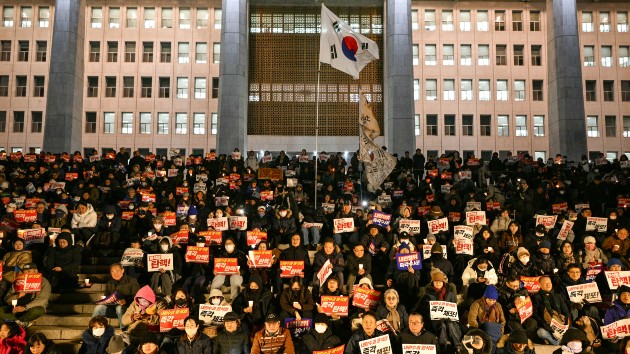
People call for the resignation of South Korea President Yoon Suk Yeol as they take part in a protest on the steps leading to the National Assembly in Seoul on December 4, 2024, as a South Korea flag flutters in the wind. South Korea’s opposition moved to impeach President Yoon Suk Yeol on December 4 after his extraordinary but short-lived imposition of martial law that brought thousands of protesters to the streets. (Photo by ANTHONY WALLACE/AFP via Getty Images)
(SEOUL) — As the opposition’s effort to impeach South Korean President Yoon Suk Yeol made its way through the National Assembly, the leader accepted the resignation of Defense Minister Kim Yong Hyun, dismissing a key ally in his brief failed imposition of martial law.
Opposition lawmakers had moved on Wednesday to impeach the president, submitting a motion a day after Yoon’s late-night declaration roiled the nation and set off hours of political turmoil. The motion to impeach was submitted by 191 lawmakers.
It is expected to make its way through the National Assembly in the coming days, with a vote likely either Friday or Saturday. The measure would require a two-thirds majority to pass. It would then be sent to South Korea’s Constitutional Court, which would have to approve the impeachment.
Yoon’s party, the conservative People Power Party, controls 108 seats in the 300-member National Assembly, meaning some would have to break with their party for the impeachment vote to succeed.
As he declared martial law in a televised speech late Tuesday, the president said the measure would be necessary due to the actions of the Democratic Party, a liberal coalition that Yoon accused of controlling parliament, sympathizing with North Korea and paralyzing the government.
The declaration included banning political activities, including rallies and protests. Yoon also called for a stop to the “dissemination of fake news” and the manipulation of public opinion. All press would have been controlled by the state under the declaration.
The declaration was met with protests and a swift vote in the National Assembly, with the 190 members on hand unanimously voting to lift Yoon’s martial law order. Within hours, Yoon had backtracked, and the State Council convened to vote to officially lift the order.
Secretary of State Antony Blinken said on Wednesday that the U.S. was not aware of Yoon’s plan before his declaration. “For us, this is one of the most critical alliances that we have anywhere in the world,” Blinken said during a visit to NATO headquarters in Belgium. “South Korean democracy, it’s one of the most powerful stories anywhere in the world.”
“It’s very important that any disputes, differences, political differences be resolved peacefully and pursuant to the rule of law,” Blinken added. “That’s what we’re seeing now. That’s what’s so important to sustain.”
Russian Foreign Ministry spokesperson Maria Zakharova claimed Thursday that the U.S. bears responsibility for the unrest. “The South Korean system was created with the help of the United States,” she said during an appearance on Russia’s Channel One, clips of which she posted on her official Telegram account.
“In 70 years, there has not been a single president who left his post peacefully, there is not a single story of a normally completed term,” Zakharova added. “What is happening now in South Korea is completely inscribed in the political system created here by the Americans.”
North Korea, she added, “is so diligently increasing its security” because “its neighbor is unpredictable.”
Yoon began his five-year term in May 2022 after wining office by a razor-thin margin.
Kim, the defense minister, had only recently taken up his post.
He had served as the head of Presidential Security Services in Yoon’s administration, before becoming a cabinet member in September, according to Yonhap News Agency. He’s a retired three-star Army general.
As opposition lawmakers worked to impeach Yoon, public calls for the president’s resignation continued. Crowds again gathered in Seoul on Thursday, holding another candlelit vigil in support of Yoon’s ouster in front of the National Assembly building.
ABC News’ Will Gretsky, Ellie Kaufman, Joe Simonetti and Meredith Deliso contributed to this report.
(WASHINGTON) — Pete Hegseth, President-elect Donald Trump’s pick for defense secretary, said on Wednesday he would not “back down” as new misconduct allegations cause growing concern among Republican senators tasked with whether to confirm him.
Going public in his own defense, Hegseth also directly addressed several of the accusations for the first time in an interview with Megyn Kelly. He denied many of the claims he mistreated women and pushed back on reports he was forced out from two veterans’ nonprofit groups.
He’s also promised senators he’s stopped drinking and won’t drink if confirmed, according to Missouri Republican Sen. Eric Schmitt. Some of the misconduct accusations included claims he has been drunk in public.
“He offered up to me, and I know he has with other senators too, that he’s not drinking, and that’s not something he’s going to do when confirmed here,” Schmitt said a day after meeting with Hegseth.
Sen. Roger Wicker, the incoming chairman of the Senate Armed Services Committee, which would vote to send Hegseth’s nomination to the full Senate, affirmed that Hegseth committed to not drinking if he was confirmed.
“The allegation was made about him being intoxicated at several times and so the questions that every member will be asking him led to his statement,” Wicker said.
Pressed to confirm Hegseth told him he would stop drinking altogether, Wicker replied, “That’s right, that’s exactly right.”
North Dakota Republican Sen. Kevin Cramer said he was encouraged by Hegseth’s pledge in their private meeting Wednesday to abstain from alcohol as defense secretary.
“He said, ‘My commitment is to not touch alcohol while I have this position,'” said Cramer, who lost a son to alcohol addiction in 2018.
“I said, ‘It’s really important that we have a clear-eyed secretary of defense if the phone rings at 3 in the morning.'” Cramer said. He said Hegseth replied that he would be clear-eyed at “3 in the morning, 3 in the afternoon, and every hour in between.”
Cramer said Hegseth told him there were times when he “drank too much, but never times that I drank too much and anything improper happened.”
Hegseth said he spoke with Trump earlier on Wednesday, and said the president-elect told him: “Keep going, keep fighting. I’m behind you all the way.”
The comments come as a number of senators — at least six — have privately signaled they are not inclined to vote for him, leading Trump’s advisers to begin discussing who may be a viable replacement, sources familiar with the matter told ABC News.
Multiple sources also told ABC News that Trump and Florida GOP Gov. Ron DeSantis spoke about the job Tuesday and DeSantis expressed interest in it. Other possible candidates include Iowa Sen. Joni Ernst and Tennessee Gov. Bill Hagerty, said sources familiar with private discussions.
As he walked with his wife through the Capitol for a third day of sit-downs with GOP lawmakers, Hegseth was peppered with questions from reporters asking if he’s committed to remaining in the running. He replied, “Why would I back down? I’ve always been a fighter. I’m here for the war fighters. This is personal and passionate for me.”
Hegseth met with Ernst on Wednesday afternoon. Ernst briefly spoke with reporters after, calling it a “throughout conversation.”
Asked by ABC’s Jay O’Brien if Hegseth alleviated any of her concerns, Ernst did not respond.
When pressed if there’s any chance she was being considered to replace Hegseth, Ernst responded: “Mr. Hegseth is the nominee.”
Shortly after he was tapped by Trump to lead the Pentagon, it was reported that Hegseth had paid a settlement agreement to a woman who accused him of sexual assault in 2017.
Over the weekend, the New Yorker, citing what it called a detailed seven-page whistleblower report, said Hegseth was forced to step down from two veterans’ nonprofit groups amid accusations of financial mismanagement, sexist behavior and other disqualifying conduct. ABC News has not independently confirmed the magazine’s account.
Hegseth denied most of the allegations against him as Kelly went through them.
He flatly denied the 2017 sexual assault allegation, saying he paid a settlement to protect his wife and career.
He pushed back on reports he was forced out of the veterans’ groups, though he didn’t dispute mismanaging funds at Veterans for Freedom, blaming it on being an “amateur.”
“Am I a perfect man? No, was I a perfect man? Absolutely not,” Hegseth said. “Do I regret those things? Yes. But is it who I am today? No, and I’m just grateful for the grace of God that gives me a new chapter.”
Hegseth’s lawyer Tim Parlatore told CNN on Wednesday his client was looking forward to doing an FBI background check.
“He knows, as I know, that FBI investigators are professionals. They’re going to go through this. They’re going to not just take a few anonymous complaints and put that in the report. They’re going to try and corroborate it,” Parlatore said. “The FBI background check is going to exonerate him of the vast majority of these claims, and so he’s very much looking forward to that.”
Parlatore claimed that while Hegseth isn’t an “angel” and that he has partied “a bit,” the onslaught of allegations coming out against him are because people are “threatened” by changes he would bring to the Pentagon.
His mother, Penelope Hegseth, also offered a defense of her son on “Fox & Friends” on Wednesday morning.
She sent an email to her son in 2018 amid his divorce in which she wrote that he was an “abuser of women.” The email was reported by the New York Times. ABC News has not independently obtained the email.
Penelope Hegseth on Wednesday said her son was a “changed” man and that the email was written in “haste” during a “very emotional time.” She said that she “retracted it with an apology email” just hours after she sent it, and that she and her son are “very close today.”
Penelope Hegseth, imploring senators to listen to his account, also said she believed her son was “the man for the job.”
Hegseth told Kelly he was still confident he’ll be confirmed but said if he isn’t, he’ll know “I did everything I could in this process.”
“So, we don’t know precisely how this is all going to play out. I’m going to go up on Capitol Hill, meet with all these senators, keep working hard, try to earn votes, respect the process,” he said.
ABC News’ Rick Klein, Rachel Scott, Ivan Pereira and Allison Pecorin contributed to this report.
(NEW YORK) — Svetlana Dali, the woman who stowed away on a Delta Air Lines flight to France, was arrested by the FBI upon her return to New York, an official confirmed.
She returned to John F. Kennedy International Airport on Wednesday, once again flying Delta, but this time escorted by U.S. law enforcement, according to the Transportation Security Administration.
The TSA confirmed that its inspectors, along with other law enforcement officials, were there to meet Dali at the gate for questioning when she deplaned.
The stowaway’s name was confirmed Tuesday by her daughter and ex-husband, although authorities had yet to verify her identity at the time of her return to the U.S.
Dali had previously been described only as a Russian national who had been caught traveling without proper documentation on Delta Flight 264. The flight was scheduled to fly between New York City and Paris on Nov. 26.
According to a statement from the French Interior Ministry, “She was not admitted to French territory due to lack of a valid travel document (visa) and was placed in the waiting area for the time necessary for her re-routing to the United States since she held a valid US residence permit.”
Dali will be making her initial appearance in Brooklyn Federal Court on Thursday, officials have confirmed.
However, the charges against her have not been made public as of the time of her arrest.
It is therefore unknown if the appearance is related to the civil case that the TSA told ABC News it was preparing against Dali.
“TSA opens a civil case against any passenger when there is evidence that TSA regulations may have been violated,” the spokesperson said in a statement on Monday.
Upon Dali’s reentry to New York on Wednesday night, Delta issued a statement thanking French and U.S. authorities for assisting in the incident.
“Our review affirms that Delta’s security infrastructure, as part of our Safety Management System framework, is sound and that deviation from standard procedures is the root cause of this event,” the statement said.
“We are thoroughly addressing this matter and will continue to work closely with our regulators, law enforcement and other relevant stakeholders,” it continued. “Nothing is of greater importance than safety and security.”
Details about how she was able to originally sneak onto an international flight remain under investigation.
Christopher Looft and Ayesha Ali contributed to this report.