(WASHINGTON) — U.S. Steel and Japan-based Nippon Steel sued the Biden administration on Monday over a decision made last week to block a merger between the two companies.
This is a developing story. Please check back for updates.
(WASHINGTON) — Congress is gathering for a joint session to certify the results of the 2024 election, the final step before President-elect Donald Trump’s inauguration on Jan. 20, after some major changes to security for the ceremony and the law that dictates how it’s carried out.
Before 2021, the Congress’ constitutionally mandated responsibilities to count electoral certifications from the states and certify the results on Jan. 6 often passed in less than an hour with little notice from the public.
But the events of four years ago make this a more closely watched affair.
Washington, D.C., is under heightened security — not only for the certification of the vote, but also for the state funeral of former President Jimmy Carter at the end of this week and Trump’s inauguration in two weeks.
There are no known threats to the certification of the electoral votes, authorities say, but police are preparing for the possibility.
And the Washington area is forecast to get its heaviest snowfall in a few years on Monday, which could impact government operations, but it isn’t expected to prevent certification.
Here’s what we expect to happen on Monday:
Security
D.C. Mayor Muriel Bowser’s request to designate Washington a National Security Special Event for the counting and certification of the vote, which was approved in September. This allows for significant resources from the federal government, as well as state and local partners, to be utilized in a comprehensive security plan, with the U.S. Secret Service as the lead agency.
The Secret Service is deploying agents and specialists from field offices across the country to supplement staffing. D.C. Police will be fully activated beginning Sunday morning and are bringing in nearly 4,000 additional officers from across the country to assist with policing for the special events. Drones will be in use for both events and training preparations.
U.S. Capitol Police Chief Tom Manger told reporters, “The United States Capitol Police [are] better staffed, better trained, better equipped than ever before, to protect our Capitol and protect our Congress.”
“The legislative process will proceed without disruption, and our government will have a peaceful transfer of power,” he said.
Capitol Police has completed more than 100 recommendations its inspector general made after the Jan. 6 attack, including increasing staffing, training, and building a new intelligence operation.
The D.C. National Guard confirmed to ABC News that it has been activated and will assist with events this month. Some 500 members of the Guard are on standby for Jan. 6 and Carter’s funeral. A request for 7,800 members of the military for Trump’s inauguration is pending approval.
Fencing is installed around a perimeter that goes beyond the office buildings on both sides of the Capitol, and there’s an inner perimeter that surrounds the immediate Capitol complex. The fencing was implemented for the first time after the 2021 insurrection and will be similar to what was installed for Israeli Prime Minister Benjamin Netanyahu’s address to Congress last summer.
The fencing on Capitol Hill and near the White House is expected to remain through February, sources told ABC News.
No major groups have applied for permits or announced any protests for the election certification.
Snow day
D.C. is expected to get between 8 to 12 inches of snow through Monday but members are expected to get to the Capitol.
House Republican leaders urged members to stay in Washington over the weekend and Speaker Mike Johnson is plowing ahead with Monday’s certification.
In an appearance on Fox News on Sunday, Johnson said he’s hoping for full attendance.
“Whether we’re in a blizzard or not, we are going to be in that chamber making sure this is done,” Johnson said.
The role of the vice president
Vice President Kamala Harris will preside over the certification, putting her in the unenviable position of certifying the victory of her 2024 opponent. Congress enacted a law in 2022 to define the role of the vice president as purely ceremonial.
The Electoral Count Reform Act modified some of the provisions that Trump attempted to use to challenge the electoral count on Jan. 6, 2021.
The law also makes it harder harder for Congress to challenge a state’s electoral votes. The law raised the threshold required to object to a state’s electoral votes from one senator and one representative to one-fifth of each chamber and it takes one half of each chamber to sustain objections.
Though there were objections to states’ electors that led to the dissolution of the joint session in 2021, none were sustained by a half-chamber vote in either the Senate or the House.
The law also cleaned up vague language about what date states must select their electors and created an expedited procedure for federal courts, or the Supreme Court when necessary, to hear cases with over state executives’ duty to issue and transmit to Congress the certification of appointed electors.
Certifying the vote
Procession of the ballots: The sealed votes arrived at the Capitol addressed to the vice president in her role as president of the Senate. The votes are placed in ceremonial leather-bound boxes and processed from the Senate to the House by a group of Senate pages.
Procession of senators to the House: Senators follow the electoral boxes to the House to convene the joint session.
Members convene for joint session: Federal law stipulates that members must convene at 1 p.m. for the opening of the presidential election results. The House sergeant at arms announces the president of the Senate (Harris) and senators as in the State of the Union address, and then the president of the Senate takes the dais and becomes the presiding officer of the ceremony. The speaker of the House usually sits behind the vice president.
“Tellers” come to the dais: Two House members and two Senate members who have been selected by the speaker and Senate majority leader help shepherd the ceremony by reading out the votes alphabetically by state. This is typically the top Republican and Democrat on the Senate Rules and House Administration committees.
Harris reads the votes by each state in alphabetical order: Starting with Alabama, Harris will open the certificates and hand them down to one of the tellers. After the teller announces the result, Harris will ask if there are any objections. If there are objections as there were in 2021, this would be when they’re heard.
If the threshold for an objection is reached: Harris would announce that the two chambers will deliberate separately on the pending objection and report its decision back to the joint session. The Senate would withdraw from the joint session and return to its chamber. Both chambers would get up to two hours to debate whether to uphold the objection. It requires the vote of half of each chamber to sustain an objection.
Never in their history has either chamber sustained an objection.
Completing the process: The vice president will announce the whole number of electoral votes (538) and what constitutes a simple majority (217) and announce how many electoral votes each candidate got, then do the same for vice president.The vice president will declare the joint session dissolved. Usually there is applause, and the certification is complete.
How long does all this take?: There have been instances in which certification has taken less than half an hour. In 2017, the certification of President Trump’s first term, presided over by then-Vice President Joe Biden, took 41 minutes.
In 2021, Congress convened at 1 p.m. in a joint session and, because of both a prolonged recess due to the breach of the Capitol and multiple state objections, did not complete its work certifying the election until 3:39 a.m. on Jan. 7.
ABC News’ Beatrice Peterson contributed to this report.
(WASHINGTON) — Nearly 1,600 individuals have faced charges in the four years since a mob of President-elect Donald Trump’s supporters attacked the U.S. Capitol, according to figures released by the U.S. Attorney’s Office on Monday.
But one of the largest investigations in the Department of Justice’s history now faces a future rife with uncertainty.
Of the roughly 1,583 defendants whom prosecutors have charged in connection with the Capitol riot, 608 have faced charges for assaulting, resisting or interfering with law enforcement trying to protect the complex that day, the office said.
Roughly 174 of those 608 were charged with using a deadly or dangerous weapon or otherwise causing serious injury to an officer.
And in a rare move, the U.S. Attorney’s Office revealed it is currently evaluating whether to bring charges in roughly 200 cases that have been referred to them by the FBI, about 60 of which involve potential felony charges involving allegations of assault or impeding law enforcement.
While the U.S. Attorney’s Office has provided monthly “by the numbers” updates in connection with the Capitol attack — detailing arrests, guilty pleas and sentencings among other figures — Monday’s update is the first to include an estimate of the number of uncharged cases being evaluated by prosecutors.
It comes just days before Trump is set to take office for his second term and potentially follow through on his years-long public promises to pardon a vast number of Jan. 6 defendants, whom he has described as “political prisoners” unfairly targeted by the Biden administration.
The two months since Election Day have already proved to be a time of major instability for the Justice Department’s Capitol riot cases — as prosecutors have sought to manage an increasing number of newly emboldened defendants seeking delays in their cases with the potential promise of pardons or commutations on the horizon.
While Trump has promised to hand down a number of pardons and commutations during his first hours in office to some Jan. 6 defendants, neither he nor his transition have provided concrete guidance on how sweeping those pardons will ultimately be.
Trump’s Justice Department is also expected to slow down or even shutter completely the ongoing investigation into the attack.
In figures released Monday, the U.S. Attorney’s Office made clear to document how many cases are outstanding in advance of Trump’s inauguration, noting that 170 defendants who have already pleaded guilty or been found guilty still await sentencing.
Roughly 300 cases remain where a charged defendant hasn’t pleaded guilty or been found guilty, approximately 180 of whom have been charged with assaulting or impeding police.
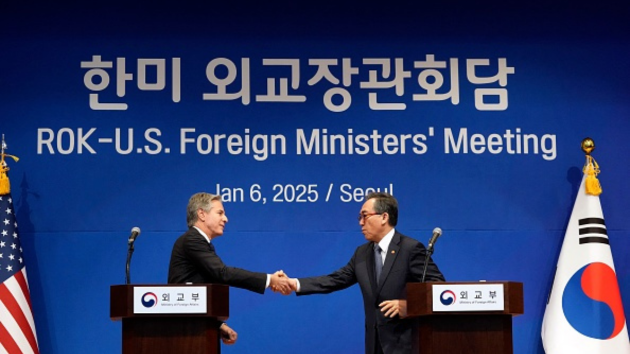
South Korean Foreign Minister Cho Tae-yul (R) and US Secretary of State Antony Blinken shake hands during a joint press conference following their meeting at the Foreign Ministry in Seoul on January 6, 2025. (Photo by Lee Jin-man / POOL / AFP)
(SEOUL, TOKYO and LONDON) — The South Korean military detected a projectile fired from North Korea that was suspected to be a medium-range ballistic missile, a test-launch that arrived as U.S. Secretary of State Antony Blinken visited South Korea.
The missile was fired from the area surrounding Pyongyang, the capital, toward the East Sea at about noon on Monday, according to the South Korean Joint Chiefs of Staff.
The joint chiefs said the South Korean military has heightened surveillance for additional launches and is maintaining a readiness posture for sharing ballistic-missile-related data with the U.S. and Japan.
Blinken condemned the test, which he called “yet another violation of multiple Security Council resolutions.” He added that President Joe Biden’s administration has “sought to engage the DPRK and multiple efforts to sit down to talk without any preconditions.”
“We communicated that on many occasions. We’ve done it privately, we’ve done it publicly,” Blinken said during a press conference in Seoul. “And the only response, effectively we’ve gotten has been more and more provocative actions, including missile launches.”
The last time North Korea test-fired a ballistic missile was Nov. 5, just before the U.S. presidential election.
The U.S., South Korea and Japan have during Biden’s term bolstered their real-time information sharing capabilities, a move that Blinken on Monday had “strengthened our common defense and common deterrence.”
He said the launch on Monday amounted to “just a reminder” of the importance of that trilateral collaboration, which has also included military drills.
“All of that and more is a strong and effective response to the provocations from North Korea,” Blinken said. “So I have confidence that, because it’s so in the interest of all of us, it will continue and future administrations, whether it’s here, whether it’s in the United States, whether it’s Japan, we’ll continue to build on the work.”
Tokyo reacted swiftly to the launch, saying it was reinforcing its regional alliances through coordinated action with the United States and South Korea. Officials condemned Pyongyang while emphasizing the importance of a unified approach.
Defense Minister Gen Nakatani, speaking from Indonesia, issued a strong condemnation, describing the repeated launches as a grave threat to Japan’s national security and regional peace.
“We strongly protest and denounce North Korea’s actions, which endanger not only our country but also the international community,” he said, reaffirming Japan’s commitment to work closely with the U.S. and South Korea to bolster deterrence and conduct thorough surveillance.
Many office workers in Tokyo were returning to their jobs after the New Year’s holidays when news of the launch broke. The projectile reached an altitude of about 62 miles and traveled about 684 miles before falling into the Sea of Japan, another name for the East Sea, and outside Japan’s Exclusive Economic Zone, according to Japan’s Ministry of Defense. The Japan Coast Guard confirmed that no damage to vessels in the affected area had been reported.
Prime Minister Shigeru Ishiba expressed serious concern about North Korea’s advancements in missile technology.
“The frequency of these launches and the evident improvement in technology demand that we redouble our efforts to strengthen deterrence,” he said during a press conference. “Japan’s peace and independence must be safeguarded by our own resolve.”
ABC News’ Will Gretsky contributed to this report.
(WASHINGTON) — President Joe Biden is making a sweeping move to ban all future offshore oil and natural gas drilling on America’s East and West coasts, the Eastern Gulf of Mexico and Alaska’s North Bering Sea.
“My decision reflects what coastal communities, businesses, and beachgoers have known for a long time: that drilling off these coasts could cause irreversible damage to places we hold dear and is unnecessary to meet our nation’s energy needs. It is not worth the risks,” Biden said in a statement announcing the decision.
According to the White House fact sheet, this move blocks drilling in more than 625 million acres of U.S. oceans.
The fact sheet adds that Biden took those actions under “Section 12(a) of the Outer Continental Shelf Lands Act” and adds that his actions “have no expiration date, and prohibit all future oil and natural gas leasing” in the designated areas.
“We do not need to choose between protecting the environment and growing our economy, or between keeping our ocean healthy, our coastlines resilient, and the food they produce secure and keeping energy prices low. Those are false choices,” Biden added.
The fact sheet says that after this sweeping move, “Biden will have conserved more lands and waters than any other U.S. president in history.”
The action comes as President-elect Donald Trump continually made his “drill, baby, drill” promise on the campaign trail, vowing to unlock America’s drilling capabilities in an effort to lower energy costs for Americans.
But the law Biden used, the Outer Continental Shelf Lands Act, was written so a presidential action under its authority is permanent, differing from other executive actions. If the Trump administration were to attempt to reverse Biden’s actions, Congress would likely have to change the law.
ABC News’ MaryAlice Parks contributed to this report.
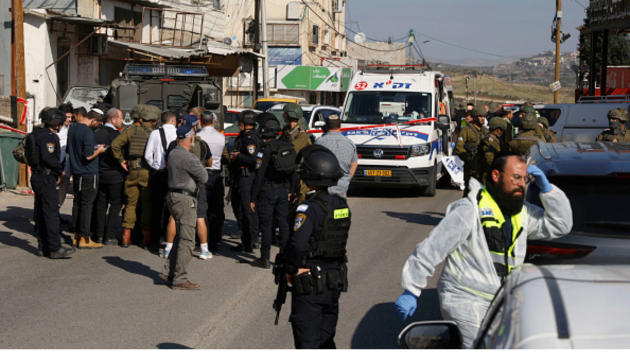
Security forces and emergency workers respond to the scene of a shooting attack that targeted a bus and other vehicles on January 6, 2025 in the Palestinian village of Al-Funduq, West Bank. Three people were reported killed and others injured, and security forces are still searching for the assailants. The site is located between the Israeli West Bank settlements of Karnei Shomron and Kdumim. (Photo by Amir Levy/Getty Images)
(LONDON) — Rebel forces in Syria are building a transitional government after toppling the regime of President Bashar Assad in a lightning-quick advance across the country.
The Israel Defense Forces continues its intense airstrike and ground campaigns in Gaza, particularly in the north of the strip around several Palestinian hospitals. A latest round of peace talks to end the 15-month-old war is set to resume in Qatar.
Meanwhile, the November ceasefire in Lebanon is holding despite ongoing Israeli airstrikes on Hezbollah targets, which Israeli officials say are responses to ceasefire violations by the Iranian-backed militant group.
Tensions remain high between Israel and Iran after tit-for-tat long-range strikes in recent months and threats of further military action from both sides. The IDF and the Yemeni Houthis also continue to exchange attacks.
Blinken hopes for Gaza ceasefire in administration’s final weeks
Secretary of State Antony Blinken told reporters Monday that the U.S. wants a ceasefire deal in Gaza and all remaining captives released within the next two weeks, before President-elect Donald Trump takes office on Jan. 20.
“We very much want to bring this over the finish line in the next two weeks,” Blinken told reporters while in Seoul, South Korea.
Blinken reported “intensified engagement,” including by Hamas, on reaching a deal, though added “we are yet to see agreement on final points.”
“We need Hamas to make the final necessary decisions to complete the agreement and to fundamentally change the circumstance for the hostages, getting them out, for people in Gaza, bringing them relief, and for the region as a whole, creating an opportunity to actually move forward to something better, more secure for everyone involved,” Blinken said.
“If we don’t get it across the finish line in the next two weeks, I’m confident that it will get its completion at some point, hopefully sooner rather than later,” Blinken added.
-ABC News’ Joe Simonetti
3 Israelis killed in West Bank shooting
Three Israelis were killed in a shooting that targeted a bus and a vehicle in the occupied West Bank on Monday morning, security and emergency officials said.
The attack occurred in the village of Al-Funduq, on one of the main east-west roads crossing the Palestinian territory, much of which is under Israeli security control.
Israel’s Magen David Adom rescue service confirmed the death of three victims — two women in their 60s and a man in his 40s. MDA said it provided medical treatment to seven injured people, including the bus driver who is in serious condition.
The Israel Defense Forces said it launched a manhunt for the suspected Palestinian shooters.
“Anyone who follows the path of Hamas in Gaza and sponsors the murder and harm of Jews will pay heavy prices, ” Israeli Defence Minister Israel Katz said in a post on his X account, reacting to the attack.
Sending his condolences to the families of the victims, the Israeli Prime Minister Benjamin Netanyahu said the attackers “will not get away.”
“We will find the abhorrent murderers and settle accounts with them and with all those who aided them,” his statement said.
The Palestinian Health Ministry in Ramallah said in an extensive report Sunday that at least 838 Palestinians — including 173 children — have been killed by Israeli fire and over 6,700 have been injured in the West Bank since the start of the war in Gaza in October 2023.
-ABC News’ Jordana Miller, Diaa Ostaz and Somayeh Malekian
WHO director calls for release of Kamal Adwan hospital director
Tedros Ghebreyesus, the director of the World Health Organization, said in a statement Saturday that WHO has received no updates about Dr. Hossam Abu Safiya, the director of North Gaza’s Kamal Adwan hospital, since he was detained by Israeli forces on Dec. 27th.
“We continue to urge Israel to release him. We repeat: attacks on hospitals and health professionals must end. People in Gaza need access to health care. Ceasefire!” he said in a statement.
-ABC News’ Victoria Beaulé
Israeli strikes kill 150 in Gaza, officials say, as peace talks resume
More than 150 people have been killed in Israeli attacks across the Gaza Strip over the past three days, according to Palestinian health authorities.
The series of airstrikes on dozens of Hamas targets came amid a renewed push to reach a ceasefire in the 15-month-old war and return Israeli hostages home before President-elect Donald Trump takes office later this month.
Delegations from both Israel and Hamas were dispatched to resume indirect negotiations in Doha on Friday. The talks will be brokered by Qatari and Egyptian mediators.
President Joe Biden’s administration, which is helping to broker the talks, urged Hamas to agree to a deal. Hamas said it was committed to reaching an agreement deal, but it remains unclear how close the two sides are.
-ABC News Nasser Atta, Bruno Nota, Diaa Ostaz, Samy Zyara and Morgan Winsor
Yevhenii Vasyliev/Global Images Ukraine via Getty Images)
(LONDON) — Ukrainian forces on Sunday launched a new offensive inside Russia’s western Kursk border region, going on the attack with substantial forces according to reports from Russian and Ukrainian military bloggers.
Russia’s Defense Ministry reported a large-scale attack by Kyiv’s forces involving armored columns that began on Sunday morning, with Ukrainian troops attacking in three directions inside Kursk.
Ukraine first seized a foothold inside the Kursk region with a surprise offensive in August. But Kyiv’s forces have since been slowly pushed back by Russia, including recently with support from North Korean troops.
A Ukrainian military source confirmed to ABC News that a new offensive operation had begun.
The head of Ukrainian President Volodymyr Zelenskyy’s office, Andrii Yermark, also appeared to cryptically confirm the offensive, writing on Telegram: “Kursk Oblast, good news! Russia is getting what it deserves.”
Andrii Kovalenko, head of Ukraine’s counter-disinformation center, also wrote that Ukrainian troops have gone on the attack in multiple directions inside Kursk.
Videos posted to Russian military blogger channels appeared to show columns of Ukrainian armored vehicles on the move. The Ukrainian assault appears to be Kyiv’s most substantial offensive operation in Kursk since August.
Multiple Russian military bloggers reported that Ukrainian troops, tanks, armored vehicles and demining equipment attacked the villages of Berdin and Bolshoye Soldatskoye, north of Sudzha — the main administrative border town that Ukraine captured in August.
Bloggers also reported an attack further west on the border town of Tetkino.
Prominent Russian military bloggers — some close to Russia’s Defense Ministry — said that the offensive was expected but that the situation is challenging for the Russian defenders.
The Defense Ministry said in a statement that two assaults were repelled. “The operation to destroy the Ukrainian Armed Forces formations continues,” it wrote on Telegram.
Ukrainian troops appeared to make small advances on Sunday but did not achieve significant breakthroughs of the Russian lines, according to open-source monitors. Some Russian military bloggers said they believe Ukraine will attempt another push through Monday, with others suggesting Kyiv’s main attack was yet to come.
The new Ukrainian assault comes just two weeks before President-elect Donald Trump returns to the White House, with the expectation that his new administration will push for a peace deal to end the nearly 3-year-old war.
ABC News’ Natasha Popova contributed to this report.
(NEW ORLEANS) — President Joe Biden and first lady Jill Biden are scheduled to travel on Monday to New Orleans, where they’ll attend a prayer service for families of victims and impacted community members following the New Year’s Day attack in the city.
The Biden are expected to arrive in New Orleans in the afternoon, touching down a few hours before the prayer service, which is to be hosted by the Archdiocese of New Orleans, according to the White House.
The visit comes days after a suspect, Shamsud-Din Jabbar, 42, an Army veteran and Houston realtor, allegedly drove a rented truck into Bourbon Street in the early hours of New Year’s Day. At least 14 people were killed and dozens were injured in the attack, which occurred over a three-block stretch of of the tourist destination in New Orleans’ bustling French Quarter.
Jabbar, a Texas resident who FBI officials said proclaimed his support for the terror group ISIS in social media posts ahead of the attack, was killed in gunfire exchanged with New Orleans police.
The 14 victims who died included a young mother teaching her son to read, a former college football player “on top of the world” living in New York City and an 18-year-old aspiring nurse.
The prayer service the Bidens are set to attend on Monday is scheduled to begin at about 6 p.m. at the Cathedral-Basilica of Saint Louis, King of France, according to the White House and the Archdiocese.
“Archbishop [Gregory Michael] Aymond continues to offer his prayers and condolences to those affected by this tragedy,” the Archdiocese said in its announcement. “He asks that all join in prayer for our community today and every day as we work to build a culture that respects the life and dignity of all people.”
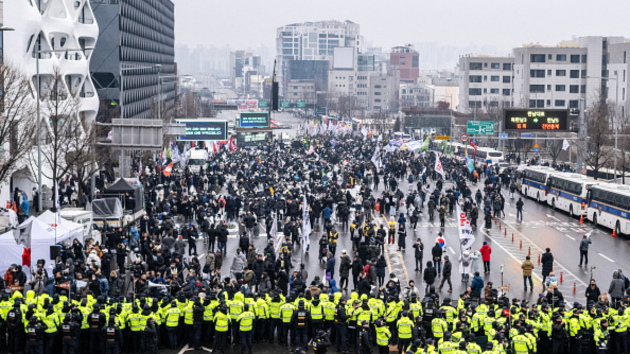
(SEOUL) — Thousands of South Korean citizens were gathering on Sunday near impeached President Yoon Suk Yeol’s residence a day before an arrest warrant for him expires.
Protesters from both sides — one calling the warrant invalid or illegal and the other shouting for arrest — have occupied the wide four-lane road in a normally quiet neighborhood, blocking all traffic, in freezing temperatures and snow.
The effort to detain Yoon came after a South Korean court issued an arrest and search warrant on Dec. 31 over his short-lived imposition of martial law, ABC News confirmed. Yoon has been suspended from his position since Dec. 14.
The warrant is valid until Jan. 6, Yonhap reported, meaning investigators hoping to serve it would have to attempt to detain the president again by Monday.
Yoon declared martial law in a televised speech on Dec. 3. The president said the measure was necessary due to the actions of the country’s liberal opposition, the Democratic Party, which he accused of controlling parliament, sympathizing with North Korea and paralyzing the government.
Animosity has been sky-high between the two sides, after over 100 investigators from the CIO anti-corruption agency and the police retreated from the residence after a tense standoff with the presidential security service.
Yoon’s die-hard supporters have been camping on the street vowing to protect him from “pro-North Korean forces about to steal away the presidency.” Anti-Yoon protesters who are backing of the opposition party claim that Yoon must be jailed for insurrection.
Arrest warrant questioned
Many law experts question the validity of the warrant, which specified that certain key provisions of South Korea’s Criminal Procedure Act should be excluded, which meant the police could search the military and government-classified presidential residence.
This court order is widely seen as a first-ever and as being highly irregular, along with being criticized by some as being outside the limits of the judiciary’s authority, violating the principles of separation of powers.
Typical search warrants include clear parameters of space, time and items to retrieve but excluding the application of legal provisions entirely is unprecedented, experts say.
Yoon’s declaration of martial law had sparked protests, and hours after the declaration, the National Assembly voted to demand that the president lift the martial law order. A majority of parliament — all 190 members who were present, out of the 300-person body — voted to lift the decree — requiring that it then be lifted, under the South Korean constitution.
Following the National Assembly’s vote, Yoon said he withdrew the troops that had been deployed to carry out martial law and “will lift martial law as soon as we have a quorum in the cabinet.” The State Council then convened to vote to officially lift it.
The country’s Democratic Party called on Yoon to resign following what it called the “fundamentally invalid” declaration of martial law. Without Yoon resigning, the opposition party worked to enact impeachment proceedings against the president.
Yoon has been suspended from his position since Dec. 14, when the National Assembly voted for his impeachment in a 204-85 vote.
Presidential security service facing charges
While politicians and lawyers argue heatedly over the validity of the warrant in higher courts, the Presidential Security Service has found itself in the limelight.
The CIO has been leading a joint investigation with police and prosecutors, but say detaining Mr. Yoon would be “virtually impossible” as long as he is protected by the security team.
CIO and the opposition party are seeking charges against the head of the president’s security team for obstruction of justice after the police were blocked from entering the residence on Friday.
The security team formed a barricade comprising about 10 buses and vehicles, at one point forming a human chain of about 200 officers to block access, according to CIO.
The opposition has criticized the president’s security team as being over-excessive and summoned the chiefs and deputy chiefs. The Presidential Security Service defied the order, citing that this is not the time to leave their positions.
“Some media and political circles are saying that the Presidential Security Service is a private soldier (to President Yoon),” Park Chong-Jun, Head of Presidential Security Service, said in a video press release. “I can’t help but feel terrible and sad as the presidential security officer”.
He added that fake news reports of him ordering to fire with live ammunition are “absurd claims,” there was no violence on Saturday, and that they should not be forced to be associated with political ideology.
ABC News’ Somayeh Malekian contributed to this report.
(WASHINGTON) — In an interview Sunday morning on ABC’s “This Week,” Homeland Security Secretary Alejandro Mayorkas warned of a “very difficult threat landscape” in the wake of the New Orleans truck attack.
“We have not only the persistent threat of foreign terrorism — that, of course, created the Department of Homeland Security — but we have adverse nation-states, and for the past 10 years, we’ve seen a significant increase in what we term ‘homegrown violent extremism,'” Mayorkas told anchor George Stephanopoulos. “It is a very difficult threat landscape, and it is why that we as a community — not just the federal government, but state and local officials and residents — need to be alert to it and take the precautions necessary to avoid violence from occurring.”
Mayorkas emphasized that, despite immigration being the department’s “highest responsibility,” the New Orleans attack was unrelated to issues at the border.
“The assailant who perpetrated the terrorist attack in New Orleans was born in the United States, raised in the United States, and served in our armed forces,” he said. “It is not an issue of the border.”
Mayorkas said he has been in touch with South Dakota Gov. Kristi Noem, President-elect Donald Trump’s pick for secretary of the Department of Homeland Security.
“I have spoken with Governor Noem a number of times, including on New Year’s Day and immediately thereafter, with respect to the horrific terrorist attack, and we have spoken substantively about the measures that we take, and I am incredibly devoted to a smooth and successful transition to the success of Governor Noem should she be confirmed as the Secretary of Homeland Security,” he said.
Republican Rep. Michael McCaul, who appeared on “This Week” after Mayorkas, warned of a resurgence of ISIS activity that he said “concerns me greatly.”
McCaul advised the Trump administration to be wary of attacks by those who become radicalized online, urging officials to “pay attention to the social media and connect the dots before these events happen.”
“You really have two types of threats. One is operational, the other one is inspired attacks radicalized over the internet,” McCaul said. “They’re both equally lethal, and they need to be focused on to stop it.”