(WASHINGTON) — Michigan Democratic Sen. Elissa Slotkin explained why she voted against confirming Pete Hegseth as secretary of defense on ABC News’ “This Week” on Sunday.
Hegseth, a former Fox News host, was sworn into the role Saturday following a hair-thin vote in the Senate.
Slotkin told “This Week” co-anchor Martha Raddatz she had not been confident Hegseth would be more loyal to the Constitution than he would be to President Donald Trump.
“He couldn’t unambiguously say that he will push back if the president asked him to do something that wasn’t constitutional, and that, to me, is why I couldn’t confirm him,” Slotkin said. “There’s a lot of other things in his background I don’t like, but I look at what is the strategic and irreversible threats to our democracy, and that’s using the uniform military in ways that violate the Constitution.”
This is a developing story. Please check back for updates.
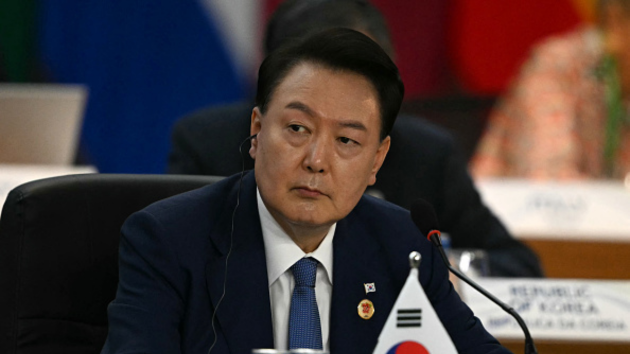
(SEOUL) — South Korean prosecutors formally indicted President Yoon Suk Yeol on Sunday, charging him with insurrection over his brief imposition of martial law in December, according to opposition lawmakers and South Korean media.
“The prosecution has decided to indict Yoon Suk Yeol, who is facing charges of being a ringleader of insurrection,” Democratic Party spokesman Han Min-soo told a press conference, Reuters reported. “The punishment of the ringleader of insurrection now begins finally.”
Yoon had declared martial law in a televised speech on Dec. 3. The president said the measure was necessary due to the actions of the country’s liberal opposition, the Democratic Party, which he accused of controlling parliament, sympathizing with North Korea and paralyzing the government. A South Korean court issued an arrest and search warrant on Dec. 31.
The indictment follows Yoon’s arrest ten days ago, when South Korean prosecutors finally succeeded in forcing him to surrender at his residence after a prolonged stand-off with his presidential bodyguard.
Yoon has previously pledged to fight the charges. He has been suspended from his position since Dec. 14.
(LOS ANGELES) — Rain was falling across Southern California on Sunday, bringing some relief to thousands of firefighters battling multiple major blazes for nearly a month in the Los Angeles area, but also prompting new threats of floods and mudslides across burn-scarred lands.
A flood watch issued by the National Weather Service is to go into effect at 10 a.m. local time on Sunday for fire-ravaged areas of Los Angeles County, which has been ground zero for the historic firestorms that have leveled thousands of homes and killed at least 28 people since first igniting on Jan. 7.
The flood watch will remain in effect until Monday afternoon in burn-scarred areas left by the Eaton, Palisades, Franklin, Bridge and Hughes fires.
The rain is forecast to be widespread but is expected to be light enough to avoid major flooding. But if a downpour spends enough time over one of the recent burn scars, a debris flow could become an issue.
Rain totals from the storm will mostly range from a half-inch to an inch, allowing for a decent soaking for the first time in months.
Since June 1, Los Angeles has only picked up 0.03 inches of rainfall, which has allowed an extreme drought to develop across the area for the first time in two years.
In addition to rain, higher elevations of Southern California, including the San Gabriel Mountains straddling northern Los Angeles and western San Bernardino counties, are expecting snow, with areas above 4,000 feet getting up to 14 inches of powder.
The rain and snow forecast comes as firefighters continued to battle five active fires on Sunday from Ventura County north of Los Angeles to the Mexican border south of San Diego.
The Palisades Fire, which ignited on Jan. 7 in Los Angeles County’s Pacific Palisades, was 84% contained as of Sunday after burning more than 23,000 acres, destroying nearly 7,000 structures and killing 11 people, according to the California Department of Forestry and Fire Protection (Cal Fire).
The Eaton Fire, which also broke out on Jan. 7 in Pasadena and Altadena, was 95% contained on Sunday after burning more than 14,000 acres, destroying more than 9,400 structures and killing 17 people.
Other fires still active on Sunday, according to Cal Fire, include the Hughes Fire near Castaic Lake, about 45 miles north of downtown Los Angeles, which was 90% contained after starting on Wednesday and burning more than 10,000 acres of brush land; the Border 2 Fire that broke out Thursday near the San Diego-Mexico border and is 10% contained after burning more than 6,600 acres of wilderness land; and the Laguna Fire, which also started Thursday in Camarillo in Ventura County, which was 98% contained on Sunday after charring 83 acres and prompting a brief evacuation of the California State University Channel Islands.
(WASHINGTON) — For the first time in U.S. history, military aircraft were used this past week to deport scores of undocumented migrants from the United States. Middle schools, Trump administration officials say, are now seen as places to target for immigration enforcement operations. And, according to President Trump’s “border czar,” every undocumented immigrant should worry they could be arrested at any time, even if they have no criminal record.
The “border czar,” Tom Homan, says it’s all part of the Trump administration’s effort to send a “clear” message: “There’s consequences [for] entering the country illegally,” he told ABC “This Week” co-anchor Martha Raddatz on Sunday.
“If we don’t show there’s consequences, you’re never going to fix the border problem,” he said.
More than 11 million undocumented immigrants are currently estimated to be living in the U.S. President Donald Trump has promised to take unprecedented action to remove as many of them as possible and stem the flow of more migrants coming to the southern border.
In his first several days in office, Trump declared a national emergency at the border, announced an end to the so-called practice of “catch and release” — when migrants claiming asylum are given court dates and then released pending those proceedings — and sought to overturn the long-held Constitutional right of birthright citizenship, a move that immediately faced legal challenges and was at least temporarily blocked by a federal judge.
As for the millions of undocumented immigrants already in the country, Homan said the administration will deport “as many as we can,” starting with threats to public safety threats and national security, Homan said.According to estimates released by House Republicans last year, based on government data, hundreds of thousands of undocumented migrants in the country are convicted criminals or have charges pending against them. Government statistics indicate that in the past four years, hundreds of migrants were caught along the southern border with names matching known or suspected terrorists on a government watchlist. And Homan has said more than 2 million people were detected along the border but never captured, so authorities don’t know who they are or what threat some of them could pose.
According to statistics released by the Department of Homeland Security last year, a tiny fraction of those who reached U.S. borders in the prior three years had any kind of criminal record, and the vast majority of them involved nonviolent crimes, such as driving under the influence or previously entering the country illegally.
Homan told ABC News that the Trump administration is only “in the beginning stages” of carrying out its mass deportation plan, making public safety threats and national security threats a “priority,” but “as that aperture opens, there’ll be more arrests nationwide.”
And he warned that there will be “collateral arrests,” especially in the so-called “sanctuary cities” that he says are resistant to helping Immigration and Customs Enforcement officials locate and arrest undocumented immigrants already in local custody for other crimes.
“Sanctuary cities lock us out of the jails,” said Homan, who led ICE as acting director in Trump’s first administration.
According to Homan, that creates significant safety concerns: When an undocumented immigrant arrested for a serious crime is released by local authorities, instead of being deported, it “endangers the community.”
Nevertheless, Homan said that’s a time when ICE officers would likely make “collateral arrests.”
“When we find him, he’s going to be with others … [and] if they’re in the country illegally, they’re coming too,” he said.
He emphasized that anyone in the country unlawfully is “on the table.”
“It’s not OK to violate the laws of this country,” he said. “We have millions of people standing in line, taking the test, doing their background investigation, paying the fees that want to come in the right way.”
“So if you’re in the country illegally, you got a problem,” he said.
On Monday, during Trump’s first day in office, acting Homeland Security Secretary Benjamine Huffman issued a directive telling immigration authorities they could conduct operations in so-called “sensitive” areas that he said were off-limits during the Biden administration.
“Criminals will no longer be able to hide in America’s schools and churches to avoid arrest,” he said in a statement.
Others, however, said the administration was simply creating fear within the immigrant community, with the chairman of the U.S. Conference of Catholic Bishops’ Committee on Migration saying that “turning places of care, healing and solace into places of fear and uncertainty … will note make our communities safer.
He said that as they prioritize national security threats and public safety threats, ICE officers might have to even go into schools because “many” members of gangs tied to South and Central America, such as MS-13, are between 14 and 17 years old.
In his interview with ABC News, Homan said that no other law enforcement agency is restricted from entering certain locations to promote public safety in the same way ICE has been.
“Name another agency, another law enforcement agency, that has those type of requirements, that they can’t walk into a school or doctor’s office or a medical campus,” he said. “No other agency is held to those standards.”
“These are well-trained [ICE] officers with a lot of discretion, and when it comes to a sensitive location, there’s still going to be supervisory review,” he said. “But ICE officers should have discretion to decide if a national security threat or a public safety threat [is] in one of these facilities.”
Homan said anyone already in the country unlawfully “should leave,” and those looking to claim asylum should “do it the legal way.”
“Go to the embassy, go to the point of entry,” he said. “You shouldn’t come to this country and ask to get asylum and the first thing you do is break our laws by entering illegally.”
In the meantime, Homan said the Trump administration is using not just the military but the “whole” government, including the Justice Department, to support its mass deportation plan, which allows ICE officers to concentrate on conducting enforcement operations.
But Homan acknowledged that the federal government won’t be able to remove every undocumented immigrant in the U.S., and that his “success is going to be based on what Congress gives us.”
ICE doesn’t currently have enough funding from Congress to detain all of the undocumented immigrants that the Trump administration says it hopes to arrest.
“I’m being realistic,” he said. “We can do what we can with the money we have. We’re going to try to be efficient. But with more money we have, the more we can accomplish.”
“What price [do] you put on national security?” he added. “When you … don’t secure that border, that’s when national security threats enter the country. That’s when sex trafficking goes up. That’s when, you know, that’s when the fentanyl comes in.”
As for what success practically looks like at the end of the Trump administration, Homan said: “Our success every day is taking a public safety threat off the streets or getting a national security threat out of here.”
(WASHINGTON) — The U.S. Department of Education’s Office for Civil Rights has announced that it is rescinding all past guidance issued against the removal of books and will no longer employ a coordinator to investigate instances of unlawful book removals.
The department also announced that it has dismissed 11 book ban complaints and six pending complaints. According to the DOE, the complaints alleged that the removal of these books “created a hostile environment for students.”
The nation has seen a wave of attempts to ban or remove books from library and classroom shelves in recent years, with the vast majority of complaints targeting books that are written by or about people of color and the LGBTQ community, according to free speech organizations that track book banning efforts.
PEN America, a free expression advocacy group, has tracked nearly 16,000 book ban attempts in public schools nationwide since 2021. In 2023 alone, the American Library Association (ALA) documented 4,240 different book titles and argued that book banning efforts are a form of censorship.
The ALA’s data found that pressure groups and individuals behind the book-banning efforts targeted multiple titles, “often dozens or hundreds at a time.” Allegations of “obscene,” “divisive,” or “inappropriate” content have largely been used to challenge books that touch on the LGBTQ+ community, sex education, race and politics, the ALA said.
The Trump administration’s Department of Education states that the books were targeted because school districts and parents “have established commonsense processes by which to evaluate and remove age-inappropriate materials.”
The statement continued, “Because this is a question of parental and community judgment, not civil rights, OCR has no role in these matters.”
“The department is beginning the process of restoring the fundamental rights of parents to direct their children’s education,” said Acting Assistant Secretary for Civil Rights Craig Trainor in a statement on the move. “The department adheres to the deeply rooted American principle that local control over public education best allows parents and teachers alike to assess the educational needs of their children and communities. Parents and school boards have broad discretion to fulfill that important responsibility.”
The move from the DOE follows the lead of state-led and local-led efforts to expand book restrictions of certain topics in schools, some of which have been legally challenged by residents.
“We will continue to raise awareness and resistance to ongoing book bans in defense of students’ freedom to read,” said Kasey Meehan, director of PEN America’s Freedom to Read effort, in a statement. “All students deserve to see themselves and the world around them reflected in the books shelved within their public schools.”
South Dakota Gov. Kristi Noem speaks during her confirmation hearing before the Homeland Security and Governmental Affairs Committee on Capitol Hill on January 17, 2025 in Washington, DC. (Photo by Eric Thayer/Getty Images)
(WASHINGTON) — South Dakota Gov. Kristi Noem, the firebrand who gained a national spotlight during the coronavirus pandemic, was confirmed by the Senate on Saturday.
The vote was 59-34.
During her confirmation hearing, Noem said the southern border is “not secure” and that she will help to fix it.
“President Trump needs to achieve this mission because two-thirds of Americans support his immigration and border policies, including the majority of Hispanic Americans,” Noem said in her opening statement. “I was the first governor to send National Guard troops to our southern border when Texas asked for help and when they were being overwhelmed by an unprecedented border crisis. If confirmed as secretary, I’ll ensure that our exceptional, extraordinary Border Patrol agents have all the tools and resources and support that they need to carry out their mission.”
The Department of Homeland Security already shut down the CBP One app, which allowed migrants to make appointments at the border to claim asylum — something Noem promised the Senate Homeland Security and Governmental Affairs Committee she’d do.
Noem will oversee 22 agencies with more than 260,000 employees who work on issues ranging from the border to federal disaster management to the Secret Service.
“As secretary, I will oversee the Secret Service, an agency that is in serious need of reforms. We all saw the threats to President-elect Trump last year and the consequences of failure,” Noem said. “Now, that should never happen again, and I’ve worked closely with my own gubernatorial protective detail, and I’m familiar with what works and what doesn’t work, and I’ll bring that experience towards strengthening the Secret Service.”
The incoming secretary said she will follow the law and implement reforms with no political bias, including with regard to disaster relief.
She added that “if given the chance to be secretary of homeland security, that I will deliver the programs according to the law and that it will be done with no political bias.”
(WASHINGTON) — Pete Hegseth was sworn in to lead the Department of Defense on Saturday, after a narrow vote in the Senate.
The vote on Friday night was initially 50-50, with Vice President JD Vance then casting the tie-breaking vote.
Former GOP leader Mitch McConnell, of Kentucky, voted no. He joined Sens. Susan Collins, of Maine, and Lisa Murkowski, of Alaska, along with all Democrats in voting against Hegseth’s nomination.
The former Fox News host was sworn in at the White House on Saturday morning during a ceremony officiated by Vance.
“We look forward to having the backs of our troops and having your back in executing peace through strength, in putting America first. And in rebuilding our military,” Hegseth said in remarks at the ceremony, thanking Vance and President Donald Trump.
In an official statement to the department, he said: “It is the privilege of a lifetime to lead the warriors of the Department of Defense, under the leadership of our Commander in Chief Donald J. Trump. We will put America First, and we will never back down.”
Hegseth, a former “Fox and Friends” television anchor, was nominated by Trump in November to lead the Defense Department.
In the time since his nomination was announced, Hegseth has been scrutinized for a number of accusations made against him, including those of sexual assault and financial mismanagement of two different veterans organizations.
Hegseth has fiercely denied the allegations. He appeared before the Senate Armed Services Committee for a public hearing earlier this month, where he asserted to the panel that he was a “changed man.”
“I am not a perfect person, but redemption is real,” he told the panel.
Speaking to reporters while on a visit to Los Angeles, Trump said he was “very happy” with the vote, and said he was not aware of McConnell’s vote.
In a statement released while the vote was still going on, McConnell said that Hegseth’s desire to be a “change agent” was not enough to qualify him for the role of secretary of defense.
“Effective management of nearly 3 million military and civilian personnel, an annual budget of nearly $1 trillion, and alliances and partnerships around the world is a daily test with staggering consequences for the security of the American people and our global interests,” McConnell said in the statement. “Mr. Hegseth has failed, as yet, to demonstrate that he will pass this test. But as he assumes office, the consequences of failure are as high as they have ever been.”
Hegseth was confirmed by one of the narrowest Senate margins of any defense secretary in modern history. Most defense secretaries have been confirmed with broad bipartisan votes.
Lloyd Austin, former President Joe Biden’s pick for defense secretary, was confirmed in a 93-2 vote and Trump’s first pick for defense secretary in his first term, James Mattis, was confirmed in a 98-1 vote.
Before the vote, Hegseth arrived at the Capitol with his wife and children to watch the proceedings in person, a rare move for a Cabinet nominee.
With the Senate’s vote Friday, Hegseth becomes the third member of Trump’s team to be confirmed by the Senate, following Marco Rubio as secretary of state and John Ratcliffe, as CIA director.
During the same hearing, he affirmed his promise to restore the “warfighting ethos” of the DOD, touting his experience in the National Guard.
It was enough to win over the support of most Republicans in the Senate, including several of those who were initially skeptical.
“He articulated a clear vision of the Pentagon, and it was clear to anyone who listened that he is going to bring energy and fresh ideas to shake up the department’s stagnant bureaucracy,” Mississippi Sen. Roger Wicker, the chairman of the Senate Armed Services Committee, said in a floor speech endorsing Hegseth on Thursday. “He will restore a warfighting ethos and relentlessly focused on the military’s core mission: to deter conflict and, if necessary, to win a war.”
The Senate Armed Services Committee advanced his nomination on a party-line vote on Monday. Then, in a closely watched moment on Thursday, Hegseth’s nomination passed a key test vote that set the table for Friday’s vote of final passage.
The nomination only required a simple majority in the Senate to advance, and it cleared the threshold narrowly, with only GOP backing.
Collins and Murkowski also voted no on that occasion.
In a statement, Murkowski explained that she could not support Hegseth due to concerns about this character and lack of experience.
“I believe that character is the defining trait required of the Secretary of Defense and must be prioritized without compromise,” Murkowski said in the post. “The leader of the Department of Defense must demonstrate and model the standards of behavior and character we expect of all servicemembers, and Mr. Hegseth’s nomination to the role poses significant concerns that I cannot overlook.”
Collins took issue with comments Hegseth made in the past about his belief that women should not serve in combat roles in the military. Though Hegseth has since changed his tune on that, Collins said she was unconvinced.
“I am also concerned about multiple statements, including some in the months just before he was nominated, that Mr. Hegseth has made about women serving in the military,” Collins said. “He and I had a candid conversation in December about his past statements and apparently evolving views. I am not convinced that his position on women serving in combat roles has changed.”
Trump expressed confidence in Hegseth ahead of the vote on Friday, though he added, “You’ll never know what’s going to happen.”
McConnell, the former GOP leader, and North Carolina Sen. Thom Tillis, ultimately cast votes in favor of advancing Hegseth’s nomination in the earlier test vote, although the president questioned whether McConnell will vote no on Hegseth Friday morning.
Tillis said he was still considering the most recent slate of allegations against Hegseth, leveled in an affidavit from his former sister-in-law Danielle Hegseth. In that affidavit, which ABC News obtained, Danielle Hegseth attested that Pete Hegseth’s ex-wife Samantha told her she “once hid in her closet from him because she feared for her personal safety” in the home they shared during their marriage. It also detailed episodes of binge drinking by Pete Hegseth.
An attorney for Pete Hegseth denied these allegations, and the claims of abuse were also rejected by his ex-wife.
(WASHINGTON) — In a late-night Friday move, President Donald Trump fired at least 17 independent watchdogs — known as inspectors general — at multiple federal agencies, sources familiar with the move told ABC News.
The conversations about ousting these government watchdogs began during Trump’s transition back to the White House.
While inspectors general can be fired by the president — it can only happen after communicating with Congress 30 days in advance and in 2022 Congress strengthened the law requiring administrations to give a detailed reasoning for the firing of an IG.
There isn’t yet have a complete list of all the IG’s impacted, but at least one high-profile watchdog — Justice Department IG Michael Horowitz — did not receive notice that he was fired as of yesterday evening.
Horowitz is an Obama appointee and has issued reports that have been critical of both the Trump and Biden administrations.
The current law also mandates that any acting IG’s must come from within the IG community, though it’s unclear whether the Trump White House believes they need to follow that aspect of the law.
Sen. Chuck Grassley, R-Iowa, told ABC News earlier this week that the president must tell Congress before removal.
“First of all to remind that our Inspector General can’t be removed from office until the president, and that’s any president, not just Trump. So this is a message to all these presidents you’ve got to tell Congress a month ahead of time the reasons for removing them,” Grassley said.
He added, “And the other thing is that inspector generals are expected to be independent of political pressure, independent of the head of the agency, and to make sure that the law is enforced and money spent appropriately, and there shouldn’t be any political pressure against any of his work.”
Grassley said Saturday that Congress was not given the required 30-day notice.
“There may be good reason the IGs were fired. We need to know that if so. I’d like further explanation from President Trump,” Grassley said in a statement given to ABC News. “Regardless, the 30 day detailed notice of removal that the law demands was not provided to Congress.”
In floor remarks Saturday morning, Democratic Leader Chuck Schumer ripped into the Trump administration for the move, saying that the dismissals are a possible violation of federal law.
“These firings are Donald Trump’s way of telling us he is terrified of accountability and is hostile to facts and to transparency,” Schumer said.
Republican Sen. Joni Ernst launched a bipartisan IG caucus just ten days ago.