Antonio Perez/Chicago Tribune/Tribune News Service via Getty Images, FILE
(GAINES COUNTY, Texas) — A measles outbreak in Texas is continuing to grow, reaching 124 cases, new data released Tuesday shows.
Almost all of the cases are in unvaccinated individuals or individuals whose vaccination status is unknown, and 18 people have been hospitalized so far, according to the Texas Department of State Health Services (DSHS). Five cases included those who have been vaccinated.
Children and teenagers between ages 5 and 17 make up the majority of cases with 62, followed by 39 cases among children ages 4 and under.
Gaines County is the epicenter of the outbreak, with 80 cases confirmed among residents, according to DSHS. State health data shows the number of vaccine exemptions in the county have grown dramatically.
Roughly 7.5% of kindergarteners in the county had parents or guardians who filed for an exemption for at least one vaccine in 2013. Ten years later, that number rose to more than 17.5% — one of the highest in all of Texas, according to state health data.
Individual schools saw similar jumps. At Loop ISD, located in Gaines County, 13.08% of students between kindergarten and 12th grade received a conscientious exemption from at least one vaccine during the 2018-19 school year, During the 2023-24 school year, that figure rose to more than 47.95%, according to DSHS data.
On Monday, DSHS warned that people may have been exposed to measles in central or south-central Texas associated with the outbreak in the western part of the state.
“A person from the outbreak area who was later diagnosed with measles visited locations in the San Marcos and San Antonio areas the weekend of Feb. 14-16 while they were contagious,” DSHS wrote in an update on its website, sharing exposure times and locations.
Meanwhile, in neighboring New Mexico, at least nine cases have been confirmed in Lea County, which borders Texas, a spokesperson for the state’s department of health told ABC News on Friday.
The Centers for Disease Control and Prevention has separately confirmed 93 cases in eight states so far this year in Alaska, California, Georgia, New Jersey, New Mexico, New York, Rhode Island and Texas.
Similarly to the local outbreaks, most of the nationally confirmed cases are in people who are unvaccinated or whose vaccination status is unknown. Of the cases, 4% are among those who received one dose of the measles, mumps, rubella (MMR) shot.
Measles is one of the most contagious diseases known to humans. Just one infected patient can spread measles up to nine out of 10 susceptible close contacts, according to the CDC.
Health officials have been urging anyone who isn’t vaccinated to receive the MMR vaccine.
The CDC currently recommends people receive two vaccine doses, the first at ages 12 to 15 months and the second between 4 and 6 years old. One dose is 93% effective, and two doses are 97% effective. Most vaccinated adults don’t need a booster.
In the decade before the measles vaccine became available, an estimated 3 to 4 million people were infected every year, according to the federal health agency.
(LOS ANGELES) — An Instagram influencer accused of a drunk driving crash that killed a man in Southern California last summer has now been arrested, officials said.
Summer Wheaton, 33, surrendered Monday at the Malibu/Lost Hills Sheriff’s Station when a warrant was issued for her arrest following a monthslong investigation, according to the Los Angeles County Sheriff’s Department.
She faces several charges, including gross vehicular manslaughter while intoxicated and driving under the influence, the sheriff’s department said.
Wheaton was released after posting bond, according to records viewed by ABC News.
On the night of July 4, 2024, Wheaton allegedly crossed the median on the Pacific Coast Highway and crashed head-on into another vehicle, according to Los Angeles ABC station KABC.
The other car’s driver — 44-year-old rideshare driver Martin Okeke — was killed in the crash.
Beforehand, Wheaton had been at a large party at the restaurant Nobu in Malibu, KABC reported.
Wheaton has more than 100,000 followers on Instagram and describes herself online as a “wellness advocate” focused on “empowering individuals to become their highest selves.”
On Tuesday morning, a day after her arrest, Wheaton posted Bible verses to her Instagram story.
Wheaton went on a monthslong Instagram hiatus after the deadly crash, but returned in December with a promoted post for a “faith-based planner” she had created.
In the promotional video — which featured shots of Wheaton exercising, journaling and gazing out at the ocean — Wheaton spoke vaguely of a “hard” few months.
“You know that feeling when life feels like it’s all falling apart, but somehow it’s the start of something really beautiful? Well, that was me,” she said in the voiceover. “The last few months have been hard. I went through moments where I truly didn’t know I pulled through.”
“But in the chaos, something shifted. I was reminded of a deeper truth: that beautiful things can bloom out of despair,” she said. “Sometimes it’s in those broken places where faith takes root and grows stronger.”
Wheaton did not immediately respond to a request for comment Tuesday.
Andrew Woodley/Universal Images Group via Getty Images
(MEMPHIS, Tenn.) — A Missouri woman has pleaded guilty in connection with what prosecutors called a “brazen” attempt to fraudulently put Elvis Presley’s Graceland estate up for auction.
Lisa Findley pleaded guilty to one count of mail fraud in U.S. District Court in Memphis, Tennessee, on Tuesday. As part of a plea deal, prosecutors agreed to dismiss one count of aggravated identity theft that was previously filed against her.
When asked if she understood what she was pleading guilty to, Findley said, “yes.” She did not make a statement explaining her conduct.
Prosecutors are recommending Findley receive a 57-month federal prison sentence. She is due back in court for sentencing on June 19.
Findley, 53, initially pleaded not guilty to the charges in the wake of her arrest last year. The trial had been scheduled to start in mid-April before Tuesday’s change of plea hearing.
The mail fraud charge carries a maximum penalty of 20 years in prison.
Federal prosecutors said Findley formed a “brazen scheme” to try to “extort a settlement from the Presley family.”
As part of the scheme, prosecutors said Findley forged the signatures of Elvis Presley’s late daughter Lisa Marie and Florida notary Kimberly Philbrick in order to claim that Lisa Marie did not pay back a $3.8 million loan from a purported company called Naussany Investments that listed Graceland as collateral.
Philbrick spoke exclusively to ABC News, telling “Good Morning America” in August 2024 and “IMPACT x Nightline” in October 2024 that she never notarized anything for Lisa Marie Presley and has no idea how her name got involved in the scheme.
Naussany Investments, an unregistered entity that prosecutors said Findley was behind, filed public notices in May 2024 stating that it would auction off Graceland at the front of the Shelby County Courthouse.
A Shelby County chancellor issued a temporary injunction at the eleventh hour that prevented such an auction from taking place, citing an affidavit from Philbrick that stated her signature was forged and she never met Lisa Marie.
This is a developing story. Please check back for updates.
(NEW YORK) — Consumer confidence plummeted in February, indicating worry about the direction of the U.S. economy under President Donald Trump.
A gauge of consumer confidence registered its largest monthly drop since August 2021, the nonpartisan Conference Board said on Tuesday.
Meanwhile, the share of consumers who expect a recession within the next year surged to a nine-month high, the data showed. A growing portion of consumers believe the job market will worsen, the stock market will fall and interest rates will rise, the report added.
Trump has issued a flurry of economy-related directives since he took office last month, including tariff proposals, spending cuts and an assault on diversity, equity and inclusion initiatives.
Earlier this month, Trump announced 25% tariffs on goods from Mexico and Canada as well as 10% tariffs on products from China.
Trump paused the tariffs on Mexico and Canada for one month after striking a deal with each of the two countries on drug trafficking and border security. On Monday, Trump said he plans to go forward with the tariffs when that pause lifts next week.
Seven of every 10 American adults believe tariffs will raise prices, an Ipsos survey found last week.
Concern about rising prices coincides with a bout of resurgent inflation that stretches back to the final months of the Biden administration. Consumer prices rose 3% in January compared to a year ago, registering a percentage point higher than the Federal Reserve’s target of 2%.
Egg prices, a closely watched symbol of rising costs, soared 53% in January compared to a year ago. An avian flu has decimated the egg supply, lifting prices higher.
“Consumers who fear the impact of higher tariffs, spending cuts, and deportations are getting worried and are likely to be more cautious,” Bill Adams, chief economist at Comerica Bank in Dallas, told ABC News.
Meanwhile, U.S. hiring slowed at the outset of the year. The nation added 143,000 jobs in January, far fewer than the 265,000 jobs gained a month prior, government data showed.
Still, some measures of consumer sentiment improved this month. Consumers’ assessment of current business conditions moved higher, while an uptick in purchasing plans for a home extended a monthslong recovery.
The fresh data follows a report last month from the University of Michigan showing that its gauge of consumer sentiment had declined for the first time in six months.
The results showed a sharp disparity between Democrats and Republicans, however. Attitudes among Democrats worsened while sentiment among Republicans improved.
(WASHINGTON) — After facing angry questions from constituents at a town hall last week, Georgia Republican Rep. Rich McCormick is back on Capitol Hill with a new message for Elon Musk and the Department of Government Efficiency: Show a little compassion.
McCormick faced ‘boos” as he fielded questions from furious constituents in his suburban Atlanta district.
“People are concerned about what DOGE is, what it can do, what its powers are, if they’re overstepping the law. They’re concerned about the rapidity of the moves and people losing their benefits,” McCormick said.
McCormick said he is heading to the White House Tuesday afternoon for a previously scheduled meeting with President Donald Trump. If given the chance, he plans to convey some of his concerns about DOGE to the president directly.
“I think some of their actions have been too rapid to adapt to — for real people. I mean, you’re talking about Republicans, too. We’re not just talking about Democrats,” he said.
“I’m all for trimming the government; I am all for also doing it in a deliberate manner that allows people to adjust to their lifestyles … We’re talking about people who are struggling and have to make big decisions,” he added.
He said Republicans have a strong message, but it’s at risk of being lost.
“You can lose that message with just one attitude. And if nothing else, we have to be careful with how we message this so it doesn’t come across as discompassionate,” he said. “In my opinion, we have to be a little more — give people a little more to adjust, who are about lose their jobs.”
“It’s very hard for me to adjust,” he said referencing the “lightning speed” pace of changes from the new administration.
“I think we can have better coordination between the executive branch and the legislative branch … just for if nothing else — we can be one team, one fight moving forward,” he added.
Republican Rep. Cliff Bentz of Oregon also got an earful from constituents at a town hall last week. His message for Musk? Don’t leave Congress in the dark.
“I think the group is learning as it goes. You can tell this by the fact that they rehired some of the people they fired, so that’s a good thing — it shows that they’re listening and paying attention to what they’re doing,” Bentz.
“I would tell him he needs to reach out to Congress and let us know what they have in mind before they do it. So we at least have some sort of heads up.”
(LONDON) — When she left her home in Gaza City 16 months ago, Tala Herzallah didn’t think she was seeing it for the last time.
Now, walking in the rubble of what used to be her house, the 22-year-old Palestinian can barely recognize the place where she spent most of her life.
“It pains me to say it, but I only can recognize a wall from my home. Just one wall,” she told ABC News. “Otherwise, everything just disappeared as if it wasn’t there.”
Herzallah, an English student at the Islamic University of Gaza, packed her school bag and a few of her most treasured belongings as she evacuated after incessant bombing hit her neighborhood, Tel Al-Hawa.
The northern part of Gaza was the first target of Israel’s retaliatory strikes following the Hamas-led October 2023 terror attack and remained the scene of some of the fiercest fighting. Multiple ground operations and relentless airstrikes damaged or destroyed most of the buildings.
Its residents were forced to evacuate. The lack of aid, medical care and basic resources made life impossible for those who stayed behind.
Still, as soon as a ceasefire between Israel and Hamas was announced in January, hundreds of thousands made their way back north.
Those that have returned have been shocked by the devastation: their houses and belongings were mostly reduced to rubble and the signs of a humanitarian crisis are apparent on every corner.
But when Herzallah looked behind from her car, as bombs fell across the road that was taking her and her parents to a safer place in the south, she still hoped to return to north Gaza as she always knew it: colorful, vibrant and full of life.
That hope never faded, but with every month of war that went by, Herzallah said she knew there would be nothing waiting for her in Tel Al-Hawa.
“I know that it was destroyed. But until the last moment, I had this tiny hope that no, it won’t be destroyed. The pictures they showed me, I didn’t trust them,” she told ABC News. “I told myself, when I will reach it, it will be good.”
But it was not. As for millions of Palestinians in Gaza, Israel’s war changed everything for Herzallah.
Her house was reduced to rubble. Her education was paused as her university was destroyed and her beloved professor, Dr. Refaat Alareer, killed in an Israeli airstrike.
She was separated from her family, with her brothers in different parts of Gaza and her nephews abroad. She lost all her privacy, having to share a bathroom with more than 20 people for months.
“I don’t want to remember these days. I don’t want to remember how much I suffered because each time I remember these details, I feel that we’re not human beings,” she said. “No human being can tolerate and bear this much of pain and suffering.”
More than 48,000 Palestinians have been killed in the conflict, the Hamas-run Health Ministry reported, and 1.9 million people have been displaced, according to the United Nations.
Unable to process her present, Herzallah said she sometimes struggles to envision her future. Especially when the future she thought she would have had, if the war had not happened, gets in the way of planning anything else.
Entering her school’s campus for the first time since the war began, Herzallah found it changed to a shocking degree.
The Islamic University of Gaza, where she studied English Literature and Translation for the past three years, was hit by an Israeli airstrike on Oct. 10, 2023, as seen in a video shared by the Israeli military. They claimed Hamas used it as a base.
“It was always colorful. Colored with smiles, laughs,” Herzallah said, surrounded by burnt seats and a damaged stage. “I’ve never imagined to enter this place and see it as black as darkness. Pain is everywhere.”
Holding a graduation hat covered in dust, Herzallah said she felt all her losses.
“The first time I came to university, I dreamed of graduation day, of taking photos here with my family, siblings and professors,” she said. “Now I am graduating with nothing.”
Still, Herzallah said her dreams are “stuck between and among this rubble,” in her education. She received a scholarship to pursue her master’s degree in the U.S., which she sees as a second chance to make up for lost time and opportunities.
But she needs to leave Gaza first. Ceasefire talks are ongoing, but a permanent end to the war has yet to be agreed and Gaza’s borders remain closed.
Surrounded by unpredictability and hardship, one certainty remains for Herzallah: that if help is given, Palestinians can rebuild.
“We are strong enough to build it again. But the point is that we need a lot of things to help us. We need a lot of machines and other stuff,” she said.
To President Donald Trump’s proposal that the U.S. take over Gaza, Herzallah has a clear answer: provide the tools and then leave Gaza to Palestinians. She added his comments felt like a slap on her face after everything her people experienced.
“The relationship between Palestinians and their land is like the relationship between any mother and her sons,” Herzallah said. “Even if they leave their mother for a period of time, they will return at last to her hug and her embrace.”
(WASHINGTON) — The Supreme Court on Tuesday ordered that an Oklahoma man convicted of murder, Richard Glossip — who has been scheduled for execution nine times and served his “last meal” three times — must now receive a new trial because errors committed by prosecutors violated his constitutional rights.
The 5-3 decision marks an extraordinary turn in a case that has seen decades of failed appeals, including a prior unsuccessful bid before the Supreme Court in which Glossip challenged the constitutionality of lethal injection as cruel and unusual punishment.
“We conclude that the prosecution violated its constitutional obligation to correct false testimony,” Justice Sonia Sotomayor wrote in her majority opinion, invoking the 14th Amendment’s right to due process. “We reverse the judgement below and remand the case for a new trial.”
Chief Justice John Roberts and justices Elena Kagan, Brett Kavanaugh and Ketanji Brown Jackson joined Sotomayor. Justices Clarence Thomas, Samuel Alito and Amy Coney Barrett dissented. Justice Neil Gorsuch recused from the case because of prior involvement as an appellate judge.
Glossip was convicted by an Oklahoma jury for involvement in the 1997 murder of his former boss, motel owner Barry Van Treese, only by testimony from the confessed killer, Justin Sneed, who later recanted the claim that he was paid by Glossip to perform the killing. He has maintained his innocence. There was no physical evidence.
Sneed — who received a life sentence in exchange for testifying against Glossip — had been diagnosed with bipolar disorder and been taking psychiatric medication, but denied it during trial — facts uncorrected by prosecutors who knew the truth.
“Had the prosecution corrected Sneed on the stand, his credibility plainly would have suffered,” Sotomayor wrote. “That correction would have revealed to the jury not just that Sneed was untrustworthy … but also that Sneed was willing to lie to them under oath. Such a revelation would be significant in any case, and was especially so here where Sneed was already nobody’s idea of a strong witness.”
The state’s Republican attorney general, Gentner Drummond, who is a death penalty advocate, came out strongly against execution after reviewing the trial record.
“The death penalty doesn’t turn on, you know, ideology or politics,” Drummond told ABC News last year. “It should turn on the rule of law. This has been a wildly unpopular position for me to take, but it’s the right thing to do.”
Drummond has said he does not believe Glossip is innocent but that a new trial is imperative.
“We are thankful that a clear majority of the Court supports long-standing precedent that prosecutors cannot hide critical evidence from defense lawyers and cannot stand by while their witnesses knowingly lie to the jury. Today was a victory for justice and fairness in our judicial system,” said Glossip’s attorney Don Knight in a statement. “Rich Glossip, who has maintained his innocence for 27 years, will now be given the chance to have the fair trial that he has always been denied.”
The Van Treese family had asked the Supreme Court to uphold Glossip’s conviction.
Justice Thomas, in a written dissent, said the high court had no authority to override Oklahoma state court’s, which had refused to give Glossip a new trial.
“The Court stretches the law at every turn to rule in his favor,” Thomas wrote. “It finds a due process violation based on patently immaterial testimony about a witness’s medical condition. And, for the remedy, it orders a new trial in violation of black-letter law on this Court’s power to review state-court judgments.”
(LONDON) — Ukrainian President Volodymyr Zelenskyy and his leadership team spent much of 2024 cautiously courting both sides of America’s widening political divide — well aware that repelling Russia’s ongoing invasion relied, in large part, on U.S. largesse.
Kyiv appeared hopeful it could weather President Donald Trump’s dramatic return to the White House, assuring itself and the world that his campaign trail alignment with Russia’s narrative would be tempered by the geopolitical realities of the world’s most powerful office.
But the first month of Trump’s second term has already delivered a radical American pivot. The opening of U.S.-Russia talks in Saudi Arabia — intended to secure peace in Ukraine, but conducted without Kyiv’s involvement — and subsequent fraying of U.S.-Ukrainian ties, poses a new crisis for a nation that has grown used to living with existential peril.
Volodymyr Fesenko, a political scientist and the СEO of the Center for Political Studies “Penta” in Kyiv, told ABC News that recent developments represent “the most acute crisis in relations between the U.S. and Ukraine in their entire history.”
“In the worst case, this is a strategic turn of the U.S. towards Russia, rapprochement with Putin and weakening — or even the destruction — of previous partnership relations with Europe and Ukraine,” Fesenko said. “I am afraid that this is the scenario that will gradually be realized.”
“With Trump’s businesslike approach to bilateral relations, and with his interest in restoring relations with Russia, the previous special partnership relations between the U.S. and Ukraine will no longer exist,” Fesenko said.
Former President Joe Biden’s commitment to involving Kyiv in any talks to end the war was embodied by the “nothing about Ukraine without Ukraine” motto. That approach appears to have been replaced with Trumpian transactionalism.
The White House now appears to be strongarming Kyiv into economic, territorial and political concessions, with Trump himself berating Zelenskyy — celebrated by many Americans for his stoic wartime stewardship — as a “dictator without elections” who “better move fast or he is not going to have a country left.”
Zelenskyy and his top officials have pushed back, noting that Ukraine is unable to hold new elections while under martial law. Kyiv has said it is happy to work with the new administration on mutually beneficial economic and security deals, while urging American partners to treat Moscow’s narrative with skepticism. Ukraine’s parliament on Tuesday voted to affirm Zelenskyy’s legitimacy and agree that no elections can be held while the war continues.
The situation is “beyond disturbing” for Kyiv, a source close to the Ukrainian government told ABC News. “It’s hard to imagine that it can be pulled back.”
Ukraine’s leadership is trying to chart a course through the minefield of Trump’s second term, the source added. “They feel that they’re striking this balance of not being impolite or disrespectful when it comes to countering some of the things that, again, at the end of the day, no Ukrainian leader can accept,” the source said.
“They feel that they’re managing it well, which doesn’t mean that they don’t have anxiety,” they added. “They do, because it is a fact that they rely on U.S. support, it is a fact that Europe cannot totally compensate for that support.”
“They’re striking this balance of pushing back, but not in a way where they’re coming off as totally obstructionist and obstinate,” the source continued.
This month’s historic U.S.-Russia meeting in Riyadh laid bare the new administration’s approach to Moscow. The two sides agreed to normalize diplomatic relations and continue talks aimed at ending Russia’s war, all without Ukraine’s involvement.
Meanwhile, Trump’s bid to win access to hundreds of billions of dollars worth of Ukrainian mineral resources further unsettled Kyiv. “We’re going to get our money back,” the president said of the would-be deal, the first draft of which Zelenskyy rejected, declaring, “I can’t sell our state.”
But after a week of intense negotiations, both sides now suggest they have all but reached a deal, with Trump saying Monday he expects to see Zelenskyy in Washington next week.
The reversal of the U.S. approach is striking. Where once Biden and his team refused to engage with Moscow outside of an unprecedented sanctions campaign, Trump and his top officials are now lauding a revival in bilateral ties.
Where Biden once led the “ironclad” commitment to defending Ukraine against Kremlin aggression “for as long as it takes,” Trump falsely suggested Ukraine “should have never started” the war.
The Biden administration’s steady flow of vital military and economic aid, meanwhile, has been replaced with Trump’s push to recoup what he sees as poorly invested American money. “I want them to give us something for all of the money that we put up,” Trump told CPAC on Saturday. The president has focused in on the value of American aid to Kyiv, which he claims is as high as $500 billion. Zelenskyy disputed the figure and said American aid was given as grants, not loans. The Kiel Institute for the World Economy — a research institute in Germany that tracks foreign aid to Ukraine — said the U.S. has contributed around $119 billion to Ukraine over three years of war. The majority — $67 billion — was in the form of military equipment.
America’s rising Ukraine-skepticism is being expressed on all fronts. In an extraordinary illustration of the re-alignment on Ukraine, the U.S. sided with Russia in a vote against a United Nations General Assembly resolution condemning Russia, which passed on Monday with the support of the U.S.’ traditional Western allies. The UN Security Council passed a U.S.-drafted resolution which called for an end to the conflict without criticizing Russia. France and the U.K. abstained on the UNSC vote.
Zelenskyy has said Ukraine will not agree to any peace deal that does not protect it against renewed Russian aggression. The Trump administration’s rapid policy shift has pushed European allies to mobilize to provide their own long-term support — and protection — of Ukraine. Britain, France and others are discussing deploying European troops to Ukraine to guard any peace deal.
Though financially and logistically dependent on foreign partners, Ukraine’s armed forces are among the world’s most potent and experienced. Zelenskyy said in January that 980,000 Ukrainians are now under arms, dwarfing any other European military.
Despite Trump’s unproven claims to the contrary, well-respected polling organizations in Ukraine have found that Zelenskyy retains the trust of the majority of Ukrainians. His compatriots want the war to end on what they consider fair terms, but a December survey by the Kyiv International Institute of Sociology poll indicates that 57% are prepared to carry the conflict’s burden for as long as necessary, despite heavy casualties, ongoing attacks on infrastructure and severe economic strain.
There are more testing days to come. Moscow has said that the U.S. and Russian negotiating teams will meet for a second round of talks within the next two weeks.
“It should not look like Americans and Russians are trying to reach a deal about Ukraine’s fate behind our backs,” Oleksandr Merezhko, a member of the Ukrainian parliament representing Zelenskyy’s party, told ABC News.
“But what is really important for us is that such communication between Americans and Russians should not lead to the decisions concerning Ukraine,” said Merezhko, who is also the chair of the parliament’s foreign affairs committee.
“I hope that it might be a part of a political game on the part of Trump, who is trying to lure Putin into negotiations to demonstrate to his voters that he is at least trying to deliver on his promise,” Merezhko added.
“That’s why we need constant communication with Trump and his team — if there is a vacuum, it can be filled by pro-Russian narratives.”
Yuriy Boyechko, the founder and CEO of the Hope for Ukraine charity, told ABC News he believes Trump “is taking a side of the aggressor.”
“Ukrainians won’t sign a surrender,” he added. “We will keep on fighting to preserve a free and democratic Ukraine even if our top ally — the U.S. — walks away. We have no other choice.”
ABC News’ Patrick Reevell contributed to this report.
(KYIV, UKRAINE) — Ukraine’s parliament has passed a resolution affirming the legitimacy of Volodymyr Zelenskyy as president and confirming that elections are not possible until after the war ends.
The resolution is a rebuff to U.S. President Donald Trump and Russian President Vladimir Putin, who have both suggested Zelenskyy is illegitimate because he has not held elections during the war with Russia.
Zelenskyy said on Sunday he would step down if it meant peace for his country, adding he would also do so if it meant Ukraine would be granted NATO membership.
The parliament noted on Tuesday that Zelenskyy was elected in legitimate elections and his mandate is not in doubt. It also said that no elections can be held until the lifting of martial law after the coming of a “just and lasting peace.”
Zelenskyy was elected in a landslide in 2019, but his term expired last May. Ukraine is under martial law which under its constitution forbids the holding of elections.
Most Ukrainians, including major opposition parties, agree that holding credible elections now amidst the war is not possible because millions are abroad as refugees, hundreds of thousands are fighting.
An election could also be an opportunity for Russia to divide the country while it is trying to defend itself.
Members of parliament passed the resolution on Tuesday in a second attempt, after an initial vote on Monday failed to achieve sufficient support.
Oleksandr Merezhko, a member of the Ukrainian parliament representing Zelenskyy’s party, told ABC News that Monday’s vote failed because too few of the president’s faction were present.
“It was Monday, when many members of parliament hadn’t come from their districts yet,” he said. By Tuesday, enough MPs were in attendance for the vote to pass comfortably.
ABC News’ David Brennan contributed to this report.
Jabin Botsford/The Washington Post via Getty Images
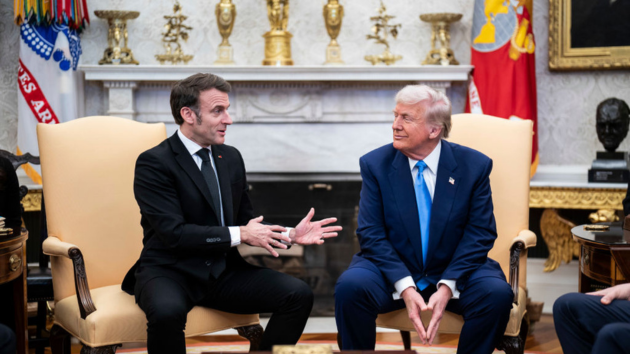
(WASHINGTON) — French President Emmanuel Macron used his visit to the U.S. to publicly push back on President Donald Trump’s repeated attacks on Ukraine, fact-checking his American counterpart in real-time and urging caution in talks with Russian President Vladimir Putin.
During their joint Oval Office appearance on Monday, Macron interrupted Trump when the latter said that Europe was being paid back 60% of the aid it contributed to Kyiv over the last three years of war.
Touching Trump’s arm to interject, Macron said, “No, in fact, to be frank, we paid. We paid 60% of the total effort: it was through, like the U.S., loans, guarantees, grants,” Macron said. “And we provided real money, to be clear.”
After Macron’s comments, Trump smiled and replied, “If you believe that, it’s okay with me.”
In a Fox News interview that also aired on Monday, Macron warned Trump to “be careful” in the nascent U.S.-Russia talks intended to end Moscow’s 3-year-old war, without the direct involvement of Ukraine or European allies.
“I think the arrival of President Trump is a game-changer,” Macron said. “And I think he has the deterrence capacity of the U.S. to reengage with Russia.”
“We want peace,” the French president continued. “And I think the initiative of President Trump is a very positive one. But my message was to say be careful because we need something substantial for Ukraine.”
Trump’s repeated demands that Kyiv repay U.S. aid given since the beginning of Russia’s invasion have strained American ties with Ukraine and with its European allies.
The White House has framed its proposed deal to secure access to hundreds of billions of dollars worth of Ukrainian resources as part of Trump’s push to recoup American wartime investment. Ukrainian officials said Monday that the deal is close to being finalized.
Trump said Monday he will soon meet with Zelenskyy, signaling the U.S. and Ukraine were “close” to a deal giving the U.S. access to profits from Ukraine’s valuable mineral resources and that Zelenskyy would come to Washington to sign it.
“I will be meeting with President Zelenskyy. In fact, he may come this week or next week to sign the agreement,” Trump said.
The president continued to focus on what he considers Ukraine’s unfair approach to U.S. and American aid during Russia’s war.
Trump again falsely claimed the U.S. has given Ukraine $350 billion during this period — a figure publicly disputed by Zelenskyy. The Kiel Institute for the World Economy estimates that the U.S. has committed about $119 billion. The majority — $67 billion — was in the form of military equipment.
The institute says that European nations — meaning the European Union, the U.K., Iceland, Norway and Switzerland — have collectively contributed around $138 billion to Ukraine, $65 billion of which was military equipment.
ABC News’ Alexandra Hutzler and Ellie Kaufman contributed to this report.