(LOS ANGELES) — Police in California discovered the body of a 51-year-old woman in the trunk of a car being driven by her 24-year-old son following a pursuit where he tried to escape authorities, police said.
The incident began on Tuesday when officers from the El Cajon Police Department were called to a “suspicious circumstance” at Motel 6, located at 550 Montrose Court in El Cajon, California.
The caller reported that he went to check on his mother who had not returned home after visiting her other son, 24-year-old Richard Leyva, who was staying at the motel. However, upon arrival, the caller said that he discovered his mother’s body in the trunk of her black Hyundai Sonata.
“Investigators have determined that an altercation then happened between the two brothers,” police said in their statement released on Wednesday. “Leyva got into the Hyundai and drove off, striking his brother in the process. The brother was uninjured.”
Police say they quickly responded to the scene and located the Hyundai when a traffic stop was attempted, but Leyva fled from the officers in the process and began to lead them on a pursuit.
“The chase ended when Leyva crashed into two other vehicles,” police continued. “He was taken into custody after officers deployed a Taser to subdue him.”
Following Leyva’s arrest, police began and inspecting the vehicle and ended up discovering the body of a deceased woman in the trunk who was later identified as 51-year-old Jamison Webster.
Her death is being investigated as a homicide, police said.
Leyva has been booked into San Diego County Jail on charges of homicide, assault with a deadly weapon, and evading law enforcement.
Detectives are continuing to investigate the circumstances that led to the woman’s death and the investigation remains open.
(WASHINGTON) — Ukraine’s President Volodymyr Zelenskyy comes to the White House on Friday to ink a deal that would give the U.S. access to his country’s mineral resources — an agreement that President Donald Trump has cast a way to ensure American taxpayers get paid back for supporting Ukraine in its war with Russia.
“We’ll be digging. We’ll be dig, dig, digging. Dig, we must,” Trump said on Thursday, saying the U.S. would be “doing a substantial amount of work” in Ukraine “taking the rare earth, which we need in our country very badly.”
“It’ll be great for Ukraine,” he continued. “It’s like a huge economic development project. So, it’ll be good for both countries.”
Zelenskyy, meanwhile, has spoken about the deal in different terms — describing it as a means to an end: keeping U.S. backing.
If not the full-fledged military security guarantee he wants, Trump administration officials have said a U.S. economic investment on the ground in Ukraine could serve as a kind of barrier to a further Russian invasion.
“I will meet with President Trump,” the Ukrainian leader said on Wednesday. “For me, and for all of us in the world, it is crucial that America’s assistance is not stopped. Strength is essential on the path to peace.”
ABC News spoke to officials and analysts to break down what’s in the deal, and what the agreement could mean for Ukraine’s future and efforts to end the war after three grueling years.
What is — and isn’t — in the deal
Officials familiar with the negotiations say that under the terms of the deal, the U.S. and the Ukraine will work together to unearth deposits of valuable minerals and other natural Ukrainian resources.
Unlike the original proposal, this framework does not call for Kyiv to use the proceeds from the sale of those resources to pay the U.S. $500 billion — which the Trump administration previously characterized as “payback” for the roughly $183 billion spent in response to Russia’s invasion, according to the U.S. special inspector general in charge of overseeing Ukrainian aid.
Instead, the deal aims to create an investment fund for Ukraine’s post-war reconstruction that will be jointly owned by both countries, they say, and that additional negotiations on the control of that fund and its operation will take place will take place after the initial deal is cemented.
Other factors will depend on the free market.
“The profitability of the fund is entirely dependent on the success of new investments in Ukraine’s resources,” said Gracelin Baskaran, the director of the Critical Minerals Security Program at the Center for Strategic and International Studies and Meredith Schwartz, a research associate at the same program.
“Therefore, the response of private industry is key to the success of the fund and will determine how much value the United States ultimately derives,” they added.
But officials say the Ukrainians also made concessions. Officials say Kyiv initially wanted the terms of the deal to include concrete security guarantees for Ukraine — something the current framework lacks.
“However, the idea is that with joint U.S.-Ukraine investment in the nation’s resources, the United States will continue to have a stake in Ukraine’s security, stability, and lasting peace and therefore be incentivized to uphold and defend Ukrainian security,” Baskaran and Schwartz said.
If it proves successful, Baskaran and Schwartz say the U.S. may boost its mineral security — but that the results could take decades to come to fruition.
“Mining is a long-term effort — so the United States may not yield benefits for another 20 years,” they said.
Trump himself has acknowledged the uncertainty.
“You know, you dig and maybe things aren’t there like you think they’re there,” he said on Thursday.
A different tune from Trump
After repeatedly bashing Zelenskyy in recent days, Trump softened his tone on Thursday.
Asked if he still believed Zelenskyy was a dictator — an assertion he made just over a week ago — Trump answered, “Did I say that? I can’t believe I said that,” before brusquely moving on to the next questioner.
Later in the day, Trump also offered praise for Zelenskyy and Ukrainian fighters’ valor on the battlefield.
“We’ve given him a lot of equipment and a lot of money, but they have fought very bravely. No matter how you figure it, they have really fought,” he said. “Somebody has to use that equipment. And they have been very brave in that sense.”
Ukrainian officials who have been urging Zelenskyy to accept the mineral pact are likely to see this turnaround as proof positive for their main argument — that signing off on Trump’s deal will boost ties between the Trump administration and Kyiv, while drawing out negotiations would further sour the president’s view of Zelenskyy.
But whether any bonhomie will last is unclear.
“Critical mineral resource access is the latest arena for Trump to focus his transactional methods of diplomacy,” Baskaran and Schwartz argue. “But the viability of the deal remains to be seen as tensions continue to rise between the two world leaders.”
Trump is not known for his patience, and some U.S. officials anticipate slow-moving results from the agreement could leave Trump frustrated.
Or, if the two clash during their high-stakes White House meeting, the president could become embittered toward Zelenskyy again even sooner where Trump is likely to spotlight potential benefits the mineral agreement holds for the U.S. and the Ukrainian leader is likely to push for additional American security guarantees.
But the president shared only positive predictions on the eve of the meeting.
“I think we’re going to have a very good meeting,” he said. “We’re going to get along really well. Okay. We have a lot of respect. I have a lot of respect for him.”
John E. Herbst, senior director of the Atlantic Council’s Eurasia Center and a former U.S. ambassador to Ukraine, argues the very fact that the meeting between Zelenskyy and Trump is taking place is a good sign for Ukraine.
“Zelenskyy’s visit highlights how far he has come from two weeks back, when Trump spoke of seeing Putin as many as three times in the near future, or even last week, when senior Russian and US officials were meeting in Riyadh,” he said. “Yet now it is Zelenskyy, not Putin, in the Oval Office.”
The other negotiations
While much of the public focus has shifted toward negotiations over the mineral deal in recent weeks, talks ultimately aimed at ultimately ending the war in Ukraine have quietly continued on a separate track.
On Thursday, American and Russian officials met in Istanbul for more than 6 hours to discuss increasing staff at their respective embassies in Moscow and Washington — a move Secretary of State Marco Rubio previously said was essential for furthering potential areas cooperation between the countries, including resolving the war in Ukraine.
Officials from sides reported a favorable outcome from the meeting, and predict that an larger diplomatic footprint could create momentum for peace talks and a potential summit between Trump and Russian leader Vladimir Putin.
As a chorus of European leaders have tried to encourage Trump to include American security guarantees for Ukraine to enforce a truce with Russia, the president has continued to say he trusts Putin to hold up his end of a deal.
“I’ve known him for a long time now,” Trump said. “I don’t believe he’s going to violate his word. I don’t think he’ll be back. When we make a deal, I think the deal is going to hold.
But ahead of his meeting with the U.K. Prime Minister Keir Starmer, he added a potentially important caveat.
“You know, look, it’s, trust and verify, let’s call it that,” he said.
Clifford D. May, founder and president of the Foundation for Defense of Democracies, argues it’s imperative that the president is clear-eyed in his dealings with Putin.
“As President Trump attempts to negotiate a halt to Russia’s war against Ukraine, it’s not unreasonable for him to show respect for Mr. Putin (as he has been) if he believes that will make Mr. Putin more likely to agree to concessions,” he said.
“But it’s imperative that President Trump harbor no illusions about Mr. Putin – about his character, ambitions, ideology, and his abiding hatred for American greatness,” May added.
Candles and messages of healing for Pope Francis are laid at the statue of John Paul II outside the Gemelli hospital where the Pope is hospitalized with pneumonia, in Rome on February 26, 2025. (Photo by ALBERTO PIZZOLI/AFP via Getty Images)
(ROME) — The Vatican press office has released a statement saying the pope had a peaceful evening of rest in hospital and is continuing his recovery in the hospital on Friday morning.
“As in recent days, the night passed peacefully and the Pope is now resting,” the Vatican said.
Officials said that Pope Francis’ condition continued to improve on Thursday, with the pontiff alternating between high-flow oxygen therapy and a ventimask, according to the Vatican.
“Given the complexity of his clinical condition, further days of clinical stability are needed to clarify the prognosis,” the Vatican said.
“For the second time, there is no mention of a critical condition,” Vatican sources told ABC News. “So we can say that we have come out of the most critical phase and we are back to what was previously described as a complex picture.”
On Thursday, the pope dedicated the morning to respiratory physiotherapy and rest. After a session of physiotherapy, in the afternoon, he gathered in prayer in the chapel of the private apartment on the 10th floor, receiving the Eucharist. The pope then dedicated himself to work activities, according to the Vatican.
“The bulletin again speaks of an improvement, a slight one, but an improvement, but the fact that the prognosis is reserved means that the doctors still have concerns,” Vatican sources told ABC News.
The pontiff, who has led the Catholic Church since 2013, was diagnosed with pneumonia last week, according to the Vatican.
Actor Gene Hackman and wife Betsy Arakawa pose for a portrait in 1986 in Los Angeles, California. (Photo by Donaldson Collection/Michael Ochs Archives/Getty Images)
(LOS ANGELES) — Authorities are searching for answers into the death of actor Gene Hackman, 95, who along with his wife, Betsy Arakawa, 65, were mysteriously found dead alongside a dog in their Santa Fe, New Mexico, home on Wednesday.
The couple was found on Wednesday during a welfare check with no obvious signs of how they died, according to the Santa Fe County Sheriff’s Office.
However, their deaths were “suspicious enough in nature to require a thorough search and investigation” due to all of the “circumstances surrounding” the scene, according to the search warrant affidavit.
There was no external trauma to either of them which led officials to conduct carbon monoxide and toxicology with the official results pending, the sheriff’s office said.
Hackman was discovered on the floor in the mud room, according to the search warrant. It appeared he fell suddenly, and he and his wife “showed obvious signs of death,” the document said.
Arakawa was found lying on her side on the floor in a bathroom, with a space heater near her body, according to the search warrant, and her body showed signs of decomposition due to some mummification to her hands and feet.
On the counter near Arakawa was an opened prescription bottle, with pills scattered, according to the search warrant.
A German shepherd was found dead about 10 to 15 feet from Arakawa, the document said. That dog was in a crate or a kennel, according to Santa Fe County Sheriff Adan Mendoza.
The Santa Fe City Fire Department found no signs of a possible carbon monoxide leak or poisoning, the document said. But, if there was carbon monoxide at the scene, it could have vented out of the home through the open front door before responders arrived.
New Mexico Gas Company also responded, “As of now, there are no signs or evidence indicating there were any problems associated to the pipes in and around the residence,” the document said.
Two maintenance workers said they hadn’t heard from Hackman and Arakawa in about two weeks, the document said.
A maintenance worker who initially responded to the home found the front door open but there were no signs of forced entry or that anything had been stolen, the document said.
There was no indication of a crime and “there could be a multitude of reasons why the door was open,” the sheriff told reporters Thursday.
There was “no obvious sign or indication of foul play,” but authorities “haven’t ruled that out yet,” the sheriff said.
Investigators are “keeping everything on the table,” he added.
ABC News’ Kevin Shalvey, Erica Morris and Emily Shapiro contributed to this report.
The main gate at the prison in Guantanamo at the US Guantanamo Naval Base on October 16, 2018, in Guantanamo Base, Cuba. (Photo by SYLVIE LANTEAUME/AFP via Getty Images)
(NEW YORK) — When Jose, a Venezuelan migrant who was seeking asylum in the United States, was awoken by an Immigration and Customs Enforcement official at 2:30 a.m. on Feb. 8, he sensed he was being sent to Guantanamo Bay, home of the notorious U.S. prison camp that administration officials said would house the most violent “worst of the worst” migrants apprehended on American soil.
“When we got on the [military] plane, they put restraints on our hands, feet, and waist,” said Jose, who requested that his last name not be used out of fear of retribution. “They searched us and then sat us in a chair, tying us to it and binding our feet together. We hoped it wouldn’t be Guantanamo but in the end, that’s where we ended up.”
Jose is one of the more than 170 migrants who spent two weeks at the naval base before being sent to Venezuela. He told ABC News that while he had a suspicion he was being sent to Guantanamo, he claims U.S. officials never told him and the other migrants where they were being sent.
“Our minds were racing, thinking we were kidnapped, wondering who would get us out of there,” said Jose. “Because no one tells you anything.”
Jose told ABC News that he had traveled to Mexico’s northern border to wait for an asylum appointment that he requested through the U.S. Customs and Border Protection app, prior to it being shut down by the Trump administration. After three weeks of waiting and “no food or a place to stay,” he decided to surrender to authorities at the U.S. southern border. He was detained at a detention center until he was transferred to Guantanamo.
ABC News spoke with Jose and another Guantanamo detainee, Jhoan Bastidas Paz, in Spanish, and reviewed court testimonies from three other detainees about their experience on the naval base before they were released. They allege U.S. officials transferred them to Guantanamo despite their having no criminal records, and several claim they were denied phone calls with their attorneys and relatives despite repeated demands.
“From the moment we were there, we tried to kick the doors, we went on countless strikes,” Jose said. “We clogged the toilets and protested, we covered the cameras because the confinement is unbearable.”
Jose told ABC News the room in which he was placed had “cobwebs and a disgusting smell.” He said that he spent 10 days without a mattress.
“They give you food … but it’s like they don’t give you any, [it’s] very little food,” Jose said. “There came a point where I would lick the plate. The food had no salt, but I would still eat it as if it were very tasty, because I was hungry.”
Jose said he and the other detainees were only allowed outside twice in two weeks and were denied phone calls with their relatives and families.
“There are four cages outside,” Jose said. “That’s the yard. You leave one room to go into another cell.”
Representatives from the Department of Homeland Security did not respond to a request for comment from ABC News.
Bastidas Paz had surrendered to authorities after crossing the U.S. southern border from Mexico in 2023. He was charged with “improper entry” to which he pleaded guilty, and was in a detention center in El Paso, Texas, until he was transferred to Guantanamo Bay.
Both Jose and Bastidas Paz told ABC News they are not members of the Venezuelan gang Tren de Aragua, despite the U.S. government saying they are.
“We’re not from Tren de Aragua or anything, we’re not criminals, we’re immigrants,” Bastidas Paz said. He said that officials never told him he was being sent to Guantanamo and then to Venezuela.
“I don’t think it’s fair that they’re taking us there, like that, with lies, because practically we’re being taken there, kidnapped, without telling us anything, and when we realize it, they leave us there, and I don’t think it’s fair,” Bastidas Paz said.
Bastidas Paz told ABC News that he went on a hunger strike with other detainees while they demanded information from officials. He also claims he was only allowed to shower three times during the time he was in Guantanamo.
“We are immigrants and we haven’t committed any crime to be taken to that very ugly prison,” Bastidas Paz said.
Jose said he has not been able to sleep since he arrived in Venezuela.
“I haven’t slept at all because of the fear that I might fall asleep and … I’d wake up back there,” he told ABC News. “That’s the terror I feel.”
(WASHINGTON) — The Department of Justice released files related to disgraced financier Jeffrey Epstein Thursday evening.
The material released contained previously published pilot logs from the prosecution of Ghislaine Maxwell. The records include redactions performed by prosecutors on the case to protect the identities of potential victims. Also published is Epstein’s so-called “black book” that has previously been made public.
One document never before seen is what the Justice Department is calling “Evidence List,” a three-page catalog of material apparently obtained through searches of Epstein’s properties in New York and the U.S. Virgin Islands.
Among the items investigators obtained, according to the document, is “one CD labelled ‘girl pics nude book 4′” and a folder titled “LSJ logbook,” which appears to be a reference to Epstein’s private island, Little St. James.
Investigators also recovered a bag “containing one yellow envelope marked ‘SK’ dated 08/27/08 containing multiple smaller envelopes containing $17,115” in U.S. currency.
The date is notable because it coincides with the time Epstein was in jail in Palm Beach, Florida. SK could be a reference to one of Epstein’s former associates.
The evidence list also contained dozens of recording devices, computers, hard drives and memory sticks along with “1 brown bust sculpture of female breasts,” one folder containing “1 vibrator, 3 buttplugs, 1 set of cuffs, 1 dildo, 1 leash, 1 box of condoms, 1 nurse cap, 1 stethoscope.”
The list also included several massage tables – one of which was wheeled into court during Maxwell’s trial – numerous photo albums and pictures, including one that said “photo album of girl and Epstein” and a bag containing “1 set of copper handcuffs and whip.”
Attorney General Pam Bondi had instructed FBI Director Kash Patel to investigate what she describes as an apparent withholding of investigative files related to Epstein.
In her letter to Patel, Bondi said prior to his confirmation she had requested all files related to Epstein — but late Wednesday evening was informed by “a source” that the FBI field office in New York was in possession of “thousands of pages of documents” that had not been handed over.
In recent media appearances on Fox News, Bondi has teased out the pending release of documents in the Justice Department’s holdings related to its investigation of Epstein, who died by suicide in August 2019 while awaiting trial.
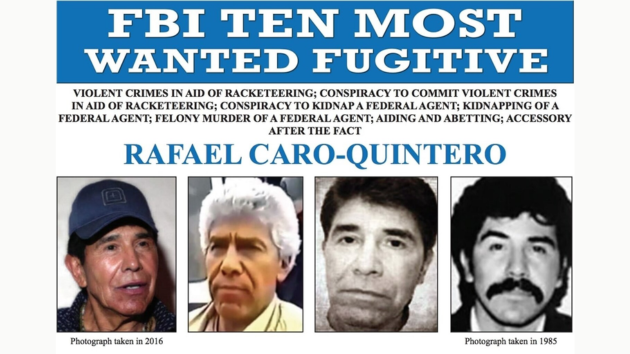
Rafael Caro Quintero is one of the most-wanted individuals by U.S. law enforcement after torturing and killing a Drug Enforcement agent in 1985. (Provided by the FBI)
(WASHINGTON) — A once-powerful drug lord convicted of one of the most notorious killings in the history of the Mexican narco wars is among 29 individuals Mexico transferred Thursday to the United States, law enforcement sources told ABC News.
Among those extradited is Rafael Caro Quintero, who was convicted of the 1985 torture and murder of U.S. Drug Enforcement Administration agent Enrique “Kiki” Camarena.
Camarena joined the DEA in 1974, the year after its founding.
For more than four years in Mexico, Camarena investigated the country’s biggest marijuana and cocaine traffickers.
In early 1985, close to unlocking a multibillion-dollar drug pipeline, he was kidnapped while headed to a luncheon with his wife. His capture and torture were dramatized in Season 1 of the Netflix show “Narcos.”
Quintero was arrested in Mexico and convicted of Camarena’s murder later that same year.
He was released in 2013 after serving 28 years of his 40-year sentence when a Mexican judge ruled that he had been improperly tried. Quintero promptly went into hiding, as U.S. officials stridently condemned the release.
In 2018, he was added to the FBI’s 10 Most Wanted list, with a $20 million reward available for information leading to his arrest or capture.
At the time, the FBI said that he was allegedly involved in the Sinaloa cartel and the Caro-Quintero drug trafficking organization in the region of Badiraguato in Sinaloa, Mexico, and warned that he should be considered “armed and extremely dangerous.”
The criminal ringleader was once again detained in Mexico in 2022, nearly 10 years after his release.
“We will be seeking his immediate extradition to the United States so he can be tried for these crimes in the very justice system Special Agent Camarena died defending,” a statement from then-Attorney General Merrick Garland read.
That effort was fulfilled Thursday, following a staunch effort on behalf of President Donald Trump’s administration to work with Mexico to curb cartels’ activity — including the decision to designate them foreign terrorism organizations.
“Beyond the name that they give, we share with the U.S. government the fight against these groups due to the violence that they leave in the country,” Mexican President Claudia Sheinbaum said in February.
The extradition comes less than a week before the U.S. is set to impose 25% tariffs on its southern neighbor.
The other 28 individuals extradited to the U.S. alongside Quintero were wanted for their links with criminal organizations for drug trafficking and other crimes, according to Mexican sources.
Notable among them are: José Ángel Canobbio Inzunza (El Güerito), El Chapito’s right-hand; Antonio Oseguera (Tony Montana), brother of wanted drug lord El Mencho from the Jalisco New Generation cartel; Miguel Ángel y Óscar Omar Treviño Morales (Z40 y Z42) from Los Zetas; and Vicente Carrillo Fuentes (El Viceroy) from the Juárez cartel.
Quintero is expected to be arraigned in Brooklyn Federal Court late Friday morning. DEA agents are expected to pack the courtroom and speak outside court after the arraignment.
ABC News’ T. Michelle Murphy contributed to this report.
Allen J. Schaben/Los Angeles Times via Getty Images
(LOS ANGELES) — Former Los Angeles Fire Chief Kristin Crowley is appealing her dismissal, nearly a week after Mayor Karen Bass removed her from the top post in the wake of the devastating Palisades and Eaton fires.
Crowley sent a letter to the Los Angeles City Council on Thursday, informing them she is proceeding with an appeal of Bass’ removal of her as fire chief.
According to the Los Angeles City Charter, the appeal would require the approval of two-thirds of the 15 city council members to overturn the firing.
In response, a spokesperson for Bass’ office said in a statement, “Former Chief Crowley has the right to appeal her dismissal.”
Bass removed Crowley from her position on Friday, saying firefighters were sent home instead of being used when the deadly fires broke out last month.
“We know that 1,000 firefighters that could have been on duty on the morning the fires broke out were instead sent home on Chief Crowley’s watch,” Bass said in a statement. “Furthermore, a necessary step to an investigation was the President of the Fire Commission telling Chief Crowley to do an after action report on the fires. The Chief refused. These require her removal.”
Ronnie Villanueva, a retired LA Fire chief deputy of emergency operations, was appointed interim chief.
Crowley exercised her civil service rights to stay with the department at a lower rank with duties to be assigned by the new interim chief, according to the mayor’s office.
The former chief said it was an “absolute honor to represent and lead the men and women of one of the greatest fire departments in the world.”
“I am extremely proud of the work, sacrifice and dedication of our LAFD members, both sworn and civilian,” she said in a statement on Saturday.
Crowley’s dismissal as chief was met with criticism by Freddy Escobar, the president of the United Firefighters of Los Angeles City.
“Chief Crowley is a strong leader who has the respect of our firefighters and wasn’t afraid to tell the truth,” he said in a statement on Saturday. “She’s being made a scapegoat from a devastating fire without the benefit of a full investigation into what actually happened.”
Bass has faced tremendous pressure and questions surrounding her decision to attend an event in Ghana when the fires broke out on Jan. 7, despite days of warnings about the unprecedented weather event that drove the fires.
Crowley openly criticized Bass in a local TV interview on Jan. 10, saying Bass had failed the city, citing funding and staffing of the fire department.
Bass said she has not cut the fire department budget while in office.
At least 29 people died as multiple wildfires — fueled by severe drought conditions and strong winds — raged across Southern California in January.
The largest of the fires in Los Angeles County — the Palisades Fire in the Pacific Palisades neighborhood — began on Jan. 7 and spread to 23,707 acres. The fire remained active for 44 days. The cause of the fire is still under investigation.
The second largest of the fires — the Eaton Fire, north of Pasadena — also began on Jan. 7 and spread to 14,021 acres. It remained active for 44 days and the cause of the fire remains under investigation.
ABC News’ Mark Osborne, Nadine El-Bawab and Bonnie Mclean contributed to this report.
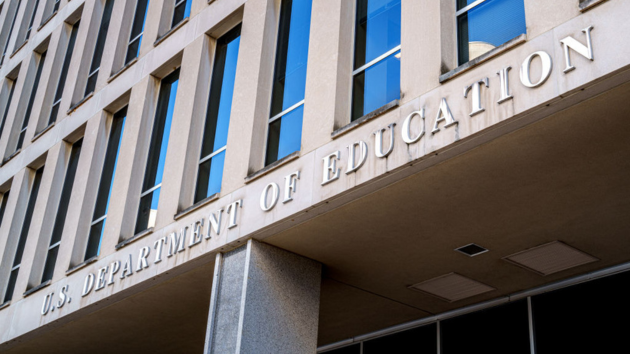
(WASHINGTON) — The Department of Education launched a first-of-its-kind website, “EndDEI.Ed.Gov,” just hours before a deadline warning institutions to end discrimination or they will be subject to federal funding consequences.
The new online portal went live on Thursday for the community to submit discrimination-focused complaints.
“The Department of Education will utilize community submissions to identify potential areas for investigation,” the new website said. The Education Department also vowed to maintain the confidentiality of the submissions to the fullest extent permitted by law.
“DEI needs to go,” Moms for Liberty co-founder Tiffany Justice, who helped orchestrate the launch of the site, told ABC News. “DEI has re-segregated our schools in many ways, and our children are forced to see race in ways that they never did.”
The conservative firebrand, who called herself a messenger for parents, said she’s been working on the website for a long time. Justice added that the site demonstrates that President Donald Trump’s Department of Education is putting power back in the hands of parents.
“For years, parents have been begging schools to focus on teaching their kids practical skills like reading, writing and math, instead of pushing critical theory, rogue sex education and divisive ideologies — but their concerns have been brushed off, mocked or shut down entirely,” Justice said in the release.
The new website says, “Schools should be focused on learning,” and has four boxes to fill out, including email, school district, ZIP code and description of complaint. At the bottom of the site, there’s a spot to upload an optional file.
The launch comes as a 1,000-word “Dear Colleague” letter sent by acting Assistant Secretary for Civil Rights Craig Trainor emphasized the agency will strictly enforce the Title VI civil rights law stressing that discrimination on the basis of race is “illegal.” The letter is critical of diversity, equity and inclusion practices and programs, which conservatives have criticized for years.
But education advocates decried the letter for its attacks on DEI. The Education Trust Senior Vice President Wil Del Pilar told ABC News that DEI was designed to “provide opportunities.”
“The whole point of these types of policies is, No. 1, to end segregation, right?” Del Pilar said. “Programs that were designed to provide opportunities or to create awareness for folks were designed to improve diversity at those institutions, not to further harm diversity at the institution.”
And education groups opposing the memo, including the American Federation of Teachers, sued the department, acting Education Secretary Denise Carter and Trainor because it could “irreparably harm” students and educators, according to the lawsuit. The lawsuit said the memo chills free speech and violates the First Amendment, and it labeled the letter as vague and unconstitutional.
National Parents Union President Keri Rodrigues said the Trump administration has struck a tone of retribution with its recent actions and that the nation’s most vulnerable students will be harmed if the department goes after school districts.
“I just think that they’re looking for any weapon to attack and cause chaos,” Rodrigues told ABC News. “And basically, this [deadline] is just going to be adding another log to the fire at this point.”
Cato Institute education analyst Neal McCluskey said “Dear Colleague” letters are inherently nebulous and don’t have the force of law.
“They’re basically the administration telling you this is how we’re going to enforce the law,” McCluskey told ABC News. “It itself doesn’t have any force of law. It’s really just informing people, ‘Hey, we have a new view of what the regulations are.'”
The letter gave institutions a Feb. 28 deadline to comply with the Department of Education.
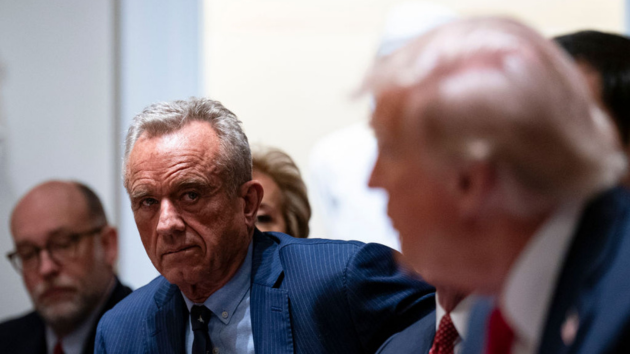
(WASHINGTON) — In his first public comments on the measles outbreak hitting West Texas and New Mexico, Health and Human Services Secretary Robert F. Kennedy Jr., a prominent vaccine skeptic whose first steps in combatting the outbreak will be closely watched, said his department was monitoring the situation daily but called it “not unusual.”
“Incidentally, there have been four measles outbreaks this year in this country. Last year there were 16. So, it’s not unusual, we have measles outbreaks every year,” Kennedy said Wednesday at the White House.
However, some public health experts were quick to point out that the outbreak in Texas has defied America’s recent history with highly contagious disease.
Prior to this outbreak, the U.S. had not seen a death from measles since 2015. And in 2000, years after the U.S. implemented a two-dose vaccine schedule, measles was declared eliminated from the U.S., meaning that the disease had stopped spreading within the country.
Only in recent years have cases and outbreaks been rising, according to data from the Centers for Disease Control and Prevention.
The outbreak in West Texas and New Mexico is already drawing close to the halfway mark of total cases seen nationally last year, when there were at least 285 cases of measles – which were also the highest numbers since 2019, according to the CDC’s latest figures.
And while there were 16 outbreaks last year, that was a four-time increase from the number of outbreaks in 2023, when there were just four outbreaks. The U.S. has nearly hit that 2023 number already, just two months into 2025.
Dr. Paul Offit, director of the Vaccine Education Center and an attending physician in the Division of Infectious Diseases at Children’s Hospital of Philadelphia, called Kennedy’s comments about measles cases happening “every year” an attempt to normalize an outbreak that has been anything but normal.
“First of all, we eliminated measles from this country by the year 2000. The reason measles have come back is because a critical percentage of parents have chosen not to vaccinate their children, because they’ve gotten misinformation and disinformation from people like him and his Children’s Health Defense,” Offit told ABC News.
Children’s Health Defense, a group founded by Kennedy, advocates against the recommended vaccine schedule for children.
“It’s unconscionable enough that he’s done that, but that he sort of glibly says, well, measles outbreaks occur every year — the point is they don’t have to occur at all, because we’ve shown we could eliminate this disease,” Offit said.
ABC News has reached out to HHS about RFK Jr.’s comments.
The increase in cases and outbreaks over the last few years coincides with decreasing vaccination coverage for measles among kindergarteners nationally from 95.2% during the 2019-2020 school year to 92.7% in the 2023-2024 school year – leaving about 280,000 kindergartners at risk, according to the CDC.
Kennedy, prior to taking his role as HHS secretary, said the measles vaccine is effective at preventing measles, but has also suggested that it’s not necessary because people who die from measles are typically malnourished or have other comorbidities.
“The measles vaccine definitely eliminates measles, or, you know, close to eliminates it,” Kennedy said in 2022.
But he went on to question the deadliness of the disease.
“In 1963, it was killing only 400 kids a year. Mainly, they were kids who had malnutrition, or had some other devastating co-morbidity,” Kennedy said. “Those were the kids who were dying.”
Kennedy has also questioned that the deaths of 83 people – mostly young children – in Samoa in 2019 were caused by measles, despite widespread evidence that the deaths were due to an outbreak of the disease caused by under-vaccination in the American territory.
“Nobody died in Samoa from measles. They were dying from a bad vaccine,” Kennedy told an interviewer last year.
20% of kids with measles in the U.S. require hospitalization, said Dr. Peter Hotez, co-director of the Texas Children’s Hospital Center for Vaccine Development and dean of the National School of Tropical Medicine at Baylor College of Medicine, often for measles pneumonia, measles diarrhea, measles encephalitis or deafness from measles otitis, an ear infection — many of which can be life-threatening conditions.
“This is a bad, bad actor. And I’m really concerned that this thing is continuing to accelerate and expand,” Hotez said Wednesday night in an interview on MSNBC.
Doctors in West Texas have described shock and feaver-treating a disease they thought was something of the past.
“This is the first time I’ve had any professional experience with a measles outbreak,” Dr. Lara Johnson, pediatrician and Chief Medical Officer at Covenant Children’s and Covenant Health in Lubbock, who is currently treating measles patients from the outbreak in West Texas, told ABC news.
“I saw one travel-related case when I was in medical school, very briefly, but at that time, back in around 2000, we really thought that we’d eradicated measles from the United States and didn’t have any anticipation of seeing any outbreaks here,” she said.
The outbreak in Texas is a prime example of the risk posed to unvaccinated communities. Vaccine exemptions among children in Gaines County, the epicenter of the outbreak, have grown dramatically in the past few years. Roughly 7.5% of kindergarteners had filed an exemption for at least one vaccine in 2013. 10 years later, that number rose to over 17.5% – one of the highest in all of Texas, state health data shows.
As the response to the outbreak in Texas and New Mexico continues, with cases expected to significantly rise, public health experts like Hotez and Offit say they’re watching Kennedy, as leader of the nation’s health department, to encourage swift surveillance and widespread vaccination.
“I want him to say to the American public that there’s a safe way to prevent these outbreaks from happening so that we don’t have the tragedy like what just happened in West Texas,” Offit said. “There’s so much in medicine you don’t know. There’s so much we can’t do. This we know. This we can do.”