
Copyright © 2025, ABC Audio. All rights reserved.

Copyright © 2025, ABC Audio. All rights reserved.

(NEW YORK) — Dr. Kimberly Shriner remembers the first COVID-19 patient who came into Huntington Hospital in Pasadena, California, in March 2020.
He was a 35-year-old man who arrived at the hospital short of breath.
“He went straight to our intensive care unit. We were very suspicious that he had COVID,” Shriner, an infectious disease specialist and the hospital’s medical director of infectious disease and infection prevention, told ABC News.
Testing was minimal at the time, but eventually the results came back and confirmed that he had COVID. The patient was eventually sedated and intubated, and he died 24 hours later. Shriner said the next few patients admitted to the hospital for COVID-19 followed similar trajectories, becoming more and more short of breath before eventually dying of their illness.
“As physicians, we understand death,” Shriner said. “We understand that we can’t save every patient, but when you’re having 100% mortality with your first experience with this thing, it was pretty overwhelming and daunting. That first week [was] particularly surreal.”
Tuesday, March 11, marked five years since the World Health Organization (WHO) declared the global outbreak of COVID-19 to be a pandemic. The U.S. is in a much better situation now, with fewer hospitalizations and deaths — and vaccines to prevent severe illness from COVID, frontline health care workers say.
However, they add that, as Americans become more removed from the early days of COVID, it may be hard to remember what it was like — especially for those who were treating patients.
“Everybody was worried, doctors, nurses,” Dr. Matthew Sims, director of infectious disease research for Corewell Health, a non-profit health care system located in Michigan, told ABC News. “It was absolutely crazy, and I think that people have forgotten. I think people have forgotten the horror of what COVID was like in the beginning and, I mean, it was a horror situation.”
Quickly changing world
Shriner said one of the indicators of how quickly the world was changing was the evolution of her hospital’s meetings about the virus and how to prepare as information was starting to come out of China.
“Meetings were held in a very tiny, little meeting room. Nobody was wearing masks or anything,” she said. “And then as things began to evolve, and we saw it was happening, that the rooms got started getting bigger, and then we started meeting with masks on, and then, eventually, went virtual.”
Shriver recalled that the situation was “very terrifying” on a personal and professional level.
“If we’d known how difficult it was going to be, I think we would have been even more disturbed,” she said.
Sims said it became clear how quickly patients could get infected in March 2020. Not long after the WHO declared a global pandemic, he came on shift that week to be the infectious disease doctor rotating in the hospital.
“We had two confirmed cases admitted at that point. By the end of the week I spent on, we had over 100 confirmed cases admitted,” he told ABC News. “It was absolutely devastating to the hospital, to the health care system as a whole … It was a crazy time.”
The state of hospitals
Both Sims and Shriner said the lack of early testing at the time was a source of frustration. Since routine testing wasn’t available, results often took days — or even weeks — to return.
Additionally, hospital labs often had to confirm results with state departments of health.
Sim said as the hospitals became full, it sometimes became a race against the clock to try and treat patients.
“I remember one of the most devastating cases I saw was a young man, relatively young, young kids at home,” he said. “A little overweight, I think he was a diabetic, but he just got super sick, and we were trying to get remdesivir, which was compassionate use at the time,” referencing an antiviral drug later approved to treat COVID-19.
Sims said the hospital had to call up the company manufacturing the drug, tell them about the patient and then get approval from the U.S. Food and Drug Administration (FDA) to use doses on the patient.
“And we got approval, and then they have to ship it to us,” Sims said. “It was all being shipped as fast as possible, but before it could even get here, that patient got too sick to even use it, and the patient died. A week before, he was home with his kids, his wife, et cetera, in normal state of health, and then, all of a sudden, got this terrible virus and died.”
As it became clear how contagious the virus was, hospital staff were required to always wear masks. Shriner said she still has a scar or imprint on her nose from having to wear a mask for 18 hours a day.
One of things she remembers most was the lack of sound, other than machines, whenever she visited ICUs.
“As the months progressed, we ended up having six different intensive care units because the patients were so sick,” she said. “We had many, many patients that were on ventilators. You’d walk into these areas, and it was just silence. All you heard were the ventilators going and seeing people in full protective gear all the time.”
To handle the influx of patients, both hospitalized and in emergency departments, Shriner said her hospital stopped all non-emergency surgeries to be able to have extra physicians available.
COVID-19 vaccines arrive
On Dec. 11, 2020, the FDA granted Pfizer-BioNTech the first emergency use authorization for a COVID-19 vaccine for those aged 16 and older. Three days later, nurse Sandra Lindsay became the first person to receive a COVID-19 vaccine in the U.S. as distribution began.
Both Shriner and Sims felt a sense of relief that a tool was finally available to help stem the spread of disease.
Shriner said she was the first person in her hospital to receive the COVID-19 vaccine, even though she didn’t want to be.
“I didn’t want to be the first person. I was perfectly fine with letting other people go ahead of me,” she said. “And [the CEO] said to me, ‘You have to be.’ She said, ‘If you don’t get vaccinated, nobody else is going to do it.'”
Shriner said the distribution of the vaccine “was a sign of the way out. It was very hopeful.”
Lessons learned
Both Sims and Shriner say COVID-19 taught health care workers many lessons, including how to share information quickly, how to diligently monitor diseases and how to scale up health care capacity.
Sims said another valuable discovery was better communicating to the public that information during a public health crisis can change rapidly.
One example is that early studies would come out suggesting certain drugs might help treat patients. Eventually additional information would be published proving the opposite.
“We were learning, and we were learning in such a rapid [way], it was hard to communicate,” he said. “I think if we had any failure, it was that in that rapid push to communicate.”
Sims noted how that created some uncertainty.
“We didn’t get the message across enough that some of what we’re learning may be wrong, and we will tell you that as we learn,” Sims said. “We’re going to tell you what we know now that may not be the same thing we know tomorrow.”
Shriner added that stay-at home orders and lockdowns were hard on people and, if another pandemic happens, she is hopeful there would be different decisions on what should be locked down.
“Maybe we don’t have such stringent lockdown rules and isolation rules,” she said. “You know, the outdoor restaurant became a great thing. You know, think of all the home delivery services really took off. And so, a lot of good things came out of it, but they were hard won.”
Copyright © 2025, ABC Audio. All rights reserved.

(NEW YORK) — At least one person is dead after severe weather hit Butler County, Missouri on Friday night, officials said.
There were previous reports of three deaths due to the storm, but Robert Myers with the Butler County Emergency Management Agency confirmed to ABC News that there was some miscommunication in the field and when comparing notes with the sheriff and coroner.
Emergency management is working through the damage now this morning, but Myers said daylight will give them a better idea of the amount of destruction.
The Black River Coliseum has been opened as shelter and Myers said that there are people with injuries in nearby hospitals but did not have an exact number.
Millions of Americans across the country are on alert for a severe weather outbreak as violent, long-track tornadoes with damaging winds of up to 80 mph and large hail is expected across the Midwest and South as the cross-country storm moves east.
There is a rare high risk warning issued for violent tornadoes in Mississippi and Alabama on Saturday afternoon and into the evening.
So far there have been 23 reported tornadoes overnight across four states – Missouri, Arkansas, Illinois and Mississippi as the severe weather outbreak continues into Saturday. Winds gusted up more than 80 mph causing damage in the Midwest from Missouri to Wisconsin.
Tornado watches remain in effect for parts of five states, from Alabama to Ohio, as the storm pushes eastward on Saturday with gusts of winds over 70 mph in some areas.
The Storm Prediction Center said that numerous significant tornadoes, some of which could be long-track and potentially violent, are expected and cities in the high risk areas include Hattiesburg, Jackson, Tuscaloosa and Birmingham.
The most dangerous tornado threat should begin Saturday during the late morning to early afternoon hours in Louisiana and Mississippi before spreading into Alabama late afternoon into the evening, followed by the western Florida panhandle and into western Georgia through late Saturday night.
The severe storms are expected to be weaker on Sunday as the storms reach the East Coast from Florida to the Mid-Atlantic.
Damaging winds, large hail and brief tornadoes on Sunday afternoon will be possible for the Southeast, while heavy rain and damaging wind threat will reach the Northeast Sunday evening into the overnight.
The severe weather outbreak is all part of a major cross-country storm system that is also prompting fire danger and red flag warnings across the Plains.
Copyright © 2025, ABC Audio. All rights reserved.

(WASHINGTON) — House Minority Leader Hakeem Jeffries tussled with reporters Friday, pushing back against the notion that the Democratic Party is fractured as some Senate Democrats, including their leader, were on the cusp of joining Republicans to avert a government shutdown.
“Is it time for new leadership in the Senate?” a reporter asked.
“Next question,” Jeffries answered, notably withholding his public support for Senate Minority Leader Chuck Schumer.
“There are some colleagues of yours here in the House that are feeling betrayed. Is that what you’re feeling right now?” another reporter asked.
“The vote hasn’t happened yet,” Jeffries said.
“Have you lost confidence in him — since you guys see this so differently?” a reporter asked.
“Next question,” Jeffries repeated, dismissing the biting query.
“None of you are willing to say at this point that you have confidence in Chuck Schumer as leader?” Rachael Bade, an ABC News contributor and Politico’s Capitol bureau chief and senior Washington columnist, asked.
“You keep engaging in these parlor games because you want to take the focus off the American people,” Jeffries dodged.
It was a common strategy from Jeffries, who repeatedly rejected attempts from reporters to learn more about the divisions between House Democrats and Schumer, who announced Thursday that he would vote to keep the government open.
Schumer’s announcement has been met with full-throated criticism from House Democrats, who were powerless to block Republicans from passing the measure earlier this week.
“House Democrats are here. We’re ready to pass a four week spending bill that keeps the government open and will allow the House and the Senate to negotiate an actual agreement that meets the needs of the American people,” Jeffries, D-N.Y., said. “But we do not support a bill that is designed to hurt the American people that Donald Trump and far right extremist Republicans are trying to jam down the throats of everyday Americans.”
Jeffries continued to push for a month-long stop-gap measure, holding out hope that Senate Democrats will stop the bill from passing and appropriators will reconvene bipartisan negotiations.
“We’ll see what happens over in the Senate, there are still undecided and undeclared senators, and we anxiously await that vote,” Jeffries said.
As the caucus melts down internally over Schumer’s decision, House Democratic leaders returned to the Capitol fired up Friday morning following their caucus retreat in Leesburg, Virginia this week.
“What the American people need to know is that House Democrats are willing to work in a bipartisan way to keep government open for 30 days,” House Democratic Caucus Chairman Pete Aguilar, D-Calif., said. “That’s all we want. That’s our solution.”
While Schumer’s influence over his caucus remains to be seen ahead of the planned vote this afternoon, House Minority Whip Katherine Clark also dismissed the so-called “parlor game” dividing the Democratic Party — and downplayed Schumer’s national celebrity and influence – even though he’s served in the Senate for a quarter century and been the party leader since 2017.
“Most American people, they can’t name us. They don’t know who Chuck Schumer is, but they do know what this administration and Elon Musk and the GOP are planning for them,” Clark, D-Mass., said.
When asked if he’s afraid to say if he has confidence in Schumer, Jeffries grew defensive if not outright angry.
“Do not characterize my remarks. I am not afraid about anything, anything. I was very clear that we look forward to working with every single one of our Senate Democratic colleagues, every single one of them to push back against the Trump administration,” Jeffries said on-camera, leaving the newser in a gaggle with reporters.
“Do you think this is what the American people care about right?” Jeffries quipped, when pressed again on his confidence in Schumer.
Copyright © 2025, ABC Audio. All rights reserved.

(WASHINGTON) — Ten Senate Democrats provided the necessary votes to allow the House-approved government funding bill to advance on Friday afternoon, setting the government funding bill on a glide path to final passage before a deadline at the end of the day Friday.
In a test vote, the Senate voted 62 to 38 to advance the bill — with 60 votes needed to advance it. Democrats voted with Minority Leader Chuck Schumer to keep the funding bill moving forward, despite blowback from other members of their party.
While the test vote wasn’t on the final passage of the funding bill, it’s an indicator of how the final vote will go. With the passage of the key procedural hurdle, it’s almost certain to eventually pass.
The vote comes after Schumer took to the Senate floor Friday morning to defend his decision to support the Republican short-term funding bill — a move that has drawn criticism from other Democrats.
His surprise reversal, first announced Thursday evening — a day after he said he and Democrats would try to block the bill — means there will almost certainly be enough Democratic votes to advance the measure to a final Senate vote Friday just hours before the shutdown deadline.
“As everyone knows, government funding expires at midnight tonight. As I announced yesterday, I will vote to keep the government open. I believe it is the best way to minimize the harm that the Trump administration will do to the American people,” Schumer said Friday.
He said he believes the short-term funding bill — or continuing resolution — is a “bad bill” but said he believes if the government were to shut down, it would be a far worse outcome for the country.
“The CR is a bad bill. But as bad as the CR is, I believe allowing Donald Trump to take even much more power via a government shutdown is a far worse option,” Schumer said.
Schumer said he believes a government shutdown would mean President Donald Trump and Elon Musk and his Department of Government Efficiency (DOGE) would have even more authority to “destroy vital government services at a much faster rate.”
He said they would also have the power to determine which federal employees are considered essential — potentially giving them more power to lay off or fire more government workers and shutter federal agencies.
“A shutdown would allow DOGE to shift into overdrive. Let me repeat, a shutdown will allow DOGE to shift into overdrive. It would give Donald Trump and DOGE the keys to the city, state and country,” he said. “Donald Trump and Elon Musk would be free to destroy vital government services at a much faster rate than they can right now and over a much broader field of destruction that they would render.”
He continued, “In a shutdown, Donald Trump and DOGE will have the power to determine what is considered essential and what is not and their views on what is not essential would be mean and vicious and would decimate vital services and cause unimaginable harm to the American people.”
“Musk has told everybody he wants a shutdown because he knows it will help him achieve his horrible goal of just decimating the federal government from one end to the other. In other words, if government were to shut down, DOGE has a plan in place to exploit the crisis for maximum destruction,” Schumer said.
“A shutdown would be the best distraction Donald Trump could ask for,” he added.
Schumer also defended some of his Senate Democratic colleagues who have come out opposed to the short-term funding bill. He acknowledged the tough decisions they as a caucus had to weigh.
“Our caucus members have been torn between two awful alternatives, and my colleagues and I have wrestled with which alternative would be worse for the American people,” Schumer said.
Trump praised Schumer in a post on his social media platform on Friday, saying it took “guts” for the New York senator to signal his support for the GOP bill.
“Congratulations to Chuck Schumer for doing the right thing — Took “guts” and courage! The big Tax Cuts, L.A. fire fix, Debt Ceiling Bill, and so much more, is coming,” Trump posted on Truth Social.
“We should all work together on that very dangerous situation. A non pass would be a Country destroyer, approval will lead us to new heights. Again, really good and smart move by Senator Schumer. This could lead to something big for the USA, a whole new direction and beginning,” Trump wrote.
Two separate letters were sent to Schumer on Friday, urging senators to reject the GOP continuing resolution — one from freshman California Rep. Derek Tran and the second from Ranking Member of House Appropriations Committee Rep. Rosa DeLauro of Connecticut.
Rep. Tran’s letter, which has 66 signatures so far and is addressed directly to Schumer, states that “as members of the House Democratic Caucus, we write to express our strong opposition to the passage of a partisan continuing resolution that potentially legitimizes President Trump and the Republican party’s dismantling of government.”
“We urge you to reject the partisan continuing resolution coming before the Senate and stand with the American people in opposing these draconian Republican cuts. All parties must come back to the negotiating table and work across party lines to keep the government open in a responsible way,” the lawmakers wrote.
Rep. DeLauro’s letter, which came from Democratic lawmakers on the Appropriations Committee, echoed similar sentiments.
“As members of the House Committee on Appropriations, we urge our Democratic colleagues in the Senate to reject the partisan and harmful continuing resolution that will only serve to enable President Trump, Elon Musk, and the Republican Party’s ongoing efforts to unilaterally and unlawfully destroy the agencies and programs that serve the American people,” the appropriators said.
“We urge all Senate Democrats to stand with House Democrats and with the American people, reject this continuing resolution,” they added.
Former Speaker Nancy Pelosi, appeared to be distancing herself from Schumer’s decision, slammed Democrats who support the House GOP bill.
“America has experienced a Trump shutdown before — but this damaging legislation only makes matters worse. Democrats must not buy into this false choice. We must fight back for a better way. Listen to the women, For The People,” she said in a statement Friday.
At the same time, Pelosi applauded House Democrats for their near unanimous vote against the measure.
“I salute Leader Hakeem Jeffries for his courageous rejection of this false choice, and I am proud of my colleagues in the House Democratic Caucus for their overwhelming vote against this bill,” she said.
ABC News’ Isabella Murray contributed to this report.
“A shutdown would be the best distraction Donald Trump could ask for,” he added.
Schumer also defended some his Senate Democratic colleagues who have come out opposed to the short-term funding bill. He acknowledged the tough decisions they as a caucus have had to weigh.
“Our caucus members have been torn between two awful alternatives, and my colleagues and I have wrestled with which alternative would be worse for the American people,” Schumer said.
He added that just because some of his colleagues will vote no on advancing the short-term funding bill, it does not mean they support a government shutdown.
“Different senators come down on different sides of this question. But that does not mean that any Senate Democrat supports a shutdown. Whatever the outcome, our caucus will be united in our determination to continue the long-term fight to stop Donald Trump’s dangerous war on our democracy and on America’s working families,” he said.
About the time Schumer was speaking, Trump praised him in a post on his social media platform, saying it took “guts” for the New York senator to signal his support for the GOP bill.
“Congratulations to Chuck Schumer for doing the right thing — Took “guts” and courage! The big Tax Cuts, L.A. fire fix, Debt Ceiling Bill, and so much more, is coming,” Trump posted on Truth Social.
“We should all work together on that very dangerous situation. A non pass would be a Country destroyer, approval will lead us to new heights. Again, really good and smart move by Senator Schumer. This could lead to something big for the USA, a whole new direction and beginning,” Trump wrote.
On Friday, House Democrats sent a letter to Schumer saying their “strong opposition” to the funding bill.
“The Republican leadership has deliberately cut Democrats out of the process, and we must not give in to Republican hostage-taking of our vulnerable seniors, veterans, and working-class families to advance their destructive funding bill,” the House Democratic Caucus’ letter said.
The letter recommends a 30-day CR as a short-term solution.
“We urge you to reject the partisan continuing resolution coming before the Senate and stand with the American people in opposing these draconian Republican cuts,” the letter said. “All parties must come back to the negotiating table and work across party lines to keep the government open in a responsible way.”
“If Republicans in Congress want to pass this bill, they should do so with their own votes,” the letter said. “However, since they cannot, Republicans must work with Democrats to pass a clean 30-day continuing resolution and continue negotiating full FY25 appropriations.”
Former Speaker Nancy Pelosi, appeared to be distancing herself from Schumer’s decision, slammed Democrats who support the House GOP bill.
“America has experienced a Trump shutdown before — but this damaging legislation only makes matters worse. Democrats must not buy into this false choice. We must fight back for a better way. Listen to the women, For The People,” she said in a statement Friday.
At the same time, Pelosi applauded House Democrats for their near unanimous vote against the measure.
“I salute Leader Hakeem Jeffries for his courageous rejection of this false choice, and I am proud of my colleagues in the House Democratic Caucus for their overwhelming vote against this bill,” she said.
ABC News’ Isabella Murray contributed to this report.
Copyright © 2025, ABC Audio. All rights reserved.
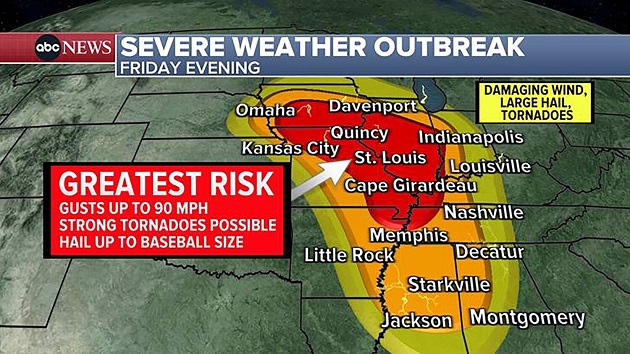
(NEW YORK) — A dangerous, multiday severe weather outbreak is set to bring tornadoes, flash flooding and damaging winds to the Midwest, the South and the East Coast, with the worst of the weather hitting the South on Saturday.
This is the first outbreak of this magnitude this year and is only the third time the National Weather Service has issued a high risk warning one day ahead.
The severe weather begins in the Midwest on Friday evening.
Residents from Davenport, Iowa, to Peoria, Illinois, and St. Louis to Memphis, Tennessee, are in the bull’s-eye for strong tornadoes. Destructive winds from thunderstorms could reach 90 mph and hail could be as large as baseballs.
On Saturday, the highest threat for tornadoes moves into the Deep South, focusing on eastern Louisiana, Mississippi, Alabama and the western Florida Panhandle.
In a rare warning, the highest risk level for severe weather/tornadoes has been issued from Jackson, Mississippi, to Birmingham, Alabama, where Gov. Kay Ivey issued a state of emergency. Those in the area should brace for numerous, significant tornadoes, some of which could be long-track and potentially violent.
The most dangerous tornado threat will begin in Louisiana and Mississippi late Saturday morning and the early afternoon. The threat spreads into Alabama in the late afternoon and evening and then reaches Florida and Georgia late Saturday night.
Destructive winds up to 80 mph and large hail are also in the forecast.
The severe storms will cover a large area, spreading as far north as Atlanta and Nashville, Tennessee.
On Sunday, the severe storms will be weaker as they target the East Coast from Florida to Pennsylvania.
The tornado threat will be focused on the Carolinas and Georgia in the afternoon.
Storms with the potential for damaging winds will reach the Northeast by the evening and last through early Monday morning.
Copyright © 2025, ABC Audio. All rights reserved.

(AUSTIN, Texas) — A man is facing charges after five people were killed and 11 were hospitalized in a collision involving 17 vehicles, including a semi-truck, in Austin, Texas, authorities said.
Solomun Weldekeal Araya, 37, has been charged with five counts of intoxication manslaughter and two counts of intoxication assault, according to Austin police.
The accident unfolded at approximately 11:23 p.m. on Interstate 35 southbound, according to Capt. Krista Stedman, public information officer for Austin-Travis County EMS. Crews arrived on scene to find multiple patients pinned in their cars, officials said.
Five people died at the scene: three adults, one child and one infant, authorities said. Eleven others were taken to hospitals.
“This incident was incredibly chaotic, and it was spread out over about a tenth of a mile,” Stedman said. “We were able to get all the critical patients off the scene within about 40 minutes and, considering how complex the scene was, that’s pretty impressive.”
The National Transportation Safety Board said it’s launched a safety investigation.
Copyright © 2025, ABC Audio. All rights reserved.

(WASHINGTON) — Vladimir Putin said Ukraine must surrender after President Donald Trump urged the Russian leader to spare the lives of Ukrainian soldiers, following ceasefire talks between the U.S. and Russia in Moscow.
In a post on Truth Social, Trump called Thursday’s discussions with Russia “very good and productive” and said there is a “very good chance that this horrible, bloody war can finally come to an end.”
He also claimed that thousands of Ukrainian soldiers are surrounded.
“AT THIS VERY MOMENT, THOUSANDS OF UKRAINIAN TROOPS ARE COMPLETELY SURROUNDED BY THE RUSSIAN MILITARY, AND IN A VERY BAD AND VULNERABLE POSITION,” he said.
“I have strongly requested to President Putin that their lives be spared. This would be a horrible massacre, one not seen since World War II,” he added.
Trump seemed to be referring to the sticking point in Russia’s Kursk region, something Putin has discussed as an issue in the talks. He also appeared to echo remarks Putin made in response to the U.S.-Ukraine ceasefire proposal on Thursday that Ukrainian troops are encircled in Kursk — a scenario Ukraine strongly denied.
Putin responded to Trump’s remarks on Friday, saying the soldiers need to surrender to be spared.
“[In] the event of a ceasefire and surrender, they will be guaranteed life and a worthy treatment in accordance with the norms of international law and the laws of the Russian Federation,” he said.
Ukraine pushed back Friday against the claims that its troops are surrounded in the Kursk region, where Putin this week ordered forces to “destroy” all Ukrainian formations remaining in the contested border region.
“The reports about the supposed ‘encirclement’ of Ukrainian units in the Kursk region are false and are being fabricated by the Russians for political purposes and to put pressure on Ukraine and its partners,” the general staff of the Ukrainian armed forces said in a statement on Friday.
“The threat of encirclement of our units is absent,” it added.
The statement comes a day after Putin referred to an “encirclement” in the Kursk region while remarking on the U.S.-Ukraine ceasefire proposal.
“We are for it. But there is a nuance,” Putin said of a 30-day ceasefire during a press briefing. “First, what are we going to do with the encirclement in the Kursk region?”
He said the situation in Kursk is “completely under our control, and the group that invaded our territory is in isolation,” and that it would be “very good for the Ukrainian side to reach a truce for at least 30 days.”
Ukrainian President Volodymyr Zelenskyy countered Friday that Putin is “lying” about the conflict and is blocking any diplomatic efforts to end the war.
“Putin is lying about the real situation on the battlefield, he is lying about the casualties, he is lying about the true state of his economy, which has been damaged by his foolish imperial ambitions, and he is doing everything possible to ensure that diplomacy fails,” he said.
“Putin cannot exit this war because that would leave him with nothing,” he continued. “That is why he is now doing everything he can to sabotage diplomacy by setting extremely difficult and unacceptable conditions right from the start even before a ceasefire.”
The claim that Ukrainian forces are surrounded was also shot down by defense analyst Michael Kofman, a senior fellow at the Carnegie Endowment who focuses on the Russian and Ukrainian militaries, who called it “simply untrue.”
Ukrainian forces pushed into Kursk last August in a surprise offensive, seizing the town of Sudzha and surrounding villages. Kyiv’s troops have repelled months of Russian counteroffensives, but recent weeks have seen their salient crumble and Russian forces retake significant ground.
During a visit to a command center in Kursk on Wednesday while clad in military fatigues, Putin said, “Your task is to completely destroy the enemy, which has entrenched itself in the Kursk region and is still conducting warfare here, and fully liberate the Kursk region’s territory within the shortest possible time.”
On Wednesday, Russian troops raised their flags over central Sudzha in Kursk as Ukrainian forces hurriedly retreated toward the shared border.
Russian advances to the border in the Kursk Oblast appeared to have slowed on Thursday compared to recent days, according to the latest assessment from the Institute for the Study of War.
The general staff of the Ukrainian armed forces said Friday that the situation “has not undergone significant changes over the past day,” and that troops are “regrouping” and have withdrawn to “more advantageous defense lines.”
“Our soldiers are repelling enemy offensive actions and delivering effective fire damage with all types of weapons,” it said.
Russian officials have indicated they will not engage in peace negotiations while any of Kursk remains under Ukrainian control.
Trump’s Middle East envoy, Steve Witkoff, met with Putin in Moscow on Thursday to discuss the proposed 30-day ceasefire in Ukraine — a step leaders in Kyiv and Washington, D.C., hope will facilitate a larger peace deal to end Russia’s three-year-old invasion of its neighbor.
Kremlin spokesperson Dmitry Peskov said there is “reason to be cautiously optimistic” about a ceasefire and said Putin and Trump now need to talk. The timing of that conversation will be determined once Witkoff reports to Trump, he said.
Copyright © 2025, ABC Audio. All rights reserved.

(NEW YORK) — In a letter to the Trump administration this week, electric automaker Tesla raised concerns about President Donald Trump’s ongoing tariffs, warning that the company could be “exposed” to retaliatory tariffs and urging the administration to “consider the downstream impacts.”
The comments were made in an unsigned letter on Tesla letterhead to United States Trade Representative Jamison Greer. It came after the USTR office earlier this year said it would be conducting a “review of unfair trade practices.”
The letter, dated March 11, comes from the company of tech billionaire Elon Musk, who has been leading the effort to slash government spending and downsize the federal workforce. It’s unclear if Musk was personally involved in sending the letter, and he has not addressed it on his social media platform, X.
As ABC News has reported, some Tesla shareholders have publicly questioned Musk’s commitment to the company as Tesla shares have fallen dramatically since Musk joined the Trump administration.
“As a U.S. manufacturer and exporter, Tesla encourages USTR to consider the downstream impacts of certain proposed actions taken to address unfair trade practices,” the letter said.
Tesla representatives did not respond to questions from ABC News, including questions regarding who wrote the letter. A White House spokesperson did not immediately respond to a request for comment.
In the letter, Tesla noted that tariff actions by the Trump administration have resulted in “immediate reactions” by the targeted countries, including increased tariffs on electric vehicles.
“Past U.S. special tariff actions have thus (1) increased costs to Tesla for vehicles manufactured in the United States, and (2) increased costs for those same vehicles when exported from the United States, resulting in less competitive international marketplace for U.S. manufacturers,” the letter said. “USTR should investigate ways to avoid these pitfalls in future actions.”
The letter also urged the administration to take into consideration supply chain issues when it comes to “future trade policy actions,” pointing, as an example, to what they say are shortages of lithium-ion batteries despite the company’s own efforts to manufacture them domestically.
“Nonetheless, even with aggressive localization of the supply chain, certain parts and components are difficult or impossible to source within the United States,” the letter states. “Tesla supports a process by USTR to further evaluate domestic supply chain limitations to ensure that U.S. manufacturers are not unduly burdened by trade actions that could result in the imposition of cost-prohibitive tariffs on necessary components, or other import restrictions on items essential to support U.S. manufacturing jobs.
“Trade actions should not (and need not) conflict with objectives to further increase and support domestic manufacturing,” the letter said.
ABC News’ Will Steakin and Kelsey Walsh contributed to this report.
Copyright © 2025, ABC Audio. All rights reserved.

(NEW YORK) — The Department of Homeland Security has arrested a second student who was involved with Columbia University protests, the agency announced.
Leqaa Korda was arrested by agents from Homeland Security Investigations for allegedly overstaying her expired visa — which terminated on Jan. 26, 2022. She was also allegedly arrested in 2024 for her involvement in the protests, according to DHS.
Korda is a Palestinian from the West Bank, according to DHS.
The arrest comes nearly a week after plain-clothed Immigration and Customs Enforcement officers arrested Mahmoud Khalil, a green card holder who was also involved in the protests at Columbia University.
The agency said another student involved in the protests — Ranjani Srinivasan, an urban planning student at Columbia and Indian citizen — used the CBP Home app to self-deport.
“It is a privilege to be granted a visa to live and study in the United States of America,” DHS Secretary Kristi Noem said. “When you advocate for violence and terrorism that privilege should be revoked, and you should not be in this country. I am glad to see one of the Columbia University terrorist sympathizers use the CBP Home app to self-deport.”
Federal agents with DHS also searched two Columbia University student residences Thursday night but did not arrest or detain anyone.
In a statement, Columbia President Katrina Armstrong said the DHS agents had two search warrants signed by a federal magistrate judge authorizing them to enter non-public areas of the university and conduct searches of two student rooms.
“I am writing heartbroken to inform you that we had federal agents from the Department of Homeland Security (DHS) in two University residences tonight,” Armstrong said in the statement. “No one was arrested or detained. No items were removed, and no further action was taken.”
The searches were part of the Trump administration’s crackdown on individuals it has described as espousing the views of Hamas and threatening the safety of Jewish students, according to sources.
Khalil was one of the leaders of the university encampment protests last spring, and is being held in Louisiana.
Khalil, a green card holder who has not been charged with a crime, is set to appear before an immigration judge on March 27.
Trump administration officials have said Khalil was detained for his purported support of Hamas. Baher Azmy, one of Khalil’s lawyers, called his client’s alleged alignment with Hamas “false and preposterous.”
Earlier Thursday, at least 98 people were arrested at a protest in the lobby of Trump Tower in New York City calling for Khalil’s release.
Separately, Columbia University announced Thursday that students who occupied the campus’ Hamilton Hall during pro-Palestinian protests last spring have been expelled, suspended for several years or had their degrees temporarily revoked.
Copyright © 2025, ABC Audio. All rights reserved.