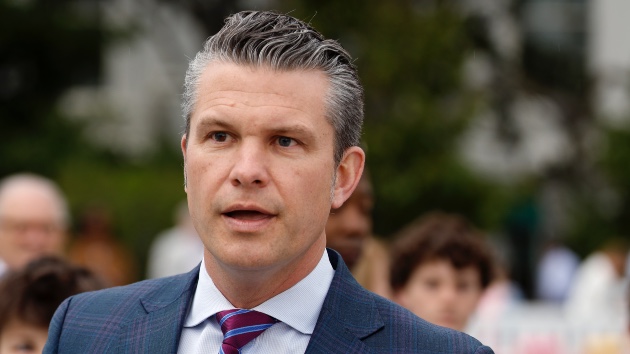
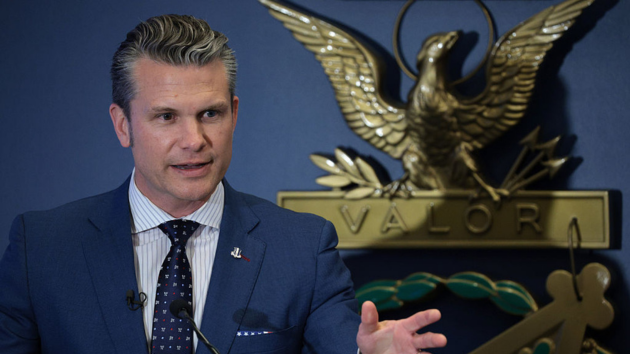
(WASHINGTON) — Defense Secretary Pete Hegseth on Monday reacted to the revelation he discussed details about an imminent attack on Houthis in Yemen in March in a second Signal group chat — one that included his wife and brother.
Speaking to reporters at the White House Easter Egg Roll, which he attended with his family, Hegseth attacked those he said were “disgruntled” former employees and the media for what he said was “anonymous smears.”
“I have spoken with the president and we are going to continue fighting. On the same page all the way,” Hegseth said.
President Donald Trump defended Hegseth and said he still has “great confidence” in him as he took reporter questions at the White House celebration.
“Here we go again. Just a waste of time. He is doing a great job,” Trump said of Hegseth.
“Ask the Houthis how he’s doing,” the president added.
Sources told ABC News that Hegseth shared information about a forthcoming attack on Houthi rebels in Yemen in a Signal message chat that included his wife Jennifer, who does not work for the Defense Department, as well as his brother and his personal lawyer.
Hegseth did not explicitly deny the report as he was asked to respond to the reports on Monday.
“They take anonymous sources from disgruntled former employees, and then they try to slash and burn people and ruin their reputations. Not going to work with me, because we’re changing the Defense Department, putting the Pentagon back in the hands of war fighters and anonymous smears from disgruntled former employees on old news doesn’t matter,” he said.
The second Signal chat reportedly occurred around the same time that top Trump officials, including Hegseth, discussed a strike on Houthis over the commercially-available app. That text chain came to light because inadvertently added to the chat was The Atlantic’s Editor-in-Chief Jeffrey Goldberg. The Pentagon’s independent inspector general is currently reviewing Hegseth’s use of Signal to discuss military actions.
White House press secretary Karoline Leavitt, pressed on the latest revelation on “Fox & Friends” on Monday, said “the president stands strongly behind Secretary Hegseth” and said Hegseth “is doing a phenomenal job leading the Pentagon.”
The use of Signal to discuss sensitive military operations may complicate ongoing investigations into potential leaks involving the first known group chat, which included top aides and other members of Hegseth’s team — at least three of whom have been since fired in relation to the inquiry.
Those officials — Dan Caldwell, Colin Carroll and Darin Selnick — have since spoken out against what they say are baseless accusations against them.
“At this time, we still have not been told what exactly we were investigated for, if there is still an active investigation, or if there was even a real investigation of ‘leaks’ to begin with,” they said in a joint statement on X on April 19.
Leavitt, when responding to the Hegseth news on Monday, also sought to blame former employees as she defended the defense secretary.
“The administration and the president have taken a very strong stance against anyone who leaks, especially sensitive and classified information that can put our troops and our war fighters at risk,” Leavitt said on Fox. “And you’ve seen the secretary has taken very strong action to rein in the leakers at the Pentagon and he will continue to do so I’m sure.”
ABC News’ Luis Martinez and Kelsey Walsh contributed to this report.
(VATICAN CITY) — Cardinal Kevin Farrell, the senior Vatican official who announced Pope Francis’ death on Monday morning, will serve as head of the Catholic Church until a new pope is elected, according to the Vatican.
Born in Ireland, the 77-year-old Farrell has long ties in the United States, having served as the bishop of the Diocese of Dallas and auxiliary bishop of the Archdiocese of Washington, D.C., according to the Vatican.
Pope Francis nominated Farrell in 2019 to be the Camerlengo of the Holy Roman Church with the responsibility of administering the property and revenues of the Holy See. In 2020, Francis also appointed Farrell as president of the Church’s Commission on Confidential Matters and in 2023, the late pontiff elevated Farrell to president of the Vatican City State Supreme Court, according to the Vatican.
On Monday morning, Farrell broke the news to the world of Pope Francis’ death, reading a statement at the chapel of the Domus Santa Marta at the Vatican, the pope’s residence and where he died. In the announcement, Farrell said, “At 7:35 this morning, the Bishop of Rome, Francis, returned to the house of the Father.”
“Dearest brothers and sisters, with deep sorrow I must announce the death of our Holy Father Francis,” Farrell said.
Standing next to Farrell for the somber announcement were Cardinal Pietro Parolin, the Vatican secretary of state, Archbishop Edgar Peña Parra, substitute chief of staff, and Archbishop Diego Ravelli, master of liturgical ceremonies.
“His entire life was dedicated to the service of the Lord and his Church,” Farrell said of Francis. “He taught us to live the values of the gospel with fidelity, courage, and universal love, especially in favor of the poorest and marginalized. With immense gratitude for his example of a true disciple of the Lord Jesus, we commend the soul of Pope Francis to the infinite merciful love of the triune God.”
The Holy See Press Office said Farrell will preside over the rite of ascertainment of death, or the certification of death, and placement of the late Pope Francis’ body in the coffin, which is scheduled to occur Monday night.
Farrell will be joined at the ritual by Cardinal Giovanni Battista Re, the dean of the College of Cardinals, relatives of the pope and other church officials, according to the Vatican press office.
Farrell is now in charge of the Holy See’s day-to-day operations during what is known as the “Apostolica Sede Vacans,” the period between the pope’s death and the election of the next pontiff during a secret gathering of cardinals in the Sistine Chapel.
Farrell is also expected to lead a procession transporting the pope’s body from the chapel of the Domus Santa Marta to St. Peter’s Basilica.
Born in 1947 in Dublin, Ireland, Farrell attended the University of Salamanca in Spain and the Pontifical Gregorian University in Rome, according to his biography on the Vatican’s website. He holds degrees in philosophy and theology from the University of St. Thomas in Rome. Farrell began studying for the priesthood in 1966 and was ordained a priest on Dec. 24, 1978, according to his biography.
After his ordination, he served as chaplain of the Regnum Christi Movement at the University of Monterrey in Mexico.
In 1984, Farrell was incardinated in the archdiocese of Washington, D.C., where he served as assistant pastor at St. Thomas the Apostle Church for a year before becoming the director of the Spanish Catholic Center in 1986, according to his biography. He also served as the executive director of the Catholic Charitable Organizations from 1987 to 1988. He was appointed pastor of the Annunciation parish in Washington, D.C., in 2000 and served until 2002.
In 2002, Farrell was appointed auxiliary bishop for the Archdiocese of Washington, D.C., and served in that role until 2007, when he became bishop of the Diocese of Dallas.
In 2016, Pope Francis called Farrell to the Vatican to serve as the vicar general of administration and moderator of the Roman Curia, the administrative arm of the Holy See and the central governing body of the Catholic Church, according to his biography.
(NEW YORK) — Federal judges in Colorado and California are hearing arguments Monday over the Trump administration’s deportation policies as government officials press to remove accused migrant gang members.
In Colorado, a federal judge will weigh arguments over a temporary order the judge issued that bars the Trump administration from removing any noncitizens from Colorado under the Alien Enemies Act, an 18th century wartime authority used to remove noncitizens with little-to-no due process.
A federal judge in San Francisco will consider next steps after that judge last month put a temporary pause on the Trump administration’s plans to end legal protections and benefits for up to 350,000 Venezuelan migrants.
The hearing comes after an appeals court on Friday denied the Trump administration’s effort to block that pause.
The Trump administration last month touched off a legal battle when it invoked the AEA to deport two planeloads of alleged migrant gang members to the CECOT mega-prison in El Salvador by arguing that the Venezuelan gang Tren de Aragua is a “hybrid criminal state” that is invading the United States.
An official with the U.S. Immigration and Customs Enforcement acknowledged that “many” of the men lack criminal records in the United States — but said that “the lack of specific information about each individual actually highlights the risk they pose” and “demonstrates that they are terrorists with regard to whom we lack a complete profile.”
The U.S. Supreme Court, in ruling over the weekend, blocked the AEA deportations of Venezuelan migrants being held in northern Texas after attorneys for the men said the accused gang members were about to be deported without due process.
(WASHINGTON) — Defense Secretary Pete Hegseth on Monday reacted to the revelation he discussed details about an imminent attack on Houthis in Yemen in March in a second Signal group chat — one that included his wife and brother.
Speaking to reporters at the White House Easter Egg Roll, which he attended with his family, Hegseth attacked those he said were “disgruntled” former employees and the media for what he said was “anonymous smears.”
“I have spoken with the president and we are going to continue fighting. On the same page all the way,” Hegseth said.
Sources told ABC News that Hegseth shared information about a forthcoming attack on Houthi rebels in Yemen in a Signal message chat that included his wife Jennifer, who does not work for the Defense Department, as well as his brother and his personal lawyer.
The chat reportedly occurred around the same time that top Trump officials, including Hegseth, discussed a strike on Houthis over the commercially-available app. That text chain came to light because inadvertently added to the chat was The Atlantic’s editor-in-chief Jeffrey Goldberg. The Pentagon’s independent inspector general is currently reviewing Hegseth’s use of Signal to discuss military actions.
White House press secretary Karoline Leavitt, pressed on the latest revelation on “Fox & Friends” on Monday, said “the president stands strongly behind Secretary Hegseth” and said Hegseth “is doing a phenomenal job leading the Pentagon.”
The use of Signal to discuss sensitive military operations may complicate ongoing investigations into potential leaks involving the first known group chat, which included top aides and other members of Hegseth’s team — at least three of whom have been since fired in relation to the inquiry.
Those officials — Dan Caldwell, Colin Carroll and Darin Selnick — have since spoken out against what they say are baseless accusations against them.
“At this time, we still have not been told what exactly we were investigated for, if there is still an active investigation, or if there was even a real investigation of ‘leaks’ to begin with,” they said in a joint statement on X on April 19.
This is a developing story. Please check back for updates.
(WASHINGTON) — Preventive care health benefits provided at no cost to tens of millions of Americans since 2010 under a popular provision of the Affordable Care Act are in the balance Monday at the U.S. Supreme Court as the justices consider whether the government task force behind the mandate to insurers is unconstitutional.
Among the services the U.S. Preventive Services Task Force designates for no-cost coverage under the federal health law are statins to lower cholesterol; colonoscopies for 45- to 49-year-olds; preexposure prophylaxis (PrEP) medicine to reduce the spread of HIV; medications to lower the risk of breast cancer for women; and lung cancer screenings for smokers.
The case was brought by a group of employers and individuals who oppose some of the task force’s recommendations for covered services on religious groups, specifically the PrEP medication to prevent HIV. They allege the group’s structure violates the Constitution and lower federal courts agreed.
If the justices uphold the decisions, the task force and its recommendations since 2010 could be invalidated — and along with them the guarantee of no-cost preventive services coverage many people enjoy.
“The case is not the kind of existential threat that we have seen in previous Supreme Court cases involving the ACA, but it’s certainly something that could affect a lot of people,” said Larry Levitt, executive vice president at KFF, a nonpartisan health policy group.
At the heart of the dispute is whether the structure of the 16-member task force is illegal under the Constitution’s Appointments Clause. The provision requires “principle officers” of the U.S. government, such as Cabinet secretaries and ambassadors, to be confirmed by the Senate. It stipulates that “inferior officers” who are appointed by Senate-confirmed officials are permissible, provided they are supervised and reviewed.
The plaintiffs allege that members of the task force, who are appointed and supervised by the Health and Human Services secretary, are not properly appointed and have too much power. While they can be removed at will, their recommendations for covered health services cannot be reviewed or overridden by anyone.
“Americans have the constitutionally protected freedom to live and work according to their religious beliefs, and governments exist to defend that freedom,” said Daniel Grabowski, an attorney with Alliance Defending Freedom, a conservative legal advocacy group supporting the plaintiffs. “We urge the Supreme Court to restore this accountability within the federal government and to the American people.”
The Fifth Circuit U.S. Court of Appeals ruled the task force unconstitutional and that its recommendations since 2010 be invalidated.
The Trump administration is defending the constitutionality of the task force and the health secretary’s power to oversee the body’s recommendations.
More than 150 million Americans rely on early screenings and interventions for chronic conditions under no-cost preventive services, according to American medical organizations. Public health groups say a decision striking down the task force could deeply affect the long-term health of Americans and disease prevention efforts. Insurers worry that it could inject instability into the insurance market, while hospital groups fear they may have to shoulder more of the burden from people who are sicker.
“The ACA’s preventive services requirement has been a game-changer, providing access to evidence-based preventive care and early detection of serious medical conditions,” said Wayne Turner, a senior attorney at the National Health Law Program, a nonprofit group that advocates for low-income communities. “The ACA’s coverage and cost-sharing protections are especially important for low-income persons, who will be harmed most if the Supreme Court refuses to allow the ACA provision to stand.”
Oral arguments in the case — Kennedy v. Braidwood Management — will be heard at the Supreme Court on Monday. A decision in the case is expected by the end of June.
(WASHINGTON) — Department of Defense Secretary Pete Hegseth shared details about an imminent attack on Houthis in Yemen in March in a second group chat using the messaging app Signal that included his wife, his brother and his personal lawyer, two sources familiar with the contents of the chat told ABC News.
Those details shared in the second chat included the flight schedules for the F/A-18 Hornets involved in the pending attack on Houthi positions, according to the officials. The New York Times was first to report Hegseth’s sharing of the details in a second Signal group.
The sharing of the details reportedly occurred around the same time in mid-March when key members of President Donald Trump’s National Security Council, including Hegseth, inadvertently shared details about the March 15 missile strike in Yemen with the editor-in-chief of The Atlantic.
Much of the same content was shared in the second encrypted chat with family members and others — a chat group that Hegseth had created on his personal phone during his confirmation process, the two officials told ABC News.
Hegseth’s wife, Jennifer Hegseth, does not work for the Defense Department.
His brother, Phil Hegseth, works as a senior adviser at the Department of Homeland Security and is detailed to the Defense Department. Tim Parlatore, Hegseth’s personal attorney, works at the Pentagon as a Navy reservist assigned to Hegseth’s office.
Sean Parnell, chief spokesperson for the Pentagon, responded to reports of the second chat in a statement on X on Sunday night saying in part, “Another day, another old story—back from the dead. The Trump-hating media continues to be obsessed with destroying anyone committed to President Trump’s agenda.”
The statement continued, “There was no classified information in any Signal chat, no matter how many ways they try to write the story. What is true is that the Office of the Secretary of Defense is continuing to become stronger and more efficient in executing President Trump’s agenda.”
Sources confirmed with ABC News that the second known Signal chat was originally created to discuss scheduling and administrative information.
The Pentagon’s independent inspector general is evaluating Hegseth’s use of the Signal app “to determine the extent to which the Secretary of Defense and other DoD personnel complied with DoD policies and procedures” to conduct official business, the acting inspector general, Steven Stebbins, said in a notification letter to Hegseth.
The Trump administration has repeatedly refuted the idea that any classified information was shared in the first known chat thread; however, several former U.S. officials have contended that the sharing of such information over unapproved channels could at a minimum put troops overseas at risk.
Its use to divulge sensitive military operations may complicate ongoing investigations into potential leaks involving the first known group chat, which included top aides and other members of Pete Hegseth’s team — at least three of whom have been since fired in relation to the inquiry.
Those officials — Dan Caldwell, Colin Carroll and Darin Selnick — have since spoken out against what they say are baseless accusations against them.
“At this time, we still have not been told what exactly we were investigated for, if there is still an active investigation, or if there was even a real investigation of ‘leaks’ to begin with,” they said in a joint statement on X on April 19.
John Ullyot, the Pentagon’s former top spokesman, on Sunday published an opinion piece in Politico where he described “a month of total chaos at the Pentagon.”
“From leaks of sensitive operational plans to mass firings, the dysfunction is now a major distraction for the president — who deserves better from his senior leadership,” he wrote.
“Hegseth is now presiding over a strange and baffling purge that has left him without his two closest advisers of over a decade — Caldwell and Selnick — and without chiefs of staff for him and his deputy,” Ullyot wrote.
“Even strong backers of the secretary like me must admit: The last month has been a full-blown meltdown at the Pentagon — and it’s becoming a real problem for the administration,” he added.
“President Donald Trump has a strong record of holding his top officials to account,” wrote Ullyot. “Given that, it’s hard to see Defense Secretary Pete Hegseth remaining in his role for much longer.”
Ullyot left the Pentagon late last week after having been sidelined after he controversially defended the removal of Jackie Robinson information from a DOD website.
He said earlier this week that he had left the Pentagon on his own accord, while a senior defense official told ABC News that Ullyot was asked to resign.
(WASHINGTON) — After his deportation was temporarily blocked by a Supreme Court order, 19-year-old Venezuelan migrant Alessandro Paredes spoke to ABC News from a detention center in Texas.
“This is not being done by law, this is totally illegal and it’s out of the blue,” Paredes said, recounting the attempted deportation on Friday.
“We get grabbed in the morning, about four in the morning, and just get taken into a van. They tried to put us into a plane,” he said from Immigration and Customs Enforcement’s Bluebonnet Detention Center in Anson, Texas.
Paredes said that before arriving at an airport, the van he was in suddenly turned around and returned him and other detainees to Bluebonnet.
In a statement to ABC News, White House press secretary Karoline Leavitt blasted the order from the Supreme Court that blocked deportations from the Northern District and said the White House is confident the actions by the administration are lawful.
“President Trump promised the American people to use all lawful measures to remove the threat of terrorist illegal aliens, like members of TdA, from the United States. We are confident in the lawfulness of the Administration’s actions and in ultimately prevailing against an onslaught of meritless litigation brought by radical activists who care more about the rights of terrorist aliens than those of the American people,” Leavitt said in her statement.
Paredes claimed to ABC News he and others were “forced to sign a paper” saying they are part of a gang. On Friday, the ACLU submitted a document they say their clients at Bluebonnet received from immigration officials. The document, titled “Notice and Warrant of Apprehension and Removal under the Alien Enemies Act,” says, “You have been determined to be… a member of Tren de Aragua.”
“We have been forced to sign a paper, right here, basically saying that we are part of a gang, that we are part of it, and they’re forcing us to sign it,” Paredes said.
Stephen Miller, Trump’s homeland security adviser, responded to a post on X by a FOX News reporter that includes a list allegedly provided by a DHS official of “suspected Venezuelan TdA gang members” detained in Texas that the Trump administration “was planning to deport before SCOTUS stepped in.”
The list included Paredes’ name and photo and says that he is a confirmed TdA member and says that he is facing criminal charges for “aggravated assault with a weapon, pointing, and presenting firearms at a person.” The post also includes photos of Paredes’ tattoos of a cross and a clock.
“This is who the Democrats are fighting to keep in your neighborhood,” Miller said in response to the social media post of the list.
A review of court records found one charge against Paredes in South Carolina for “pointing and presenting firearms at a person” in February. The case is still ongoing and Paredes is scheduled to have his second court appearance in August.
According to WCIV, an ABC News affiliate, Paredes turned himself in on the gun charge and was booked into Al Cannon Detention Center in Charleston County, South Carolina in February. The ICE detainee locator confirms Paredes is currently at Bluebonnet Detention Center.
Paredes’ mom told ABC News in a statement through their attorney that she denies the allegation that her son is a member of TdA.
“My son is only 19 years old,” the mother said, who did not want to be named. “He was a good student, a talented football player, and a loving son. He is a devout Catholic. He carries his faith on his body and in his heart — he even had a large cross tattooed on his body to mark his lifelong commitment to God.”
“He’s not a terrorist,” she said, adding that she wishes for her son to be sent to Venezuela.
“Please do not send him to El Salvador — a country he has never known, where he faces grave danger and has no support,” she added.
Earlier this month, SCOTUS lifted an injunction that barred deportations under the AEA and ruled that any person the administration sought to deport under the proclamation must be given due process. The ACLU argued Friday that the Venezuelan migrants who are being held in a detention center in Texas are at risk of deportation and have not had adequate notice or enough time to challenge their removals, violating the court’s requirement that the men have “reasonable time” to practice their due process rights.When asked by ABC News if he fears being deported to El Salvador, Paredes said he is “very scared” because he and the other detainees are not from El Salvador.
“We are very scared [that] everybody here will get deported to El Salvador,” Paredes said. “Because, first of all, we are not from there. Most people in here got no criminal records. Not even a ticket, nothing.”
“There’s underage people,” Paredes added. “We even got disabled people right here next to me.”
Paredes said he was not given any information on Friday and he still has not received answers from the officers at the detention center.
“They just tell us that they don’t know anything, and they don’t give us any kind of information,” Paredes said.
“We just want justice, we are humans, we have human rights,” Paredes added. “We just want to go back to our country.”
(TRILLA, IL) — Four people from Wisconsin were killed on Saturday when their private, single-engine plane crashed in a field near an airport in rural Illinois after reportedly striking powerlines, authorities said.
The Cessna 180G aircraft crashed about 10:16 a.m. local time Saturday in the unincorporated community of Trilla, Illinois, southeast of Coles County Memorial Airport in nearby Mattoon, according to the National Transportation Safety Board.
Preliminary information, according to the NTSB, indicated that the plane struck powerlines before crashing.
All of the plane’s occupants were pronounced deceased at the scene, according to the Illinois State Police.
The Coles County Coroner on Sunday evening identified the two men and two women killed in the crash. They are Ross R. Nelson, 46; Raimi A. Rundle, 45; Courtney L. Morrow, 36; and Michael H. Morrow, 48.
All four crash victims were from Menominee, Wisconsin, about 45 miles northwest of Green Bay, according to the State Police.
“My whole house shook,” Kynnedi Goldstein, who lives near the crash site, told ABC News.
Goldstein shared video footage she took in the aftermath of the crash, showing smoke billowing from the wreckage, which was strewn across a field and a two-lane road.
The cause of the crash is under investigation by the NTSB, which sent a team to Trilla on Sunday. The Federal Aviation Administration, which also sent personnel to the crash scene, is assisting in the investigation, the agency said.
The NTSB said the investigation involves three primary areas: the pilot, the aircraft and the operating environment.
As part of the investigation, the NTSB said it will review flight track data, recordings of any air traffic control communications, aircraft maintenance records and weather reports from around the time of the crash.
The agency said it is also reviewing the pilot’s license, ratings and flight experience. The NTSB is also conducting a 72-hour background check on the pilot “to determine if there were any issues that could have affected the pilot’s ability to safely operate the flight.”
The agency said it expects to release a probable cause report on the crash in 12 to 24 months.
(VATICAN CITY) — The process by which a new pope is elected has undergone numerous changes in the nearly two millennia that the Catholic Church has existed, with the current procedure a combination of ancient traditions and modern updates as recent as 2013, reflecting changes instituted by Pope Benedict XVI. Even so, the essential ritual has remained largely unchanged for centuries.
Pope Francis’ death sets into motion a series of formalized rites and observances that occur during what is called the interregnum, which begins upon the pontiff’s passing and ends with the election of his successor. The period of time during which the papacy is vacant is known as the sede vacante, Latin for “vacant seat.”
The pope’s death is first ritually verified by the cardinal camerlengo, or chamberlain, who who runs the ordinary affairs of the Vatican city-state during the sede vacante. A traditional nine days of mourning then commences. This includes the pope’s funeral, which per tradition is held within four to six days of his death, after his body lies in state for several days in St. Peter’s Basilica. This also allows global dignitaries and heads of state to pay their respects and attend the funeral.
It’s also during the interregnum that all cardinals under the age of 80 who are eligible to participate are summoned to Rome to prepare for the secret conclave inside the Sistine Chapel to choose the next pontiff, a gathering that typically commences between 15 to 20 days after the pope’s death. The cardinals spend the interregnum housed in private rooms in the Domus Marthae Sanctae — essentially a residence hotel in the Vatican with dining facilities that usually houses visiting clergy and laity. Per tradition, the cardinals are cut off from the outside world, including televisions, phones, computers and newspapers.
The College of Cardinals will cast as many as four ballots in a single day for the next pope, with a two-thirds majority required to elect a pontiff. After each vote, the ballots are burned and smoke is released from the Sistine Chapel’s chimney as a signal to the throngs holding vigil in St. Peter’s Square. Black smoke — fumata nera in Italian — indicates an inconclusive vote, while white smoke — fumata bianca — will signify that a new pope has been elected. If three days pass with no pope elected, voting can be suspended for a day to allow the cardinals time for reflection before the next round of ballots are cast.
Once the College of Cardinals elects a new pope, the candidate is formally asked in the Sistine Chapel if he accepts the election and, if so, to choose his papal name. While popes have the option of keeping their baptismal name, every pope for the last 470 years has chosen to change his name, usually to honor a predecessor and to signal their intention to emulate his example.
The interregnum ends when the newly elected pope makes his first public appearance in his new role, stepping onto the central balcony at St. Peter’s Basilica, overlooking St. Peter’s Square, to bless the gathered crowd there after being introduced by the senior cardinal deacon with the traditional declaration “Habemus papum” – Latin for “We have a pope.”
(VATICAN CITY) — Who was the very first pope? How many popes have there been? Has anyone ever refused the office?
For an institution that has existed for nearly 2,000 years, most people know very little about the papacy and its history. Here are some of the most commonly asked questions – and a few answers you may find surprising.
Who can be pope?
Canon law says any unmarried, baptized male Catholic, clergy or not, is eligible to be pope. That said, only cardinals have been elected for the last 600-plus years, so being considered for the position in this case is very much the result of whom you know.
Who was the very first pope?
The first pope was St. Peter, after whom St. Peter’s Basilica in Vatican City is named. St. Peter wasn’t elected, however, being said by the church to have been appointed by Christ. In fact, all popes were essentially appointed for about the first thousand years; even if the church selected a successor, that selection had to be approved by a secular party or parties – think monarchs, heads of state and other power brokers – a process that made choosing the next pope both fractious and extremely political.
It’s generally accepted that the papal election process as we currently recognize it began with Pope Nicholas II, the 155th pope, who in 1059 issued a landmark bull, or edict, that contained major church reforms, among them giving the sole power of papal election to the College of Cardinals – a responsibility they retain to this day.
How many popes have there been?
Pope Francis, elected in 2013, who died on Monday, was the 266th pope in the Catholic Church’s roughly 2,000-year history, which spans three millennia. However, that count comes with qualifications.
There were nearly 40 popes who were considered to be illegitimate for various reasons, mostly because they were appointed by secular rulers or warring factions within the church itself, and so aren’t officially counted by the Vatican. The last of these so-called antipopes was Felix V, whose roughly nine-and-a-half-year reign ended in 1449.
There also were five interregnums – that is, periods without a pope and no active papal selection process – the first in the late 13th century and the most recent ending in March 1800, totaling 10 years and 50 days.
Has anyone ever rejected being elected pope?
Has anyone ever rejected being elected pope?It’s rare, but it has happened. The first person known to have done so was St. Philip Benizi, in 1271, who reportedly was so opposed to being elected that he ran away and hid until another candidate was chosen. The late 16th century St. Charles Borromeo, one of the few cardinals to be canonized, also refused the papacy, though in less dramatic fashion.
Most recently, when Cardinal Giovanni Colombo, the 76-year-old archbishop of Milan, began receiving votes during the conclave in October 1978, he reportedly made it clear that he would refuse the papacy if elected. Cardinal Karol Józef Wojtyla, Archbishop of Kraków, was ultimately elected pope and took the name John Paul II.
Why do popes change their names, and do they have to?
Short answer? Tradition. In fact, immediately after affirming that he accepts his election, the ceremonial second question a new pope is asked is, “By what name shall you be known?”
That said, no pope is required to change their name upon election, and for more than a thousand years, few did. The first pope to change his name was the Roman-born 56th pope, John II, elected in the year 533, who felt that using his birth name – Mercurius – was inappropriate because of its association with the Roman god Mercury. He chose John II in honor of his predecessor, Pope John I, the 53rd pontiff.
Even so, the practice of choosing a papal name remained inconsistent for the next 1,000 years, with most popes using their baptismal names. Taking a papal name became more common as the centuries passed, with some non-Italian popes doing so for no more complex a reason than to make it something easier for Romans to pronounce.
Pope Marcellus II, elected in 1555, was the last to use his baptismal name. His successor, Giovanni Pietro, chose the papal name Paul IV, and the practice has continued uninterrupted since. The tradition is now seen as a way for the new pope to signal which of his predecessors he will emulate.
However, although most popes select a predecessor’s name, they are not obliged to do so. Pope Francis bucked that tradition when he was elected, instead choosing his name to honor St. Francis of Assisi, the 13th century cleric now celebrated in the church as the patron saint of animals and the environment. Pope Francis said St. Francis inspired him as “the man of poverty, the man of peace, the man who loves and protects creation.”
Interestingly, there have only been two popes to take a double papal name, both of them in the 20th century and both back-to-back. John Paul I was the first to do it, in August 1978, and was also the first to intentionally include the designation ‘the first’ in his papal name. Upon his unexpected death less than two months later, John Paul I’s successor, Karol Wojtyla, chose the name John Paul II to honor him.
What are the most-used papal names?
With 266 popes and 2,000 years of history, there are plenty of papal names from which new popes can choose. There are, however, some clear favorites.
The most popular papal name, by far, is John: 23 popes have taken it. The first was John I, the 53rd pontiff, in 523; the most recent was John XXIII, the 261st pope, elected in October 1958.
In second place is Gregory, with 16 uses, the first in 590 and the most recent in 1831. Benedict is tied for second, also with 16 uses, with the most recent being Pope Francis’ predecessor, Benedict XVI. Some purists, however, insist there were only 15 Benedicts, purposely omitting Benedict X, who was elected in 1058 but later determined to be an antipope and replaced in less than a year by Nicholas II.
Following Gregory and Benedict, there have been 14 Clements, 13 Innocents, 13 Leos, and 12 popes to use Pius. It’s single-digits from there on, with 44 out of 266 papal names used only once. Chief among the single-use names is Peter, being St. Peter, the first pope – a name that, per tradition, is unlikely ever again to be used.
Who was pope for the longest/shortest time?
The church officially recognizes St. Peter, the first pope, as the longest-serving, with at least 34 years. However, many historians dispute that as impossible to verify, and instead say the longest-serving pope was Pius IX, who held the office just shy of 32 years, until his death in February 1878.
The record for shortest time as pope goes to Urban VII, who died of malaria in September 1590 after just 13 days in office.
Who was the youngest/oldest pope?
At 81 years old, Pope Gregory XII was the oldest pope at time of election, in November 1406. The youngest was John XII, who is believed to have been just 18 years old when he was elected in 955 as the 130th pope.
The longest-lived pope, active or former, was Benedict XVI, who resigned the papacy in February 2013 at age 85 and was 95 years old when he died Dec. 31, 2022. Having turned 78 just three days before he was elected pope in April 2005, he also was the fifth-oldest pope in history when he accepted the office.
Of the nine popes who reigned in the 20th century – beginning with Leo XIII, whose papacy ended in 1903 – their average age at the time of election was 65. Of those, John XXIII was the oldest, at 76, and John Paul II the youngest, at 58. The average age of the 62 popes elected since 1400 is 62.4 years. Any age data prior to 1400 is considered largely unreliable.
Bonus fact: Who makes the pope’s clothes?
The liturgical garments – such as robes, stoles and hats – worn by the pope and other Christian church officials are known as vestments. Since 1798, the pope’s vestments have been manufactured by the Gammarelli family tailors in Rome, who first made the garments for Pope Pius VI. They also make off-the-rack liturgical garments for clergy other than the pope, but the election of a new pope requires special attention.
While a new pope is being chosen, the Gammarellis prepare three sets of vestments in small, medium and large sizes so they will be ready to be worn immediately by the new pope, who makes his first public appearance within hours of election. Once he’s elected, the Gammarellis make bespoke vestments for him, though the pontiff has the option of obtaining his vestments elsewhere if he so chooses.
Despite the care taken, those ready-to-wear initial papal vestments didn’t always do the trick. Pope John XXIII, who was five feet, six inches tall and weighed close to 200 pounds when elected in 1958, donned the small-size vestments by mistake for his first public appearance, requiring attendants to slit them up the back so that they appeared to fit from the front. Conversely, the athletic Pope John Paul II – five feet, ten inches tall and broad-shouldered – is said to have barely been able to fit into the large-sized vestments for his first public appearance.
ABC News’ Phoebe Natanson contributed to this report.