
Senate likely to change House-passed megabill advancing Trump’s agenda

Senate likely to change House-passed megabill advancing Trump’s agenda
ABC News

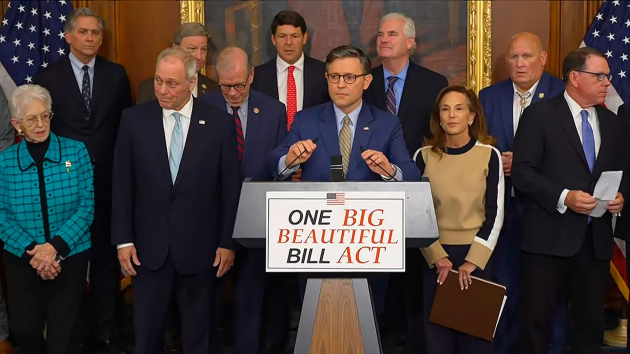
(WASHINGTON) –House Republicans approved the “One Big Beautiful Bill Act” encompassing President Donald Trump’s legislative agenda early Thursday. But clearing the House is just the first hurdle for the bill, which will also have to pass muster with a Senate Republican conference that is already telegraphing that changes to it are coming.

Trump is pushing for swift action on his megabill, urging senators in a post on X to act “as soon as possible” after the narrow victory in the House.

“We can celebrate this pass in the House for a couple of hours, but now it’s time for the Senate to get to work,” White House press secretary Karoline Leavitt said during Thursday’s White House press briefing. “The president has great relationship with … Senate Majority Leader [John] Thune, and of course, so many friends on the Senate side of the Hill. And he’s expecting them to get busy on this bill and send it to his desk as soon as possible.”

Senate Republicans say they’re clear-eyed about wanting to pass Trump’s legislative agenda into law as swiftly as they can, but have every intention of modifying the bill to leave their own distinct mark on the package and working to change things they object to.

Majority Leader Thune said Wednesday that “there are things that we need to adjust or modify or change,” adding that Speaker Mike Johnson “fully understands and accepts that.”

Chief among the issues GOP senators have raised about the bill is that it adds trillions of dollars to the national debt.

“[The] House bill is going to add about $4 trillion to the debt ceiling. The Senate bill adds $5 trillion. There’s nothing fiscally conservative about expanding the debt ceiling more than we’ve ever done it before,” Republican Sen. Rand Paul said Thursday. “This will be the greatest increase in the debt ceiling ever, and the GOP owns this now … the deficit this year will be $2.2 trillion the GOP owns that now too.”

Some Senate Republicans are calling for steeper spending cuts so that raising the debt limit would not be part of this bill.

Republican Sen. Ron Johnson, a notable fiscal hawk, has also signaled strongly that he would not support the bill in its current form, given that it raises the deficit.

“It’s so far off the mark. It’s so bad. I’ve been trying to interject reality. I’ve been trying to interject facts and figures,” Ron Johnson told reporters on Wednesday afternoon at the Capitol, as the House was still advancing the bill through the Rules Committee.

“Currently the fiscal situation is not even in the conversation in the House debate. We’re missing the forest talking about twigs and leaves. Medicaid, that’s, that’s a tree. That’s a big enough issue. But all this, all this, all these little tweaks they’re trying to make to get the deal completely ignores the elf in the room.. which says, on average, I mean, current [Congressional Budget Office] estimate, on average, we’ll have a $2.2 trillion deficit, per year,” Sen. Johnson added.

A few GOP Senators seemed more supportive of the bill, but noted there was significant work needed to be done in order to pass through the upper chamber.

Republican Sen. Thom Tillis said “a lot of it looks pretty good,” adding that it’s a “good start.”

“Still, I think there’s some opportunities for more efficiency, some more savings, and we have to look at the specifics of some of the renewable investment tax credits and production tax credits, and I think that even if we’re going to revise them, we’ve got to make sure that businesses who believe the government was setting this as a priority don’t have a lot of stranded costs,” he added.

If the bill is retooled by the Senate, it risks a complicated path for the speaker down the road when the bill goes back to the House. Republicans have set a Fourth of July deadline for both chambers to pass the bill and get it to Trump’s desk.

Passing this massive package through the Senate is also no cakewalk for Thune, who will only be able to afford to lose three of his members if it comes up for a vote on the Senate floor.

The House-passed bill includes new tax cuts, cuts to social safety net programs and changes to the food assistance program, SNAP — all of which have led Democrats to lambaste the legislation for creating benefits for some of the richest Americans and cuts for some of the poorest.

Minority Leader Chuck Schumer slammed the bill in a post on X Thursday morning.

“This is not one big, beautiful bill. It’s ugly,” Schumer said. “There’s nothing beautiful about stripping away people’s healthcare, forcing kids to go hungry, denying communities the resources they need, and increasing poverty.”

Democratic Sen. Patty Murray called the bill a “scam” in a post on X, urging all Republicans to vote no.

“House Republicans don’t want you to know they just passed a bill that makes health care MORE expensive and kicks MILLIONS off Medicaid, all to pass tax cuts for billionaires & giant corporations,” Murray wrote. “We need to make sure America knows. And we need to kill this bill in the Senate.”

Leavitt criticized Democrats as being “out of touch” with Americans.

“Every single Democrat in the House of Representatives who voted against all of these common sense and massively popular policies,” Leavitt said during Thursday’s White House press briefing. “The Democrat Party has never been more radical and out of touch with the needs of the American people.”

The Senate will also have to contend with the rules governing what can be included in such a package. Making sure that the bill passes muster with the Senate parliamentarian could lead to additional changes to the bill that Mike Johnson will eventually have to sell to his conference in the House.

As Trump now prepares to negotiate with Senators, Leavitt told ABC News Chief White House Correspondent Mary Bruce that she was not aware if those conversations had started already.

What did GOP holdouts get?

Speaker Johnson had to work with his right flank to get the megabill passed in the House, which he managed to do by one vote. So what changed to get those more than a dozen holdouts on board?

Not much, several hard-liners told ABC News.

After laboring for days to push for steeper spending cuts and repeatedly railing against the spending that added to the bloated national deficit, many of the holdouts caved.

“The Freedom Caucus was instrumental, and we held it out as long as we could to get the cuts, as long as we could. We couldn’t do it any longer. We live to fight another day,” Republican Rep. Ralph Norman, a key holdout, told reporters.

Norman says there was no specific deal struck between Trump, the speaker and the hard-line holdouts — even after a high-stakes, last-ditch meeting at the White House Wednesday.

Chair of the House Freedom Caucus, Andy Harris, wouldn’t give the bill his vote. He voted “present.”

Republican Rep. Keith Self, another hard-liner, told ABC News that he waited until the last minute to vote yes on the bill. He didn’t fully support the bill, but didn’t want to be the one to tank it.

“We got something … I would have preferred to go further too, to be honest with you, but we did what we could, and we fought the good fight,” Self said.

That number of “more than a dozen” holdouts also included Republicans from states like New York and California, pushing for a higher cap on the state and local tax deduction. Speaker Johnson raised that cap from its proposed $30,000 to $40,000, and increasing 1% a year thereafter. That was enough to get their support.

But, for the spending hawks, it’s unclear how they can characterize this as a win.

Leavitt said Thursday that she believes that Trump would want to see the two Republican representatives who voted no on the bill — Reps. Thomas Massie and Warren Davidson — should be primaried.

“I don’t think he likes to see grandstanders in Congress. What’s the alternative? I would ask those members of Congress. Did they want to see a tax hike? Did they want to see our country go bankrupt? That’s the alternative by them trying to vote no,” Leavitt said.

ABC News’ Sarah Beth Hensley contributed to this report.

Copyright © 2025, ABC Audio. All rights reserved.
Trump administration bars Harvard from enrolling international students

Trump administration bars Harvard from enrolling international students
Andrew Lichtenstein/Corbis via Getty Images

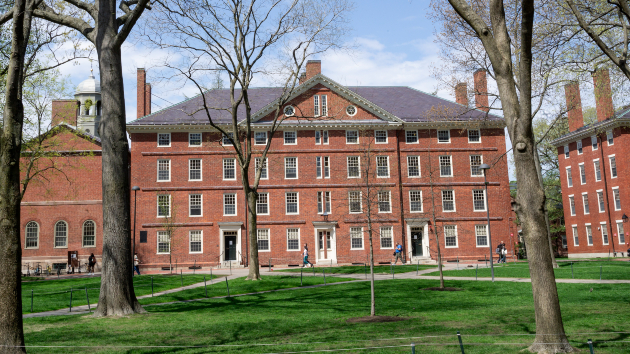
(WASHINGTON) — The Trump administration has barred Harvard from allowing international students to enroll at the university, after the school lost its ability to use the Student and Exchange Visitor Program.

The SEVP program allows for noncitizens to study at the university under a specific visa.

“As a result of your refusal to comply with multiple requests to provide the Department of Homeland Security pertinent information while perpetuating an unsafe campus environment that is hostile to Jewish students, promotes pro-Hamas sympathies, and employs racist ‘diversity, equity, and inclusion’ policies, you have lost this privilege,” Department of Homeland Security Secretary Kristi Noem wrote in a letter to the university.

Harvard said the move by the Trump administration is not legal.

“The government’s action is unlawful. We are fully committed to maintaining Harvard’s ability to host our international students and scholars, who hail from more than 140 countries and enrich the University – and this nation – immeasurably. We are working quickly to provide guidance and support to members of our community,” the school said in a statement on Thursday. “This retaliatory action threatens serious harm to the Harvard community and our country, and undermines Harvard’s academic and research mission.”

Noem wrote to Harvard in April requesting a tranche of information be given to DHS in order for the school to retain its SEVP status.

According to the letter, she asked Harvard to give information over on student visa holder’s “known” illegally activity; violent activity; threats to students or faculty; disciplinary actions taken as a result of being involved in a protest; information on whether the student obstructed the school’s learning environment; and the coursework that the student is taking to maintain the visa status.

Noem said the school did not provide adequate information in response, and that it is a “privilege, not a right” for students to study at American universities.

“The revocation of your Student and Exchange Visitor Program certification means that Harvard is prohibited from having any aliens on F- or J- nonimmigrant status for the 2025-2026 academic school year.,” she writes. “This decertification also means that existing aliens on F- or J- nonimmigrant status must transfer to another university in order to maintain their nonimmigrant status.”

Noem said that “consequences must follow to send a clear signal to Harvard and all universities that want to enjoy the privilege of enrolling foreign students, that the Trump Administration will enforce the law and root out the evils of anti-Americanism and antisemitism in society and campuses.”

This is a developing story. Please check back for updates.

Copyright © 2025, ABC Audio. All rights reserved.
Former Harvard morgue manager pleads guilty to trafficking body parts from donated cadavers

Former Harvard morgue manager pleads guilty to trafficking body parts from donated cadavers
Scott Eisen/Getty Images

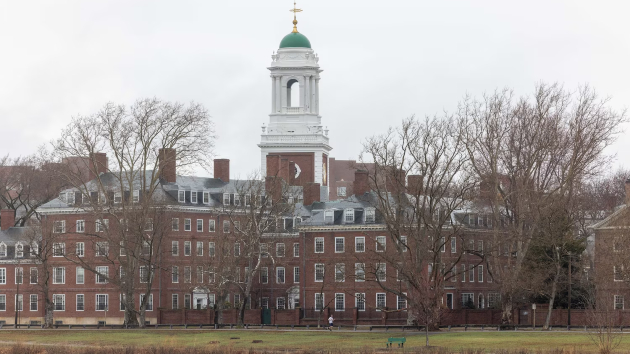
(BOSTON) — The former manager of the Harvard Medical School morgue pleaded guilty to stealing body parts from cadavers donated to the Boston institution and then selling them, federal prosecutors said.

Cedric Lodge, 57, of Goffstown, New Hampshire, pleaded guilty to transporting stolen human remains, the Department of Justice said Thursday.

He pleaded guilty during a change of plea hearing Wednesday in federal court in Williamsport, Pennsylvania. He faces a maximum sentence of 10 years in prison and a fine of $250,000, according to his plea agreement.

Lodge, who had managed the morgue for the Anatomical Gifts Program at Harvard Medical School, admitted to transporting and selling the stolen human remains across multiple states from 2018 to at least March 2020, prosecutors said.

While employed by the morgue, he “removed human remains, including organs, brains, skin, hands, faces, dissected heads, and other parts, from donated cadavers after they had been used for research and teaching purposes but before they could be disposed of according to the anatomical gift donation agreement between the donor and the school,” the U.S. District Court Middle District of Pennsylvania said in a press release.

He then took them to his home and, along with his wife, sold them to people in Massachusetts, New Hampshire and Pennsylvania, prosecutors said. The transactions totaled in the tens of thousands of dollars, according to the indictment.

Lodge’s attorney declined to comment on the case Thursday.

Harvard Medical School terminated Lodge’s employment in May 2023, school officials said following his indictment, calling the activities an “abhorrent betrayal” and “morally reprehensible.” Lodge acted “without the knowledge or cooperation of anyone else” at the institution, the school said.

Several other individuals have also pleaded guilty to interstate transport of stolen human remains in related cases, including Lodge’s wife, Denise Lodge, who is awaiting sentencing, prosecutors said.

Copyright © 2025, ABC Audio. All rights reserved.

Woman found guilty of stowing away on Delta flight from New York to Paris

Woman found guilty of stowing away on Delta flight from New York to Paris
Niagara County Sheriff’s Office

(NEW YORK) — A federal jury has convicted Svetlana Dali of stowing away on a Delta flight to Paris last November after passing through security in a lane reserved for crewmembers and bypassing gate agents by blending in with boarding passengers.

Dali had been charged with a federal stowaway count for boarding an overnight Delta flight from John F. Kennedy International Airport in New York City on Nov. 26, 2024, and traveling to Paris-Charles de Gaulle Airport in France without having a ticket. She had pleaded not guilty.

A Brooklyn federal jury found her guilty on Thursday.

Dali, a Russian citizen and U.S. permanent resident who most recently lived in Philadelphia, took the witness stand during the brief trial. She admitted she did not have a boarding pass when she walked onto the flight.

Instead, she said she walked through to “where the people were boarding the flights and then I just walked into the airplane.”

Dali said she stayed in the bathroom “almost the duration of the flight, almost from the beginning to the end.”

A sentencing date was not immediately set.

In a video obtained by ABC News, Dali can be seen walking up to gate B38 at Terminal 4 while other passengers have their boarding passes and passports checked for the Paris flight. After gate attendants assisted a separate group of customers and ushered them toward the jet bridge, Dali followed immediately behind, the video shows.

Dali was ultimately spotted by Delta employees before the plane landed in France, according to the FBI complaint. The complaint stated that Dali was unable to provide a boarding pass and that once the plane landed, French law enforcement would not allow her to pass the customs area.

During an interview with the FBI upon her return, Dali reportedly admitted to flying as a stowaway and stated she did not have a plane ticket and that she intentionally evaded TSA security officials and Delta employees so she could travel without buying one, according to the complaint.

Officials attempted to send Dali back to the United States on another flight shortly after, but Dali was removed from the plane after insisting against her return.

She was eventually brought back to New York to face charges. After being released, Dali allegedly cut off her ankle monitor and traveled to Buffalo, where she tried unsuccessfully to cross over the Peace Bridge into Canada on a bus.

This is a developing story. Please check back for updates.

Copyright © 2025, ABC Audio. All rights reserved.

2 Israeli Embassy staffers killed in ‘act of terror’ in Washington, DC

2 Israeli Embassy staffers killed in ‘act of terror’ in Washington, DC
IsraelinUSA/Twitter/Anadolu via Getty Images

(WASHINGTON) — Two staff members with the Israeli Embassy — a couple about to get engaged — were gunned down outside an event at the Capital Jewish Museum in Washington, D.C., on Wednesday in what FBI Director Kash Patel called an “act of terror.”

The shooting has sparked outrage and has been condemned as an “unspeakable” act of antisemitism after officials said the suspect, who is in custody, shouted “free, free Palestine” following the shooting.

Yaron Lischinsky and Sarah Lynn Milgrim were identified by Israeli Foreign Minister Gideon Sa’ar as the victims during a press conference on Thursday morning.

He said the pair were attending a Jewish conference of the American Jewish Committee when they were gunned down “in a horrific terrorist attack.”

“This is the direct result of toxic anti-Semitic incitement against Israel and Jews around the world that has been going on since the October 7th massacre,” Sa’ar added. “I have been worried for the past few months that something like this would happen. And it did.”

An official with the Israeli Ministry of Foreign Affairs confirmed to reporters during the presser that Lischinsky and Milgrim were not diplomats but embassy staff. Lischinsky was a researcher in the political department of the Israeli Embassy, while Milgrim organized U.S. missions to Israel.

Suspect taken into custody

The suspect, identified as 30-year-old Elias Rodriguez of Chicago, was promptly taken into custody at the scene and is being questioned by police, D.C. Metro Police Chief Pamela Smith said.

The FBI said on Thursday it was conducting “court authorized activity” at a home in Chicago that is believed to be related to the suspect in the shooting.

FBI Deputy Director Dan Bongino said the early indicators point to the shooting being a “targeted attack.”

“The US Attorney’s office is on scene with me, and our WFO management team, at the Washington Field Office reviewing the evidence to determine additional actions,” Bongino said. “The shooting happened a short distance from our Washington Field Office. Our FBI police officer, assigned to the external post on the WFO property, immediately responded and rendered aid after the attack. Early indicators are that this is an act of targeted violence. Our FBI team is fully engaged and we will get you answers as soon as we can, without compromising additional leads.”

Bongino said on Thursday that the FBI is aware of “certain writings allegedly authored by the suspect, and we hope to have updates to the authenticity very soon.”

After the shooting, officials said Rodriguez attempted to enter the building where the event was taking place and was stopped by event security, Smith said.

Katie Kalisher, who was inside the museum at the time of the shooting, told ABC News before his arrest, Rodriguez “came over to where I was and we offered him water,” which is when he reached into his backpack, pulled out a keffiyeh and said, “I did this for Gaza, free Palestine.”

Another witness, Yoni Kalin, said the suspect “looked frightened.”

Once in custody, he implied that he had committed the shooting and began to chant, “free, free Palestine,” Smith said.

He also explained where he had allegedly ditched the gun used in the shooting, which was promptly recovered, according to officials.

‘No active threat’

“There is no active threat,” D.C. Mayor Muriel Bowser said during the press conference at the Metropolitan Police Department.

“I want to be clear that we will not tolerate this violence or hate in our city. We will not tolerate any acts of terrorism, and we’re going to stand together as a community in the coming days and weeks to send a clear message that we will not tolerate antisemitism.”

Emergency call centers began receiving calls around 9:08 p.m. reporting a shooting in the area, Smith said.

When emergency responders arrived, the man and one woman were found at the scene, not breathing, she continued. At least one of the victims was first transported to a local hospital in critical condition, sources told ABC News.

The two victims had been exiting the event at the museum when the incident occurred, officials confirmed.

“The couple that was gunned down tonight were about to be engaged,” Israeli Ambassador to the United States Yechiel Leiter said at the press conference. “The young man purchased a ring this week with the intention of proposing next week in Jerusalem.”

Leiter also shared that he had received a call from President Donald Trump on Wednesday evening, pledging the support of the U.S. in combating antisemitism.

Meanwhile, Trump posted a statement about the shooting on his social media platform, Truth Social, saying, “These horrible D.C. killings, based obviously on antisemitism, must end, NOW! Hatred and Radicalism have no place in the USA. Condolences to the families of the victims. So sad that such things as this can happen! God Bless You ALL!”

Attorney General Pam Bondi said Thursday they believe the suspect acted alone — “from everything we know now.”

“I saw a young man’s body being taken away, who was about to get engaged. He had an entire life in front of him, and that was taken away. The hate has got to stop, and it has to stop now. This person will be prosecuted to the fullest extent of the law,” Bondi said.

Questions about security

Ted Deutch, CEO of the American Jewish Committee, confirmed with ABC News that the AJC had hosted an event at the museum on Wednesday night, adding, “We are devastated that an unspeakable act of violence took place outside the venue. At this moment, as we await more information from the police about exactly what transpired, our attention and our hearts are solely with those who were harmed and their families.”

The incident took place near the FBI field office in D.C. A top spokesperson for the FBI posted on X that there was a bureau presence at the scene working in conjunction with the Metropolitan Police Department.

Bondi and interim U.S. Attorney for the District of Columbia Jeanine Pirro went to the scene shortly after the incident, Bondi said in a post on X.

“Praying for the victims of this violence as we work to learn more,” she wrote.

Bondi was asked Thursday morning, when she again visited the scene, about whether there was a security failure in preventing the attack.

“I don’t think anyone would have expected what happened last night,” Bondi said. “They were in an event, a beautiful event. … But no, I think law enforcement were on the scene immediately because of that, and the great men and women of the FBI are doing an incredible job as well as Metropolitan Police.”

Reaction to the shooting

Israeli Prime Minister Benjamin Netanyahu’s office issued a statement in the aftermath of the shooting saying he was “shocked” at the murder of two employees of the Israeli Embassy in Washington, D.C.

“The Prime Minister spoke with Israel’s Ambassador to the United States, Yechiel Leiter, and received an immediate update on the details of the incident,” the statement said. “The Prime Minister sends strength to the Ambassador and the embassy employees.”

“My heart aches for the families of the beloved young man and woman, whose lives were cut short by a heinous anti-Semitic murderer,” Netanyahu said. “I have instructed to increase security arrangements at Israeli missions around the world and security for representatives of the state.”

Netanyahu also spoke with the parents of both victims, the prime minister’s office said.

In Washington, D.C., the Secret Service on Wednesday night increased the security posture and patrols for the Israeli Embassy and the residence of the Israeli ambassador, officials said.

In New York City, the NYPD expanded its presence and security measures at Jewish and Israeli facilities and locations connected with the Israeli government. The increased security will remain in place indefinitely and is both visible and hidden, officials said.

Danny Danon, the Israeli ambassador to the United Nations, called the shooting a “depraved act of anti-Semitic terrorism” in a post on X.

“Harming diplomats and the Jewish community is crossing a red line,” he wrote.

United States Department of Homeland Security Secretary Kristi Noem said on X, “We are actively investigating and working to get more information to share. Please pray for the families of the victims. We will bring this depraved perpetrator to justice.”

Former Vice President Kamala Harris and former second gentleman Doug Emhoff shared reactions to the incident on social media Thursday morning, with Harris calling the attack a “shocking act of antisemitic violence.”

“Jews must be able to gather without fear or violence. We will not be silent and we will never let antisemitic terror defeat us. May the memory of Yaron and Sarah be a blessing,” Emhoff, who is Jewish and worked to combat antisemitism as second gentleman, wrote on X.

The Capital Jewish Museum, which has been closed since the shooting, will be reopening “in the coming days, with all necessary security in place,” according to Beatrice Gurwitz, executive director of the museum.

Copyright © 2025, ABC Audio. All rights reserved.
Supreme Court blocks Oklahoma from launching taxpayer-funded religious charter school

Supreme Court blocks Oklahoma from launching taxpayer-funded religious charter school
Kayla Bartkowski/Getty Images

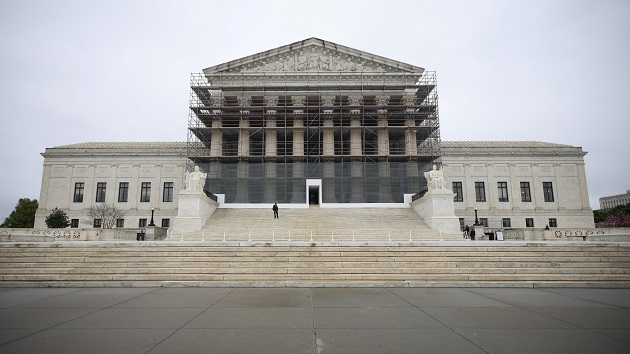
(WASHINGTON) — The Supreme Court on Thursday, in a rare deadlocked 4-4 ruling, said Oklahoma cannot create the nation’s first religious charter school funded directly with taxpayer dollars.

Justice Amy Coney Barrett, a Catholic, did not take part in the decision, recusing from the case early on, presumably given her ties to the Notre Dame Law School clinic that supported the Catholic archdiocese’s effort to create the school, but she did not explain her decision.

The Supreme Court issued a one-line opinion upholding the Oklahoma Supreme Court’s ruling that taxpayer-funded religious schools would violate both the state and U.S. constitutions.

“The judgment is affirmed by an equally divided Court,” the Supreme Court wrote in an unsigned ruling, so it is not known how each justice voted on the issue.

The court action leaves in place lower court rulings that said the arrangement would have violated the establishment clause of the First Amendment.

The decision is a setback for a religious freedom movement that has notched major gains in recent years under the Supreme Court’s current conservative majority, including rulings allowing the use of taxpayer-funded school vouchers, scholarships, and capital improvement grants by religious organizations.

First Liberty, a major religious right advocacy group behind faith-based cases at the high court, represented the Oklahoma state school superintendent, Ryan Walters, who was pushing for religious charters.

Walters vowed to keep fighting for them.

“Allowing the exclusion of religious schools from our charter school program in the name of 19th century religious bigotry is wrong,” said Walters. “As state superintendent, I will always stand with parents and families in opposition to religious discrimination and fight until all children in Oklahoma are free to choose the school that serves them best, religious or otherwise.”

The Supreme Court ruling is almost certainly not the final word on the issue, however.

Because the high court divided evenly, its decision is not a binding precedent nationwide and sets the stage for the entire court to reconsider the issue in a future case, perhaps from another state.

The decision is being greeted with relief by advocates for public schools and independent charter schools, who feared that a ruling in favor of St. Isidore of Seville, the Oklahoma Catholic school, would create major disruptions to education systems nationwide.

Forty-five states have charter school programs, encompassing 8,000 schools that serve 3.8 million kids.

Some states, opposed to funding of religious charter schools, had warned they may be forced to curtail their charter programs or end them entirely.

The American Federation of Teachers, which filed an amicus brief in the two related cases before the court, celebrated the court’s block of taxpayer-funded religious charter schools.

“Today, the court let the decision of the Oklahoma Supreme Court stand, which correctly upheld the separation of church and state and backed the founders’ intention to place religious pluralism over sectarianism,” AFT President Randi Weingarten said. “We are pleased that four of the justices agreed that we must preserve and nurture the roots of our democracy, not tear up its very foundations.”

“We respect and honor religious education. It should be separate from public schooling,” Weingarten added. “Public schools, including public charter schools, are funded by taxpayer dollars because they are dedicated to helping all—not just some—children have a shot at success. They are the bedrock of our democracy, and states have long worked to ensure that they remain secular, open and accessible to all.”

ABC News’ Alexandra Hutzler contributed to this report.

Copyright © 2025, ABC Audio. All rights reserved.

Nearly $34 million worth of illegal e-cigarettes seized by federal officials

Nearly  million worth of illegal e-cigarettes seized by federal officials
Nearly $34 million worth of illegal e-cigarettes seized by federal officials
Nikos Pekiaridis/NurPhoto via Getty Images

(CHICAGO) — Federal authorities seized nearly $34 million worth of illegal e-cigarettes in their latest effort to crack down on unauthorized vaping products entering the U.S.

The Food and Drug Administration and U.S. Customs and Border Protection discovered nearly two million illegal e-cigarette units during inspections in Chicago this February, officials announced Thursday.

Almost all the products came from China and included brands like Snoopy Smoke and Raz.

In a new move to combat illegal imports, the FDA also sent warning letters to 24 companies that bring tobacco products into the country.

“We can and will do more to stop illegal e-cigarettes from coming into the United States,” FDA Commissioner Marty Makary said in the press release. “These seizures keep unauthorized products away from our nation’s youth.”

More than 20 million e-cigarettes are sold each month in the U.S., according to CDC Foundation data. However, only 34 tobacco and menthol-flavored e-cigarette products are allowed to be sold in the U.S.

Officials said many companies tried to sneak illegal products past customs by using fake labels and incorrect values on shipping documents.

“We keep finding more shipments of vaping products that are packaged and mislabeled to avoid getting caught,” according to Bret Koplow, who leads the FDA’s tobacco regulation center. “But we’re getting better at stopping these products before they reach U.S. stores.”

The FDA said the seized products would be destroyed. This operation was part of an ongoing effort that had already stopped more than $77 million worth of illegal e-cigarettes in the past year through similar raids in Los Angeles, Miami, and Chicago.

The agency has also issued more than 750 warning letters to companies making or selling unauthorized vaping products and over 800 warnings to stores selling them. It also filed financial penalties against 87 manufacturers and more than 175 retailers.

Copyright © 2025, ABC Audio. All rights reserved.
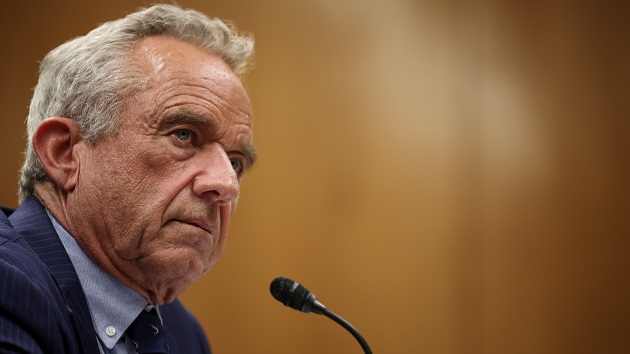
White House releases RFK Jr.-led report on chronic disease

White House releases RFK Jr.-led report on chronic disease
Tasos Katopodis/Getty Images

(WASHINGTON) — The White House’s Make America Healthy Again Commission offered a range of critiques about chronic disease in America in a report released Thursday,

Chiefly, the report blames many chronic illnesses on ultra-processed foods, sedentary behavior and over-reliance on digital devices among children, and chemicals in the environment. It also suggests childhood vaccines need to be studied further.

Health and Human Services Secretary Robert F. Kennedy Jr., who leads the commission, told reporters on a call Thursday that the report is the “most radical consensus by a government agency in history about the state of America’s health.”

“It is very strong. It’s very frank, and it is a clarion call to do something with utmost urgency to end this crisis, and that’s what we wanted,” Kennedy said.

However, the 69-page document leaves many questions unanswered, including how much it will cost to address the chronic illnesses that Kennedy is focused on and what steps might be taken to curtail them.

Kennedy told reporters that the commission doesn’t yet have a budget to fund the future health initiatives, noting officials plan to develop policy recommendations in the next 100 days.

“There is no budge,” Kennedy said. “At this point, there’s no concrete policy that could be funded in a budget. We’re going to work out the policy recommendations over the next 100 days.”

“The next stage of this process is to come up with policy recommendations for the president, and then we’ll spend the next four years implementing those policy recommendations,” he continued.

Despite the lack of budget details, Kennedy maintained that addressing the chronic health issues would save money in the long term.

“We’re going to save a lot more money in the long run and even in the short run, we can reduce the numbers, which we intend to do during this administration,” Kennedy said.

Officials including Calley Means, a special government employee and adviser to Kennedy who has fought against the presence of ultra-processed foods and pesticides, praised the report.

“The fact that an official U.S. government document … gives credibility to complaints about pesticides and names specific pesticides in there is a monumental symbol,” he told ABC News.

Though the officials largely highlighted improving Americans’ diet, which Kennedy said President Donald Trump had directed the commission to look into, Kennedy also emphasized “exposure to toxic chemicals, a lack of physical activity and chronic stress and over-medicalization.”

He said these factors have made American children “the sickest kids in the world.”

On the issue of pesticides in food — which found a lot of industry pushback in the last few weeks as the report neared its due date — Secretary of Agriculture Brooke Rollins and Environmental Protection Agency Administrator Lee Zeldin, who both have more direct oversight than Kennedy over the industry, were careful to ensure that farmers would not face any surprises.

While Kennedy and others in the MAHA movement have questioned the safety or health of the ingredients in foods on store shelves, Rollins stressed that the U.S. food supply remains safe.

“The food supply is 100% safe,” Rollins said. “It isn’t just safe. It is the safest in the world. And it’s really, really important that we continue to make sure that people understand that,” she added.

Rollins pledged that Kennedy and the MAHA Commission will not “compromise the ability of our American agriculture to do what they do best,” and Zeldin said that any moves to regulate pesticides would be carefully considered against the cost to farmers.

“American farmers rely on these products, and actions that further regulate or restrict crop protection tools, beyond risk-based and scientific processes set forth by Congress, must involve thoughtful consideration of what is necessary for adequate protection, alternatives and cost of production,” he said.

Zeldin added that any quick changes in agricultural practices could have “adverse impact on American agriculture and the domestic food supply.”

The report also calls for new studies on childhood vaccines, which dozens of high-quality studies have found to be safe and effective.

Although the report states that vaccines protect children from infectious diseases, it also claims parents are concerned about their “appropriate use” and their “possible role” in chronic diseases among children.

“Despite the growth of the childhood vaccine schedule, there has been limited scientific inquiry into the links between vaccines and chronic disease, the impacts of vaccine injury, and conflicts of interest in the development of the vaccine schedule. These areas warrant future inquiry,” the report states.

Dozens of studies have failed to find a link between an increased number of vaccines and more chronic disease among children.

Copyright © 2025, ABC Audio. All rights reserved.

Treasury Department to phase out the penny after Trump says the coin no longer makes ‘cents’

Treasury Department to phase out the penny after Trump says the coin no longer makes ‘cents’
Tim Boyle/Getty Images

(WASHINGTON) — The U.S. Treasury Department says it will phase out production of new pennies early next year after President Donald Trump asked the agency to stop producing the coin that has been part of the American currency for more than 230 years.

The Treasury Department said in a statement that the U.S. Mint, which it oversees, will stop producing new pennies once it runs out of blank templates used to make the mostly copper and zinc coins. The agency confirmed that it made its final order of penny blanks this month.

The retirement of the penny, which was first reported by the Wall Street Journal, is expected to save the Treasury Department around $56 million annually in reduced material costs, according to the department’s statement.

“Additional savings will accrue as facility usage is adjusted and other efficiencies are achieved with the reduced production,” the Treasury Department said.

The agency announced the move just months after Trump criticized production of the coin in February as being “wasteful.”

In an announcement in February on his Truth Social platform, Trump said the cost of minting the coin featuring the profile of the country’s 16th president, Abraham Lincoln, is more than twice the currency’s face value.

“For far too long the United States has minted pennies, which literally cost us more than 2 cents. This is wasteful!” Trump wrote. “I have instructed my Secretary of Treasury to stop producing new pennies. Let’s rip the waste out of our great nation’s budget, even if it’s a penny at a time.”

According to the U.S. Treasury Department, the cost of producing a single penny has more than doubled in the past 10 years, from 1.3 cents to 3.69 cents in 2024.

Printing a paper $1 bill is cheaper than producing a penny, which, according to the U.S. Mint, is comprised of 97.5% zinc and 2.5% copper and requires a smelting process to mold the metals. According to the Federal Reserve, it costs Treasury’s Bureau of Engraving and Printing 3.2 cents to print a $1 note – less than the cost of minting a penny.

The U.S. Mint reported losing $85.3 million on making pennies in fiscal year 2024, according to the Mint’s annual report to Congress.

The one-cent piece has been part of the fabric of America since 1792. Lincoln’s portrait has been embossed on it for 116 years, according the U.S. Mint’s website.

There are about 114 billion pennies currently in circulation in the United States, but they are severely underutilized, according to the Treasury Department.

“Given the cost savings to the taxpayer, this is just another example of our administration cutting waste for the American taxpayer and making the government more efficient for the American people,” the Treasury Department said in it’s statement.

The move would usually require the approval of Congress. Even though it’s part of the U.S. Treasury, “Congress authorizes every coin and most medals that the U.S. Mint manufactures and oversees the Mint’s operations under its Public Enterprise Fund,” according to the Mint’s website.

However, Laurence H. Tribe, the Carl M. Loeb University professor of constitutional law emeritus at Harvard Law School, told the Associated Press in February that the U.S. Code, a list of general and permanent federal statues, gives Treasury Secretary Scott Bessent the authority to scrap the penny.

“This action seems to me entirely lawful and fully constitutional,” Tribe said.

The penny will become the 12th U.S. currency denomination to be retired, joining the half-cent coin, the 2-cent coin, the 20-cent piece and the “trime” – a silver three-cent piece issued from 1851 to 1873, Caroline Turco, assistant curator of the Money Museum in Colorado Springs, Colorado, told ABC News.

“We retired them for multiple different reasons, but normally because they were not being used or they just became too expensive to produce,” said Turco.

Is it a good idea?

Mark Weller is executive director of Americans for Common Cents, a Washington, D.C., organization that provides research to Congress and the executive branch on the benefits of the penny. He told ABC News that he believes eliminating the coin “is an absolutely horrible idea.”

“It would be bad for consumers and it would be bad for the economy. It really would, in fact, not save money, but it would increase government losses and have some unintended economic consequences,” Weller said.

Weller – who disclosed to ABC News that he is also a lobbyist for companies in various industries, including Artazn, a Tennessee-based manufacturer of zinc products, some of which are used in making pennies – said doing away with the penny would prompt the U.S. Mint to increase production of the nickel.

According to the U.S. Mint, the cost of minting a single nickel is nearly 14 cents, almost three times the coin’s face value and more than three-and-a-half times the cost of minting a penny.

“Without the penny, nickel production could nearly double, which would increase the Mint’s losses,” Weller said. “So, it’s just hard to understand how you could produce more nickels that are losing more money than the penny and say you’re going to save money.”

Weller further said that ditching the penny could lead to the cost of goods going up for American consumers.

“If there’s one thing most economists agree on is that private business has a profit motive. So, the assumption would be that they would price things in a way that they would round up, not round down,” Weller said.

Although digital payments are increasingly more common, Weller said cash remains a crucial tool, “especially for someone economically underserved and under-banked.”

The U.S. Mint produced 3.2 billion pennies in fiscal year 2024, according to the Mint’s annual report to Congress, with an estimated 250 billion pennies currently in circulation.

History of the penny

Turco, whose museum is the education branch of the American Numismatic Association, told ABC News that one big misconception about the penny is that, technically, it has never existed in the United States.

“The American system does not have a ‘penny.’ That is a misnomer,” Turco said. “We have a cent because when we rebelled against the British they had pennies and that is a British word.”

Turco said the 1-cent piece was first produced in the United States in 1792 and was originally the size of the present-day quarter.

Turco said Lincoln, whose likeness is also on the $5 bill, was added to the coin in 1909.

The United States wouldn’t be the first country to eliminate the coin, Turco said. Canada, for example, decided to phase out its penny in 2012. In the U.S., the Department of Defense stopped using pennies at its overseas bases in 1980 because it became too expensive to ship them.

Regardless of the penny’s fate, Turco said she believes it will always be a part of the United States, at least colloquially, adding that such phrases as “a lucky penny” and “a penny saved is a penny earned” will likely always be a part of the American lexicon. Perhaps, ironically, the penny’s value could increase if its discontinued.

“I think collectors will still enjoy having them,” Turco said. “But I don’t think that the value of a penny will just skyrocket overnight.”

Copyright © 2025, ABC Audio. All rights reserved.
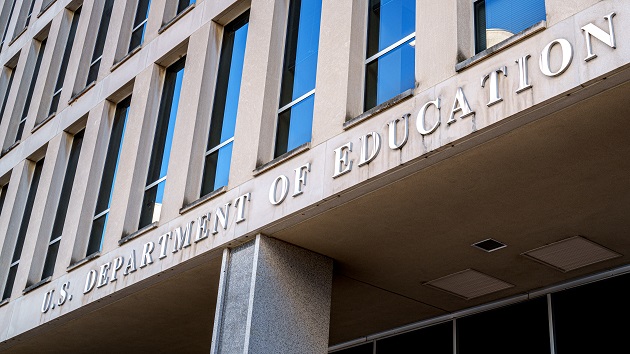
Judge blocks Trump administration from attempting to dismantle Department of Education

Judge blocks Trump administration from attempting to dismantle Department of Education
J. David Ake/Getty Images

(WASHINGTON) — A federal judge in Boston has blocked the Trump administration from attempting to dismantle the Department of Education.

U.S. District Judge Myong Joun issued a preliminary injunction Thursday that bars the Trump administration from firing half the Department of Education’s workforce.

The order from Judge Joun — a Biden appointee — also prohibits the Department of Education from transferring the management of federal student loans to the Small Business Administration.

The decision marks the first time a federal judge has determined the Trump administration’s sweeping changes to the Department of Education are unlawful.

For now, the order puts a stop to the Trump administration’s effort to fire more than 2,000 Department of Education employees, transfer federal student loan obligations, and otherwise implement the president’s March 20 executive order to “take all necessary steps to facilitate the closure of the Department of Education.”

A group that includes several state attorneys general, schools, and nonprofits challenged Trump’s efforts to reduce the size of the Department of Education last month, arguing the president cannot unilaterally shut down a federal department created by Congress.

Lawyers for the Trump administration argued that the efforts to reduce the Department of Education would make it more efficient, and were separate from Trump’s vow to abolish the department.

Judge Joun was unconvinced. His decision offered a blistering assessment of the Trump administration’s claim that recent changes to the Department of Education are to improve efficiency, rather than carry out Trump’s vow to abolish the Department outright.

“The idea that Defendants’ actions are merely a ‘reorganization’ is plainly not true,” he wrote.

The changes imposed by Trump and Education Secretary Linda McMahon, Judge Joun wrote, “effectively impossible for the Department to carry out its statutorily mandated functions.”

Though Trump has the authority to remove executive officers, the president does not have the power to dismantle entire federal departments outright, he wrote. He also cast doubt on the claim that the legislative effort to abolish the Department of Education was separate from his executive actions.

“Not only is there no evidence that Defendants are pursuing a ‘legislative goal’ or otherwise working with Congress to reach a resolution, but there is also no evidence that the RIF has actually made the Department more efficient. Rather, the record is replete with evidence of the opposite,” the judge wrote, referring to the “reduction in force” firings.

“Consolidated Plaintiffs have demonstrated that the Department will not be able to carry out its statutory functions — and in some cases, is already unable to do so — and Defendants have proffered no evidence to the contrary,” he wrote.

Copyright © 2025, ABC Audio. All rights reserved.