
Two doses of Johnson & Johnson’s COVID-19 vaccine 85% effective against hospitalizations, South Africa study shows

Two doses of Johnson & Johnson’s COVID-19 vaccine 85% effective against hospitalizations, South Africa study shows
JUSTIN TALLIS/AFP via Getty Images

(NEW YORK) — A real-world study of South African health care workers found that two doses of the Johnson & Johnson COVID-19 vaccine offer 85% protection against hospitalization from the omicron variant.

Separately, the company announced new data from a laboratory study that shows its vaccine likely also works well as a booster for people who got the Pfizer shots originally.

The lab study specifically tested two types of immune system responses — antibody and T-cell responses — against the omicron variant.

Using the J&J vaccine as a booster raised people’s antibodies and T-cells to levels higher than those seen among people who got a third dose of Pfizer — according to samples taken four weeks after each booster.

The new data adds weight to the argument that mixing and matching vaccine types could be an effective strategy, but the data is limited because it was a laboratory study, not real-world data.

The new findings were described in a press release and submitted to pre-print journals.

“As the Omicron variant has mutated from the original SARS-CoV-2 strain, there is a need to understand how effective currently authorized COVID-19 vaccines remain at protecting against severe disease,” Dr. Dan Barouch, Ph.D., director of the Center for Virology and Vaccine Research at BIDMC, said in a statement. “Our analysis shows that a booster shot of the Johnson & Johnson COVID-19 vaccine generated a robust increase in both neutralizing antibodies and T-cells to Omicron.”

Since its launch, the single-shot J&J vaccine has been dogged by the perception that it is less effective than Pfizer and Moderna’s vaccines. And indeed, many experts agree that one dose of J&J isn’t as effective as two shots from the other brands; but when given as two doses, the J&J shot seems to be an effective vaccine.

“While one dose to prevent COVID was always desirable to improve vaccine access and acceptance, we now have irrefutable evidence that two doses provides significantly more protection,” said John Brownstein, Ph.D, chief innovation officer at Boston Children’s Hospital and ABC News contributor. “The second dose triggers the immune system to produce antibodies and memory cells that ultimately yield longer term vaccine effectiveness.”

Earlier this month, the Centers for Disease Control and Prevention recommended that anyone considering getting vaccinated should get the Pfizer and Moderna vaccines, if available, over the J&J single-shot vaccine. This isn’t because the single-shot J&J vaccine — which has been associated with a risk of very rare blood clots — isn’t safe and effective, CDC researchers said, but because the Pfizer and Modern two-shot vaccines appear to work even better. Collectively, this means the risk-benefit analysis is more favorable for the Pfizer and Moderna vaccines, the CDC said.

Copyright © 2021, ABC Audio. All rights reserved.
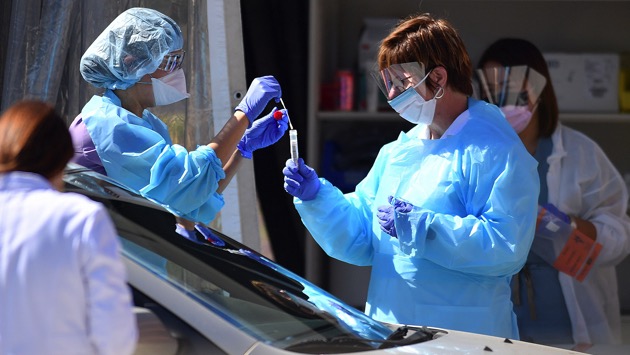
COVID-19 live updates: Three Americans testing positive every second

COVID-19 live updates: Three Americans testing positive every second
JOSH EDELSON/AFP via Getty Images

(NEW YORK) — As the COVID-19 pandemic has swept the globe, more than 5.4 million people have died from the disease worldwide, including over 821,000 Americans, according to real-time data compiled by Johns Hopkins University’s Center for Systems Science and Engineering.

About 61.9% of the population in the United States is fully vaccinated against COVID-19, according to data from the Centers for Disease Control and Prevention.

Here’s how the news is developing. All times Eastern:

Dec 30, 5:34 am
UK plans surge hospitals as ‘war footing’ for omicron

Hospitals across England were setting up “Nightingale surge hubs,” temporary structures capable of handling 100 patients, as they prepared for a potential wave of omicron patients.

The United Kingdom’s National Health Service announced the plan on Thursday, a day after health officials recorded a new daily high for COVD-19 infections.

“Given the high level of COVID-19 infections and increasing hospital admissions, the NHS is now on a war footing,” NHS National Medical Director Professor Stephen Powis said in a statement on Thursday.

The NHS said it would start with hubs at eight hospitals around the country. Health Secretary Sajid Javid said in a statement that an additional 4,000 beds could be added if necessary.

“We do not yet know exactly how many of those who catch the virus will need hospital treatment, but given the number of infections we cannot wait to find out before we act and so work is beginning from today to ensure these facilities are in place,” Powis said.

Dec 30, 4:14 am
UK, Italy, Greece report record new daily cases

The United Kingdom, Italy and Greece broke records on Wednesday for daily new COVID-19 cases, according to government health officials.

The Greek government reported a record increase for new cases for a third consecutive day with 28,828 new cases and 72 COVID-19-related deaths.

About 64.3% of the population is fully vaccinated and 26.5% have received a booster or third dose, according to the European Centre for Disease Prevention and Control.

Health Minister Thanos Plevris announced on Wednesday that new restrictions will go into effect on Jan. 3, but Greece’s Kathimerini newspaper reported that the government has decided to put them into effect at 6 p.m. local time on Thursday.

Italian health authorities recorded another record increase on Wednesday with 98,0303 new COVID-19 cases and 148 deaths.

Semi-official ANSA reported Wednesday’s positivity rate is 9.5% and there are 1,185 patients in ICUs. About 51.7% of Italy’s residents are fully vaccinated and 24.9% have received a booster or 3rd dose, per the ECDC.

UK health officials recorded 183,037 new cases and 57 deaths. The record-setting new case number included five days of data from Northern Ireland, which last published data on Dec. 24, according to health officials.

About 82.3% of adults in the UK have received two vaccine doses and 57.5% have received a booster, according to government data.

-ABC News’ Christine Theodorou

Dec 29, 7:35 pm
Fauci backs CDC isolation recommendations

Dr. Anthony Fauci appeared on ABC News Live Wednesday and shared his thoughts on the U.S. Centers for Disease Control and Prevention’s decision to lower its recommended isolation period to five days for asymptomatic patients.

Fauci also said that while new evidence shows  omicron may be less severe than delta, people should still be cautious of contracting and spreading the virus.

“You can get people safely back out in a five day period so long as they wear a mask, if they are without symptoms. That is the science,” he told ABC News Live. “The impact of that is to try and not be in a situation where we essentially have to shut down the entire country.”

Fauci also said it would be too premature to be less worried based on evidence that omicron may be less severe.

“We are heartened by the fact that from the South African data, the data from the U.K., and the accumulating data in the United States that it looks like it is less severe,” he said. “It’s much more transmissible, which is something you need to take seriously.”

Dec 29, 6:10 pm
FDA authorizes 2 new at-home COVID-19 test kits

The U.S. Food and Drug Administration gave emergency use authorization to two over-the-counter COVID-19 tests.

The tests are manufactured by SD Biosensor and Siemens.

“Combined, it is estimated the companies can produce tens of millions of tests per month for use in the U.S.,” the U.S. Department of Health and Human Services said in a statement.

-ABC News’ Sony Salzman

Dec 29, 2:24 pm
4 Smithsonian locations closed

Four Smithsonian locations in Washington, D.C., have closed due to an increase in COVID-19 cases over the last few days.

The four museums — the National Museum of African Art, the National Postal Museum, the Anacostia Community Museum and the National Museum of Asian Art — are expected to reopen Jan. 3.

The Smithsonian said the cases and quarantine periods impacted “essential and operational staff,” so these closures “will allow the Smithsonian to reallocate staff and keep all other museums open for the remainder of the week.”

The Smithsonian closed in March 2020 due to COVID-19 and loccations started to reopen in May 2021.

-ABC News’ Beatrice Peterson

Copyright © 2021, ABC Audio. All rights reserved.

US shatters COVID case records, as experts predict infection rates will continue to grow

US shatters COVID case records, as experts predict infection rates will continue to grow
iStock/koto_feja

(NEW YORK) — Amid a record-breaking surge, the U.S. is now averaging more COVID-19 cases per day than at any other point in the pandemic, according to new data updated on Wednesday from the Centers for Disease Control and Prevention.

Federal data shows the nation is now reporting an average of more than 277,000 new cases a day, shattering the previous record of 250,000 cases per day from last January.
Recent Stories from ABC News

“These numbers are absolutely staggering, especially considering we are two years into the pandemic,” said John Brownstein, Ph.D., an epidemiologist at Boston Children’s Hospital and an ABC News contributor.

The record average comes after the U.S. reported two consecutive days of more than 430,000 new cases, following soaring demand for tests and a backlog of holiday reporting data.

Over the last month, the U.S. daily case average has tripled, and the nation has reported more than 1.9 million new cases in the last week alone — an average of about three Americans testing positive for COVID-19 every second.

“The combination of the most transmissible variant to date alongside holiday travel and gatherings is a recipe for record-breaking case counts,” Brownstein said, referring to the omicron variant. “These numbers are likely to be a significant undercount given, the shortages in testing and the absence of home test results in official counts.”

Although the significantly high case total is due, in large part, to the country’s latest surge, a number of factors, including data backlogs from the holiday weekend, and a surge in testing demand, may artificially increase the totals.

In addition, more than 30 states are not reporting consistently over the holiday stretch, which can also significantly skew data.

However, on Tuesday, CDC Director Rochelle Walensky told NPR in an interview that given the shortage in COVID-19 tests right now, ultimately, the official number of positive cases is likely undercounted.

The nation’s latest surge is widespread, with every state in the country currently experiencing high community transmission. In June, no states were reporting high community transmission.

Hospitalizations are also on the rise, according to federal data, albeit about two-thirds the levels experienced last winter.

Across the country, more than 84,000 Americans are currently hospitalized with COVID-19 — up by 40,000 patients in the last seven weeks. On average, more than 9,400 Americans are being admitted to the hospital with COVID-19 every day, up by nearly 20% in the last week.

With increased demand in testing and a renewed strain on the hospital system, the federal government has deployed surge teams to help to support the national COVID-19 response, from vaccinations, to testing, to clinical care.

More than 13,000 National Guard members have been activated in 48 states to support the nation’s COVID-19 response, including vaccinations, testing and clinical care.

On Monday, Dr. Anthony Fauci told ABC News’ Whit Johnson that it is difficult to know exactly when the country’s latest surge will peak, given the fact that so many Americans remain unvaccinated.

“It’s going to get worse before it gets better — that’s for sure. We don’t expect things are going to turn around in a few days to a week. It likely will take much longer than that, but that’s unpredictable,” Fauci said.

At this time, 89 million Americans remain completely unvaccinated, and less than a third of fully vaccinated people have been boosted.


Copyright © 2021, ABC Audio. All rights reserved.

Jury reaches verdict in trial of Jeffrey Epstein associate Ghislaine Maxwell

Jury reaches verdict in trial of Jeffrey Epstein associate Ghislaine Maxwell
iStock/CatEyePerspective

(NEW YORK) — A jury has reached a verdict in the criminal trial of Ghislaine Maxwell, the longtime associate of serial sex offender Jeffrey Epstein who is facing charges related to the alleged abuse and trafficking of underage girls.

Maxwell faces a six-count indictment for allegedly conspiring with and aiding Epstein in his sexual abuse of underage girls between 1994 and 2004. She has been held without bail since her arrest in July 2020 and has pleaded not guilty to the charges.

If convicted, Maxwell could spend decades in prison.

This is a developing story. Please check back for updates.


Copyright © 2021, ABC Audio. All rights reserved.

COVID-19 live updates: 3 Americans testing positive every second

COVID-19 live updates: 3 Americans testing positive every second
John Paraskevas/Newsday via Getty Images

(NEW YORK) — As the COVID-19 pandemic has swept the globe, more than 5.4 million people have died from the disease worldwide, including over 821,000 Americans, according to real-time data compiled by Johns Hopkins University’s Center for Systems Science and Engineering.

About 61.9% of the population in the United States is fully vaccinated against COVID-19, according to data from the Centers for Disease Control and Prevention.

Latest headlines:
-3 Americans testing positive every second
-Fauci recommends against big New Year’s parties
-WHO concerned omicron, delta leading to ‘tsunami’ of cases
-US daily case average nearly triples in 1 month

Here’s how the news is developing. All times Eastern.

Dec 29, 4:01 pm
3 Americans testing positive every second

The U.S. reported more than 1.9 million new cases this week, which equals about three Americans testing positive for COVID-19 every second.

The U.S. is now averaging 277,000 new cases each day, shattering the previous record average from Jan. 11, 2021, which was 250,000 cases each day, according to federal data.

Although this significantly high number is in large part due to the latest surge, it’s also attributable to the soaring demand for tests and backlogs of data following Christmas weekend.

ABC News’ Arielle Mitropoulos

Dec 29, 3:01 pm
30% of New York City’s EMS out on COVID sick leave

In New York City, 30% of emergency medical workers and 17% of firefighters are out on leave tied to COVID-19 — and the fire department is reminding New Yorkers to only call 911 in a true emergency.

“If you are not severely ill, allow first responders to assist those most in need,” the FDNY said in a video message.

Meanwhile, the New York Police Department has canceled regular days off for Dec. 31 and Jan. 1 due to COVID-19 and staffing needs for New Year’s Eve.

ABC News’ Mark Crudele, Aaron Katersky

Dec 29, 2:24 pm
4 Smithsonian locations closed

Four Smithsonian locations in Washington, D.C., have closed due to an increase in COVID-19 cases over the last few days.

The four museums — the National Museum of African Art, the National Postal Museum, the Anacostia Community Museum and the National Museum of Asian Art — are expected to reopen Jan. 3.

The Smithsonian said the cases and quarantine periods impacted “essential and operational staff,” so these closures “will allow the Smithsonian to reallocate staff and keep all other museums open for the remainder of the week.”

The Smithsonian closed in March 2020 due to COVID-19 and loccations started to reopen in May 2021.

ABC News’ Beatrice Peterson

Dec 29, 2:00 pm
DC public school students, staff must test before returning to classrooms

All public school students and staff in Washington, D.C., must test when they return to the classroom after winter break.

Free rapid tests will be provided by the city to the over 90,000 students in the largest data collection D.C. has done since the pandemic began, Mayor Muriel Bowser said.

The tests will be distributed on Jan. 3 and Jan. 4. Families are asked to upload results to the city by Jan. 4 at 4 p.m.

“Any student that does not have their results loaded by Jan. 4, will not be allowed to attend school on Jan. 5,” school chancellor Lewis Ferebee told reporters.

Bowser told reporters, “We expect that we’re going to be in this winter surge for a few more weeks, so throughout January we’re going to have to maintain vigilance.”

ABC News’ Beatrice Peterson


Copyright © 2021, ABC Audio. All rights reserved.

Lake Tahoe sees 16 feet of snow in December, crushing records

Lake Tahoe sees 16 feet of snow in December, crushing records
Getty IMages/Christopher Kimmel

(NEW YORK) — Following a year of both extreme heat and drought, Lake Tahoe has seen a record-breaking amount of snow this December, according to the U.C. Berkeley Central Sierra Snow Lab.

The Tahoe area has seen 210 inches of snow since the beginning of the month, the lab, based in Soda Springs, California, reported Wednesday. That makes this month the third snowiest on record and the snowiest December ever, per tracking from the lab that started in 1970.

If weather modeling holds up, it’s possible December could also overtake the current No. 2 record holder, February 2019, which saw a whopping 221 inches of snow, Dr. Andrew Schwartz, who works at the lab, told ABC News.

According to data from the lab, typically about 110 inches of snow will have fallen by Jan. 1 in a given water year, which begins on Oct. 1. But, so far, 2021 has already seen 264 inches of snowfall, putting the region at 258% of its average for this point in the year and breaking the 51-year-old October through December snowfall record of 260 inches set in 1970.

California recorded its second driest water year on record in 2021, according to a report from the state’s Department of Water Resources. But there’s hope that the abnormal amount of snow the Sierra has seen could help break the state’s ongoing drought.

“The snowfall that we’ve received has given us an amazing start to the water year and developed a solid foundation for upcoming snow,” Schwartz said, “but we still need average or above average snowfall in the upcoming months for it to impact the drought.”

Schwartz added that the lab has recorded receiving 70% of its average annual snowfall already, “which is great because the remaining four months with snow only need to make up that remaining 30%.”

He cautioned, however, that if those months end up being dry, then California could end up short of its average snowfall and there won’t be any improvement in the drought at all.

The Sierra snowpack typically holds about a third of California’s water reservoirs, but several are still running lower than normal, even with the increased precipitation.

Data from the National Drought Mitigation Center at the University of Nebraska-Lincoln has shown mild improvement in California’s drought, with 79% of the state in an extreme or exceptional drought as of Dec. 21, down from 88% three months ago.

“So, we’re off to an incredibly promising and exciting start,” Schwartz said, “but we need some cautious optimism going forward.”

ABC News’ Hope Osemwenkhae and Daniel Manzo contributed to this report.


Copyright © 2021, ABC Audio. All rights reserved.

Ghislaine Maxwell jury wants more testimony

Ghislaine Maxwell jury wants more testimony
iStock/nirat

(NEW YORK) — Jury deliberations in the Ghislaine Maxwell trial resumed Wednesday morning. Maxwell was walked partway into the courtroom around 9:25 a.m., wearing a burgundy turtleneck and clutching a green folio.

While the trial is in its 18th day, the jury has deliberated for about 37 hours. And it appears that the jury is no rush to render a verdict before the New Year’s holiday.

The jury, which told Judge Alison Nathan at the end of the day Tuesday, that it was “in a good place,” sent a note to the judge Wednesday morning.

“May we please have the following transcripts,” the note said before listing several names: Shawn, Cimberly Espinoza, Amanda Young and Jason Richards.

When Nathan stepped off the bench after addressing the first note, Maxwell and defense attorney Bobbi Sternheim had a close conversation while standing. Maxwell’s sleeves were rolled up and her hands were clasped behind her back. A short time later she was huddled with her other attorneys, seated at the defense table.

“May we please have the Larry Visoski testimony?” the jury also asked in a note.

Visoski, one of Jeffrey Epstein’s private pilots, was the very first witness for the prosecution. He recalled accuser “Jane” on Epstein’s plane, along with her “piercing powder blue eyes.”

The jury has now asked for transcripts of testimony from a third of the witnesses.

Shawn was the boyfriend of an alleged Maxwell victim, identified only as Carolyn.

Espinoza was the first witness called by the defense. She was Maxwell’s assistant in 1996 in Epstein’s New York office. This is the first time the defense has asked for testimony from a defense witness.

Amanda Young and Jason Richards are both FBI agents on the Epstein-Maxwell case. The defense called the two agents to testify about inconsistent statements by the accusers.

In the same note, jurors also asked about their own schedules.

“May we have clarification regarding our schedule going forward. Are we required to continue our deliberations everyday including 12/31 and 1/1? We ask in order to plan our schedules accordingly,” the note said.

Jurors asked for testimony from an additional witness but neither the judge nor the lawyers could read the name. Upon clarification, the jury asked for the transcript of Elizabeth Loftus, the defense expert witness who testified about the frailty of memory.

Regarding the schedule, the judge said she would tell jurors that deliberations would continue as needed every day going forward, including Dec. 31, Jan. 1 and Jan. 2, until there’s a verdict.

The judge said jurors could inform the court of a “substantial hardship because of unmovable commitments” but otherwise the judge said deliberations would continue uninterrupted by the holiday.

“By this I don’t mean to pressure you. You should take all the time that you need,” Judge Alison Nathan said in her reply.

Nathan cited the “high likelihood that a necessary member of the trial participants or one or more members of the jury would need to quarantine for ten days should they test positive.” She said that would result in “a substantial delay.”


Copyright © 2021, ABC Audio. All rights reserved.

Georgia deploys National Guard to hospitals and testing centers as the state reports record-high COVID cases

Georgia deploys National Guard to hospitals and testing centers as the state reports record-high COVID cases
iStock/narvikk

(ATLANTA) — Georgia is planning to deploy the National Guard to hospitals and testing sites as the state set a single-day record for COVID-19 cases.

Over the next few days, the Georgia Department of Community Health said it will provide troop assignments depending on the centers that are in need of the most assistance.

Additionally, Gov. Brian Kemp will speak with nine hospital systems in the state Wednesday to determine where the most help is needed.

A spokesperson for Kemp’s office told WSB-TV there is not yet a breakdown of where troops will be sent.

It comes as Georgia recorded 13,670 new confirmed and probable COVID-19 cases Tuesday, the most reported in a single day and shattering the previous record of 10,165 set on Jan. 8.

Rising cases have led to an increased demand for testing. Drive-up centers have seen cars lined up for blocks with people waiting several hours to be screened.

Dr. Lynn Paxton, head of the Fulton County Board of Health, which includes Atlanta, told the Atlanta Journal-Constitution that the National Guard will help reduce the long waits for testing.

“Basically, the cavalry is coming in,” she said.

The governor’s office told WSB-TV it is encouraging to see data suggesting fully vaccinated people with a booster shot are well-protected and — if they do suffer a breakthrough infection — tend to develop only mild symptoms.

Kemp, who is fully vaccinated and boosted, continues to ask residents to get their shots, but is not planning to institute any vaccine or mask mandates.

“He will continue to urge Georgians to talk with their doctors about the benefits of getting the vaccine or receiving their booster shot,” a spokesperson for Kemp said in a statement.

“Ultimately, he feels that we must trust our citizens to do what’s right for themselves and their families. He will not be implementing any measures that shutter businesses or divide the vaccinated from the unvaccinated or the masked from the unmasked.”

Kemp’s office did not immediately reply to ABC News’ request for comment.

This is not the first time that Georgia has asked for the National Guard’s help.

In August, during the state’s delta-fueled surge, Kemp deployed more than 2,500 National Guard troops to Georgia hospitals overwhelmed with COVID-19 patients.

The recent rising number of cases also led to Atlanta canceling the annual Peach Drop — Georgia’s New Year’s Eve ball drop celebration. Additionally, Emory University announced that spring semester classes will be remote until at least Jan. 31.


Copyright © 2021, ABC Audio. All rights reserved.

European countries tighten COVID-19 restrictions as omicron spreads

European countries tighten COVID-19 restrictions as omicron spreads
Chesnot/Getty Images

(LONDON) — France this week became the latest European country to tighten its coronavirus restrictions, with nations across the continent posting record numbers of COVID-19 infections in an omicron-fueled surge.

On Dec. 21, the WHO’s regional director for Europe, Dr Hans Kluge, warned that the omicron variant — believed by scientists to be far more transmissible than delta — was set to become the dominant variant on the continent following confirmation that it already had in Denmark, Portugal and the U.K.

Since then, the rate of infection has increased, with France, Italy, the U.K. and Spain posting historic record numbers of COVID infections in recent days. Infections, according to Kluge, are 40% higher than during the same period last year.

In France, where nearly 90% of the eligible population is fully vaccinated, from Jan. 3 there will be an obligation to work from home for three days a week and mask mandates in outdoor city centers. Several countries announced prior to Christmas that they would be introducing restrictions for after the holiday weekend.

In Germany, that means that nightclubs will have to close, large-scale events such as soccer games cannot occur with a live audience and the sale of fireworks is also banned and large-scale events for New Years’ Eve are prohibited.

The Netherlands, meanwhile, is already in an effective lockdown to combat COVID-19 infections, with schools, non-essential stores, bars and restaurants closed until Jan. 14. In the U.K., Wales, Northern Ireland and Scotland have reintroduced social distancing restrictions not seen since before the summer, while England has introduced health passports for mass gatherings and reintroduced mask mandates for public transport and outdoor settings.

However, England has been a notable outlier in that Boris Johnson’s government, encouraged by data that indicates the risk of hospitalization is lower from omicron than the delta variant, has not announced any new restrictions for the New Years’ period — despite the U.K. posting record numbers and more than 100,000 daily infections on several days last week.

Despite relatively high vaccination rates — around 68% of the European Union’s population has been fully vaccinated — there are concerns that not enough has been done to institute a booster drive across the continent which officials say is needed to drive up resistance against omicron.

For interstate European travel, the European Commission announced that their EU Digital COVID Certificate will only be valid for 9 months, meaning that boosters will be required for certificates to be renewed.

In several countries, life is set to become far more difficult for the unvaccinated. This month, Germany has placed major restrictions on access to public life for unvaccinated people — with only those who have been vaccinated or recently recovered allowed entry into non-essential stores, leisure facilities, bars and restaurants.

France meanwhile is set to change its COVID “health pass” into a “vaccine pass” from next month — now it is only valid with vaccination, rather than vaccination or proof of a negative test.

Several European officials have indicated that mandatory vaccinations are likely to become a fact of life in the future. Austria from February will institute a monthly fine on people who do not take up the offer of a vaccine. EU Commission President Ursula Von der Leyen has suggested vaccine mandates could be welcome, with concern that the estimated 150 million Europeans still unvaccinated are the group driving increases in hospitalizations.

Copyright © 2021, ABC Audio. All rights reserved.

How this mom lost over 200 pounds after family tragedies

How this mom lost over 200 pounds after family tragedies
Courtesy Tiesha Robinson

(STATESVILLE, N.C.) — A North Carolina mom is celebrating after losing over 200 pounds, half of her original weight.

Tiesha Robinson, of Statesville, North Carolina, said she lost the weight even after struggling with it for her entire life.

“I can’t think back of when I haven’t had to lose weight or when I wasn’t trying to lose weight,” Robinson, 35, told Good Morning America. “Obesity runs in my family and then also I made a lot of wrong food choices.”

The push to lose weight came on strong for Robinson after she experienced two family tragedies, the death of her beloved aunt in 2016 and then the death of her son’s father in 2018.

“I didn’t want my son to have to go through that pain again if I could prevent it,” she said. “So that was kind of my motivation to save myself so that I could be here for my son.”

Speaking of her aunt’s death in 2016, Robinson said: “My aunt was kind of like everyone’s hero, like the backbone, so to watch her struggle to live was a turning point. It really made me realize that even though I’m strong and I try to be here for everyone, I have to show up for myself because if I’m not here, then I can’t help anyone.”

In 2017, one year after her aunt’s death, Robinson said she hit her highest weight of 416 pounds.

In 2019, after her son’s father died, Robinson began tracking her food using WW, formerly known as Weight Watchers.

“I didn’t know that I would be as successful as I am, but I knew I had to try,” she said of WW. “I knew I couldn’t give up because if I gave up on me, it would be like I’m giving up on my son, and that wasn’t an option, so I just had to throw away all the excuses and all the distractions.”

Robinson said WW’s method of tracking food showed her how to balance what she was eating and “now just indulge in everything that I wanted in one day.”

“I was able to balance healthy choices and just learn a new healthy lifestyle,” she said. “It saved my life by just learning how to eat healthy, be healthy, stay active.”

In the past two years, Robinson said she has lost 208 pounds and changed her life. Her weight loss transformation is featured in People magazine’s 2021 “Half Their Size” issue, available on newsstands now.

She said she is now more “mindful” and in control of her diet, and has taken up hobbies like Zumba, walking and writing poetry that she turns to instead of food.

Robinson said she and her son, now 15, joined a gym together just before the start of the coronavirus pandemic, but she has since learned to love working out at home, which she said helps her eliminate any excuses.

“I learned to exercise at home and that way I don’t have no excuse,” she said, noting she takes Zumba classes on YouTube or plays a dance game on an Xbox. “If it’s too late, I’m in my house so I can exercise. If it’s early and I have energy, I have the opportunity to exercise.”

Through her weight-loss journey, Robinson said she has learned to “set goals, not limits,” which is the advice she gives to others.

“I will say just refuse to give up on yourself,” she said. “Refuse to give up, learn to adapt and if you mess up, don’t make that an excuse to give up.”

Robinson said she has also learned the importance of celebrating her own accomplishments on her weight-loss journey, instead of waiting for other people’s approval.

Her most important advice, she said, is to just start out on the journey, saying, “In order to finish, you have to start, so just get started and keep going.”

Copyright © 2021, ABC Audio. All rights reserved.