
Florida voter has election fraud charges touted by DeSantis dismissed

Florida voter has election fraud charges touted by DeSantis dismissed
Creativeye99/Getty Images

(MIAMI) — A Florida man had his election fraud charges dismissed on Friday, making him the first of 20 people who Gov. Ron DeSantis announced had been charged with voter fraud in August, to beat his case.

The ruling by a Miami judge may now pave the way for similar motions and rulings in the other 19 election fraud cases, which garnered national attention and controversy when they were announced on Aug. 18. DeSantis said at the time that they were the “opening salvo” by Florida’s newly funded Office of Election Crimes and Security to crack down on voter fraud.

Robert Lee Wood, who faced one count of making a false affirmation on a voter application, and one count of voting as an unqualified elector, had his charges dismissed on the grounds that the prosecutor lacked appropriate jurisdiction.

Wood was facing up to five years in prison and $5,000 in fines and fees, for allegedly illegally voting in the 2020 election.

When the charges were announced on Aug. 18, DeSantis said at a press conference that local prosecutors had been “loath” to take up election fraud cases.

“Now we have the ability with the attorney general and statewide prosecutor to bring those [cases] on behalf of the state of Florida,” he said.

But a judge found on Friday that the statewide prosecutor did not have jurisdiction over one case in Miami. Statewide prosecutors, which are an extension of the Attorney General’s office, are prosecuting all of the election fraud cases that were brought in August.

In order for the statewide prosecutor to have jurisdiction, the crimes alleged must have occurred in at least two judicial circuits.

The judge agreed with the defense’s argument that the alleged violations, applying to vote and voting while ineligible, only occurred in Miami-Dade County. Thus, the statewide prosecutor was found to not have jurisdiction.

Statewide prosecutors argued that the alleged crimes were committed in Leon County in addition to Miami-Dade County, because the defendants’ applications and votes were later transmitted to the Department of State in Tallahassee.

The defense argued the alleged offenses only happened in Miami-Dade.

The judge sided with the defense, even citing Shakespeare’s “Henry VI” in his order granting the motion to dismiss.

“His arms spread wider than a dragon’s wings,” the judge wrote in his order, in reference to the statewide prosecutor.

“How much wider even than that does [the statewide prosecutor] seek to extend its reach?”

“It is an old truth that all politics is local,” the judge added. “[The statewide prosecutor] seeks to stand that old truth on its head”

Larry Davis, the attorney for Wood, said that his motion to dismiss on grounds of jurisdiction has been circulated to attorneys representing the other election fraud defendants.

The statewide prosecutor can now appeal the case. If unsuccessful, the Democratic Miami-Dade State Attorney Katherine Fernandez Rundle will also have the option to file charges.

Just days before Florida’s primary in August, DeSantis said at a press conference that 20 people who had cast their ballots in 2020 had been charged with voter fraud. They had all been convicted of murder or felony sex offenses, DeSantis added, which by Florida law stripped them of their right to vote.

“Yet they went ahead and voted anyways. That is against the law, and now they’re going to pay the price for it,” the governor said.

Those charged with illegally voting were sent voting cards by the state, according to the Tampa Bay Times. Many of them told agents that they believed they were eligible, according to court records.

That includes Wood, who was charged with second-degree murder in 1991. Wood registered to vote in 2020 after being approached by a voter rights advocate at a grocery store. Wood claimed he did not fill out the form, rather he just signed it, according to the affidavit of arrest filled out by an FDLE agent.

The form includes a section which asks the applicant to either verify that they are not a felon, or if so, to declare that their right to vote had been restored.

Voter rights advocates say that provision is especially confusing because of the passage of Amendment 4 to the Florida Constitution in 2018, which restored all felons their rights to vote except for those convicted of sex felonies or murder charges.

Later, another condition was added requiring voters with felonies to pay off their fines and fees before having their rights restored.

Republican Florida state legislator Jeff Brandes, who authored Amendment 4, criticized the 20 arrests in a tweet during DeSantis’ press conference, urging the state to look at the intent of the voters.

“It was our intent that those ineligible would be granted some grace by the state if they registered without intent to commit voter fraud,” he tweeted on Aug. 18.

Mark Earley, president of Florida’s election supervisor association, told ABC News that the local supervisors do not have the resources to check a prospective voter’s criminal record. That is the Department of State’s obligation, he said.

Election supervisors check the applications and then transmit them to Tallahassee, where Division of Elections’ staff can check convictions against voter rolls.

Unless an election supervisor receives a packet from the Department of State which contains information that says a voter is ineligible, the voter is sent a voting card, Earley said.

But due to a backlog, as described by a Divisions of Elections official in a 2020 federal case, Florida was “struggling” to come up with a process to identify ineligible felons, The Tampa Bay Times reported.

It’s unclear if the Department of State ever sent those packets to local election officials. But local election officials sent all 20 voter cards to the arrested voters, according to the Tampa Bay Times. The former head of the Office of Election Crimes and Security Pete Antonacci, sent a letter reviewed by ABC News to local elections supervisors on the day of the governor’s announcement, telling them “through no fault of your own” convicted felons voted in their counties.

Neil Volz, the director of the Florida Rights Restoration Coalition, who helped Brandes with Amendment 4, said in a statement that Friday’s ruling, “strengthens our resolve to continue to place people over politics.”

The ruling in Wood’s case is the first disposition of the 18 cases that were announced by the Florida Department of Law Enforcement, following the DeSantis announcement.

Copyright © 2022, ABC Audio. All rights reserved.

Steve Bannon sentencing updates: Bannon sentenced to four months, pending appeal

Steve Bannon sentencing updates: Bannon sentenced to four months, pending appeal
Kevin Dietsch/Getty Images

(WASHINGTON) — Former Trump adviser Steve Bannon is scheduled to be sentenced today following his conviction on two counts of criminal contempt of Congress, after he defied a subpoena from the House select committee investigating the Jan. 6 attack on the U.S. Capitol.

He was subpoenaed by the Jan. 6 panel for records and testimony in September of last year. He refused to comply and was found guilty of contempt in July.

Here are the latest developments. All times Eastern:

Oct 21, 11:46 AM EDT
Bannon, defiant, says he will appeal conviction

Speaking to reporters outside the courthouse after receiving his four-month sentence, Bannon said he respected the judge’s decision. But he was defiant about his conviction, and his attorney confirmed he would be filing a notice of appeal.

Bannon also attacked the Jan. 6 committee and urged people to vote in the upcoming election.

Protesters nearby chanted “traitor” and “liar” as he spoke.

Oct 21, 11:30 AM EDT
Judge reiterates seriousness of Jan. 6

In sentencing Bannon to four months, Judge Nichols reiterated how serious the events of Jan. 6 were and said the congressional committee has every reason to investigate what happened that day and to prevent anything like it from happening again.

Nichols emphasized that Bannon has not produced a single document or any testimony to the Jan. 6 committee — nor did he provide a log of documents that he believed to be covered by executive privilege.

However, the judge said the factors in Bannon’s favor include that he was taking the advice of counsel, even if it was misguided. Nichols also said the committee did not attempt to sue Bannon to enforce their subpoena.

The four-month sentence is two months shorter than the sentence prosecutors had been seeking.

Oct 21, 11:16 AM EDT
Judge sentences Bannon to four months, pending appeal

Steve Bannon has been sentenced to four months in prison and has been ordered to pay a fine of $6,500.

However Judge Nichols said he agreed that Bannon should not have to serve a sentence while he appeals his case, which Bannon has indicated he will do.

Oct 21, 10:57 AM EDT
Bannon attorney argues for executive privilege

Bannon attorney David Schoen took exception to the suggestion that Bannon did not have a legitimate claim of executive privilege when he rejected the committee’s subpoena.

In particular, Schoen went after Trump lawyer Justin Clark, who told DOJ investigators in July that at no point did former President Donald Trump ever invoke executive privilege over Bannon’s testimony.

“You wouldn’t believe a thing he says,” Schoen said of Clark, who also contradicted other claims made by Bannon’s defense team in their case.

Oct 21, 9:56 AM EDT
Prosecutor says Bannon ‘not above the law’

Federal prosecutor J.P. Cooney argued that Bannon is not above the law and should be sentenced and treated like any other citizen.

“It must be made clear to the public and the grand jury … that no one is above the law,” Cooney said. “He hid behind a fabricated claim of executive privilege, to thumb his nose at Congress.”

“He had an interest in making a public spectacle of the committee’s hearings,” Cooney told the judge, saying that Bannon “has tried to make it about nothing but politics and retribution.”

Oct 21, 9:45 AM EDT
Judge ‘tends to agree’ with DOJ on guidelines

The hearing got underway with Judge Carl Nichols saying he tended to agree with the government on the sentencing guidelines.

The judge said that Bannon “has expressed no remorse for his actions” and hasn’t demonstrated that he has any intention of complying with the subpoena from the Jan. 6 committee.

Bannon attorney David Schoen argued that there should not be a 30-day mandatory minimum of jail time for the offense.

Nichols, however, rejected that argument, saying the statute is clear on the point that there is a mandatory minimum of 30 days and a mandatory maximum of 12 months.

Oct 21, 8:58 AM EDT
Courthouse arrival

Bannon arrived at the courthouse before 9 a.m. He thanked the TV news cameras for being there and called the Biden administration illegitimate.

He also thanked a woman who was chanting “traitor.”

Oct 21, 8:43 AM EDT
‘This is just Round 1’

Bannon, whose sentencing hearing is scheduled for 9 a.m. EST, blasted members of the Jan. 6 committee on his way out of the courtroom after being found guilty in July.

“We may have lost a battle here today, but we’re not going to lose this war,” he said. “[The jury] came to their conclusion about what was put on in the in that courtroom. But listen, in the closing argument, the prosecutor missed one very important phrase, right? ‘I stand with Trump and the Constitution, and I will never back off that, ever.'”

Bannon’s attorney, David Schoen, said that Bannon’s defense team would appeal the case, saying, “This is just Round 1.”

Oct 21, 8:17 AM EDT
Bannon ‘willing to pay any fine’

Bannon is scheduled to be sentenced this morning in Washington, D.C. He was interviewed as part of the court’s presentencing investigation, but prosecutors said he refused to disclose any information about his finances.

They did, however, say that Bannon insisted “that he is willing and able to pay any fine imposed, including the maximum fine on each count of conviction,” according to Monday’s court filing.

“For his sustained, bad-faith contempt of Congress, the Defendant should be sentenced to six months’ imprisonment — the top end of the Sentencing Guidelines’ range — and fined $200,000 — based on his insistence on paying the maximum fine rather than cooperate with the Probation Office’s routine pre-sentencing financial investigation,” prosecutors said in Monday’s filing.

Oct 21, 6:55 AM EDT
DOJ seeks six months’ jail time for Bannon

The Department of Justice is seeking six months in prison and a fine of $200,000 when Steve Bannon is sentenced this morning, according to a court filing Monday.

The adviser to former President Donald Trump was convicted in July on two counts of criminal contempt of Congress, after he refused to appear before the House select committee investigating the Jan. 6 attack.

“From the time he was initially subpoenaed, the Defendant has shown that his true reasons for total noncompliance have nothing to do with his purported respect for the Constitution, the rule of law, or executive privilege, and everything to do with his personal disdain for the members of Congress sitting on the Committee and their effort to investigate the attack on our country’s peaceful transfer of power,” prosecutors said in Monday’s filing. “[Bannon’s] abject refusal to heed the Committee’s subpoena, under the circumstances with which this country is confronted, could not be more serious.”

Bannon faces a maximum sentence of one year per count, for a total of two years behind bars.

In his own sentencing memorandum, Bannon asked that he be sentenced to a period of probation and is seeking a stay of any sentence pending appeal of his conviction.

Copyright © 2022, ABC Audio. All rights reserved.

What to know about RSV, one of the main viruses causing pediatric hospitals to fill to capacity

What to know about RSV, one of the main viruses causing pediatric hospitals to fill to capacity
ABC News

(NEW YORK) — Many pediatric hospitals across the country are experiencing a surge in patients, and one of the main reasons, experts say, is an increase in cases of the respiratory virus known as RSV.

RSV, or respiratory syncytial virus, usually causes mild, cold-like symptoms, but it can become serious, especially for infants.

RSV infections are the most common cause of bronchitis and pneumonia in kids under the age of 1 in the U.S., according to the Centers for Disease Control and Prevention.

One parent, Jeff Green, said he noticed his 4-month-old daughter Lindy was sleeping “pretty much nonstop” after contracting RSV.

Lindy is now hospitalized at Cook Children’s Medical Center in Fort Worth, Texas.

“She’s just really lethargic,” Green told ABC News, adding of her earlier symptoms, “She was sleeping pretty much nonstop and started running a pretty significant fever.”

Adria Mullins, of Oklahoma, told ABC News she thought her 4-month-old daughter Shiloh had what she described as a “normal cold.”

When the infant’s breathing became labored, Mullins brought her to the emergency room, where she was admitted for RSV.

“It was rapid breathing,” Mullins said of Shiloh’s condition. “And it was her chest sinking in as she took a breath in and her stomach going out.”

In California, Amanda Bentley said her 18-month-old son Joshua has been hospitalized for more than a week with RSV.

“When I took him to the doctor, she said, ‘I think I’m going to send you to the ER,’ and I’m like, ‘What?'” Bentley recalled. “It was just a shock.”

Hospitals from California to Rhode Island — more than two dozen states in total across the country — have told ABC News they are grappling with a higher-than-expected number of pediatric patients amid the surge of RSV, flu and other common respiratory viruses.

Nationally, pediatric bed capacity is at the highest level in two years, with 71% of the estimated 40,000 beds filled, according to the Department of Health and Human Services.

Experts say the influx of respiratory viruses among children is likely due to a convergence of factors, including the start of flu season and the fact that kids are now less likely to wear face masks and socially isolate as they were doing during the height of the coronavirus pandemic. And RSV, in particular, is a very contagious virus.

“Not only are we seeing more viruses, we are seeing them sooner than we typically see them in cold and flu season,” Dr. Lauren Mientkiewicz, a pediatric emergency medicine physician at Cleveland Clinic in Ohio, told ABC News.

What parents should know about RSV

RSV is a contagious virus that can spread from virus droplets transferred from an infected person’s cough or sneeze, from direct contact with the virus, like kissing the face of a child with RSV, and from touching surfaces, like tables, doorknobs and crib rails, that have the virus on it and then touching eyes, nose, or mouth before hand-washing, according to the CDC.

People infected with RSV are usually contagious for three to eight days, but some infants can continue to spread the virus even after they stop showing symptoms, for as long as four weeks, according to the CDC.

Among children, premature infants and young children with weakened immune systems or congenital heart or chronic lung disease are the most vulnerable to complications from RSV.

“Pretty much all kids have gotten RSV at least once by the time they turn 2, but it’s really younger kids, especially those under 6 months of age, who can really have trouble with RSV and sometimes end up in the hospital,” Dr. William Linam, pediatric infectious disease doctor at Children’s Hospital of Atlanta, told ABC News last year. “That’s where we want to get the word out, for families with young children or children with medical conditions, making sure they’re aware this is going on.”

In the first two to four days of contracting RSV, a child may show symptoms like fever, runny nose and congestion.

Later on, the symptoms may escalate to coughing, wheezing and difficulty breathing.

Parents should also be alerted to symptoms including dehydration and not eating, according to Linam.

“Not making a wet diaper in over eight hours is often a good marker that a child is dehydrated and a good reason to seek medical care,” he said. “Sometimes kids under 6 months of age can have pauses when they’re breathing, and that’s something to get medical attention for right away.”

Infants and toddlers can be treated at home for RSV unless they start to have difficulty breathing, in which case parents should contact their pediatrician and/or take their child to the emergency room.

At-home care for kids with RSV can include Tylenol and Motrin for fevers, as well as making sure the child is hydrated and eating.

Parents can help protect their kids from RSV by continuing to follow as much as possible the three Ws of the pandemic: wear a mask, wash your hands and watch your distance, according to Linam.

Infants who are either born prematurely (less than 35 weeks) or born with chronic lung disease may benefit from a medication to prevent RSV since they are at risk of developing more complications from it. Parents should discuss this with their pediatrician.

Copyright © 2022, ABC Audio. All rights reserved.

Voter fraud charge dismissed in Florida after arrest

Florida voter has election fraud charges touted by DeSantis dismissed
Creativeye99/Getty Images

(MIAMI) — A Florida man had his election fraud charges dismissed on Friday, making him the first of 20 people who Gov. Ron DeSantis announced had been charged with voter fraud in August, to beat his case.

The ruling by a Miami judge may now pave the way for similar motions and rulings in the other 19 election fraud cases, which garnered national attention and controversy when they were announced on Aug. 18. DeSantis said at the time that they were the “opening salvo” by Florida’s newly funded Office of Election Crimes and Security to crack down on voter fraud.

Robert Lee Wood, who faced one count of making a false affirmation on a voter application, and one count of voting as an unqualified elector, had his charges dismissed on the grounds that the prosecutor lacked jurisdiction to bring them.

Wood was facing up to five years in prison and $5,000 in fines and fees, for allegedly illegally voting in the 2020 election.

When the charges were announced on Aug 18, DeSantis said local prosecutors had been “loath” to take up election fraud cases.

“Well, now we have the ability with the attorney general and statewide prosecutor to bring those on behalf of the State of Florida,” he added at the press conference.

But a judge found on Friday that the statewide prosecutor did not have jurisdiction over one case in Miami.

In order for the statewide prosecutor to have jurisdiction, the crimes alleged must have occurred in at least two judicial circuits.

The judge found with the defense, which argued that the act of applying to vote and voting only occurred in Miami Dade. All 20 cases are being prosecuted by the statewide prosecutor.

In order for the Attorney General’s office to have jurisdiction, the crimes that they allege must have occurred in at least two judicial circuits.

State prosecutors argued that the crimes were committed in Leon County in addition to Miami Dade County, because the defendants’ applications and votes were later transmitted to the Department of State in Tallahassee.

The defense argued the alleged offenses only happened in Miami Dade.

The judge found with the defense.

Larry Davis, the attorney for Wood, said that his motion to dismiss on grounds of jurisdiction has been circulated to attorneys representing the other election fraud defendants.

The statewide prosecutor can now appeal the case. If unsuccessful, a similar case could be brought by the Democrat Miami Dade State Attorney Katherine Fernandez.

Copyright © 2022, ABC Audio. All rights reserved.

Anti-gun violence group will spend $1M against election-denier secretary of state candidates

Anti-gun violence group will spend M against election-denier secretary of state candidates
Marilyn Nieves/Getty Images

(WASHINGTON) — Everytown for Gun Safety, the prominent gun violence prevention organization, on Friday announced its first-ever investments in local secretary of state races amid what they described as worries the GOP nominees would not certify presidential election results in 2024 — if elected this year.

The $1 million investment is funding ads and mailers targeting Mark Finchem and Kristina Karamo, the Republican secretary of state nominees in Arizona and Michigan, respectively, and will boost the Democratic Association of Secretaries of State, Everytown said.

The media campaign will be featured on digital platforms like Instagram, Facebook, Roku and YouTube, as well as via direct mail, according to the advocacy group.

Both Finchem and Karamo have spread baseless fraud claims about the 2020 presidential election and have declined to firmly commit to certifying the 2024 election results in their states, if they are in office.

“Electing gun sense champions requires fair elections — and that requires electing Secretaries of State who will stand up to armed extremists threatening our democracy and fight for free and fair elections,” John Feinblatt, president of Everytown, said in a statement.

“Everytown is going to make sure voters know that far-right candidates like Mark Finchem and Kristina Karamo, who deny election results and cozy up to extremist groups, are putting both our democracy and our lives at risk,” Feinblatt said.

The ad against Finchem, who was at the U.S. Capitol during last year’s insurrection (but said he didn’t go inside), highlights his association with the Oath Keepers militia and denial of the veracity of the 2020 election results. And a mailer focusing on Karamo casts her as “too dangerous for Michigan” while noting her election denialism and opposition to abortion access.

Neither Finchem’s nor Karamo’s campaigns responded to requests for comment from ABC News.

Pressed on his own election denialism in the past, Finchem has said that as secretary of state, he would theoretically certify a reelection win for President Joe Biden “if the law is followed, and legitimate votes have been counted” and “if there’s no fraud.” But he told Time magazine, that “quite frankly, is a fantasy.”

Everytown is one of the country’s major supporters of increased gun laws. But Charlie Kelly, the group’s senior political adviser, said that electing lawmakers who will advocate for those changes is only possible if election results are certified — and if voters are free from violence while casting ballots.

“That’s why we’re engaging the secretary of state races,” Kelly told ABC News in an interview.

Kelly said Everytown is hoping that their investment can reach tens of thousands of voters, indicating the new emphasis on secretary of state and other down-ballot races. Both Finchem and Karamo are candidates in swing-states.

Former President Donald Trump’s refusal to accept his own defeat in the 2020, by some seven million votes, has spurred a slew of Republicans running for office this year to cast doubt on the last election and this year’s races, with some candidates preemptively saying that if they win, it would be in spite of fraud — not because of the absence of it.

Kelly, the Everytown adviser, said that Arizona and Michigan were chosen for the advertising blitz after a collaboration with other groups to determine where the investment would go the furthest.

“These are ones that we determined we have an opportunity in. And again, as you’re looking at the battlefield, there are certainly a number of secretaries of state races across the board and across the country where there are extremist candidates running,” Kelly said, “but working again with partners to fill gaps and sort of where the needs are, these two rose to that level.”

Still, Kelly indicated that Everytown will not shy away from investing in secretary of state races in the future, suggesting that the contests will be focuses of Democrats and their allies beyond the midterms.

“If there are extremists and dangerous candidates like Finchem and Karamo running in future cycles, yes, we will be there in a significant way,” Kelly said. “These folks are putting their own sort of political priorities before our constitutional right to vote and our safety and should individuals like this decide to run in future elections, of course we’ll be there. We need to draw that contrast.”

Copyright © 2022, ABC Audio. All rights reserved.
Wave of new Americans could play key role in Arizona midterm election

Wave of new Americans could play key role in Arizona midterm election
ABC News

(PHOENIX) — As Yesenia Cruz-Bejarano emerged from the Moose Lodge, an early voting location in South Phoenix, tears streamed down her face even as she smiled brightly with joy.

“I’ve been here for so long, you know, more than half of my life. So, I feel so proud,” said Cruz-Bejarano, who had just cast her first ballot as a newly-naturalized U.S. citizen. “I’m happy that I can make a difference, you know, with my vote.”

The married mother of three from Mexico, who works full-time at a local children’s shelter, is among a highly diverse wave of new American voters that could play a critical role in one of the hottest political battlegrounds of the midterm elections.

More than 64,000 immigrants gained citizenship in Arizona since 2016, according to a report last month by a coalition of immigrant, labor and voting rights groups in partnership with researchers at the University of California, San Diego.

“Arizona is at the top of the list of states for newly-naturalized voters,” said Nicole Melaku, executive director of the National Partnership for New Americans, a nonpartisan, nonprofit group that sponsored the report. “We know that they will play an outsized role in determining the fate of the U.S. Senate and, of course, their state legislative body.”

Melaku points out the 2020 presidential election in Arizona was decided by just over 10,000 votes. The voting bloc of newly-naturalized citizens is more than six times that margin.

“In order to have a better future, we need to show up and vote and elect those that represent our values,” said Eduardo Sainz, a father of three who recently became a naturalized citizen after waiting 16 years in line. “We have to take out racist politicians out of office.”

Arizona’s population of naturalized American voters is a racially and ethnically diverse mix of immigrants from all over the world. More than half immigrated from Latin America and a third came from Asia, according to the report. Both groups of new citizens have a historically high rate of voter participation.

“They’re important because they’ve come to this country to be part of the American dream. They’ve come here to be part of the fabric of our country,” said Petra Falcon, executive director of Promise Arizona, a nonpartisan immigrant advocacy group.

The issues most important to them mirror those of the U.S. electorate more broadly, Falcon said, sharing concerns about the economy, health care, education, immigration and abortion rights.

“No voting bloc is a monolith, but they are most certainly not all Democrats,” said Melaku, “and they’re certainly people who need to be engaged, courted to really fully understand the issues at stake.”

Tuach Ruon, a father of five, and Tema Patrick, father of six, became U.S. citizens earlier this year as refugees from north and central Africa. Both now have union jobs working the overnight shift at a distribution warehouse — and both said health care is a top issue.

“In my native Congo, I never vote,” said Patrick, 45, who explained in broken English that he had never been able to cast a ballot. “This is my first time. I’m very happy.”

“It is important for us to vote to show that we are American,” added Ruon, “and to show that the people who we are voting for are doing the job that we are expecting them to do.”

Researchers say the newest Arizona voters are disproportionately young and female: More than half are under the age of 45 and nearly 6-in-10 are women.

“Self autonomy is a very big thing, specifically to women, non-binary individuals, anyone,” said Arisbeth Valenzuela, who became a U.S. citizen in 2019 and is now a grassroots organizer with Mi Familia Vota, a civic engagement group.

“There’s been a lot of women that have the same concerns that I do, and a lot of them are now getting much more invested in politics,” she said.

Overall, Arizona is home to nearly half a million naturalized citizens that comprise more than 6% of the state’s total population. Nearly one-fifth of those immigrants joined the voter rolls since 2016.

“We have a diversity of new people that are changing the electorate of Arizona,” said Arizona State University political scientist Irasema Coronado.

“The fact that we have two Democratic senators is a change. The fact that we have progressive members of the city council is a change. And so, you have a variety of people with new experiences and more progressive politics,” she said.

Their political power may depend in part on the ability to navigate new state voting restrictions, advocates said.

“That really could have a negative impact for voter behaviors, but we’re actually feeling quite hopeful that this year,” said Melaku, whose group is spearheading outreach to newly-minted American citizens.

“This is a powerful, rising voting bloc of people who are most likely bilingual, multicultural, come from, you know, diverse families and, of course, who care about a lot of issues,” she said.

Cruz-Bejarano said the responsibility and excitement of being a new voter instills a natural sense of engagement.

“There’s so many people becoming American citizens,” she said. “I have a lot of friends, you know, they are doing it right now. It’s — I think it’s really going to make the difference.”

Copyright © 2022, ABC Audio. All rights reserved.
Steve Bannon sentencing updates: Former Trump adviser faces up to two years

Steve Bannon sentencing updates: Bannon sentenced to four months, pending appeal
Kevin Dietsch/Getty Images

(WASHINGTON) — Former Trump adviser Steve Bannon is scheduled to be sentenced today following his conviction on two counts of criminal contempt of Congress, after he defied a subpoena from the House select committee investigating the Jan. 6 attack on the U.S. Capitol.

He was subpoenaed by the Jan. 6 panel for records and testimony in September of last year. He refused to comply and was found guilty of contempt in July.

Here are the latest developments. All times Eastern:

Oct 21, 8:58 AM EDT
Courthouse arrival

Bannon arrived at the courthouse before 9 a.m. He thanked the TV news cameras for being there and called the Biden administration illegitimate.

He also thanked a woman who was chanting “traitor.”

Oct 21, 8:43 AM EDT
‘This is just Round 1’

Bannon, whose sentencing hearing is scheduled for 9 a.m. EST, blasted members of the Jan. 6 committee on his way out of the courtroom after being found guilty in July.

“We may have lost a battle here today, but we’re not going to lose this war,” he said. “[The jury] came to their conclusion about what was put on in the in that courtroom. But listen, in the closing argument, the prosecutor missed one very important phrase, right? ‘I stand with Trump and the Constitution, and I will never back off that, ever.'”

Bannon’s attorney, David Schoen, said that Bannon’s defense team would appeal the case, saying, “This is just Round 1.”

Oct 21, 8:17 AM EDT
Bannon ‘willing to pay any fine’

Bannon is scheduled to be sentenced this morning in Washington, D.C. He was interviewed as part of the court’s presentencing investigation, but prosecutors said he refused to disclose any information about his finances.

They did, however, say that Bannon insisted “that he is willing and able to pay any fine imposed, including the maximum fine on each count of conviction,” according to Monday’s court filing.

“For his sustained, bad-faith contempt of Congress, the Defendant should be sentenced to six months’ imprisonment — the top end of the Sentencing Guidelines’ range — and fined $200,000 — based on his insistence on paying the maximum fine rather than cooperate with the Probation Office’s routine pre-sentencing financial investigation,” prosecutors said in Monday’s filing.

Oct 21, 6:55 AM EDT
DOJ seeks six months’ jail time for Bannon

The Department of Justice is seeking six months in prison and a fine of $200,000 when Steve Bannon is sentenced this morning, according to a court filing Monday.

The adviser to former President Donald Trump was convicted in July on two counts of criminal contempt of Congress, after he refused to appear before the House select committee investigating the Jan. 6 attack.

“From the time he was initially subpoenaed, the Defendant has shown that his true reasons for total noncompliance have nothing to do with his purported respect for the Constitution, the rule of law, or executive privilege, and everything to do with his personal disdain for the members of Congress sitting on the Committee and their effort to investigate the attack on our country’s peaceful transfer of power,” prosecutors said in Monday’s filing. “[Bannon’s] abject refusal to heed the Committee’s subpoena, under the circumstances with which this country is confronted, could not be more serious.”

Bannon faces a maximum sentence of one year per count, for a total of two years behind bars.

In his own sentencing memorandum, Bannon asked that he be sentenced to a period of probation and is seeking a stay of any sentence pending appeal of his conviction.

Copyright © 2022, ABC Audio. All rights reserved.

Parents of Purdue student killed in dorm open up about ‘peacemaker’ son’s shocking death

Parents of Purdue student killed in dorm open up about ‘peacemaker’ son’s shocking death
ABC News

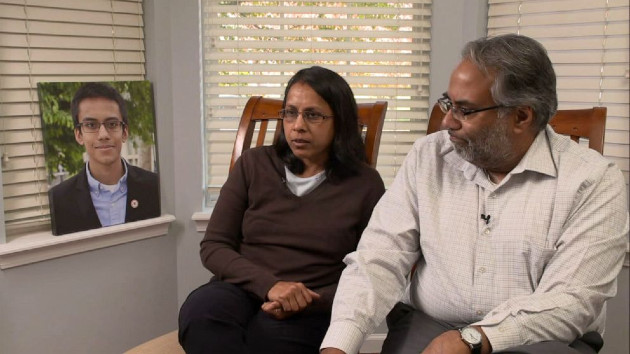
(NEW YORK) — The 20-year-old Purdue University student stabbed to death in his dorm room was effusive, close with his family and wise beyond his years, according to his parents.

Varun Manish Chheda, a senior majoring in data science, was found dead in his room on the school’s West Lafayette, Indiana, campus on Oct. 5 after his roommate called 911, university police said. The roommate, 22-year-old Ji “Jimmy” Min Sha, was arrested and charged with Chheda’s murder.

Although Varun was a busy college student, he always stayed in touch with his mom, dad and little sister. He’d call his mom between classes, share his Wordle score with her, and check in over text each morning and night, his mother, Seema Dedhiya, told ABC News in an exclusive interview.

On Varun’s final night alive, Dedhiya said she texted her son her usual evening message: “Eat well, sleep well. … Finish your homework.”

“He said, ‘Yes, Mom, I’ve done it all,'” she recalled.

She said Varun’s final text to her at 11:45 p.m. read, “Goodnight, Mama.”

Early on the morning of Oct. 5, two police officers came to the family’s door in Indianapolis with the tragic news. The 20-year-old suffered multiple stab wounds in an “unprovoked” attack, according to Purdue University Chief of Police Lesley Weite.

Seema Dedhiya and her husband, Manish Chheda, said they had no sense of problems with Varun’s roommate and said their son rarely mentioned him. They described Varun as a peacemaker, which they said made his violent death all the more shocking.

Varun was a minimalist and environmentalist. He never asked his parents for money and insisted he didn’t need a nicer car or nicer computer, they said.

He was passionate about Taekwondo, strategy games and especially science, said his father, Manish Chheda.

Varun was recently studying medical genomics and “was even thinking maybe of following in my footsteps and becoming a physician,” he said.

“How it would’ve turned out, we just only can guess at this point,” he said. “I think he would’ve been involved in … helping people face-to-face or in a research realm.”

He was a kind big brother and a thoughtful friend, his dad said, recalling the time Varun encouraged a friend to donate his long hair to cancer survivors.

“We think he did a lot of good in the time he had,” Manish Chheda said. “We’re proud of that.”

Asked what she’ll miss most, Dedhiya replied through tears: his laugh, his hugs, “his brilliance” and “all the conversations.”

“I miss him terribly,” Dedhiya said.

Manish Chheda said he doesn’t know when he’ll “be psychologically ready” to return to his work as a doctor.

“I need to be more focused than I am right now. We’re gonna get help, we’re gonna get counseling,” he said.

The family will “never be normal again,” but he said he hopes they’ll find a “new normal.”

“You can’t lose someone like this and ever get over it. But we have to try,” he said.

Sha has not entered a plea. As he headed to his first court appearance on Oct. 7, Sha told reporters “I am very sorry” when asked if he had a message to the victim’s family. Sha also said, “I was blackmailed,” but did not elaborate.

His defense attorney did not immediately respond to ABC News’ request for comment.

Copyright © 2022, ABC Audio. All rights reserved.

Who will be the UK’s next prime minister? Here are the potential candidates

Who will be the UK’s next prime minister? Here are the potential candidates
Andrew Holt/Getty Images

(LONDON) — Liz Truss announced her resignation on Thursday after only 45 days in office, making her the shortest-serving U.K. prime minister in history.

Her resignation follows weeks of political and economic turmoil after her government introduced a “mini-budget” that sent financial markets into crisis and cratered the value of the Great British Pound.

As a result, members of the Conservative Party’s 1922 Committee, the ruling group that sets out leadership contest rules, have introduced immediate changes to the process as the party prepares to name its third prime minister in two months.

Potential prime ministerial candidates will need the support of at least 100 fellow Members of Parliament to secure their spot on the ballot to become the next party leader.

The Conservative Party currently has 357 members in Parliament meaning there will be a maximum of three leadership candidates that could be put forward.

The increased threshold of MPs needed to support a candidate for office “can be achieved by any serious candidate with a chance of going through” Sir Graham Brady, Chairman of the 1922 Committee, said on Thursday.

Many see these changes as an attempt to bypass the Conservative Party’s internal membership voting in the leadership contest and, as a result, could produce another leader who creates further political and economic instability.

Former Prime Minister Boris Johnson is speculated to make a dramatic return to the frontline of British politics only six weeks after he reluctantly resigned amid intense scandal. He remains popular with Conservative Party members but is seen as a liability by many of his fellow colleagues.

On the potential return of Johnson, John Baron, MP for Basildon and Billericay, told the BBC that “we’ve now got to look forward and pick a new candidate, somebody who has credibility, experience and can unite the party.”

Johnson has not yet confirmed if he is standing for office again but will be flying back to the U.K. this weekend after enjoying a vacation in the Caribbean.

Former Finance Minister Rishi Sunak is seen as another likely candidate after he came second to Liz Truss in this summer’s leadership contest. Sunak repeatedly warned Truss that her economic plans and proposed tax cuts would create economic turmoil. The subsequent financial fallout looks to have proven him correct.

Sunak is a potential calming voice and remains the U.K.’s seventh most popular politician, according to analytics firm, YouGov. However, reports that his wealthy family used non-domiciled status to reduce their tax payment is seen as a potential gift to Labour, the U.K.’s opposition party, amid the current cost of living crisis.

Penny Mordaunt, who placed third in the leadership contest, is another likely favorite.

Mordaunt served as former Prime Minister Theresa May’s defense secretary, the first woman to hold the post in British history, and her previous experience within the Ministry of Defense could be a vital benefit when it comes to how the U.K. deals with the war in Ukraine.

Suella Braverman, the former Interior minister — who lasted a day less in office than Liz Truss did — is another probable contender for the top job.

A renowned anti-immigration and Brexit supporter, Braverman proposed strengthening the punishment for possessing cannabis and is seen as the preferred candidate for the ideological right of the Conservative Party.

Across the aisle, however, Leader of the U.K.’s Opposition Party, Sir Keir Starmer, has joined other political leaders from the minority parties in calling for a general election.

“The British public deserve a proper say on the country’s future” and “we need a general election,” he said on Twitter.

The next prime minister will be announced by Oct. 28.

Copyright © 2022, ABC Audio. All rights reserved.

Lawsuit against Barilla over slogan ‘Italy’s No.1 brand of pasta’ may proceed

Lawsuit against Barilla over slogan ‘Italy’s No.1 brand of pasta’ may proceed
Smith Collection/Gado/Getty Images

(NEW YORK) — Barilla Pasta is being sued for its marketing as “Italy’s No. 1 brand of pasta.”

A lawsuit filed last year by customers Matthew Sinatro and Jessica Prost claims that the slogan in question “leads reasonable consumers to believe that Barilla’s products are made and/or manufactured in Italy using ingredients from Italy.”

Sinatro and Prost, who said they bought one box of angel hair and two boxes of spaghetti, respectively, claim in the lawsuit that they purchased Barilla thinking the contents were made in Italy. They also claim the colors of the Italian flag and imagery “further reinforces the notion that the products ‘are authentic pastas from Italy.” The duo are also challenging “the packaging for 52 additional Barilla-brand pastas across several sub-brands: Classic Blue Box, Collezione Artisanal, Gluten Free, Veggie, and Whole Grain,” which they did not purchase.

In a motion to dismiss, Barilla argued that the slogan is a registered trademark and “its utility is to exclusively identify Barilla (not Italy) as the source of the product.”

Barilla argued that “no reasonable consumer could be deceived” by their packaging because all 54 products — which includes Barilla-brand pastas from several sub-brands — “are conspicuously marked ‘Made in the USA’ with the location of Barilla’s headquarters in Illinois.”

While the statement appears on the blue cardboard boxes, Barilla also states on its website that its pasta “sold in the United States is made in our plants in Ames, Iowa and Avon, New York, with a few exceptions. Barilla Tortellini and Barilla Oven Ready Lasagne are made in Italy.”

When the company first opened plants in the U.S., the website states, “the Barilla family was very concerned about maintaining Barilla’s high quality standards” and ensured that the machines used to make pasta in those facilities were the same as those used in the Parma, Italy plant.

“The recipe and the wheat blend are the same as that used in Parma, Italy. Barilla purchases its wheat from around the world, ending up with the best wheat available,” the site reads.

On Monday, Judge Donna M. Ryu denied in part Barilla’s motion to dismiss and said the lawsuit can proceed.

“As Plaintiffs note, Barilla asks the court to assume that consumers would solely perceive the Challenged Representation to mean that the products at issue are part of the Barilla brand, and not that they are made in Italy from Italian ingredients,” Ryu wrote. “In other words, Barilla asks the court to decide as a matter of law that the Challenged Representation can mean only one thing. However, Plaintiffs have alleged that the Challenged Representation appears with the colors of the Italian flag, and that this imagery further reinforces the notion that the products ‘are authentic pastas from Italy.'”

Ryu also rejected the company’s argument that the case should be dismissed because its products “are conspicuously marked ‘Made in the USA’ with the location of Barilla’s headquarters in Illinois,” stating that the materials on which that argument rests “are not properly before the court.” Elsewhere in the order, Ryu stated that those materials — including photos of its packaging and nutrition label — were “barely legible” and “purportedly cut and pasted from third party websites, accompanied by typed captions that do not appear to have been part of the original webpages.”

ABC News’ Good Morning America has reached out to both Barilla and Clarkson Law Firm, which is representing the plaintiffs, for comment on the decision and will update with a response.

The order allows the case to move forward, but also allows Barilla to continue using the slogan as the case proceeds.

Copyright © 2022, ABC Audio. All rights reserved.