(NEW YORK) — Six train cars, including two carrying propane, derailed in Manatee County, Florida, on Tuesday, according to the train’s operator, Seminole Gulf Railroad.
There is no immediate danger or leaks and no one was injured, according to the Manatee County Sheriff’s Office.
Robert Fay, vice president with Seminole Gulf Railroad, told ABC News that six rail cars derailed. Five cars went completely on their sides; four were carrying sheetrock and one was a propane tanker. A sixth car, also a propane tanker, derailed but that car stayed upright, Fay said.
None of the LPG, or liquified petroleum gas, on either car leaked out, Fay said.
The Southern Manatee Fire Rescue said that hazmat and fire crews are working to turn the cars upright.
According to Seminole Gulf Railroad, four train cars were hauling sheetrock and one tank car flipped over. One car was described as “half-derailed” and upright.
The derailment comes as East Palestine, Ohio, continues to grapple with cleanup after a Northfolk Southern train carrying hazardous materials derailed earlier this month, causing ongoing concerns and anxiety for residents, as well as increased scrutiny of railway protocols and demands for reform.
The salvage operation in Florida will take multiple days, with a spokesperson for Seminole Gulf Railroad saying that restoration efforts will be completed by March 6, according to Southern Manatee Fire Rescue Chief Robert Bounds.
One of the tipped-over train cars was carrying 30,000 gallons of liquid propane, Bounds told ABC News.
Since the tanker is undamaged, crews will not try to offload the propane, instead lifting the car with the contents within the tanker.
According to Bounds, a 100-foot section of the railroad is “snapped in half” and uprooted.
“It’s kind of a domino effect,” he said. “The one car jumped the track and flipped, and that’ll pull the next car, and so on and so on until the inertia stops enough that the last car just unbuckled.”
Bounds said that an effort to upright the propane tanker would occur in the coming days.
According to Bounds, crews monitoring the site are equipped with gas-monitoring equipment and local businesses have been notified about the derailment.
The Manatee County Sheriff’s Office is providing security near the site.
“The scene is as safe as it can be right now. Short of that tank being on its side, there is no problem,” Bounds said.
The Florida Department of Transportation will investigate the incident.
(WASHINGTON) — A top Pentagon official said Tuesday that Iran could make the nuclear material for a device in about 12 days if it wanted to do so.
Last week, the International Atomic Energy Agency said its monitors had detected that Iran now had the capability of enriching uranium to close to 84%.
On Tuesday, the IAEA said the capability had actually reached 83.7 percent, which is on the verge of making weapons-grade uranium.
In response to a question from Rep. Jim Banks, R-Ind., at a House Armed Services Committee hearing on Ukraine, Colin Kahl, the Pentagon’s top policy official, was asked to describe Iran’s nuclear progress since then-President Donald Trump pulled the U.S. out of the Iran nuclear deal, known as the Joint Comprehensive Plan of Action, or JCPOA.
“Iran’s nuclear progress since we left the JCPOA has been remarkable,” Kahl said.
“Back in 2018, when the previous administration decided to leave the JCPOA, it would have taken Iran about 12 months to produce one bomb’s worth of fissile material,” said Kahl about Iran’s so called “breakout time. “Now it would take about 12 days.”
Kahl said he still thinks going back to the deal is better than not having any deal because he said it could “put constraints” on Iran. At the same, he acknowledged that isn’t likely, given that efforts to go back to the deal are “on ice” since Iran turned down a U.S. offer last summer.
“Of course, Iran’s behavior has changed since then, not the least of which there’s support for Russia and Ukraine, which is the subject of the conversation here today,” he told lawmakers. “So, I don’t think we’re on the precipice of reentering the JCPOA.”
(NEW YORK) — The jury in the double murder trial of disgraced South Carolina attorney Alex Murdaugh — who is accused of killing his wife and younger son at the family’s property in 2021 — will travel to the site of the brutal killings on Wednesday ahead of closing arguments.
The bodies of Margaret Murdaugh, 52, and Paul Murdaugh, 22, were found dead from multiple gunshot wounds near the dog kennels at the family’s estate Moselle in June 2021, authorities said.
Alex Murdaugh, 54, who called 911 to report the discovery, was charged with their murders 13 months later.
The defense argued that it would be useful for the jury to visit the 1,772-acre hunting estate in Islandton to get a sense of the space in which the killings took place.
“You just can’t really appreciate the spatial issues without actually seeing them,” defense attorney Richard Harpootlian told the court on Monday.
Prosecutors had argued against the visit to Moselle, given that the property has changed in the 20 months since the killings, but Judge Clifton Newman ruled in favor of the defense on Monday.
The jurors are slated to travel to the property, which is under contract for $3.9 million, Wednesday morning amid tight security. No questions can be asked and no talking will be allowed on the trip. The judge has warned them that some things have changed on the property since the crime occurred.
Following the trip, court is expected to resume around 11 a.m., at which point the attorneys will argue charges for how the jury will be instructed to deliberate.
Once those rules are established, closing arguments will take place, then the judge will charge the jury before deliberations into the high-profile case begin.
Over the past nearly six weeks, the jury has heard from over 60 witnesses called by state prosecutors, who have argued that Alex Murdaugh killed his wife and son to gain sympathy and distract from his financial problems.
Prosecutors have focused on footage taken from Paul Murdaugh’s cellphone the night of the murders, including a video taken at the kennels several minutes before the victims were believed to be killed that investigators said has Alex Murdaugh talking in the background. Alex Murdaugh told investigators early in the case that he was not down by the kennels that night and had last seen his wife and son at dinner before finding bodies upon returning home from visiting his mother.
The defense has called 14 witnesses, including Alex Murdaugh himself, who during hours of at-times emotional testimony admitted to stealing from his clients and lying to investigators about his whereabouts the night of the murders but repeatedly denied fatally shooting his wife and son.
The defense has argued that police ignored the possibility that anyone else could have killed them and called experts who said investigators did not adequately examine the crime scene. On Monday, in one of their last witnesses before resting, the defense brought a crime scene expert to the stand who said he believed the killings were likely committed by two people.
Before resting on Tuesday, prosecutors brought forward experts to dispute some of the defense witnesses’ theories on how the shootings occurred and called former Murdaugh law partner Ronnie Crosby to the stand to discuss Alex Murdaugh’s tactics as a trial attorney.
“You asked me what kind of lawyer Alex was, and I told you he was a good lawyer,” Crosby said. “One of the things that I think I explained to you was that he was of a theatrical type presence in the courtroom and he could get very emotional doing closing arguments in front of a jury.”
Alex Murdaugh faces 30 years to life in prison without parole if convicted of the killings, for which he has pleaded not guilty.
(NEW YORK) — When Alyn Carroll received information that her Supplemental Nutrition Assistance Program (SNAP) will soon be substantially decreased, her emotions almost overtook her.
“I wanted to cry,” Carroll, 56, told ABC News. “I wanted to cry because I just started feeling comfortable where I could budget every week a certain amount of money to spend and I did OK with that. But now, they taking that back? It’s like, what is a person to do?”
Carroll, who lives in Baltimore, has been using SNAP to buy food for around seven years and said it is a crucial part of her grocery budget as a person with diabetes. The remaining SNAP emergency allotments that were expanded during the COVID-19 pandemic are set to expire, however — and Carroll’s monthly SNAP check will go from $283 to just $56, she said.
“You can’t survive off of $56 a week, let alone four weeks,” she said. “That extra money helped. I mean, it didn’t fix the problem, but it helped greatly. With them taking those funds back, it’s going to be terrible because we already didn’t have enough money to feed our families.”
While nearly 30 million Americans could see reduced payments when the expanded SNAP benefits expire, Black and Latino communities may be pushed back below the poverty line without the support of the emergency allotments, which were temporarily extended during a time of financial and economic hardship from the pandemic.
According to a study from the Urban Institute, SNAP’s benefits kept 4.2 million people out of poverty since the fourth quarter of 2021, with the largest poverty reduction from the program for Black and Hispanic people.
The emergency allotments reduced poverty by 10% and child poverty by 14% in their states, according to the study.
Eighteen states have already ended the extra SNAP benefits, impacting some 12 million Americans. The remaining 32 states and the jurisdictions of Washington, D.C., Guam and the U.S. Virgin Islands follow suit on Wednesday.
“It’s important to know that communities of color have a higher rate of poverty at a national and statewide level than their white counterparts. Because of that, they’re already at a disadvantage in terms of access to benefits,” said Gina Plata-Nino, Food Research and Action Center (FRAC) deputy director for SNAP.
The FRAC prioritizes improving the nutrition, health and well-being of people struggling against poverty-related hunger in the U.S. through advocacy, partnerships, and by advancing bold and equitable policy solutions, according to its website.
According to the U.S. Census Household Pulse Survey data, food insufficiency — or “sometimes” or “often” not having enough to eat — continues to be over twice as high for Black and Latino adults compared to white adults.
“SNAP is able to protect people. It pushes them out of the poverty hole. It allows them to have enough resources to be able to feed their kiddos and I think it’s important to know that while this is the Supplemental Nutrition Assistance Program for many of these families, it is also their one sole income to feed their families,” Plata-Nino said.
While Carroll is solely responsible for finding food for herself, she expressed empathy for those in her community with families who will struggle because of the end of SNAP’s emergency benefits.
She said she also worries how food banks will be able to pivot during a time of record inflation, with food prices up 10.1% in January, compared with a year ago, according to the U.S. Bureau of Labor Statistics.
President and CEO of the Atlanta Community Food Bank Kevin Waide told ABC News that his organization currently spends around $2 million just for food purchases, a record-breaking number for the facility.
“Food banks are sourcing food from donations from federal commodity support and food that we buy, and for every dollar of food resources that are taken out of the SNAP program, we have to find a way to make up for that,” Waide said.
“And so that means we’ve got to go raise more money, buy more food donations, buy more food. And at the scale that we’re talking about, that’s just a very challenging proposition right now in our food bank. … And even now, we are not meeting the food needs in our community. I don’t think, given the level of demand that’s out there,” he said.
The bank serves 600,000 people in 29 counties across Georgia, one of the states that discontinued SNAP’s emergency allotments after May 2022. Since then, Waide said, his food bank saw a 30% increase in visits.
Georgia Gov. Brian Kemp’s office has pointed to low unemployment and other positive economic news in the state, in light of the reduced benefits, but said last year: “If any Georgian or Georgia families are experiencing food insecurity, we have many other statewide programs to help support them.”
“The state made its decision for a variety of reasons, not just because they didn’t want to extend benefits, but there are other factors that went into that decision,” Waide said.
That had real consequences, he told ABC News.
“So many families across our community are facing significant financial pressure right now, and losing $100 a month really puts them in harm’s way,” he said. “We hear that every day from our neighbors that we’re serving, that that additional money has helped them keep food on the table as food prices have continued to increase and as they’re trying to recover from the long-term effects of the pandemic.”
Although some households may see around $95 or less gone in their budget for groceries, according to the Center on Budget and Policy Priorities, a left-leaning think tank, factors such as family size and income can result in some families losing hundreds of dollars each month.
From butter’s price recently rising an average of 31% to bread being up 15%, year over year, according to inflation data, SNAP users like Carroll look to the legislators to help those in the community who need it most.
“I’m just hoping that the government can find a way to give people some funds back that they’ve taken away to help our community survive,” she said. “Because we’re not surviving right now. We’re just barely existing. We want to do better, but we need help.”
(WASHINGTON) — FBI director Christopher Wray on Tuesday spoke publicly for the first time on the bureau’s assessment that the COVID-19 virus “most likely” originated from a potential lab incident in Wuhan, China.
He also faulted the Chinese government in an interview with Fox News’ Bret Baier for, he said, trying to thwart the work of U.S. agencies investigating the beginnings of the global pandemic.
“The FBI has for quite some time now assessed that the origins of the pandemic are most likely a potential lab incident in Wuhan,” he said.
Wray’s comments came after a report in the Wall Street Journal, not independently confirmed by ABC News, that a new Department of Energy assessment has found the virus was most likely the result of a lab leak in Wuhan, but it did so with “low confidence,” compared with the FBI’s “most likely” finding with “moderate confidence.”
While the DOE assessment, which the New York Times reported was based on new intelligence, is in line with the FBI’s, four other U.S. agencies believe the virus was a result of natural transmission and that the virus, known as SARS-CoV-2, jumped from animals to humans at a wet market. Two other agencies are undecided.
“The FBI has for quite some time now assessed that the origins of the pandemic are most likely a potential lab incident in Wuhan,” Wray said.
“Let’s step back for a second. You know, the FBI has folks agents, professionals, analysts, virologists, microbiologist, etc, who focus specifically on the dangers of biological threats, which include things like novel viruses like COVID and the concerns that they’re in the wrong hands,” he said, “some bad guys, a hostile nation state, a terrorist a criminal, the threats that those those could pose.”
“So, here you’re talking about a potential leak from a Chinese government-controlled lab that killed millions of Americans, and that’s precisely what that capability was designed for,” he continued.
“I should add that, that our work related to this continues. And there are not a whole lot of details I can share that aren’t — aren’t classified,” he told Baier.
“I will just make the observation that the Chinese government seems to me has been doing its best to try to thwart and obfuscate the work here the work that we’re doing the work that our U.S. government and close foreign partners are doing. And that’s unfortunate for everybody,” Wray said.
(WASHINGTON) — While calls for the U.S. to send F-16s to Ukraine have generated a lot of attention, a top Pentagon official told lawmakers Tuesday that the planes are not one of Kyiv’s top three requests and that there would be no advantage in the U.S. providing training now ahead of any potential delivery of the aircraft.
Colin Kahl, the Pentagon’s top policy official, told the House Armed Services Committee that President Joe Biden and Ukraine’s President Volodymyr Zelenskyy spoke about F-16s during Biden’s surprise visit to Kyiv last week and that Ukraine’s “top priorities are air defense systems … keeping their interceptors and our defense network alive against Russian cruise missiles and the Iranian drones, artillery and fires which we’ve talked about, and armored and mechanized systems.”
He said the fastest available timeline of delivery of the aircraft and potential training would be 18 months.
“So, you don’t actually save yourself time by starting the training early in our assessment. And since we haven’t made the decision to provide F-16s and neither have our allies and partners. It doesn’t make sense to start training them on a system they may never get,” Kahl said.
Overall, Kahl said, giving Ukraine new F-16s would take three to six years and giving it older versions would take 18-24 months.
Last Friday, in an exclusive interview with ABC News anchor David Muir, Biden was asked about Zelenskyy publicly pushing the U.S. for F-16s.
“You don’t think he needs F-16s now?” Muir Biden.
“No, he doesn’t need F-16s now,” Biden responded.
Asked by Muir if that meant “never,” Biden said there was no way to know exactly what the Ukraine’s defense would require in the future, but that “there is no basis upon which there is a rationale, according to our military now, to provide F-16s.”
“I am ruling it out for now,” Biden said.
Kalh said what the Ukrainians have asked for is a mix of 128 U.S. made aircraft, including F-15s, F-16s, and F/A-18s.
The U.S. Air Force believes that, over the long term, Ukraine would need 50 to 80 F-16s to replace its existing air force, but that would require newly built F-16s which would cost $10 billion to $11 billion, he said.
Getting only half that number with slightly older versions would still cost $2 billion to $3 billion, he said, making the argument that it made more sense to use comparable amounts of money now to meet Ukraine’s needs for Patriots and Bradley Fighting Vehicles in the current fight.
(WASHINGTON) — Senate Republicans, joined by some Democratic colleagues, may soon send legislation to President Joe Biden’s desk to rescind changes to Washington, D.C.’s criminal code that were opposed by the district’s mayor but overwhelmingly supported by its city council.
The Senate legislation, being led in the chamber by Sen. Bill Hagerty, R-Tenn., would roll back a newly-passed package that, among other things, expands the requirement for jury trials and reduces penalties for some violent crimes, including robberies and carjackings, while punishments for other crimes would increase.
The so-called crime bill, which has been worked on for more than 16 years by local officials and was unanimously passed by the city council last year, has come under fire from some lawmakers and activists in D.C. — including Mayor Muriel Bowser, a Democrat.
Under the district’s unique status, Congress has ultimate jurisdiction over its laws.
Congressional republicans say the new criminal code will worsen public safety in the nation’s capital while its supporters, including on the city council, have said it is a necessary and nuanced set of revisions to century-old laws. (Experts say the underlying data shows the reality of how criminal sentencing is imposed is more complicated than it may appear when comparing the new and old criminal codes.)
The House’s Republican majority, along with 31 House Democrats, last month approved a bill to block the new criminal code.
On Monday, Senate Democrat Joe Manchin of West Virginia breathed new life into the legislation’s prospects of passing the chamber, narrowly controlled by Democrats, by announcing his intention to support it.
“You’ve got to send a signal you’re not going to slap them [criminals] on the wrist. They know exactly what they can get by with all over the country,” Manchin said.
The proposal is expected to come to the Senate floor under a special procedural tool that exempts it from some of the usual hurdles. It will only require a simple majority of votes to pass.
With Sen. John Fetterman, D-Pa., out for an indefinite length of time while he receives treatment for clinical depression at Walter Reed National Military Medical Center, Manchin’s support coupled with that of all Republicans in the chamber clears a pathway for passage.
Separately, when asked if he would support the GOP effort to quash the new criminal code and oppose his party’s leadership, Montana Democratic Sen. Jon Tester said, “It’s not looking good.” But he did add that he needed to get briefed by his staff.
Joe Biden’s administration has said it opposes such a move without guaranteeing a veto. That sets up a potentially fraught political predicament for the president, who is expected to soon announce his 2024 campaign, given how Republicans have and continue to emphasize public safety and crime as major concerns.
Both Manchin and Tester are also up for reelection next year in states where the GOP dominates.
“Democrats want to debate anything and everything besides violent crime itself, because the modern Democratic Party and its coalitions have decided it’s more important to have compassion for serial violent felons than for innocent citizens who just want to live their lives,” Senate Republican leader Mitch McConnell said during a floor speech on Monday focused on the D.C. law. “That’s the issue here: a binary choice. Should we be softer on crime, like Democrats want, at the local, state and federal levels? Or should we be tougher on crime, like Republicans and the American people want?”
Hagerty said Tuesday he expects a vote on his bill could come up in the Senate as soon as next week. He’s confident it will pass, with the support of perhaps even more than one Democrat, he said on Tuesday.
“I think a number of Democrats are looking at this very hard,” he said. “The attempt by some to conflate D.C. statehood and what should be just public safety concerns I think is very misguided, and I think some of my colleagues are waking up to that.”
Hagerty was referring to a renewed push among some in D.C. to grant the district statehood so that it would not be subject to Congress’ authority over its laws.
The White House previously issued a statement decrying congressional action on D.C.’s criminal code.
“Congress should respect the District of Columbia’s autonomy to govern its own local affairs,” read an administration statement issued last month, which advocated for D.C. statehood.
During a press gaggle on Tuesday, White House spokesperson Olivia Dalton referred reporters back to that statement.
“But broadly speaking, the president has been clear that we have to do more to reduce crime and save lives and he has outlined how he anticipates we should do so in his ‘safer America’ plan,” Dalton said.
Many Senate Democrats share the administration’s view that D.C. ought to be able to govern itself.
“I’m a home rule guy,” Sen. Tim Kaine, D-Va., said Tuesday. “I tend to believe we shouldn’t be micromanaging what D.C. does. D.C. elects a city council and mayor and they have the complete capacity to judge their actions and decide if they want different people.”
The public safety issue has divided D.C.’s local government as crimes like carjacking have been on the rise. Mayor Bowser vetoed the council’s bill in January. But her veto was overridden.
ABC News’ Beatrice Peterson, Ben Gittleson, Alexandra Hutzler and Trish Turner contributed to this report.
(WASHINGTON) — The Supreme Court’s conservative majority on Tuesday appeared deeply skeptical of the legality of a White House plan to forgive $400 billion in federal student loans during the pandemic, even as the Biden administration vigorously defended its power and attacked the ability of six states to block it.
Oral arguments in a pair of cases challenging the Biden plan, which remains on hold pending the litigation, stretched well past their scheduled two hours, as the justices wrestled with key questions of legal standing and legal authority under a 2003 education law.
The court’s conservative justices seemed most concerned about the scope and scale of the administration’s action, which was not specifically authorized by Congress.
“We’re talking about half a trillion dollars and 43 million Americans,” said Chief Justice John Roberts. “I think most casual observers would say, if you’re going to give up that much amount of money, if you’re going to affect the obligations of that many Americans on a subject that’s of great controversy, they would think that’s something for Congress to act on.”
After the relief program was announced in August 2022, more than 26 million Americans signed up; 16 million were approved for relief before federal courts put it on hold pending the litigation, according to the White House. More than 90% of the financial benefit would accrue to individuals making less than $75,000 a year, an administration official said.
“In effect, this is a grant of $400 billion,” posited Justice Clarence Thomas, “and it runs headlong into Congress’ appropriations authority.”
Justice Samuel Alito suggested it’s unlikely Congress could have imagined implicitly authorizing a plan of such a large scale. “A trillion dollars here, a trillion dollars there, it doesn’t seem very sensible,” he said. “Is this the sort of thing Congress is likely to address expressly?”
“Congress did address this expressly here,” replied Solicitor General Elizabeth Prelogar, arguing for the Biden administration. She said the HEROES Act, which Congress approved 20 years ago, explicitly grants the Education Secretary authority to “waive or modify” the terms of existing federal student loans during a national emergency.
“It’s perfectly logical for Congress to broadly empower the executive to provide benefits, especially in a crisis situation or an emergency like we’ve seen with COVID-19,” Prelogar said. The administration says financial fallout from the COVID pandemic had “profound” effects on student borrowers.
“This is not a situation where the secretary is acting outside the heartland of his authority,” she said. “This is the student loan program. That falls within the wheelhouse of the secretary of education.”
The three liberal justices relentlessly zeroed in on the legal standing of six GOP-led states suing the administration, suggesting none would suffer direct harm from federal loan cancellation and therefore have little grounds to sue.
The court’s precedents say a plaintiff must suffer an “injury in fact” directly flowing from a policy or program in order to challenge it in court.
“We really do have to be concerned about jumping into the political fray, unless we are prompted to do so by a lawsuit that is brought by someone who has an actual interest,” said Justice Ketanji Brown Jackson, who suggested the alleged harm to states was “attenuated.”
Jackson added that she “worries” about the government’s ability to operate if states can sue over the “most minor state interests.”
A key focus of the questions on standing was the state of Missouri, home to the nation’s largest loan servicer, the Missouri Higher Education Loan Authority, or MOHELA. It alleges that eliminating loans on the company’s books would in turn harm its ability to contribute student aid to Missouri.
“About half of MOHELA’s operating revenue from direct loans will be cut and overall that amounts to about forty percent of its operating revenue,” said James Campbell, Nebraska’s solicitor general, arguing on behalf of the states. “The state’s interest is directly implicated.”
“MOHELA is not here, General Crawford [sic]; isn’t that correct?” responded Justice Elena Kagan. “Usually we don’t allow one person to step into another’s shoes and say I think that that person suffered a harm, even if the harm is very great.”
Added Justice Sonia Sotomayor: “It’s hard to imagine how the state of Missouri can claim an injury … when it’s not responsible for the debts of MOHELA.”
Justice Amy Coney Barrett appeared to share some of the concerns about standing related to MOHELA, which is notably not a party to the case.
“If MOHELA is an arm of the state, why didn’t you just strong-arm MOHELA and say you’ve got to pursue this suit?” Barrett asked skeptically.
A second, related challenge to the Biden debt forgiveness plan, brought by two individual borrowers who are ineligible for relief, accuses the administration of acting arbitrarily without sufficiently considering the interests of all Americans as required by law.
While federal law ordinarily requires a public “notice and comment” period for significant regulatory changes, the administration argues emergency circumstances allowed them to bypass that process.
Justices Neil Gorsuch and Brett Kavanaugh suggested the administration overlooked questions of fairness.
There may be “deficiency” for not considering costs to “in terms of fairness, for example, people who have paid their loans, people who don’t — plan their lives around not seeking loans, and people who are not eligible for loans in the first place,” Gorsuch said. “I didn’t see anything in the [secretary’s] memorandum that dealt with those kinds of questions.”
“There are going to be winners and losers, and that raises similar questions about individual rights, individual liberty,” said Kavanaugh.
Justice Alito added: “Why is it fair to the people who didn’t get comparable relief?”
“Congress has made the judgment that when an emergency affects borrowers in this way, the secretary can provide relief,” Prelogar said.
A decision in the cases is expected by the end of June.
(EAST PALESTINE, Ohio) — A freight train carrying hazardous materials derailed on Feb. 3 near East Palestine, Ohio, sending toxic chemicals into the air, soil and creeks in the area.
The incident has caused lingering concerns and anxiety for residents of the town, located near the Ohio-Pennsylvania border, as well as increased scrutiny of railway regulations and calls for reform.
Here’s a look at what’s unfolded so far.
Feb. 3
About 50 cars of a freight train operated by Norfolk Southern derailed in a fiery crash on the outskirts of East Palestine around 8:54 p.m. local time. Security camera footage from a local residence captured roughly 40 minutes before the derailment showed sparks and flames under one of the 149 railcars — which could have been a wheel bearing overheating, according to the National Transportation Safety Board.
Eleven of the derailed cars were transporting hazardous materials, five of which contained vinyl chloride, a highly volatile colorless gas produced for commercial uses. Several cars were also carrying ethyl acrylate and isobutylene, which are considered to be very toxic and possibly carcinogenic, according to the Centers for Disease Control and Prevention and the National Institutes for Health.
First responders started evacuating residents within 1 mile of the derailment site, impacting up to 2,000 residents. There were no injuries reported from the accident, according to officials.
Feb. 5
Amid concerns an explosion could take place, authorities ordered a mandatory evacuation of homes and businesses within a mile of the derailment site.
Feb. 6
Authorities expanded the evacuation zone to within 2 miles of the derailment site.
Around 4:40 p.m., responders began an hourslong controlled release and burn of vinyl chloride in five derailed tanker cars, which were carrying 115,580 gallons of the flammable gas, that lasted for several hours. A large ball of fire and a plume of black smoke filled with contaminants could be seen billowing high into the sky from the smoldering derailment site as the controlled burn took place, prompting concerns from residents about the potential effects.
Feb. 8
A mandatory evacuation order was lifted after air and water samples taken the day before were deemed safe, officials said.
Feb. 10
The EPA reported in a letter to Norfolk Southern that vinyl chloride, butyl acrylate, ethylhexyl acrylate and ethylene glycol monobutyl ether were released during the incident and have been detected in samples from several creeks near the derailment site.
Feb. 13
In an open letter, Norfolk Southern Railway President and CEO Alan Shaw stated that the company was committing $1 million to a community support fund as a “down payment” on its contribution to rebuilding the village.
“I hear you, we hear you,” Shaw said. “My simple answer is that we are here and will stay here for as long as it takes to ensure your safety and to help East Palestine recover and thrive.”
Feb. 15
Residents confronted local, state and federal officials during a town hall, where many voiced health and safety concerns a week after the evacuation order was lifted and called for assurances that the testing will protect themselves and their loved ones before moving back into their homes.
State and federal officials have maintained that the air, soil and water surrounding the crash site remain safe enough for residents to return — and that contaminated waterways were contained.
Feb. 16
Ohio Gov. Mike DeWine spoke with White House officials and requested on-the-ground federal assistance in East Palestine, according to his office.
Feb. 17
A plume filled with contaminants that floated over the Ohio River in the wake of the incident had “completely dissipated,” DeWine told reporters.
Feb. 18
The Federal Emergency Management Agency deployed a team to East Palestine to help support the ongoing operations.
Feb. 19
U.S. Secretary of Transportation Pete Buttigieg sent a three-page letter to Norfolk Southern Railway’s president, accusing the company of repeatedly prioritizing profit over safety.
“The future must not resemble the past when it comes to your company’s and your industry’s follow-through on support for stringent safety policies,” Buttigieg wrote. “Major derailments in the past have been followed by calls for reform — and by vigorous resistance by your industry to increased safety measures. This must change.”
Feb. 21
U.S. EPA Administrator Michael Regan announced that his agency ordered Norfolk Southern “to conduct all necessary actions associated with the cleanup from the East Palestine train derailment.”
The rail operator will be required to continue cleaning up the contaminated soil and water and transport it safely; reimburse the EPA for cleaning services; and attend public meetings at the EPA’s request and share information. If Norfolk Southern does not comply, the company will be ordered to pay triple the cost, according to Regan.
Meanwhile, amid residents’ health concerns, a medical clinic opened in East Palestine run by the Ohio Department of Health and the Columbiana County Health Department and supported by the U.S. Department of Health and Human Services.
Feb. 22
Former President Donald Trump visited East Palestine, during which he delivered remarks at the East Palestine Fire House and toured an Ohio River tributary near the site of the derailment.
Feb. 23
The National Transportation Safety Board released preliminary findings from its ongoing investigation into the derailment, noting the surveillance video that showed “what appeared to be a wheel bearing in the final stage of overheat failure moments before the derailment.” During a press conference, NTSB Chair Jennifer Homendy called the derailment “100% preventable” and said it was “no accident.”
Meanwhile, the Ohio Department of Natural Resources announced that the number of aquatic life killed as a result of the derailment — including small fish, crayfish, amphibians and macroinvertebrates — is estimated to be around 5,500.
Buttigieg also visited East Palestine for the first time in the wake of the crash.
Feb. 24
In an exclusive interview, President Joe Biden told ABC News anchor David Muir that he’s “made it clear” to officials on the ground that “anything they need, we’ll make it available to them.” The comments came after East Palestine’s mayor called it a “slap in the face” that Biden traveled to Ukraine while his town felt forgotten in the weeks after the crisis.
Meanwhile, Norfolk Southern announced additional donations to the community of East Palestine, including $300,000 for the school district “without condition.”
Feb. 27
In letters sent to Norfolk Southern and other major U.S. freight rail companies, Buttigieg said he expects the industry to work in tandem with Congress and the U.S. Department of Transportation to improve safety, strengthen accountability and prevent future disasters in the wake of the East Palestine derailment, while calling on Norfolk Southern to join a program that would allow its employees to voluntarily and confidentially report close calls.
So far, approximately 4,832 cubic yards of contaminated soil and 1.8 million gallons of liquid waste have been collected for disposal from the derailment site, according to the Ohio governor’s office, which cited the Ohio EPA.
ABC News’ Morgan Winsor, Sasha Pezenik and Emmanuelle Saliba contributed to this report.
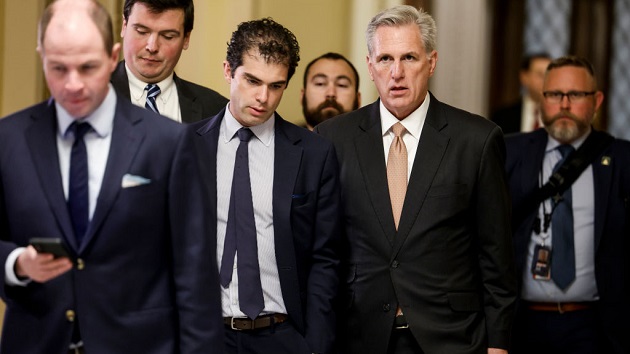
(WASHINGTON) — House Speaker Kevin McCarthy on Tuesday defended giving Fox host Tucker Carlson exclusive access to nearly 42,000 hours of previously unreleased surveillance video from the day of the Jan. 6 attack on the U.S. Capitol.
He said other networks and the American public would get access to the video as “soon as possible” but would not commit to a timeline.
“Well, first of all, we didn’t hand over anything. Tucker was interested. You had videos for more than two years. I didn’t hear anybody concerned about that when CNN was given exclusive,” McCarthy told reporters.
While CNN was given access to similar videos, no outlet ever exclusively was given access to all the surveillance footage until now.
“Have you ever had an exclusive?” McCarthy said. “Because I see it on your networks all the time. So, they have exclusive, then I’ll give it out to the entire country.”
When asked about concerns about handing the video to Carlson, who has downplayed the attack on the Capitol, McCarthy took aim at the news media.
“Well, I get concerned about CNN giving exit routes out when they have the footage. I’m concerned about Nancy Pelosi’s daughter’s showing whether we went to Fort McNair when we weren’t supposed to say we were there, made a documentary — CNN put those out. That was a security problem. I was concerned about showing the exit route of Pence on the January 6, I was concerned in my own office, they showed the exit route — never talked to me either. We won’t play politics like that,” McCarthy said.
Asked when other news outlets and the American public would be able to see the same footage that he is providing exclusively to Fox News, McCarthy said, “As soon as possible.”
“I think sunshine matters so everybody could be able to see it. We’re walking through it. It’s many more hours of tape than we were ever told,” he said.
McCarthy said he did not consult with Senate Republican Leader Mitch McConnell on giving Fox access to the footage and pushed back that doing so was a concession to win over GOP Rep. Matt Gaetz’s vote in his quest for speaker.
McConnell, who himself was hustled to a secure location during the attacks, dodged when asked point blank Tuesday if he’s comfortable with McCarthy giving access to Carlson, who has downplayed what happened on Jan. 6.
“Going back to when Speaker Pelosi was speaker, my main concern is the security of the Capitol,” he said.
Earlier Tuesday, House Majority Leader Steve Scalise also defended the plan to provide Carlson and his producers unfettered access to the video footage but said the release is being coordinated and that the video will go through vetting before it is ultimately released.
It’s still not clear when Carlson plans to air the footage or what specific footage he intends to show, but his team does not have the ability to record it and is required to view the material in a controlled environment and cannot take footage with them.
Without elaborating, Scalise said at a news conference that what gets released “is going to obviously be scrutinized” and accused former Houser Speaker Nancy Pelosi of exposing sensitive information through the footage that was played during the Jan. 6 hearings.
The Jan. 6 investigators didn’t release the video without close consultation with the Capitol Police and their general counsel, however, according to sources familiar with their work. The general counsel would review footage that the committee wanted to show and then come back with specific requests of what video to trim or what video they did not want to be used publicly. Committee investigators also had to view the video in a dedicated terminal set up by the Capitol Police.
“Well, of course, if you watch what the January 6 committee did, under Speaker Pelosi, they actually released a lot of video that was very sensitive,” Scalise said. “I mean, they literally released video of Vice President Pence exiting the Capitol showing the route that he takes. I didn’t hear a lot of concern about that back then. We were concerned how selective they were.”
“So, people should ask the J6 committee if they were concerned about national security aspects when the released a ton of footage,” Rep. Byron Donalds, R-Fla., said.
Behind closed doors during a conference meeting on Tuesday, McCarthy defended the arrangement with Carlson and the importance of “transparency,” according to sources in the room.
McCarthy has previously ignored reporters’ questions regarding the Jan. 6 tapes, including a number of times before he spoke to reporters Tuesday.
A lawyer representing media outlets, including ABC News, has sent a letter to congressional leaders requesting that the footage be made available to additional media outlets and not just the opinion arm of Fox News.
The Justice Department has already made public hundreds of hours of surveillance and body camera footage as part of its more than 900 prosecutions of rioters charged in the attack on the Capitol. But at times, the DOJ has joined with the Capitol Police in expressing concerns over the release of some footage that could disclose sensitive areas in the Capitol, the location of closed-circuit cameras, and other sensitive security movements.
Separately, a coalition of media outlets, including ABC News, has also fought in court for the release of exhibits from those prosecutions, in many cases over the objections of defendants.