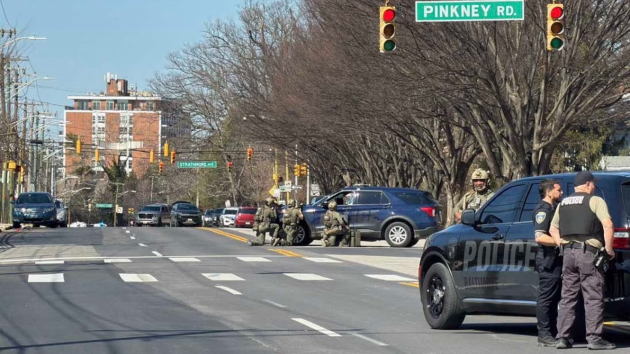
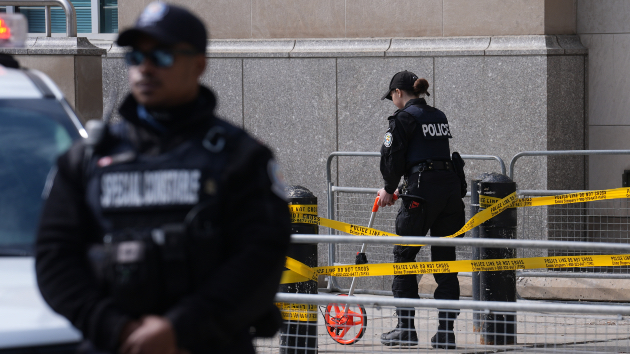
In this image released by the Baltimore Police Department, law enforcement officers are shown at the scene of a shooting, on March 10, 2026. (Baltimore Police Department)
(BALTIMORE) — An officer responding to a report of a burglary at a residence in Baltimore was injured when a suspect opened fire on authorities from inside the home, according to police.
The shooting suspect is dead, according to the Baltimore Police Department.
The incident occurred shortly before noon Tuesday at a residence on the 6200 block of Park Heights Avenue, according to police.
“When officers arrived, they were immediately met with gunfire from the suspect firing from inside of a house,” Baltimore Police Commissioner Richard Worley said during a press briefing.
A 36-year-old officer was shot in the leg and transported to an area hospital, where he is in stable condition, officials said.
Responding SWAT officers “neutralized” the shooting suspect, who was pronounced dead at the scene, Worley said.
A firearm was recovered from the home, he said.
During the incident, a woman jumped out of the window of the residence, Worley said. The suspect also held a gun to the head of a second woman at the window before he was shot, Worley said, referring to it as a “hostage” situation that was quickly resolved.
“He was firing on our officers. As soon as our SWAT team got there, was able to take cover and our SWAT sniper was able to take the shot, he took the shot,” Worley said.
The suspect was related to the people in the house, Worley said. Both women have been transported to a hospital, he said.
The police department’s special investigations response team is investigating, the commissioner said.
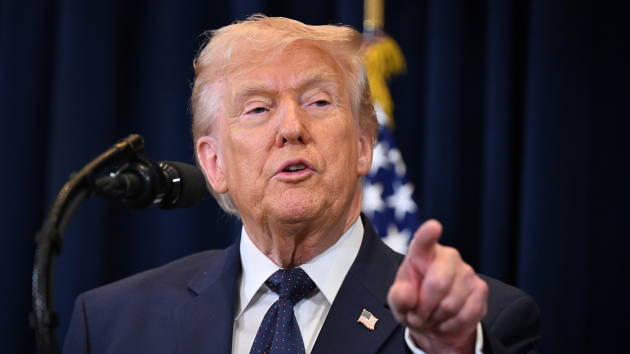
U.S. President Donald Trump speaks to reporters during a news conference at Trump National Doral Miami on March 9, 2026, in Doral, Florida. President Trump spoke on his administration’s strikes on Iran. (Photo by Roberto Schmidt/Getty Images)
(WASHINGTON) — President Donald Trump said that he and Vice President JD Vance are “philosophically a little bit different” when it comes to U.S. war with Iran after ABC News previously reported that Vance internally expressed reservations about the strikes late last month.
When asked during his Monday evening news conference in Florida if there were any disagreements between him and Vance on action against Iran, Trump said he didn’t “think so.”
“We get along very well on this,” Trump said. “He was, I would say, philosophically a little bit different than me. I think he was maybe less enthusiastic about going, but he was quite enthusiastic. But I felt it was something we had to do. I didn’t feel we had a choice. If we didn’t do it, they would have done it to us.”
Trump’s comments about their differences on Iran come after ABC News reported that Vance, who has largely opposed U.S. intervention abroad, made his reservations about the strikes against Iran known internally, according to a source familiar with the matter.
Once it became clear that the decision had been made to move forward with the strikes, Vance shifted his focus to supporting the military operation, a source told ABC News.
This is not the first time Vance, a Marine Corps veteran who served in Iraq, has expressed concerns internally about possible U.S. foreign military intervention.
Last year, in the Signal group chat discussing the U.S. attack on Houthis in Yemen that a journalist was inadvertently invited to join, Vance appeared to break with Trump and questioned whether the president recognized that a unilateral U.S. attack on the Houthis to keep international shipping lanes open was at odds with his tough talk about European nations paying their share of such efforts.
A few days before the U.S. and Israeli strikes on Iran, Vance told The Washington Post that there was “no chance” of a drawn-out war in Iran if the U.S. moved forward with the strikes.
Vance reiterated that same sentiment in a recent interview with Fox News, but also added that the operation against Iran “could go for a lot longer.”
“There’s just no way that Donald Trump is going to allow this country to get into a multi-year conflict with no clear end in sight and no clear objective. What is different about President Trump, and it’s frankly different about both Republicans and Democrats of the past, is that he’s not going to let his country go to war unless there’s a clearly defined objective,” Vance told Fox News.
“He’s defined that objective as Iran cannot have a nuclear weapon and has to commit long-term to never trying to rebuild the nuclear capability. It’s pretty clear. It’s pretty simple, and I think that means that we’re not going to get into the problems that we’ve had with Iraq and Afghanistan,” he said.
Ahead of his second term, Trump campaigned on “America First” policies, which attracted his MAGA base. After the strikes on Iran, there has been criticism from within his base — including former political adviser Steve Bannon, who called the it “a mistake not to put America first.”
Trump said Monday that the U.S. is making “major” progress in achieving its military goals and that the operation is “ahead of our initial timeline by a lot.”
“We’re achieving major strides toward completing our military objective. And some people could say they’re pretty well complete. We’ve wiped every single force in Iran out very completely,” Trump said.
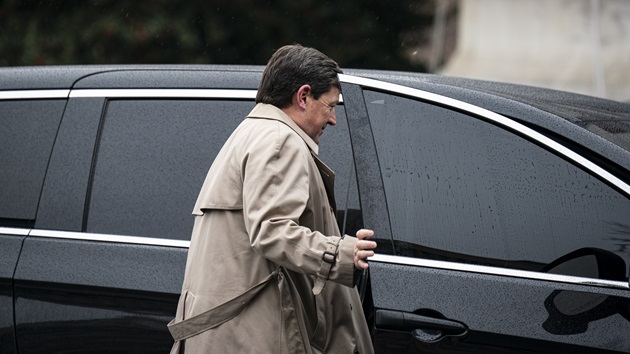
Ed Martin, former Interim U.S. Attorney for the District of Columbia, departs following a meeting at the White House on January 9, 2026 in Washington, DC. (Al Drago/Getty Images)
(WASHINGTON) — The Washington, D.C., Bar initiated disciplinary proceedings against Justice Department pardon attorney Ed Martin over allegations he improperly threatened to withhold federal funding from Georgetown University’s law school and then attempted to sideline an investigation into his conduct while serving as D.C.’s top federal prosecutor last year, according to a disciplinary petition.
In a two-count petition filed last week with the D.C. Court of Appeals Board of Professional Responsibility, attorneys with the D.C. Bar’s Office of Disciplinary Counsel alleged that Martin engaged in “conduct that seriously interferes with the administration of justice,” including by allegedly demanding that a judge suspend the attorney investigating his actions.
“Mr. Martin knew or should have known that, as a government official, his conduct violated the First and Fifth Amendments to the Constitution of the United States,” the disciplinary petition said.
According to the complaint, Martin – while serving as the interim U.S. Attorney for the District of Columbia last year – threatened to withhold federal funding and freeze hirings from Georgetown University Law Center over allegations that the school was promoting diversity, equity, and inclusion (DEI) measures.
After sending letters to the dean of Georgetown’s law school about DEI programming last year, Martin allegedly told the school’s interim president that their answers about DEI would “bear directly on Georgetown University’s status as a 501(c) nonprofit and its receipt of nearly $1 billion of federal tax money.”
“He demanded that Georgetown Law relinquish its free speech and religious rights in order to continue to obtain a benefit, employment opportunities for its students,” the petition said. “His demand did not provide Georgetown Law fair notice of what is allegedly prohibited because he did not define ‘DEI,’ cited no authority for his demand, and did not describe what actions, and what timetable, might satisfy his demand.”
After a retired judge reported Martin’s conduct to the Office of Disciplinary Counsel, Martin allegedly attempted to sideline the investigation by sending a letter directly to the chief judge and senior judges on the D.C. Court of Appeals, according to the complaint.
“In that letter, he stated that he would not be responding to Disciplinary Counsel’s inquiry, complained about Disciplinary Counsel’s ‘uneven behavior,’ and requested a ‘face-to-face meeting with all of you to discuss this matter and find a way forward.’ He copied the White House Counsel ‘for informational purposes because of the importance of getting this issue addressed,'” the complaint said.
The complaint alleges that Martin – after being told to not directly communicate with judges – sent another letter to the chief judge demanding that the court suspend the investigator probing his conduct and dismiss the case against him.
With the charges filed, D.C.’s Board on Professional Responsibility is expected to refer the petition to a hearing committee.
Martin’s interactions are just one among a series of controversies from his brief tenure as Washington’s top federal prosecutor from January to May 2025 before his temporary appointment to the position lapsed and he failed to gain enough support from Republican senators for his confirmation to the post.
He was then appointed to four separate senior positions in the Justice Department before sources said he was effectively demoted earlier this year after multiple other incidents where he faced admonishment from leadership for his conduct.
Martin remains in his role as pardon attorney, according to the DOJ, and has used the post to float controversial clemency recommendations to the White House while frequently citing the phrase, “No MAGA left behind.”
The ethics complaint was filed the same week that the DOJ proposed new regulations that would seek to give Attorney General Pam Bondi the authority to suspend state bar investigations, arguing the policy is necessary to combat the “weaponization” of the complaint process. It’s not immediately clear what legal basis the department would have to intervene in state-level proceedings, however.
Martin and a DOJ spokesperson did not immediately respond to a request for comment on the complaint.
Georgetown Law’s then-Dean William Treanor previously responded to Martin’s letter, affirming the school’s speech protections under the First Amendment. He accused Martin of mounting “an attack on the University’s mission as a Jesuit and Catholic institution.”
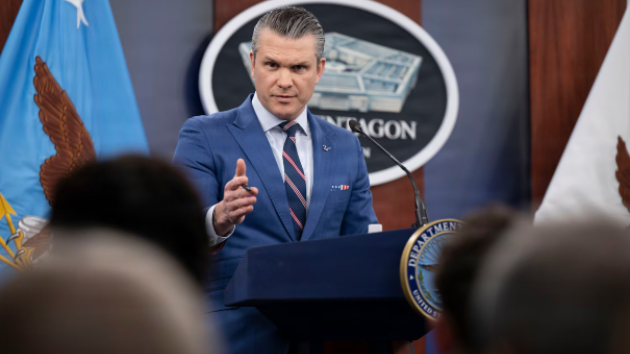
Secretary of War Pete Hegseth and Chairman of the Joint Chiefs of Staff U.S. Air Force Gen. Dan Caine conduct a press briefing on Operation Epic Fury at the Pentagon, in Washington, March 10, 2026. (Petty Officer 1st Class Eric Brann/DoD)
(WASHINGTON) — Defense Secretary Pete Hegseth on Tuesday said the U.S. will end its war with Iran “on our timeline” and “at our choosing” amid mixed messaging from the administration on the timing of the operation and its ultimate objective.
Hegseth notably declined to give a further assessment on how much longer the military campaign will last, saying Tuesday would be the most intense day of strikes yet in the 11-day conflict and that it will be up to President Donald Trump to decide when the war is over.
“The president has set a very specific mission to accomplish, and our job is to unrelentingly deliver that,” Hegseth told reporters at a Pentagon press briefing.
“Now he gets to control the throttle. He’s the one deciding. He’s the one elected on behalf of the American people when we’re achieving those objectives. And so, it’s not for me to posit whether it’s the beginning, the middle or the end. That’s his. And he’ll continue to communicate that,” the defense secretary said.
Trump himself has made conflicting statements on the matter.
Trump told CBS News on Monday afternoon that the war is “very complete, pretty much.” But around that time, the Defense Department’s rapid response social media account posted on X: “We have Only Just Begun to Fight.”
ABC News White House Correspondent Selina Wang pressed Trump later Monday evening at a news conference: “So, which is it and how long should Americans be preparing for this war to last for?”
“Well, I think you can say both. The beginning — it’s the beginning of building a new country, but they certainly, they have no navy, they have no air force, they have no anti-aircraft equipment,” Trump said.
“We could call it a tremendous success right now. As we leave here, I could call it. Or we could go further and we’re going to go further,” the president added.
Trump said on Monday he thinks the war will be over “very soon” and repeatedly called the war a “short-term excursion.”
Trump and his top officials have outlined four objectives of the military offensive: destroy Iran’s ballistic missile capabilities; annihilate their Navy; ensure they can never obtain a nuclear weapon; and prevent the Iranian regime from arming and funding terrorism outside its borders. But broader goals on what comes after the fighting ends remains unclear.
Trump’s signaled he could declare the military campaign a success at any time, even as the Iranian regime remains in power and Iran still maintains its enriched uranium stockpile. Trump’s repeatedly said Iran cannot be allowed to obtain a nuclear weapon — and over the weekend said he was not ruling out the possible use of U.S. ground troops in Iran, but said that they would be used only “for a very good reason.”
The president has also sent mixed messages on regime change, and how involved the U.S. intends to be in what new leadership will take control in Tehran.
Trump expressed disappointment in the selection of Mojtaba Khamenei, the 56-year-old son of Ayatollah Ali Khamenei, who was killed in a U.S.-Israeli strike at the beginning of the war.
In a phone interview with ABC News Chief White House Correspondent Mary Bruce on Sunday, Trump said the new leader is “going to have to get approval from us.”
“If he doesn’t get approval from us he’s not going to last long. We want to make sure that we don’t have to go back every 10 years, when you don’t have a president like me that’s not going to do it,” Trump told ABC.
Hegseth, though, on Tuesday vowed the U.S. would not be involved in “mission creep.”
“This is not endless. It’s not protracted,” Hegseth said.
“This is not 2003. This is not endless nation-building … Those days are dead. Instead, we’re winning decisively with brutal efficiency, total air dominance, and an unbreakable will to accomplish the president’s objectives,” Hegseth said.
A general view shows Toronto police securing the area after a âfirearm dischargeâ at the US Consulate in Toronto, Ontario, Canada on March 10, 2026. (Mert Alper Dervis/Anadolu via Getty Images)
(TORONTO) — Investigators are looking for two suspects and clues after shots were fired at the U.S. consulate in Toronto on Tuesday morning.
There were people inside the building at the time, but no one was injured, Toronto Police Service Deputy Chief Frank Barredo said. Officers got a call about the shooting around 5:29 a.m., and found shell casings and damage to the building when they arrived, he noted.
Witnesses observed two people emerging from a white Honda CR-V and discharge a handgun at the consulate before driving away, according to Barredo.
“This is very early in the investigation. It is very active, and we are aggressively assigning investigative resources to determine what happened and to bring the offenders to justice,” he told reporters.
Chris Leather, the chief superintendent for the Royal Canadian Mounted Police (RCMP) Ontario Criminal Operations, told reporters that it is “being treated as a national security incident,” and prompted increased security around embassies in Toronto and Ottawa.
“There will be no tolerance for any form of intimidation, harassment, or harmful targeting of any communities or individuals in Canada. We want to ensure that everyone’s safety and security remain at the forefront of everything we do,” he said.
Leather noted that it was too early to determine if the shooting was linked to the U.S.-Israeli war with Iran.
The RCMP is in communication with the FBI and other U.S. agencies, Leather said.
He noted that recent incidents in Toronto and elsewhere have prompted a need for heightened vigilance and security around diplomatic missions, expressing hope that these measures will help “bring the temperature down in the coming days and weeks.”
In this image released by the Baltimore Police Department, law enforcement officers are shown at the scene of a shooting, on March 10, 2026. (Baltimore Police Department)
(BALTIMORE) — A police officer was shot in an “active shooter incident” in Baltimore on Tuesday, according to police.
A suspect has also been shot, according to the Baltimore Police Department.
The shooting occurred on the 6200 block of Park Heights Avenue, according to police, who urged people to avoid the area.
The officer has been transported to an area hospital, according to police.
Authorities have not released any information on the condition of the officer or the suspect.
This is a developing story. Please check back for updates.
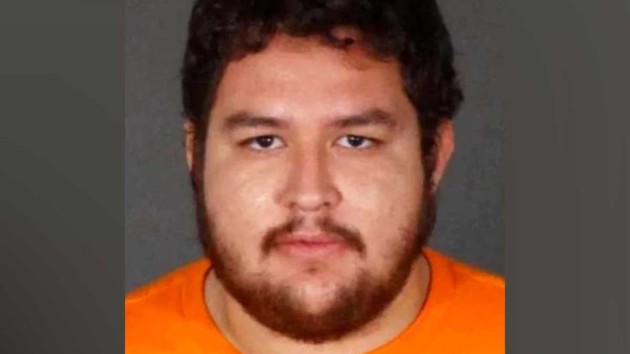
The FBI is offering a reward of up to $1,000,000 for information leading to the arrest of Omar Alexander Cardenas. (FBI)
(WASHINGTON) — The FBI is now offering $1 million for information leading to the arrest of one of its “Top Ten Most Wanted Fugitives.”
Omar Alexander Cardenas is wanted by local and federal authorities for a 2019 murder in Los Angeles.
Cardenas is accused of firing several rounds at the victim, Jabali Dumas, at a barber shop on Aug. 15, 2019, according to the FBI. Dumas was struck in the head and died, authorities said.
Cardenas has “known gang affiliations,” and the shooting is believed to have been gang-related, according to Los Angeles Police Chief Jim McDonnell.
A local arrest warrant was issued for Cardenas in April 2020 after he was charged with murder, the FBI said. He is believed to have possibly fled to Mexico and has also been federally charged with unlawful flight to avoid prosecution, according to the FBI.
The FBI initially offered a $100,000 reward for information on Cardenas’ whereabouts when he was added to its “Top Ten Most Wanted Fugitives” list in 2022. The reward, which subsequently increased to $250,000, has now surged to $1 million, the FBI announced on Tuesday.
McDonnell called the new reward a “critical step forward” in the case.
“We believe that someone knows Omar Cardenas’ whereabouts, and we’re urging anyone with information to please come forward,” the chief said during a press briefing on Tuesday. “Our mission is clear — to locate and apprehend Cardenas and bring justice for the Dumas family.”
Akil Davis, the assistant director in charge of the FBI Los Angeles field office, said the U.S.’ relationship with the government of Mexico “has never been stronger,” pointing to the recent apprehension in Mexico of another “Most Wanted” fugitive — former Olympic snowboarder turned alleged drug kingpin Ryan Wedding.
Davis shared a message directed at Cardenas.
“Mexico is not safe for you. Mr. Cardenas, if that’s where you’re hiding,” Davis said during the briefing. “I have full faith in this task force that they will bring you to justice.”
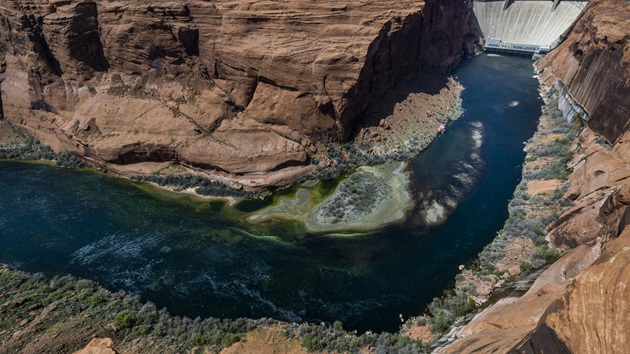
The Colorado River flows below the Glen Canyon Dam on Tuesday, April 18, 2023, in Page, Arizona. (L.E. Baskow/Las Vegas Review-Journal/Tribune News Service via Getty Images)
(NEW YORK) — Cold and snowy conditions dominated the winter season in the Northeast with much of the region experiencing its coldest winter in a decade or more, and several cities seeing their biggest snowfall in years. However, if you live in other parts of the country, this winter was very different.
Meteorological winter — December to February — was unseasonably warm across much of the contiguous U.S., ranking as the second-warmest winter on record since 1895, behind the 2023-24 season, according to a new report from the National Oceanic and Atmospheric Administration (NOAA).
While the Northeast faced persistent blasts of bitter cold and snow, exceptional winter warmth in the West nearly pushed the nation to a new all-time high for the season.
Nine states finished off with their warmest winter on record: Arizona, Colorado, New Mexico, Nevada, Texas, Oklahoma, Oregon, Utah and Wyoming. Dozens of cities in the West and Plains saw a top 5 warmest winter with cities such as Albuquerque, Phoenix, Las Vegas, and Salt Lake City seeing their all-time warmest.
Dallas, Texas, recorded 16 days with high temperatures of at least 80°F, the highest seasonal total on record.
For much of the country, winter was not only exceptionally warm, but exceptionally dry, ranking as the driest winter in 45 years across the Lower 48. Much of the western United States entered the season already grappling with drought, and persistent warmth fueled the worst snow drought in decades across parts of the Rockies as more precipitation fell as rain instead of snow.
Drought on its own already stresses water supplies, agriculture, and ecosystems. But when winter fails to deliver significant mountain snow, those impacts can intensify, according to NOAA.
A persistent snow drought can trigger a cascade of hydrologic changes. Low snowpack and early snowmelt can affect vegetation, reduce surface and subsurface water storage and alter streamflow, all of which directly impact water management and planning across the West.
Snowmelt supplies a large share of the region’s water used by communities, agriculture, and ecosystems. In some states, up to about 75 percent of water supplies can come from melting snow, according to the USGS.
The Colorado River provides water for more than 40 million people and fuels hydropower resources in seven states: California, Arizona, Nevada, Colorado, New Mexico, Utah and Wyoming, according to the Bureau of Reclamation.
Widespread, persistent drier-than-average conditions also impacted parts of the Heartland and Southeast, bringing drought expansion and intensification during the winter months. Multiple states, including Arkansas, Missouri, Illinois and Nebraska, experienced one of their driest winters on record.
According to the latest U.S. Drought Monitor reportreleased on March 5, more than half of the contiguous U.S. is experiencing drought conditions, an increase of about 10% from the beginning of February.
Florida is enduring its worst drought in 25 years, according to the National Integrated Drought Information System, with a heightened risk of wildfires this spring as conditions worsen across the state.
All of Florida is currently experiencing some level of drought, with more than 70% of the state facing an extreme drought level 3 of 4, U.S. Drought Monitor data shows.
“We expect the drought to continue or even worsen in the next couple of months, as we are in the heart of peninsular Florida’s dry season that usually lasts until mid-May,” Florida State Climatologist David Zierden told ABC News. “Then the summer convective rains kick in and provide some relief.”
The National Interagency Fire Center says Florida faces an above-average risk of significant wildland fires throughout meteorological spring, which began on March 1. Dozens of counties across the state have issued burn bans due to the ongoing drought and elevated wildfire risk.
The worsening conditions are raising concerns beyond wildfires, including impacts to water supplies and agriculture.
“Four of the five Water Management districts have either voluntary or mandatory water restrictions limiting outdoor irrigation,” Zierden added. “Range and pasture for cattle is the agricultural commodity that is hit hardest right now.”
Ed Martin, former Interim U.S. Attorney for the District of Columbia, departs following a meeting at the White House on January 9, 2026 in Washington, DC. (Al Drago/Getty Images)
(WASHINGTON) — The Washington, D.C., Bar has initiated disciplinary proceedings against Justice Department pardon attorney Ed Martin over allegations he improperly threatened to withhold federal funding from Georgetown University’s law school and then attempted to sideline an investigation into his conduct, according to a petition.
This is a developing story. Check back for updates.
(NEW YORK) — A 2.3 magnitude earthquake struck about half a mile west of Sleepy Hollow, New York, on Tuesday morning, the U.S. Geological Survey confirmed.
The earthquake struck at 10:18 a.m. ET.
This is a developing story. Please check back for updates.