

ICE agent charged with allegedly pulling a gun on motorists in Minneapolis

ICE agent charged with allegedly pulling a gun on motorists in Minneapolis

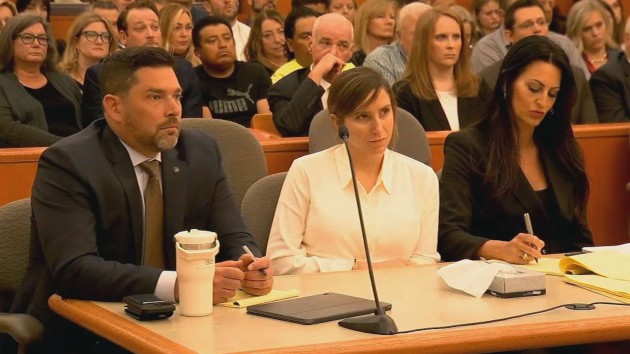
(WASHINGTON) — A U.S. Immigration and Customs Enforcement (ICE) agent was charged with assault for allegedly pointing a gun at the heads of two motorists in Minneapolis in February, the Hennepin County Attorney’s office said Thursday.

According to the prosecutor’s complaint, Gregory Morgan Jr., an ICE agent in Minneapolis, was ending his shift on Feb. 5 and was a driving back to the Whipple Federal Building when a person allegedly cut him off as Morgan was trying to pass them, and the agent then allegedly brandished a firearm at them. 

Morgan, of Temple Hills, Maryland, is charged with two counts of assault with a dangerous weapon and a warrant has been issued nationwide for his arrest. Hennepin County Attorney Mary Moriarity said in a news conference Thursday that Morgan has not been taken into custody but hopes he’ll turn himself in.

The Department of Homeland Security has not responded to ABC News’ request for comment.

The incident occurred during a contentious period in Minneapolis when the city was the focal point of an immigration enforcement surge and after the killings of Alex Pretti and Renee Good by federal law enforcement. During that time questions arose about whether ICE agents could be prosecuted by state or local authorities.

Moriarity said Thursday that Morgan was driving “illegally” on the shoulder, “appearing to bypass shoulder traffic.”

The complainant told police that they did not know the person driving the other car was an ICE agent until investigators told them, according to the prosecutor’s complaint.

“There were no markings on Defendant’s vehicle that would identify it as law enforcement and the vehicle was not displaying or using lights or sirens,” according to the complaint. “Defendant continued to travel on the shoulder but rather than continue to drive past the victims, he pulled alongside their vehicle, rolled down his window, and pointed a black handgun directly at Victim 1 and Victim 2. Victim 1 had a clear view of Defendant’s appearance, saw that Defendant was wearing a black t-shirt, saw that the gun was pointed directly at their heads, saw that the gun was a Glock or Sig Sauer handgun with what appeared to be a red-dot sight, and noted that Defendant 2 yelled something indiscernible.” 

That is when they called police to report what had happened, the complaint said. 

Investigators interviewed Morgan, his supervisor and his partner a day later.

According to the prosecutor’s complaint:

“[Morgan] stated that Victim 1 swerved over in front of him and cut him off. Defendant claimed that he feared for his safety and the safety of others so, in response, he pulled alongside Victim 1’s vehicle, rolled down his window, drew his firearm, and yelled ‘Police Stop.’ [Morgan] stated he was trying to get Victim 1 to ‘back up.’ Defendant acknowledged that his firearm was a Glock 19 with a laser light, which Defendant had holstered on his right hip at the time of the interview. Defendant stated that after he pulled the gun on Victim 1 and Victim 2 he got in front of their vehicle and drove to the Whipple Building.”

Investigators also said they received cellphone footage from the complainant and reviewed traffic camera footage from the road on which they were traveling.

Copyright © 2026, ABC Audio. All rights reserved.
Pope Leo’s brother’s home targeted with false bomb threat

Pope Leo’s brother’s home targeted with false bomb threat
Pope Leo XIV reading his speech as he lead a prayer vigil for peace at St.Peter’s Basilica in the Vatican on April 11, 2026. (Photo by Isabella Bonotto/Anadolu via Getty Images)

(NEW LENOX, Ill.) — One of Pope Leo’s brothers was the victim of a false bomb threat on Wednesday night, according to the New Lenox, Illinois, police department.

Officers received a call at 6:29 p.m. for a reported bomb threat at a private residence, officials said.

“Upon receiving the report, officers were immediately dispatched to the scene and established a secure perimeter to ensure the safety of nearby residents. Out of an abundance of caution, surrounding homes were notified, and asked to evacuate,” according to a statement from the police department. “Specialized units, including the Will County Sheriff’s Office bomb sniffing K9 were requested to assist in the investigation.”

There were no explosives, and no injuries, according to police.

“The incident remains under investigation as authorities work to determine the origin of the report. Making false reports of this nature is a serious offense and may result in criminal charges,” the statement says. “Anyone with information related to this incident is encouraged to contact the NLPD at 815-485-2500 or submit an anonymous tip through the Village of New Lenox website.”

Copyright © 2026, ABC Audio. All rights reserved.
Husband of American woman missing in Bahamas leaves islands, attorney says

Husband of American woman missing in Bahamas leaves islands, attorney says
Cadaver dogs in the Bahamas to help search for missing American Lynette Hooker, April 16, 2026. (ABC News)

(NEW YORK) — The husband of an American woman who is missing in the Bahamas has left the islands two days after being released by local authorities, his attorney said Wednesday, as the search continues for his wife, Lynette Hooker.

The attorney for Brian Hooker said his mother is not well.

Meanwhile, cadaver dogs from the U.S. Coast Guard are now being used to help with the search for Lynette Hooker, local police told ABC News.

The Royal Bahamas Defence Force said in a statement Thursday that the search and recovery work is ongoing, with operations involving “extensive shoreline patrols, sea patrols, aerial drone surveillance, and submersible drone operations.”

Lynette Hooker has been missing since the evening of April 4. Her husband reported she went overboard on a dinghy.

When the 55-year-old Michigan woman and her husband departed Hope Town on the Abaco Islands for their yacht, Soulmate, in Elbow Cay, bad weather caused her to fall off the dinghy, her husband told authorities.

Brian Hooker, 58, was arrested on April 8 and questioned by police. He was released on Monday without charges.

Brian Hooker told ABC News on Tuesday that he was staying in the Bahamas with a “sole focus” of finding his wife, “no matter how likely or unlikely that is.”

He said at the time that he planned “to go back to the boat, and then hire or beg people to help me go find some areas to search.”

Brian Hooker’s attorney did not allow him to answer questions about what happened the night his wife went overboard due to the pending investigation.

When asked if there was anything he wishes he’d done differently, Brian Hooker was emotional, saying, “I will always think there was something I could have done differently. My one job, my one job was to look out for her, and that has not happened. And I’m gonna keep looking out for her now, the best I can.” 

ABC News’ Brian Andrews contributed to this report.

Copyright © 2026, ABC Audio. All rights reserved.
Fine arts panel gives initial approval to Trump’s ‘triumphal arch’ but asks for design revisions

Fine arts panel gives initial approval to Trump’s ‘triumphal arch’ but asks for design revisions
Karoline Leavitt, White House press secretary, near an artist’s rendering of President Donald Trump’s planned Triumphal Arch during a news conference on April 15, 2026. (Mattie Neretin/Bloomberg via Getty Images)

(WASHINGTON) — President Donald Trump’s proposed 250-foot-tall “triumphal arch” at the National Mall in Washington, D.C., was given initial approval on Thursday by the Commission of Fine Arts, a federal agency, but revisions were requested to address the panel’s design concerns.

Five members on the commission, now made up entirely of Trump appointees, voted in favor of moving along with the project. The panel’s other two members were not present for the hearing.

The towering arch Trump wants to build near Arlington National Cemetery would be more than twice as tall as the Lincoln Memorial and taller than France’s Arc de Triomphe.

Protesters gathered outside the National Building Museum, where the commission has its office, and held up signs that read: “Stop Arch Insanity,” “No Trump Arch,” and “No Vanity Arch.”

The commission’s vote came after Thomas Luebke, its secretary, said nearly 1,000 public comments were submitted online and that “100% of the comments were against the project.”

Luebke said many of the comments characterized the project as “a waste of money and misuse of funds” and others said “that it would obstruct historic views and disrupt the landscape, it was inappropriate imperial or political symbolism, that the design was gaudy, oversized, incompatible, and that it was disrespectful to Arlington National Cemetery and military sacrifice.”

James McCrery, the commission’s vice chair and the initial architect behind Trump’s massive White House ballroom project, voiced a laundry list of concerns that he wants the architects of the arch to address.

McCrery opposed a planned 250-foot underground pathway for visitors to access the arch, saying building under the capital is “a really, really unfortunate thing.”

“Sometimes it’s absolutely necessary,” McCrery told Nicolas Charbonneau, the architect behind the arch. “Here, I think it’s not absolutely necessary at all.”

McCrery also took issue with proposed lion statues at the base of the arch, arguing they were not culturally American symbols.

“They’re not of this continent,” McCrery said. “They’re noble, they’re courageous, and they’re strong, they’re all those things, but maybe there are alternatives.”

And McCrery called on the architects to “open these arches and air them out” so they don’t obstruct views of other Washington landmarks.

Zachary Burt, the community outreach manager for the D.C. Preservation League, voiced his opposition to the arch during Thursday’s meeting.

Burt said the arch “threatens the solemn vista” between Arlington National Cemetery and the Lincoln Memorial and that its proposed size “risks overshadowing the revered landmarks that Americans hold in the highest regard.”

Lisa Fuller, who said she was a lifelong Washington-area resident, grew emotional recounting crossing Arlington Memorial Bridge as a kid as she argued the arch would obstruct views of the cemetery.

“I first walked across that bridge with my dad after John Kennedy died. We started at the Lincoln Memorial. My father told me all about it, and then we walked across, and we saw the Eternal Flame,” Fuller said.

Copyright © 2026, ABC Audio. All rights reserved.

ICE agent charged with 2 counts of felony assault in Minneapolis

ICE agent charged with allegedly pulling a gun on motorists in Minneapolis

(WASHINGTON) — A U.S. Immigration and Customs Enforcement (ICE) agent has been charged with two counts of second degree assault which occurred in February, according to the Hennepin County Attorney’s Office in Minneapolis.

This is a developing story. Please check back for updates.

Copyright © 2026, ABC Audio. All rights reserved.
Researchers propose solutions to stop Venice from sinking

Researchers propose solutions to stop Venice from sinking
A seagull stands on the 16th-century Rialto Bridge over the Grand Canal in Venice, Italy, Monday, April 13, 2026. (Photo by Danil Shamkin/NurPhoto via Getty Images)

(VENICE, Italy) — One of the world’s most iconic cities could be heavily impacted by climate change and sea level rise in the coming years, leading researchers to search for solutions on how to protect it.

Venice, the historic Italian city known for its canals that serve as water traffic corridors, has been said to be sinking for nearly a century. The site within the vicinity of the Venetian Lagoon has flooded increasingly over the past 150 years, according to a paper published in Scientific Reports on Thursday.

Historically, there have been 28 events in which seawater flooding impacted at least 60% of the city, according to the paper. Eighteen of those events have taken place in the last century.

Piero Lionello, a professor of atmospheric physics and oceanography at the University of Salento in Italy and native Venetian, has noticed an uptick in flooding events throughout his lifetime, he told ABC News.

“The rate has been quite impressive the last three decades,” he said.

Climate experts are now calling for long-term planning to protect the city from rising sea levels over the next several centuries.

The Venetian Lagoon is a “special system” because it is so connected to the Adriatic Sea, said Lionello, the lead author of the paper.

Proposed strategies to prevent flooding as sea levels rise include movable barriers, ring dikes — which are circular or oval-shaped embankments designed to protect localized areas from floodwaters — or even closing the Venetian Lagoon and relocating the city, according to the paper.

Currently, the city is defended by a trio of movable barriers at the edge of the Venetian Lagoon. The MOSE project, installed in the 1990s, is a system of mobile flood barrier shields as tall as a five-story building that can be raised to separate the lagoon from the Adriatic Sea during high tides.

The system allows the waterways of Venice to function normally during high tide and has prevented flood disasters from storm surge. But it won’t be sufficient in the future, Lionello said.

“The present system, it will certainly be become inadequate,” he said.

The existing movable barriers may be effective against sea level rise up to 1.25 meters, or about 4.1 feet, according to the paper. But this benchmark is likely to be exceeded by the year 2300 under a low-emissions scenario due to rising global temperatures and ground subsidence — the gradual sinking of the ground — the researchers said.

Dikes may be necessary to protect Venice’s city center from the rest of the lagoon, according to the paper. The dikes would consist of walls surrounding the city, separating it from the lagoon, Lionello said.

Construction of dikes could cost between $600 million and $5.3 billion, according to the paper.

A “super levee” that could cost more than $35 billion to construct may be needed to close the lagoon and protect the land that is already below sea level.

If sea levels rise enough, it may be necessary for the city’s residents and historic landmarks to be moved inland, the researchers said. Relocating the city could be necessary beyond a 4.5-meter, or nearly 15-foot, sea level rise, which is projected to occur after 2300 under a high emissions scenario, according to the paper. Relocating the city could cost up to $118 billion, according to the researchers.

This solution is the most “provocative” and would involve moving individual buildings and monuments inland, Lionello said.

“You can preserve a building. You can have different solution to keep people living there, but it will be a completely different Venice from the Venice that we have now,” Lionello said.

The system of mobile barriers has been working overtime, according to officials. The MOSE barriers were lifted from the seabed to stop water from the Adriatic Sea from entering the lagoon 31 times during a six-month period between October 2023 and April 2024.

Climate scientists have predicted a steady rise in sea levels in the Adriatic Sea — with the lagoonal ecosystem in Venice experiencing relative sea level rise of about 2.5 millimeters per year, a 2021 study found.

Over the past 60 years, high tides in the Venetian Lagoon have become more frequent.

Between 1870 and 1949, 30 high tides exceeded 1.1 meters — or 3.6 feet — the level above which the MOSE barrier system is activated, according to the Venice Tide Study Center. There were 76 such high tides between 2015 and 2024 alone.

Rapid action to protect the city of Venice from climate change is “essential,” especially since the construction of large-scale interventions could take decades, the researchers said.

Copyright © 2026, ABC Audio. All rights reserved.

Kennedy restores staffing at 9/11 health program ahead of Capitol Hill testimony

Kennedy restores staffing at 9/11 health program ahead of Capitol Hill testimony
Robert Kennedy Jr. appears before the Senate Finance Committee at the Dirksen Senate Office Building on September 04, 2025 in Washington, DC. (Andrew Harnik/Getty Images)

(WASHINGTON) — Health and Human Services Secretary Robert F. Kennedy Jr. heads to Capitol Hill Thursday after restoring staffing at the World Trade Center Health Program, a move that could ease one of the most persistent points of bipartisan criticism he has faced for months.

Program advocates and lawmakers said they received an email from the secretary on Wednesday approving hiring for 37 long-vacant positions. This will raise staffing from its current 83 employees to the federally authorized level of 120.  

The move comes after nearly a year of bipartisan criticism that staffing shortages were slowing care for the 140,000 responders and survivors the program serves, many of whom have been diagnosed with cancer, respiratory disease and other conditions tied to exposure to toxins after the 9/11 terror attacks in New York, Shanksville, Penn., and Washington, D.C.

The World Trade Center Health Program was created as part of the James Zadroga 9/11 Health and Compensation Act to provide long-term medical monitoring and treatment to those affected by the attacks. For more than a year, the program has operated far below capacity with about 83 staff members, following a period of upheaval that included firings, rehires and shifting leadership, even as the participant population grew by nearly 30,000 new enrollees.

Advocates say the reduced staffing has had real consequences, including slower approval of survivors into the program, delays in managing contractors, and longer wait times for care.

“This is progress,” Benjamin Chevat, executive director of Citizens for the Extension of the James Zadroga Act, told ABC News. He credited the progress to sustained pressure from lawmakers in both parties and their consistent support of the program.

Lawmakers also have welcomed the end of the hiring freeze.

Rep. Andrew Garbarino, R-N.Y., told ABC News that the approval for the additional staff would “directly support the responders and survivors who rely on this care every day,” and that “more staff means better access to care, shorter wait times, and stronger support for those still living with the health impacts” of the attacks.

He called the move “real progress for the 9/11 community” and said it is “about making sure those who answered the call on September 11th get the care they have earned.”

Rep. Dan Goldman, D-N.Y., also welcomed the news but criticized the delays. “I am encouraged that, after repeated demands from me and from other members of Congress, Secretary Kennedy is finally increasing staffing at the World Trade Center Health Program so that our brave survivors and first responders can receive the quality health care they deserve,” Goldman told ABC News.

“The ongoing staffing shortages under this administration are unacceptable and have been undermining the program’s ability to provide timely and quality care to the enrollees,” Goldman added. “I will be watching closely to ensure that new staffers are hired as quickly as possible and that our heroes receive the quality healthcare they were promised and deserve.”

At a senate hearing last May, Kennedy acknowledged that “we made a couple of mistakes” in firing program staff and promised to address them.

“Under Secretary Kennedy’s leadership, the World Trade Center Health Program continues to move forward and deliver for responders and survivors,” a spokesperson for the Department of Health and Human Services told ABC News in response to a request for comment. “The approval of these positions reflects HHS’ commitment to strengthening the program. The petition reviews are proceeding through established processes, and work is actively underway to advance pending petitions. Protecting the health and well-being of those affected by 9/11 remains a top priority.”

Chevat pointed out the timing of the decision, which comes as Kennedy prepared to face lawmakers at Thursday’s public hearing: “Now a year later he is finally letting the program fill the staff vacancies that the program was blocked from filling.”

In a previous statement to ABC News, HHS spokesperson Andrew Nixon said decisions about the program, including staffing and whether to add new health conditions to be covered under the program, rest with the World Trade Center Health Program administrator, not Secretary Kennedy.

Even with the staffing issue moving toward resolution, significant concerns for the program remain, Chevat said. They include key decisions about expanding coverage for additional conditions including autoimmune, cardiac, and cognitive disorders are still pending – for years, in some cases.

Those decisions ultimately require sign-off within HHS, under Kennedy’s direction, according to Chevat. Until that happens, patients with those conditions don’t qualify for full coverage through the program.

Research funding for the program also remains stalled, according to Chevat. Its annual grant cycle, which typically distributes about $20 million for studies on 9/11-related illnesses, is still waiting for approval, despite the understanding that it would begin this past February, he said.

Additionally, communication between the program and the 9/11 community has been sparse under HHS oversight, with fewer updates and less clarity about decision-making, according to Chevat and other 9/11 survivor advocates.

Lawmakers are still likely to ask Kennedy questions about the World Trade Center Health Program during today’s hearings, Chevat said. The research funding budget is also expected to come up during a Senate Health, Education, Labor and Pensions Committee hearing next week.

For now, however, the decision to restore program staffing removes one of the most visible and widely criticized problems, Chevat said.

Copyright © 2026, ABC Audio. All rights reserved.

Former Virginia Lt. Gov. Justin Fairfax kills wife, self in their home: Police

Former Virginia Lt. Gov. Justin Fairfax kills wife, self in their home: Police
Virginia Lieutenant Gov. Justin Fairfax (D) speaks during a news conference on June 4, 2020 in Richmond, Virginia. Virginia Gov. Ralph Northam (D) and Richmond Mayor Levar Stoney announced plans to take down a statue of Confederate General Robert E. Lee on Monument Avenue. (Photo by Zach Gibson/Getty Images)

(NEW YORK) –Former Virginia Lt. Gov. Justin Fairfax fatally shot his wife, Cerina, in their home before taking his own life, police said Thursday.

Fairfax County Police Chief Kevin Davis told reporters that there was an “ongoing domestic dispute surrounding a complicated, messy divorce.”

Police responded to a domestic call at the couple’s Annandale, Virginia, home in January, Davis said, but no charges were filed from that incident. The couple were separated but still living together inside the house, according to Davis.

“Former Lt Gov Fairfax was recently served some paperwork associated with an upcoming court proceeding that apparently led to this incident last night,” he said.

Davis said that the shooting took place around midnight and the couple’s two teenage children were inside the home.

Their son, the eldest child, called 911, according to Davis.

“[It’s] a traumatic event for those children to live through,” he said.

Fairfax served as the state’s lieutenant governor between 2018 and 2022.

This is a developing story. Please check back for updates.

If you are struggling with thoughts of suicide or worried about a friend or loved one, call or text the Suicide & Crisis Lifeline at 988 for free, confidential emotional support 24 hours a day, seven days a week.

Copyright © 2026, ABC Audio. All rights reserved.

Trump admin touts new dietary guidelines, but will your child have healthier school lunches next fall?

Trump admin touts new dietary guidelines, but will your child have healthier school lunches next fall?
Kids eating lunch at school (Tetra Images/Getty Images)

(NEW YORK) — As President Donald Trump’s administration touts its new federal dietary guidelines, experts and officials suggest there’s a long road ahead before America’s students have healthier school meals.

With the Departments of Agriculture and Health and Human Services partnering to address chronic disease — aiming to place whole, nutrient-dense food at the center of diets — the administration believes it has taken a major step toward solving America’s youth health crises.

From Secretaries Brooke Rollins and Robert F. Kennedy Jr. to Food and Drug Administration Commissioner Marty Makary, there’s a full-scale push to make school meals healthier by next school year, but the USDA’s former Food and Nutrition Service Administrator Cindy Long said their changes won’t happen “overnight.”

Long — who was USDA’s Deputy Administrator for Child Nutrition under former President Barack Obama and during President Donald Trump’s first term — told ABC News the Healthy-Hunger Free Kids Act, which is the school meals bill that was signed into law in 2010, ignited a shift to healthier school meals over a decade ago.

Celebrating the newest dietary guidelines, the foundation of dozens of federal feeding programs, including school meals, Agriculture Secretary Brooke Rollins has said that her agency is submitting its proposed school meals rule by mid-spring. Meanwhile, implementing the meals in U.S. classrooms will see delays after the updated regulations, some health policy experts noted.

Dr. David Ludwig, a professor of nutrition at the Harvard School of Public Health, suggested the changes may take a while both in practice and culture.

“We have to address this on many levels,” Ludwig told ABC News, adding, “First, improving the guidelines that regulate food quality in schools. That’s foundational.”

Ludwig echoed the Trump administration’s 2025-2030 guidelines, which are updated every five years, emphasizing that new school meal ingredients must reduce sugar and other processed carbohydrates and increase whole foods.

“Layer two is adequate funding so that not only healthful but delicious foods can be prepared,” he said, adding, “It’s critical for children to understand that we don’t want to raise a generation that thinks healthy foods are going to be just bland.”

Updates will be made through formal rulemaking, the government’s multi-step process that includes opportunities for public comment, to ensure USDA supports children’s access to nutritious, high-quality meals at school, according to a USDA spokesperson.

However, Long told ABC News that some of the President Joe Biden administration’s changes to reduce added sugar and sodium to school meals are still being implemented.

“You can’t change this enormous system with 100,000 schools operating overnight,” she said, adding “You’ve got to allow time for people to be successful, for people to change menus, for them to procure the right products, for industry to be able to produce products that will help them bring down the sodium, bring down the added sugar etc.”

White House Senior Advisor Calley Means told ABC News there will be a “flurry” of regulation changes this year that will bolster kids’ meals at school. He bemoaned critics’ concerns that the administration lacks the funding to make the necessary changes.

“The government spends hundreds of billions of dollars on food procurement,” he said, adding, “We do not have a budget issue. There’s been a political will problem that President Trump and Bobby Kennedy and Brooke Rollins have solved. There’s care about this issue. We’re going to be driving common sense solutions.”

Parental control over school meals

University of Illinois Professor of Nutrition Dr. Donald Layman believes promoting healthier meal options — like increased protein and the subtraction of ultra-processed foods — signals a “total sea change” for parents.

“I think it gives parents a different structure,” he told ABC News, adding, “They’ve been told that, well, eggs were bad for you, or that meats were bad for you, and they’re left not knowing what to give their kids.”

“I’ve always felt that the issue was, how do we empower parents to do what they know is right, but they’ve been told they shouldn’t do,” Layman added.

Hilary Boynton — a California mom and former head of nutrition services at her kids’ school — said, “people are starting to recognize that they have agency over their own health and [they can] be empowered by that.”

In Summer Barrett’s home state of West Virginia, a mom who says she’s a part of the Make America Healthy Again Movement, said she’s grown frustrated with school meals containing excess amounts of sugar in Dunkin’ Stix Donuts breakfasts.

“You’re giving them 52 grams of sugar, and then you send them to class and you wonder, ‘oh, why can’t you sit still,’” Barrett said. “Why can’t you learn? Why can’t you focus?” Well, cause you just jacked them up on more sugar than they should have in an entire day,” she added.

The new guidelines may signal that school meal changes are to come, thanks to MAHA moms like Barrett who have been “hungry for this nutrition science for a long time,” according to FDA Commissioner Makary. Makary and Kennedy have already started visiting schools to help promote programs that serve scratch-cooked meals with Whole Foods like fruits and vegetables.

Meanwhile, Cindy Long told ABC that the administration’s changes will only build on prior policy wins.

“I’m hoping that this will just continue on the path of, sort of, continuing to make school meals stronger and stronger,” she said.

Copyright © 2026, ABC Audio. All rights reserved.
Weekly ER visits for tick bites reach highest level in nearly a decade. Will this season be worse?

Weekly ER visits for tick bites reach highest level in nearly a decade. Will this season be worse?
Photo of tick (rbkomar/Getty Images)

(NEW YORK) — Weekly visits to emergency rooms for tick bites are at the highest level since at least 2017, according to data from the Centers for Disease Control and Prevention (CDC).

During the most recent week, 71 per 100,000 ER visits were due to tick bites, compared to the average of about 30 per 100,000 ER visits for this time of year, more than double from what is typical this time of year.

Currently, the Northeast is reporting the most ER visits for tick bites, followed by the Midwest, Southeast, West and South Central regions, respectively, CDC data shows.

“We’re running well above historic average and even well above last year,” Dr. John J. Halperin, chair of the New Jersey Stroke Care Advisory Panel and member of the department of neuroscience at Atlantic Health Overlook Medical Center in New Jersey — who partly focuses on Lyme disease — told ABC News.

“The ticks have started a little earlier. There seems to be a lot of them. A lot of people are going to the emergency room,” he continued. “It’s not entirely clear how much of this is increased recognition and as people become more aware of this, more going to the emergency room. But there seems to be a clear increase in the number of ticks out there.”

May is typically when ER visits for tick bites peak each year, and it remains unclear if the upward trend will continue.

Halperin said it is possible that the monthly April average will level out and match prior years.

“Spring and early summer are prime time for getting bitten by the locally youngest form of ticks, which are the main ones who get us humans,” he said. “So, seeing a lot of them certainly means an increased risk.”

Tick-borne diseases have been on the rise in recent years and scientists suspect it is partly linked to climate change, which has caused shorter winters, earlier springs and hotter summers.

Dr. Christopher Bazzoli, an emergency medicine physician at Cleveland Clinic, said because of increased tick populations, in conjunction with warmer weather and heavy rains, it is likely some tick populations grow earlier in the season.

“Ticks tend to become active when the temp reaches 45 degrees [Fahrenheit] or more,” he told ABC News. “If [temperatures] stay higher into the fall, we could also see a longer tick season.”

Halperin said that in addition to climate change, there has been an increase in the recognition of certain tick-borne diseases.

“One big change … was the CDC changed what they would allow to be called a confirmed case of Lyme disease and really loosened the criteria,” he said. “So, there was a huge bump in the reported numbers.”

The CDC recommends that people avoid wooded and brushy areas with high grass and leaf litter and stay in the center of trails when hiking. The agency also recommends using Environmental Protection Agency-registered insect repellents containing at least 20% DEET,  20% picaridin as the listed active ingredient or other approved ingredients, but to avoid use for children under the age of 3.

“The thing to appreciate is these ticks have a strongly preferred habitat,” Halperin said. “They spend much of their lives in low brush. Their preferred reservoir host is the field mouse. Field mice carry Lyme disease … and if a tick lodges on that field mouse, it picks up the infection, and they can give it to us. The first thing you could do is stay away from areas where there might be field mice and ticks.”

The CDC also recommends treating outdoor clothing and gear with 0.5% permethrin, an insecticide and repellent, which remains effective even after multiple washes.

Halperin suggests doing a tick check at the end of the day. If you find one, he recommends using fine-tip tweezers, placing them between the skin and the tick and pulling to remove the tick.

Bazzoli recommended cleaning the area and taking a picture of the tick to identify it and what type of disease it could possibly be carrying.

Copyright © 2026, ABC Audio. All rights reserved.