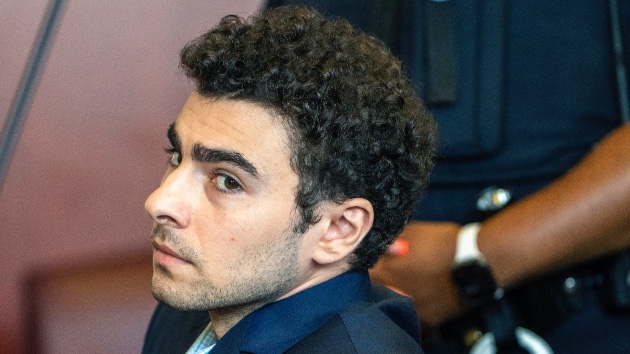
Luigi Mangione appears at an evidence suppression hearing at Manhattan Supreme Court on May 18, 2026 in New York City. Mangione is charged with murder in the fatal shooting of UnitedHealthcare CEO Brian Thompson in Manhattan in December 2024. (Photo by Steven Hirsch-Pool/Getty Images)
(NEW YORK) — Attorneys for Luigi Mangione plan to present an “affirmative psychiatric defense” at his state trial, alleging he was suffering an “extreme emotional disturbance” at the time of the killing of UnitedHealthcare CEO Brian Thompson, Judge Gregory Carro said at a hearing Wednesday.
Carro ordered Mangione’s attorneys to turn over his psychiatric records to prosecutors immediately.
Carro also agreed to dismiss one of the criminal counts related to possession of a large capacity ammunition magazine.
Prosecutors consented to drop the charge after a ruling earlier this year that prohibited them from using the magazine at trial because it was improperly searched by the officers who arrested Mangione in Pennsylvania.
Mangione pleaded not guilty to state and federal charges after he was arrested for allegedly gunning down Thompson, a husband and father of two, on a Midtown Manhattan street in December 2024.
Mangione’s state trial is scheduled to begin on Sept. 8 and his federal trial is set for next year.
Flint Hills, Kansas near Tallgrass Prairie National Preserve. (Wolfgang Kaehler/LightRocket via Getty Images)
(NEW YORK) — America has lost about half of one of its most prominent and iconic landscapes, and protecting what’s left is key to ensuring healthy ecosystems and biodiversity in the future, experts told ABC News.
The continental U.S. has lost about half of its historic grasslands prior to European settlement, according to a press release from America’s Grasslands Coalition, a network of conservation organizations, researchers and government agencies that aims to restore North America’s native prairie and grassland ecosystems. An estimated 98% of native tall grass prairies has been eradicated, Ryan Sensenig, a grassland ecologist at the University of Notre Dame, told ABC News.
While grasslands are typically associated with the Great Plains, they used to exist in nearly every region of the U.S., Dwayne Estes, co-founder and executive director of the Southeastern Grasslands Institute told ABC News.
Grasslands were common everywhere from the Atlantic coastlines to the Mississippi River and into the Rocky Mountains and the West Coast, according to experts. Regions that are not typically associated with grasslands, including New York, Maryland, Virginia, North Carolina and Florida, were covered in them, Estes said.
They are part of the very fabric of North America’s natural heritage, “from sea to shining sea,” Patrick Keyser, director of Tennessee’s Center for Native Grasslands, told ABC News.
Grasslands continue to be threatened, experts say
Today, grasslands continue to disappear at an “alarming rate,” the coalition said.
Invasive plant species have infiltrated many of the natural grasslands, said David Wedin, director of the University of Nebraska’s Center for Grassland Studies. And most recently, development of housing, shopping malls and interstate highways — and now data centers — are popping up in areas that would have been grasslands, Keyser said.
Currently, grasslands cover about 1 million square miles in the continental U.S., according to America’s Grasslands Coalition. This includes savannahs and shrublands.
The most prominent pockets of native grasslands that still exist today are in the Flint Hills of Kansas, which contains about 4.5 million acres of grasslands, and the Nebraska Sandhills, which has about 12 million acres of grasslands.
The area of Nebraska is still an intact grassland. Much of the land is privately owned cattle ranches, but there is still a lot of native grassland and species left there, Wedin said.
Central Montana also contains scattered patches of native grasslands, Keyser said.
There are more than 1,000 native grasses that have been documented in the U.S. The two species of dominant native grasslands in the U.S. include the big bluestem, a robust grass that can grow to 10 feet tall and make for “excellent” cattle forage, and the little blue stem, a much smaller plant that is common on sandier, drier soils, Keyser said.
When US grasslands began to vanish
Indigenous communities relied on grasslands to survive, Sensenig said. They would practice prescribed burning to maintain the grasslands and enhance its biodiversity, Sensenig said. Native Americans would use the plant species for basket-weaving and currency and feed on the grazers, such as bison, elk and deer, Sensenig added.
“Eastern Massachusetts was historically dominated by grasslands before European settlement, and in that area people used to eat these things called prairie chickens regularly,” Keyser said, adding that prairie chickens require extensive grassland for their habitat.
Other evidence of grasslands on the East Coast includes thousands of insect and plant species that are tied to grasslands that still exist in the region, Estes said.
Grasslands east of the Mississippi River have been gone for “a very long time,” Estes said.
As early as the 1690s, grasslands began to disappear from places like Philadelphia and Baltimore, even before the nation was founded, Estes said.
In the 1700s and 1800s, pioneers began to clear land where there were fewer trees to create their farms. They tended to prioritize semi-open areas, Keyser said.
“Eastern grasslands were lost so long ago that basically they’ve been erased from society’s collective memory,” Estes said. “They were lost before the camera was invented.”
Grasslands continued to be eradicated as settlers migrated West.
The Transcontinental Railroad later brought settlers into the Great Plains in the 1870s, and gasoline-powered tractors led to widespread plowing of the native grasslands in the region, Keyser said.
“So, consequently, what had been a grassland ecosystem became a cornfield,” Keyser said.
Why grasslands are so important
Grasslands play a vital role in supporting wildlife, storing carbon, sustaining food systems and maintaining ecosystem balance, according to America’s Grasslands Coalition.
Grasslands also store huge amounts of carbon, which helps to regulate the atmosphere, Sensenig said. It is important for soil conservation, water regulation and wildlife habitat, Wedin said.
Grasslands are thought to store 30% of the world’s soil-based carbon — and 80% of that carbon is beneath the ground in the soil, Sensenig said.
Keystone herbivore species such as the American bison, elk and mule deer live in grasslands and help to regulate the rich plant biota for other creatures to thrive, Keyser said. Birds, pollinators and smaller mammals, such as prairie dogs, also depend on the open, grassy ecosystem and assist in maintaining the biodiversity, Estes said.
Grassland ecologists are concerned about the gradual degradation of grasslands due to lack of management and climate change and other changes to the environment, such as intensive modern agriculture, Wedin said.
“These sorts of chronic, low-level threats have a cumulative impact on our grasslands,” Wedin said.
Nearly half of 2,014 Americans surveyed are unfamiliar with grasslands, according to findings released Wednesday by America’s Grasslands Coalition.
Increasing appreciation and awareness of America’s grasslands is key to accelerating conservation action, according to the coalition.
The upcoming 250th birthday of America is an integral time to raise awareness of the importance of grasslands, Ginette Hemley, senior vice president of wildlife conservation at the World Wildlife Fund, said in a statement.
“As the United States approaches its 250th anniversary, this is a moment to recognize the landscapes that have shaped the nation,” Hemley said. “From iconic species like bison to the communities that depend on them, grasslands are part of that heritage — and protecting them is part of our shared future.”
Former president Barack Obama and first lady Michelle Obama speak with “Good Morning America” co-anchor Robin Roberts at the Obama Presidential Center on June 13, 2026. (Michael Le Brecht IL/ABC News)
(CHICAGO) — For former President Barack Obama and former first Lady Michelle Obama, the opening of the Obama Presidential Center Friday is the culmination of their shared journey from Chicago’s South Side to the White House.
In their first joint network TV interview since leaving office in 2017, the couple reflected on their accomplishments in their eight years in the White House and the hope they have for the country ahead.
“People are a little discouraged right now,” Barack Obama told ABC News’ Robin Roberts in an interview that aired Wednesday on “Good Morning America.” “But, again, I believe that we go through these cycles, and there’s going to be a younger generation that pops up and there are going to be leaders who pop up.”
The former president said since leaving office, he has largely refrained from inserting himself too much into public policy debates as he sees himself these days as less of a “player” and more of a “coach” for the new generation of leaders.
“You pick and choose your spots. I’m not suggesting I’ve done it perfectly,” he said, going on to cite the example of how George Washington stepped away from politics after his time in office.
“He kind of said, ‘All right, I’ve done my stint. And now I’m going, you know, back home,'” Barack Obama said of the nation’s first president. “I think Michelle, you know, very much would prefer a quieter life for us. And on the other hand, there’ve been some folks who would like to see me out every day, right, banging the drum.”
With the Obama Presidential Center, part of the hope, he said, is to “encourage the next generation of leadership.”
The center’s campus encompasses 19 acres in Chicago’s Jackson Park, just steps from the University of Chicago. At a cost of $850 million, it includes 3.7 acres of parkland, offices for the Obama Foundation, an auditorium for public events, public art and athletic facilities, and a new branch of the Chicago Public Library.
In collaboration with the National Archives and Records Administration, the Obama presidential archives are fully digital.
The center’s centerpiece is a four-story museum that places the Obama years within a greater context of social change, starting with the Declaration of Independence and spanning the civil rights and labor movements, as well as the grassroots political movement in Chicago that led to Barack Obama’s political ascent.
Obama on his greatest accomplishment in office When asked by Roberts what he considers the greatest accomplishment of his two terms in office, Barack Obama cited the passage of the Affordable Care Act in March 2010, which expanded Medicaid, provided greater consumer protections, and lowered health insurance costs, especially for households at or below the federal poverty level.
He said the legislation continues to show that his administration represented all of America.
“For all the resistance from our political opposition, the Affordable Care Act has now helped 50, 60 million people, and continues to help people even though the current Congress has tried to weaken it and taken away some of the subsidies that were really helping a lot of working people,” the former president said. “I’m very proud of the message we sent to the country that we’re representing everybody.”
In addition to his legislative accomplishments, museum also tells the story of Barack Obama’s political ascendancy and how the core messages of “hope” and “change” were critical to his campaign for his first term.
Despite the harsh partisanship of today’s political culture, Michelle Obama said those messages are still possible.
“People just have to be fed up enough. They have to want more,” she said. “And I think the presidential center hopefully will remind people of just how close we are to moving this country in the direction that we want to move it in.”
Michelle Obama said an exhibit in the center that reflects on the Obamas’ position as the first Black first family in the history of America reflects that.
“You have one exhibit where people thought that it could never happen, that a Black man, a Black family would never live in the White House. That America would never accept that,” she said. “And lo and behold, the whole country, you know, the vast majority of the country believe differently.”
Amid the museum’s focus on the promise of democracy, Barack Obama said Americans, in times of disagreement, can focus on making their voice heard with their vote.
“The premise of this country is everybody gets a right to say, ‘No, I don’t agree with that. I challenge that. No, Obama, I think you’re making a mistake,’ you know?” he said. “And then we have a conversation about it, and then it gets settled in an election. And if enough people decide I didn’t know what I was doing, then you move on to the next person.”
Tune into the ABC News special “The Obama Legacy: First Joint Interview Post-White House,” streaming Thursday, June 18, on Disney+ and Hulu.
The Walt Disney Co. is the parent company of ABC News.
Rex A. Heuermann pleads guilty in court to the murders of eight women during a 17-year killing spree on April 8, 2026 in Riverhead, New York. (James Carbone/Pool/Getty Images)
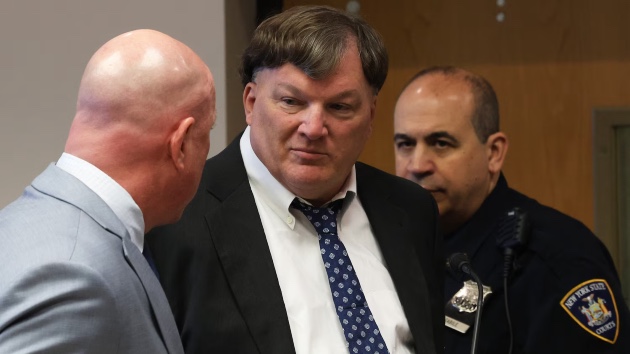
(NEW YORK) — Gilgo Beach, New York, serial killer Rex Heuermann may address the court when he is sentenced to life in prison on Wednesday.
In April, Heuermann pleaded guilty to killing seven women: Melissa Barthelemy, Megan Waterman, Maureen Brainard-Barnes, Amber Lynn Costello, Jessica Taylor, Valerie Mack and Sandra Costilla. He also admitted to killing an eighth woman, Karen Vergata, though he was not formally charged in her death. Their families will have the opportunity to address Heuermann on Wednesday.
At the April hearing, Heuermann agreed to serve three consecutive life sentences followed by four consecutive sentences of 25 years-to-life, according to prosecutors.
Prosecutors said the New York City architect targeted sex workers, strangled them and dumped their bodies near Long Island’s Gilgo Beach over the course of 17 years.
Heuermann “walked among us, play acting as a normal, suburban dad, when in reality, all along, he was obsessively targeting innocent women for death,” Suffolk County District Attorney Ray Tierney said in April.
The Gilgo Beach cases went unsolved for years, until Heuermann’s arrest in 2023.
Since then, Heuermann has been in custody at the Riverhead Correctional Facility. While in jail, Heuermann has been reading books about murder and serial killers, and he’s communicated with Keith Hunter Jesperson, a 1990s serial killer known as the Happy Face Killer, Suffolk County Sheriff Errol Toulon told ABC News.
Defense attorney Michael Brown said in April that the decision to plead guilty belonged solely to Heuermann.
“There came a point in this defense when Rex said, ‘I want to plead guilty,'” Brown said, adding that admitting his guilt brought Heuermann “a huge sense of relief.”
Brown said Heuermann would likely have more to say at sentencing.
Part of Heuermann’s plea agreement also requires him to be interviewed by the FBI’s behavioral analysis unit.
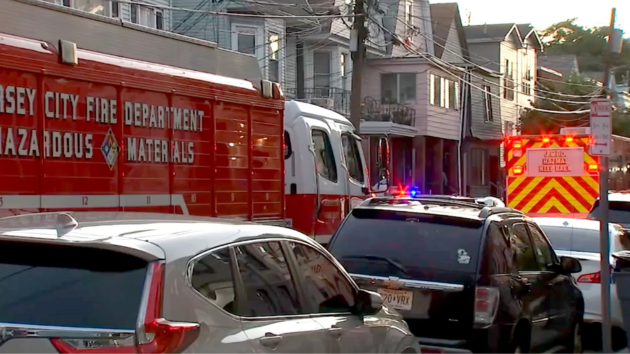
First responders at the scene of a reported acid attack in Jersey City, New Jersey, June 15, 2026. (WABC)
(NEW JERSEY) — Six people were injured, including three teenagers, in an apparently targeted acid attack in New Jersey, police said.
A juvenile has been arrested in connection with the incident, with charges pending, a police spokesperson said Tuesday.
The incident occurred Monday night in a residential area of Jersey City, officials said.
The victims were outside when “individuals riding in a vehicle drove up and threw what is believed to be sulfuric acid at them,” Kim Wallace Scalcione, a spokesperson for Jersey City’s Department of Public Safety, said in a statement.
“The incident appears to have been targeted and may have stemmed from a dispute between a large group of people earlier in the day,” she said.
The victims were transported to a local hospital with non-life-threatening injuries, including skin burns and peeling. One of the victims, a 21-year-old woman, was transferred to a burn unit on Tuesday to be treated for second-degree burns to her face and scalp, Wallace Scalcione said.
Jersey City Mayor James Solomon said he has directed police to “use its full resources” on the investigation, which remains ongoing.
“My thoughts are with those hurt in this horrific attack, and I want our communities to know that violence like this has absolutely no place on our streets,” Solomon said in a statement.
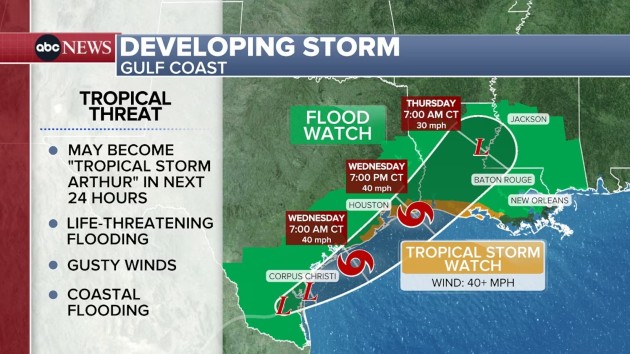
(NEW YORK) — Gulf Coast states already dealing with massive floods are bracing for even more extreme weather as the first tropical storm of the season could form as early as Tuesday night.
Tropical Storm watch issued for 2 states
The National Hurricane Center issued a tropical storm watch on Tuesday for the Gulf Coast from southeast Texas –including the cities of Brazosport, Galveston and Port Arthur– to parts of southwestern Louisiana.
Potential Tropical Cyclone One, the name of the low-pressure system developing, is forecast to become a tropical storm later Tuesday or early Wednesday along the Gulf Coast.
A hurricane is not expected to form, according to the latest forecast.
Very heavy rain is forecast for New Orleans as early as Wednesday evening or as late as Thursday morning, depending on how quickly the storm develops. New Orleans is under a flood watch.
Winds will gust over 40 mph at times along the coast and coastal flooding may also become an issue, according to the forecast.
Deadly flash flood threat continues in the South
A woman in Bandera County, northwest of San Antonio, Texas, called 911 on Monday morning, saying her car was being swept away into a creek by floodwaters, the county’s sheriff’s office said on social media.
Within moments, the call dropped, the office said, and hours later the woman was found dead in the vehicle “several miles downstream” of its initial entry point, the sheriff’s office said. The woman was not immediately identified.
In San Antonio, Houston and Waco there were stalled vehicles due to high waters on roads. In Shreveport, Louisiana, there were water rescues and water entering buildings.
In St. Martin, Mississippi, ramps to I-10 and I-110 were closed due to high waters. South of there, at Kessler Air Force Base, several roads became impassible.
More than 17 million Americans remain on Tuesday under a flood watch from Texas to Mississippi.
Heavy rainfall may lead to localized significant flash flooding from Corpus Christi to Houston to Lafayette and Alexandria, Louisiana, and McComb, Mississippi. A level 3 of 4 threat for flash flooding is in place there.
The greatest risk is likely along a frontal boundary laid over central Louisiana and into southeast Mississippi — rainfall may be heavy for a few hours in this area on Tuesday and could lead to significant flooding.
Rains closer to the coast are going to be more difficult to sustain but there is certainly enough ingredients there that if they get going, localized instances of significant flash flooding are possible.
Tomorrow, the level 3 of 4 flood threat is for Houston, Beaumont, Lake Charles, and Lafayette.
On Thursday, the level 3 of 4 flood threat moves to Baton Rouge through Jackson, MS, Montgomery, AL and Birmingham, AL.
This heavier rain for Wednesday and Thursday will come from a developing tropical low over the western Gulf.
The National Hurricane Center gives it a 60% chance of forming into a tropical storm later on Tuesday or on Wednesday. If it becomes a tropical storm, it will be named Arthur, the first of the season.
Severe weather outbreak in the Midwest on Wednesday
About 40 million Americans are in the storm zone where a severe weather outbreak is expected on Wednesday
The greatest likelihood for a destructive outbreak is in Illinois and Indiana, and possible for parts of Missouri, Iowa and Ohio, too.
A level 4 of 5 moderate risk for destructive storms is in place for central Illinois and northern Indiana on Wednesday. This includes Springfield, Peoria, Decatur, Champaign and Bloomington, Illinois, along with Rensselaer, Indiana.
Large and long-lived tornadoes are possible, along with destructive wind gusts up to 80 mph, and hail up to the size of baseballs.
The level 3 of 4 risk includes Chicago, Indianapolis, St. Louis and Fort Wayne.
-ABC News’ Ivan Pereira contributed to this report.
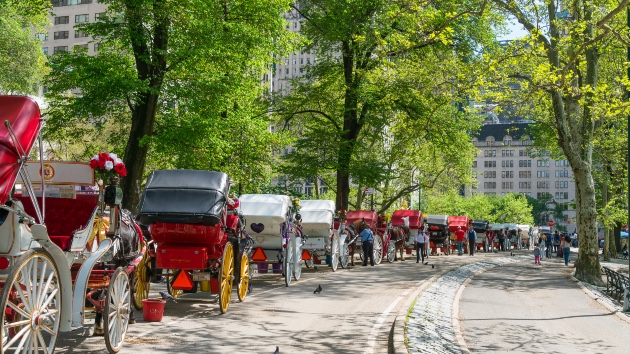
Row of horse carriages to wait for customer to ride on the carriage. – stock photo Row of horse carriages to wait for customer to ride on the carriage along the fresh green tree lined Park road at New York City on May 06 2019. (Toshi Sasaki/Getty Imagtes)
(NEW YORK) — The death of a Central Park carriage horse that collapsed last week while on a ride with two passengers was caused by a foreign toxic plant, according to a necropsy publicized on Tuesday by the union representing carriage drivers.
The Transport Workers Union of America said the horse, Deniz, was giving a ride near East 90th Street in Manhattan on June 9 when it paused to eat a shrub along the curb.
A short time later, the 16-year-old horse collapsed and died, according to the necropsy performed by Cornell University’s College of Veterinary Medicine, the union said.
Two passengers were in the carriage when the incident happened, police said.
The plant was a Japanese yew, an ornamental that is toxic and deadly to horses, according to the report.
The union cited the necropsy report to counter growing calls from activists and the Central Park Conservancy to ban carriage horses due to how they’re treated.
“Deniz’s tragic death was not caused by neglect or abuse or the fact he was a carriage horse — as some animal rights activists and elected officials claimed,” Alexander Kemp, TWU’s administrative vice president, said in a statement.
“Poor Deniz died because the people running the Park Conservancy never warned anyone that there were deadly yew plants in the park. This is negligence at the highest level of the Conservancy,” he added.
The Central Park Conservancy didn’t immediately respond to ABC News for comment.
Some animal activist groups, like PETA, have long protested horse-drawn carriage rides in the park, arguing that the animals are put in danger because of nearby car traffic and forced to work in poor conditions, especially in extreme weather.
Deniz had passed a physical exam conducted by the NYPD’s Mounted Unit veterinarian in March, according to the TWU.
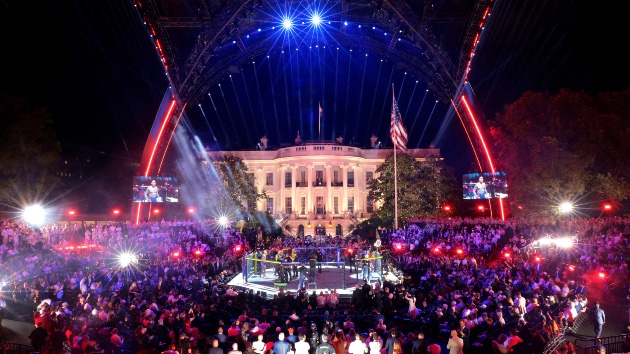
UFC Freedom 250 is seen on the South Lawn of the White House on June 14, 2026 in Washington, DC. (Photo by Chip Somodevilla/Getty Images)
(WASHINGTON) — The FBI disrupted an alleged plot targeting the “UFC Freedom 250” fights at the White House on Sunday that included explosive drones designed to target buildings in the area, according to multiple sources familiar with the situation.
FBI Director Kash Patel said in a statement to ABC News that law enforcement became aware of the plot on June 10, the Wednesday prior to the event. He praised the “rapid action” of the FBI and its partners, including a “a multi-state operation.”
Five people are in custody as of Tuesday morning, according to sources. The alleged suspects in custody include one individual from Cincinnati, Ohio, sources said.
Twenty-three people were allegedly in Signal chats discussing preoperational plans, according to sources. Some of those involved in the plot allegedly traveled to Fredericksburg, Virginia, on June 12 or 13 according to sources.
FBI and Department of Homeland Security officials warned in a bulletin earlier this month that the fights were “attractive symbolic targets.” There were no credible threats listed in the bulletin at the time.
The Ultimate Fighting Championship event was held in the evening on Sunday, June 14, on the grounds of the White House. Billed as a celebration of America’s 250th anniversary, it also coincided with the 80th birthday of President Donald Trump, who was in attendance.
The alleged plot involved explosive-laden drones, according to sources, which were designed to hit buildings in the area to spur a mass evacuation.
A “second wave” targeting a security checkpoint was then planned, according to sources.
Patel said law enforcement response included a “multi-state operation.”
“While the result represented the best of investigative work, it was also nothing out of the ordinary for this law enforcement team — we are built to detect, respond to, and bring to justice those who threaten the lives of American citizens — particularly during large gatherings like the historic UFC 250 fight,” Patel said in his statement. “That’s exactly what we did here. I want to thank our great agents and partners, this work remains ongoing and we will continue to update the public as permitted.”
Federal law prohibits flying drones in the airspace over the National Capital Region, the special agent in charge of the Secret Service’s Washington field office told ABC News last week.
“We will have law enforcement drones for overwatch, but just to make it simple for the public, if they see a drone, we want them to report that,” Tara McLeese, the special agent in charge, said at the time.
ABC News’ Josh Margolin contributed to this report.