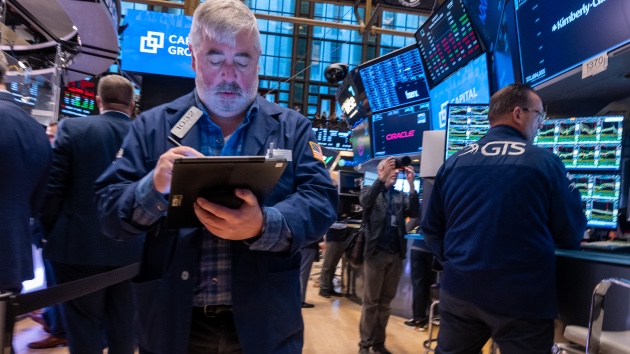
(NEW YORK) — The stock market fell on Monday after President Donald Trump slapped tariffs on Canada, Mexico and China, eliciting threats of retaliation and setting the stage for a trade war.
The Dow Jones Industrial Average slid about 550 points, or 1.25%, in early trading on Monday. The S&P 500 dropped 1.5%, and the tech-heavy Nasdaq plummeted 2%.
Traders demonstrated their jitters with a selloff of U.S. auto companies, which hold deep ties to suppliers in Canada and Mexico. Shares of General Motors plummeted 6%, while Ford saw its stock price plunge 4%.
The market rout extended worldwide. Japan’s Nikkei index fell 2.5% on Monday, and the pan-European STOXX 600 dropped about 1%.
On Saturday, Trump imposed 25% tariffs on products from Mexico and Canada, as well as 10% tariffs on goods from China. The tariffs are set to take effect on Tuesday, the White House said.
Canadian Prime Minister Justin Trudeau and Mexican President Claudia Sheinbaum both responded within hours of the announcement, vowing to retaliate.
Trudeau said Canada will implement 25% tariffs on $155 billion worth of U.S. goods, while Sheinbaum said she has instructed officials in her government to implement what she called Plan B, “which includes tariff and non-tariff measures in defense of Mexico’s interests.”
The tariffs imposed by the White House could raise prices for an array of products ranging from avocados to tequila to gasoline, experts previously told ABC News. The price impact remains unclear, however, since businesses within the supply chain could opt to take on some or all of the tax burden, they said.
Potential retaliatory tariffs issued by Canada and Mexico would make it more difficult for U.S. exporters to compete in those markets, raising the possibility of weaker sales.
This is a developing story. Please check back for updates.
(WASHINGTON) — Tariffs on goods from Mexico and Canada that are set to take effect could hike the price of a gallon of gasoline for some drivers by as much as 70 cents and send grocery bills climbing, experts told ABC News.
The Trump administration this week reiterated plans to slap 25% tariffs on all products from Canada and Mexico on Feb. 1. Those countries make up two of the three largest U.S. trading partners, government data shows.
Tariffs of this magnitude would likely increase prices paid by U.S. shoppers, since importers typically pass along a share of the cost of those higher taxes to consumers, experts said. The policy could raise prices for an array of products ranging from tomatoes to tequila to auto parts.
“The scary thing is the list of products is very, very long,” said Jason Miller, a professor of supply-chain management at Michigan State University.
The price impact remains unclear, however, since businesses within the supply chain could opt to take on some or all of the tax burden, some experts added, noting the tariffs may not take effect at all since Trump has previously used them as a source of leverage in international negotiations.
In response to ABC News’ request for comment, a White House spokesperson touted Trump’s previous economic policies, including tariffs.
“In his first administration, President Trump instituted an America First economic agenda of tariffs, tax cuts, deregulation, and an unleashing of American energy that resulted in historic job, wage, and investment growth with no inflation. In his second administration, President Trump will again use tariffs to level the playing field and usher in a new era of growth and prosperity for American industry and workers,” White House spokesperson Kush Desai told ABC News.
Here’s what to know about which products could see price increases as result of the tariffs, according to experts:
Gas
Mexico and Canada account for 70% of U.S. crude oil imports, which make up a key input for the nation’s gasoline supply, according to the U.S. Energy Information Administration, a government agency.
Those imports come primarily from Canada, which sends crude oil to U.S. refineries built specifically to process the crude and redistribute it as car-ready gasoline, Timothy Fitzgerald, a professor of business economics at the University of Tennessee who studies the petroleum industry, told ABC News.
Gasoline that originates as Canadian crude reaches customers in the upper Midwest as well as some along the East and West coasts, Fitzgerald said. For those drivers, he added, prices could rise between 40 and 70 cents per gallon of gasoline.
“You could definitely be looking at 50 cent-a-gallon increases in a lot of parts of the country,” Fitzgerald added, noting that the effects would be limited to the regions that rely on imported crude.
The tariff-related price increase may combine with a seasonal price hike set to take effect within weeks, since demand for gas typically grows as travel picks up in the warmer spring weather, experts said.
That seasonal price impact could add another 30 cents per gallon, putting the total increase in gasoline prices at $1 per gallon if the tariffs remain in place at the onset of spring, Fitzgerald said.
Tomatoes and Avocados
The U.S. imported $38.5 billion in agricultural goods from Mexico in 2023, making it the top recipient of such products, U.S Department of Agriculture data showed. Those imports include more than $3 billion worth of fresh fruits and vegetables.
Mexican imports account for a large share of some fruits and vegetables routinely eaten by Americans.
Roughly 90% of avocados eaten in the U.S. last year originated in Mexico, USDA data showed. Other products with a high concentration of Mexican imports include tomatoes, cucumbers, bell peppers, jalapenos, limes and mangos, Miller said.
It would be difficult for the U.S. to replace those goods with domestic production or an alternative supplier, making it likely that prices would rise significantly if the tariffs take effect, he added.
“You’d certainly expect to see an impact on prices,” Miller said.
The U.S. also imports large quantities of beer, tequila and other alcoholic beverages from Mexico, experts said. In 2022, the U.S. imported about $26 billion worth of alcoholic drinks from Mexico, according to the USDA.
“Don’t forget all that beer we import from Mexico,” Miller said.
Cars and auto parts
Carmakers and consumers depend on the auto industry’s deep ties to Canada and Mexico, making tariffs a threat to prices, experts said.
Mexico and Canada make up the top two U.S. trading partners for both finished motor vehicles and car parts, according to a Cato Institute analysis of data from the U.S. International Trade Commission.
In 2023, Canada and Mexico accounted for nearly $120 billion worth of U.S. motor vehicle imports, which totaled about 47% of all such vehicles imported that year. Canada and Mexico made up nearly the same share of auto parts imports that year, the Cato Institute analysis showed.
“The operations of auto companies on both sides of the border will be hugely affected by these tariffs,” Robert Lawrence, a professor of trade and investment at Harvard University’s Kennedy School of Government, told ABC News.
(WASHINGTON) — The Federal Reserve held interest rates steady on Wednesday, just days after President Donald Trump called on the central bank to lower them.
The announcement put the central bank on a potential collision course with Trump, though a longstanding norm of independence typically insulates the Fed from direct political interference.
The decision to maintain the current level of interest rates pauses a series of three consecutive interest rate cuts imposed by the Fed over the final months of 2024.
The Federal Open Market Committee (FOMC), a policymaking body at the Fed, said on Wednesday that the central bank remains attentive to concerns centered on the potential for both a rise in unemployment and a surge of inflation. Inflation stands at a moderately elevated rate, while unemployment remains at a historically low level, the FOMC added.
Taken together, those two considerations — employment and inflation — make up the Fed’s “dual mandate.”
“The Committee judges that the risks to achieving its employment and inflation goals are roughly in balance,” the FOMC said.
“The economic outlook is uncertain, and the Committee is attentive to the risks to both sides of its dual mandate.”
The Fed indicated last month that it would cut interest rates at a slower pace than it had previously forecast, however, pointing to a bout of resurgent inflation. That forecast sent stock prices plummeting, though markets have broadly recovered the losses.
Inflation has slowed dramatically from a peak of more than 9% in June 2022, but price increases remain nearly a percentage point higher than the Fed’s target rate of 2%.
During a virtual address to the World Economic Forum in Davos, Switzerland, last week, Trump demanded a drop in interest rates after calling for a reduction of oil prices set by a group of nations known as OPEC, which includes Saudi Arabia.
The prospect of low oil prices will enable the Fed to dial back its fight against inflation and bring down interest rates, Trump said.
“I’m going to ask Saudi Arabia and OPEC to bring down the cost of oil,” Trump said, later adding: “With oil prices going down, I’ll demand that interest rates drop immediately.”
The U.S. does not belong to OPEC, nor does the president play a role in the organization’s decisions regarding the price of oil sold by its member states.
Several past presidents have sought to influence the Fed’s interest rate policy, including Trump, who repeatedly spoke out in favor of low interest rates during his first term.
On the campaign trail in August, Trump said a U.S. president should have a role in setting interest rates.
Fed Chair Jerome Powell struck a defiant tone in November when posed with the question of whether he would resign from his position if asked by Trump.
“No,” Powell told reporters assembled at a press conference in Washington, D.C., blocks away from the White House.
When asked whether Trump could fire or demote him, Powell stated: “Not permitted under the law.”
The Fed retreated in its fight against inflation over the final months of last year, lowering interest rates by a percentage point. Still, the Fed’s interest rate remains at a historically high level of between 4.25% and 4.5%.
Last month, Powell said the central bank may proceed at a slower pace with future rate cuts, in part because it has now lowered interest rates a substantial amount.
Powell also said a recent resurgence of inflation influenced the Fed’s expectations, noting that some policymakers considered uncertainty tied to potential policy changes under Trump.
“It’s common-sense thinking that when the path is uncertain, you get a little slower,” Powell said. “It’s not unlike driving on a foggy night or walking around in a dark room full of furniture.”
(WASHINGTON) — The Federal Reserve on Wednesday will announce its latest decision setting the level of interest rates, just days after President Donald Trump called on the central bank to lower them.
Investors widely expect the Fed to hold interest rates steady, putting the central bank on a potential collision course with Trump. A longstanding norm of independence typically insulates the central bank from direct political interference.
A decision to maintain the current level of interest rates would pause a series of three consecutive interest rate cuts imposed by the Fed over the final months of 2024.
The Fed indicated last month that it would cut interest rates at a slower pace than it had previously forecast, however, pointing to a bout of resurgent inflation. That forecast sent stock prices plummeting, though markets have broadly recovered the losses.
Inflation has slowed dramatically from a peak of more than 9% in June 2022, but price increases remain nearly a percentage point higher than the Fed’s target rate of 2%.
During a virtual address to the World Economic Forum in Davos, Switzerland, last week, Trump demanded a drop in interest rates after calling for a reduction of oil prices set by a group of nations known as OPEC, which includes Saudi Arabia.
The prospect of low oil prices will enable the Fed to dial back its fight against inflation and bring down interest rates, Trump said.
“I’m going to ask Saudi Arabia and OPEC to bring down the cost of oil,” Trump said, later adding: “With oil prices going down, I’ll demand that interest rates drop immediately.”
The U.S. does not belong to OPEC, nor does the president play a role in the organization’s decisions regarding the price of oil sold by its member states.
Several past presidents have sought to influence the Fed’s interest rate policy, including Trump, who repeatedly spoke out in favor of low interest rates during his first term.
On the campaign trail in August, Trump said a U.S. president should have a role in setting interest rates.
Fed Chair Jerome Powell struck a defiant tone in November when posed with the question of whether he would resign from his position if asked by Trump.
“No,” Powell told reporters assembled at a press conference in Washington, D.C., blocks away from the White House.
When asked whether Trump could fire or demote him, Powell stated: “Not permitted under the law.”
The Fed retreated in its fight against inflation over the final months of last year, lowering interest rates by a percentage point. Still, the Fed’s interest rate remains at a historically high level of between 4.25% and 4.5%.
Last month, Powell said the central bank may proceed at a slower pace with future rate cuts, in part because it has now lowered interest rates a substantial amount.
Powell also said a recent resurgence of inflation influenced the Fed’s expectations, noting that some policymakers considered uncertainty tied to potential policy changes under Trump.
“It’s common-sense thinking that when the path is uncertain, you get a little slower,” Powell said. “It’s not unlike driving on a foggy night or walking around in a dark room full of furniture.”
Nvidia CEO Jensen Huang/ Photo Credit: PATRICK T. FALLON/AFP via Getty Images
(NEW YORK) — The emergence of China-based AI app DeepSeek sent shares plummeting on Monday for many U.S. tech giants, including chipmaker Nvidia and AI-backer Microsoft.
Nvidia, which helped catapult market wide gains in recent years, saw its share price plummet by more than 12% in early trading on Monday. Shares of Microsoft, a major stakeholder in ChatGPT-maker OpenAI, fell about 4.5%.
The tech-heavy Nasdaq fell more than 3% in early trading on Monday. The Dow Jones Industrial Average and S&P 500 also inched downward.
The DeepSeek chatbot — which responds to user queries, just like its U.S.-based counterparts — stands atop the Apple app-store charts. Early testing suggests that the quality of DeepSeek rivals that of U.S.-based AI products.
Developers of the system powering the AI, called DeepSeek-V3, published a research paper indicating that the technology relies on much fewer specialized computer chips than its U.S. competitors.
DeepSeek has emerged despite export controls issued by the Biden administration that prohibit U.S. manufacturers from selling such specialized chips to firms in China.
Ivan Feinseth, a market analyst at Tigress Financial, described DeepSeek as “the first shot at what is emerging as a global AI space race.”
“The potential power and low-cost development of DeepSeek is calling into question the hundreds of billions of dollars committed in the U.S,” Feinseth said in a note to clients on Monday.
Alphabet, the company behind AI chatbot Gemini, saw shares drop about 3% on Monday. The stock price of Amazon, which offers its own AI-fueled shopping assistant, also fell about 3%.
The dip interrupts a yearslong surge for many tech giants, driven in part by enthusiasm about the future of AI. The tech-heavy Nasdaq climbed more than 30% in 2024, sustaining much of its sky-high 43% growth over the year prior. Many analysts expected those robust gains to continue this year.
“When expectations are high, one skeptical headline can knock the market off its axis. That’s exactly what we’re seeing today,” Callie Cox, chief market strategist at Ritholtz Wealth Management, said in a statement on Monday.
(NEW YORK) — While some companies are steering away from diversity, equity, and inclusion (DEI) policies, others are sticking with their previous commitments.
Leaders at Goldman Sachs, Costco and JPMorgan Chase & Co have recently spoken out in support of their diversity programs, as anti-DEI activist shareholders continue to push proposals that would roll back company policies.
Costco’s Board of Directors unanimously voted Thursday against a proposal from the National Center for Public Policy Research that had called for Costco to evaluate and publish a report on any risks that may be associated with the company’s diversity and inclusion efforts, according to a Jan. 23 shareholders meeting statement.
“Our efforts around diversity, equity and inclusion follow our code of ethics,” the board statement on the proposal stated. “For our employees, these efforts are built around inclusion – having all of our employees feel valued and respected. Our efforts at diversity, equity and inclusion remind and reinforce with everyone at our Company the importance of creating opportunities for all. We believe that these efforts enhance our capacity to attract and retain employees who will help our business succeed.”
The board argued that its diversity programs comply with the law, and defended its commitments to diversifying its supplier base — including special attention to small businesses. The board statement ultimately argued the proposal reflected a “policy bias.”
Costco representatives have not responded to ABC News’ request for comment.
Amid ongoing pressure over its DEI initiatives, a Goldman Sachs spokesperson told ABC News in a statement: “We strongly believe that organizations benefit from diverse perspectives, and Goldman Sachs is committed to operating our programs and policies in compliance with the law.”
Goldman Sachs representatives directed ABC News to a Jan. 22 interview with CNBC from CEO David Solomon, in which Solomon said that the financial services company is looking at these issues “through the eyes of our clients.”
He added, “They think about decarbonization, they think about climate transition,” he said. They think about their businesses, how they find talent, the diversity of the talent they find all over the world. You know we operate a big global business and we serve global clients everywhere. We think about these issues through the lens of, how do we help our clients navigate these things? And we continue to stay focused on talking to our clients and doing the things we’ve always done.”
The company has come under scrutiny for its stated commitments to racial equity, gender equality and increasing diversity. Strategies listed on its website include expanded recruitment efforts, pay gap data collection, aspirational hiring goals and career development programs.
JPMorgan Chase CEO Jamie Dimon, in an interview with CNBC, said he’s “very proud of what we’ve done.”
“We will continue to reach out to the Black community, the Hispanic community, the veterans community, LGBTQ, we have teams with second chance initiatives — where I go, with blue states, red states, governors, they like what we do,” said Dimon.
JPMorgan Chase did not respond to request for comment.
DEI initiatives, according to ABC News interviews with DEI experts, are intended to address and correct discriminatory policies or practices that may be found within an organization. Experts told ABC News that some examples of DEI initiatives include: implementing accessibility measures for people with disabilities, addressing gender pay inequity, mitigating bias in hiring and recruitment practices, and holding anti-discrimination trainings and more.
Several other companies across industries — including Amazon, Meta and McDonalds — have stepped back and ended their diversity and inclusion initiatives that were largely pledged after the police killing of George Floyd and subsequent protests against racial inequality.
The reversal comes amid ongoing anti-DEI action from conservative politicians, who have implemented policies restricting diversity and equity programs in government, colleges, universities, and more. After taking office this week, President Donald Trump signed an executive order dismantling DEI programs in the federal government.
In an interview with ABC News, Ethan Peck, deputy director for the National Center for Public Policy Research’s Free Enterprise Project, said that diversity programs pose risks to shareholder value, as they may invite lawsuits from those claiming to have been discriminated against based on recent arguments made against affirmative action.
Some legal experts disagree, arguing that repealing DEI policies could leave companies vulnerable to potential lawsuits from marginalized groups alleging discrimination.
Peck, whose group mounts campaigns to pressure companies to disband DEI programs, argued that diversity programs sacrifice “excellence and innovation,” but said he did not provide examples of employment discrimination at these companies.
“Eventually you will drop DEI, and it’s better for your shareholders if you do it sooner rather than later,” said Peck, who noted that Boeing and John Deere were faced with similar proposals and later dropped their diversity, equity and inclusion programs.
“I believe that this is a fad,” he said.
Anti-DEI activists also argue that “aspirational” goals for increasing diversity and representation are a guise for quotas, which are largely considered illegal, according to the Equal Employment Opportunity Commission.
“You can be fair in hiring and promotions with candidates of all backgrounds and perspectives without resorting to quota systems and considerations based on immutable characteristics,” said Paul Chesser, the director of the Corporate Integrity Project at the National Legal and Policy Center, in an emailed statement.
Christie Smith, former vice president of inclusion and diversity at Apple and C-Suite adviser, argued that DEI commitments instead increase shareholder value.
DEI has prompted “increased innovation, increased growth in these organizations, increased opportunities in startup organizations, which mostly women and people of color are at, starting these kinds of companies and growing our economy in that way,” she told ABC News.
Chip Somodevilla/Getty Images/Bloomberg via Getty Images
(WASHINGTON) — President Donald Trump on Thursday said he will call for a lowering of U.S. interest rates, exerting pressure on the Federal Reserve despite a longstanding norm of political independence at the central bank.
During a virtual address to the World Economic Forum in Davos, Switzerland, Trump demanded a drop in interest rates after calling for a reduction of oil prices set by a group of nations known as OPEC, which includes Saudi Arabia.
The prospect of low oil prices will enable the Fed to dial back its fight against inflation and bring down interest rates, Trump said.
“I’m going to ask Saudi Arabia and OPEC to bring down the cost of oil,” Trump said, later adding: “With oil prices going down, I’ll demand that interest rates drop immediately.”
The U.S. does not belong to OPEC, nor does the president play a role in the organization’s decisions regarding the price of oil sold by its member states.
The central bank is typically insulated from political interference, but several past presidents have sought to influence the Fed’s interest rate policy, including Trump, who repeatedly spoke out in favor of low interest rates during his first term.
On the campaign trail in August, Trump said a U.S. president should have a role in setting interest rates.
Fed Chair Jerome Powell struck a defiant tone in November when posed with the question of whether he would resign from his position if asked by Trump.
“No,” Powell told reporters assembled at a press conference in Washington, D.C., blocks away from the White House.
When asked whether Trump could fire or demote him, Powell retorted: “Not permitted under the law.”
The prospect of a presidential role in setting interest rates drew opposition from both liberal and conservative economists who previously spoke to ABC News.
Critics of an expanded role for the president point to a bout of high inflation in the 1970s and 1980s. Before the inflation took hold, President Richard Nixon had urged Fed Chair Arthur Burns to cut rates in the run-up to the 1972 presidential election.
Nixon’s advocacy is widely viewed as a contributing factor for lower-than-necessary interest rates that enabled inflation to get out of control, some economists noted.
“Allowing the president, any president, to help set monetary policy would eventually wreck the U.S. economy,” Mark Zandi, chief economist at Moody’s Analytics, told ABC News.
The statements from Trump on Thursday came amid a monthslong reduction in interest rates.
The Fed cut interest rates by a total of a percentage point over the final months of 2024, delivering relief for borrowers long-saddled by a prolonged stretch of high interest rates.
The central bank, however, has indicated that it may cut rates less often in 2025 than it previously indicated. Inflation may prove more difficult to bring under control than policymakers thought just a few months ago, according to the bank.
The Fed is set to make its next decision on interest rates next week. The central bank is widely expected to maintain interest rates at the current level of between 4.25% and 4.5%, according to the CME FedWatch Tool, a measure of market sentiment.
Speaking on Thursday, Trump said a lowering of rates could bring about a reduction of interest rates worldwide.
“They should drop all over the world,” Trump said. “They should follow us.”
(NEW YORK) — Shares of Netflix soared 12% in early trading on Wednesday, just hours after the streaming giant announced price increases set to impact all of the company’s U.S. subscribers.
The standard monthly subscription without advertisements will climb from $15.49 to $17.99, and a standard monthly subscription with ads will increase one dollar to $7.99, Netflix said.
The price hikes arrived alongside a stellar earnings report that showed the largest subscriber gains over a three-month period since the company’s founding more than a quarter-century ago.
Netflix added 19 million subscribers over the last quarter of 2024, vaulting the company to 302 million subscribers worldwide. Revenue jumped 16% over the final three months of 2024 compared to a year earlier, topping $10 billion in a single quarter for the first time.
“As we continue to invest in programming and deliver more value for our members, we will occasionally ask our members to pay a little more so that we can re-invest to further improve Netflix,” Netflix said in a letter to investors.
The second season of hit show “Squid Game” helped propel the subscriber bounce, Netflix said, noting that the series is on pace to be the most-watched season of original programming in the company’s history.
Netflix also found success in the latter part of 2024 with the holiday movie “Carry On” and a live boxing match between influencer Jake Paul and former heavyweight champion Mike Tyson, the company said.
“It’s great that all these big swings worked very well in the quarter,” Netflix co-CEO Ted Sarandos said on a conference call with investors on Tuesday.
The price hikes at Netflix follow a string of price jumps imposed by competitors last year.
In August, Disney announced price increases for streaming services Disney+, Hulu and ESPN+ that amounted to hikes of between $1 or $2 for each platform. Two months earlier, Warner Bros. Discovery’s Max increased prices for its ad-free membership by $1 per month. (Disney is the parent company of ABC News.)
Stock analysts lauded Netflix in memos to clients on Wednesday.
In a note shared with ABC News, Bank of America Global Research described the earnings report as “very strong.”
Tigress Financial, a New York City-based advisory firm, said Netflix’s performance foretells further increases in the company’s share price.
“The incredible power of its subscriber growth and subscriber base will continue to drive further gains in the stock,” Tigress Financial wrote in a letter shared with ABC News.
Netflix led all studios with 36 nominations for the Golden Globes, which took place earlier this month. “Emilia Pérez,” a film starring Zoe Saldaña and Selena Gomez, won four awards, including best motion picture – musical or comedy.
Speaking to investors on Tuesday, Sarandos said the wildfires in Los Angeles would not delay the company’s releases this year or reduce anticipated revenue.
“No meaningful delays in the delivery of the projects and no meaningful impact to the cash in 2025, but very meaningful disruption in people’s lives,” Sarandos said.
“So, our goal is to keep everything on schedule safely, be mindful of folks who need time to work through the challenges of the fires, including, in some cases, loss of life and home. But this industry has been through a really tough couple of years, starting with COVID, going into the strikes, and now this,” Sarandos added.
(ISSAQUAH ,WA) — In pursuit of increased wages and renegotiated employee benefits, more than 18,000 Costco union members nationwide voted to authorize a strike if the wholesale company doesn’t agree to their terms by Jan. 31.
The looming Costco strike marks the latest in a string of Teamsters union walkouts from employees of industry giants including Amazon and Starbucks.
The strike was approved on Sunday with more than 85% of Costco Teamsters voting in favor of hitting the picket lines if demands aren’t met.
The union said Costco had rejected contract proposals that included increased seniority pay, paid family leave, bereavement policies, sick time and safeguards against surveillance.
Bryan Fields, a Costco employee in Baltimore and member of Teamsters Local 570, told ABC News that the strike deadline comes after months of stalled conversations, extensions and failed negotiations with the company.
“They had plenty of months to negotiate and they would extend, extend, extend,” Fields, who has worked for the membership-only retailer for over a decade, claimed.
He and Teamsters spokesperson Matt McQuaid said negotiations with the company have been ongoing since August, without agreement.
ABC News has reached out to Costco Wholesale for a comment.
“No one wants to strike, no one’s excited about doing anything like that, and I’m sure they don’t want us to do that as well,” Fields said of the company, adding, “Let’s bypass all of that and just do what they promise in their code of conduct, which is ‘take care of employees.'”
According to Teamsters, Costco recently reported $254 billion in annual revenue and $7.4 billion in net profits, which marked a 135% increase since 2018.
While the details of the union’s negotiations with Costco’s top brass remain fluid, according to McQuaid, employees are “fully prepared” to picket come Feb. 1 if an agreement is not reached.
Last week hundreds of Costco Teamsters nationwide organized practice pickets from Hayward, California, to Sumner, Washington, and Long Island, New York, the organization said in a press release Sunday.
The 18,000 Teamsters union members who voted to authorize the strike account for 8% of Costco’s mostly non-union employees.
“Our members have spoken loud and clear — Costco must deliver a fair contract, or they’ll be held accountable,” Teamsters General President Sean M. O’Brien said in the release.
“From day one, we’ve told Costco that our members won’t work a day past January 31 without a historic, industry-leading agreement. Costco’s greedy executives have less than two weeks to do the right thing. If they refuse, they’ll have no one to blame but themselves when our members go on strike,” O’Brien added.
As of this month, there were 624 Costco Wholesale locations across the country.
The membership-only warehouse club chain is the third-largest retailer in the world behind Walmart and Amazon, with over 600 locations across the U.S.
Fields says employees who are the “backbone” of the multi-billion-dollar company’s success just want a “piece of the pie.” He hopes Costco can reach an agreement with union members before the strike terms expire, saying, “It’s in their hands right now.”
“The union is simply a voice of the people. They choose whether we become the weapon for the people. It’s as simple as that,” Fields said.
(NEW YORK) — Cryptocurrencies affiliated with President Donald Trump and first lady Melania Trump plummeted in the initial hours after Trump was sworn into office Monday.
“Official Trump,” a recently launched crypto token, plunged more than 20% in value over a 24-hour stretch ending Tuesday morning, according to crypto tracking site CoinGecko. After the drop, Official Trump stood at $38.
The decline for Trump’s meme coin reverses some of the gains enjoyed in an initial surge after it hit crypto markets last week. The coin’s price climbed from about $10 on Saturday morning to a high of about $74.59 before it began to slide.
“Melania Meme,” which also launched last week, dropped in value by more than half over a 24-hour timespan ending on Tuesday morning, CoinGecko data showed. The price of the Melania Meme was $4.19 on Tuesday morning.
The recent decline for the coins associated with Trump and Melania coincided with a slight drop for bitcoin, the world’s largest cryptocurrency. In early trading on Tuesday, bitcoin fell nearly one percentage point, putting its price at $102,853.
Many digital assets have climbed since Trump won the November election, indicating investor enthusiasm about declarations Trump made in support of cryptocurrency.
In July, Trump told the audience at a cryptocurrency conference in Nashville, Tennessee, that he wanted to turn the U.S. into the “crypto capital of the planet.”
Trump also has promised to ease regulations for the sector and establish the federal government’s first National Strategic Bitcoin Reserve.
On Monday, Securities and Exchange Commission Chair Gary Gensler officially resigned from his position, marking the departure long-sought by some crypto boosters who viewed Gensler as overly restrictive toward digital assets.
There have been reports that Trump would sign an executive action that would prioritize cryptocurrency policy. However, no such order was among the dozens of actions Trump signed