
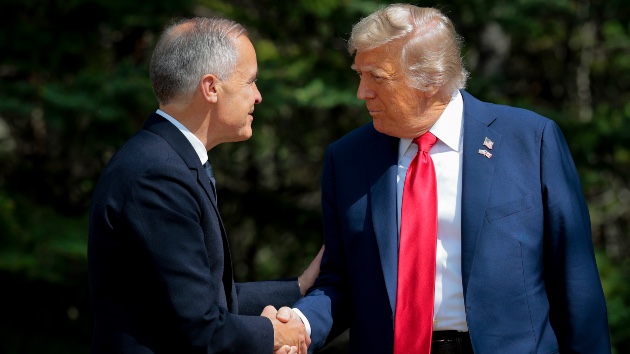
(NEW YORK) — President Donald Trump said he is pausing for three days the new 50% tariffs on Canadian goods that were set to go into effect early Wednesday, citing a deal between the U.S. and Canada.
“I have paused the 50% Tariffs against Canada, that were scheduled to kick in tomorrow morning for a three day period, based on the fact that Canada and the U.S.A., subject to the finalization of documents, have a DEAL,” Trump said in a social media post on Tuesday night.
The new tariffs, targeting dozens of products from hockey sticks to wine, were set to go into effect at 12:01 a.m. ET on Wednesday.
Trump confirmed Wednesday that he had a “very good conversation” with Canadian Prime Minister Mark Carney on Tuesday night, repeating that he’d struck a deal to avert a 50% American tariff on a hodgepodge of Canadian goods for now.
“Yeah, we had a very good conversation with the Prime Minister last night, and we’ve come to a deal with Canada. As you know, the 50% tariffs across the board were going on against Canada today,” Trump said Wednesday.
The president claimed that as part of the Canadian deal, Canadian tariffs on American agricultural goods would be “non-existent.”
“The tariffs will be non-existent for our farmers. Our farmers were paying tremendous tariffs into Canada. And those tariffs are going to be totally eviscerated down to zero,” Trump noted.
Canada’s latest statement on the matter reflects that while “substantial progress” has been made, important work remains.
“As this work is ongoing, the United States has agreed to postpone the implementation of its 50% tariff on a range of Canadian goods under Section 338 of the U.S. Tariff Act of 1930 until end of day, August 21,” Carney said in a statement.
The U.S. Trade Representative’s official account on X responded to Trump’s announcement Tuesday, providing a bit of insight into what a final deal might entail.
“The deal will include comprehensive market access for all American goods, economic security commitments, digital trade alignment, and many important provisions that will continue to protect our market and American workers, along with our Canadian partners,” the USTR posted.
Trump had suggested the deal might include a renewed effort to build the Keystone Pipeline, despite the project being canceled in 2021 after years of criticism about the project’s environmental impact.
“Keystone XL Pipeline, long ago killed by Sleepy Joe Biden, may be awoken from the grave!” Trump added in the post.
Due to exemptions on key goods, the tariffs were expected to hit only a fraction of U.S. imports from Canada.
Still, the list of affected goods features an array of food items such as dairy products, honey, whey protein and molasses; as well as alcoholic beverages like whiskey and vodka.
It all comes weeks after Trump imposed sweeping new tariffs on 60 trade partners, including the European Union. Those levies ramped up an effort to reconstruct far-reaching duties struck down by the Supreme Court earlier this year.
Unlike previous tariffs, the new Canada tariffs would have applied to products compliant with the United States-Mexico-Canada Agreement, or USMCA, a free trade agreement. The levies included significant exemptions, however, leaving out some top Canadian imports such as oil, gas and potash.
Trump first announced the tariffs in a series of executive orders last month, saying the move had been made in retaliation for Canadian policies he considers discriminatory against U.S. exports.
“President Trump is offsetting the burden and disadvantage on U.S. commerce from Canada’s discriminatory treatment of U.S. commerce and is leveling the playing field for crucial American exports–cars, alcohol, and dairy,” the White House said at the time.
In a statement last month, Carney criticized a flurry of U.S. tariffs put forward since last year, saying Canada has “merely matched those measures.”
“This trade dispute has raised costs for families, particularly in the U.S. Canada stands ready to engage intensively to address outstanding issues with the U.S. to the mutual benefit of our citizens,” Carney said.
Trump has carried out on-again, off-again trade negotiations with Canada since he took office, aiming to resolve a dispute that began with tariffs announced by Trump early in his second term.
Trump sought to impose the tariffs under a legal authority enshrined in section 338 of the Tariff Act of 1930, which allows the president to enact levies up to 50% for countries found to have discriminated against the U.S. relative to their treatment of other nations.
The provision has never been invoked before, meaning the move lacks judicial precedent, Abigail Watt, an economist at UBS, said in a memo shared with ABC News.
Copyright © 2026, ABC Audio. All rights reserved.